


 Top Rated Course

We may not have the course you’re looking for. If you enquire or give us a call on 0800 446148 and speak to our training experts, we may still be able to help with your training requirements.
What are the Challenges of Adopting M_o_R?
David Evans 15 July 2026Navigating the Challenges of M_o_R Adoption: This exploration delves into the world of M_o_R, offering insights into its fundamentals and a detailed analysis of the challenges associated with its adoption, including training, comprehensive risk assessment, permanent implementation, perspective diversity, and change management.

Training Outcomes Within Your Budget!
We ensure quality, budget-alignment, and timely delivery by our expert instructors.
Table of Contents
The Challenges of Adopting M_o_R in an organisation involve a cultural shift of the employees towards a more risk-aware mindset. Implementing the framework requires ongoing training and communication efforts, which will help the organisation to tackle the potential risks.
According to the 2022 PwC Global Risk Survey, over 75% of organisations noticed Risk Management challenges during their digital transformation process. Identifying these challenges helps an organisation develop more approaches to handle and mitigate the risks. M_o_R implementation offers both benefits and challenges for organisations. Continue reading to learn more about the Challenges of Adopting M_o_R.
Table of Contents
1) A Brief Overview of M_o_R
2) Understanding the Challenges of Adopting M_o_R
a) Training the Right People
b) Considering all Forms of Risks
c) Permanent Implementation of M_o_R
d) Taking Multiple Perspectives Into Account
e) Managing Change Effectively
3) Conclusion
A Brief Overview of M_o_R
M_o_R, an acronym that stands for ‘Management of Risk’, is a widely recognised framework designed to assist organisations in effectively managing risks. The M_o_R is a framework developed by the UK government, providing a structured Risk Management approach. It is formulated to enable businesses to identify, assess, and systematically mitigate risks.
Furthermore, M_o_R provides organisations with a holistic approach to Risk Management by encompassing both the negative aspects of risk, i.e., threats and the positive aspects, I.e., opportunities. Organisations are encouraged by this framework's help to adapt with a proactive mentality, where they perceive risks as possibilities for growth and innovation.
Moreover, they can leverage their knowledge of the potential risks to make informed decisions that mitigate possible harm and capitalise on potential advantages. Hence, the M_o_R framework ultimately helps organisations maintain their overall resilience.

Understanding the Challenges of Adopting M_o_R
Implementing M_o_R as a Risk Management framework in organisations can present certain challenges. The process starts with a cultural shift, necessitating a risk-aware mindset at all levels of the organisation. The shift may face resistance from employees who are accustomed to traditional approaches.
Furthermore, integrating M_o_R into existing business processes and structures requires careful planning and coordination to ensure smooth implementation. These measures translate to the understanding and adopting of Management of Risk & principles and M_o_R's working throughout the organisation. Here is a briefly discussed list of challenges faced when organisations adopt M_o_R:
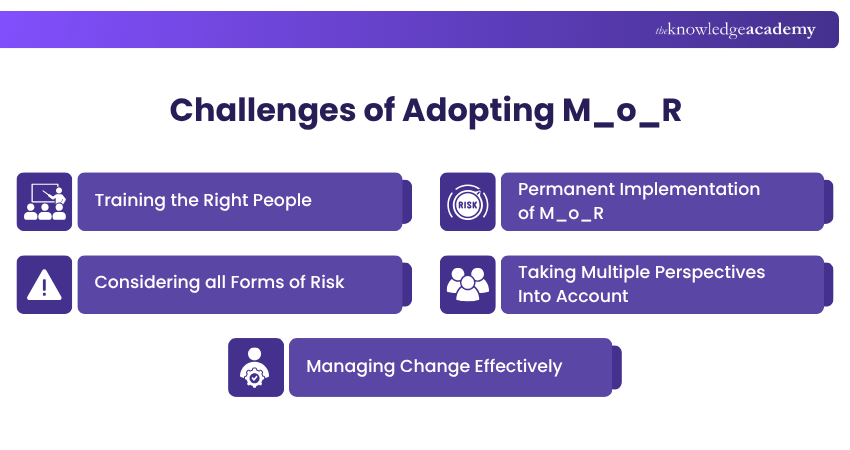
1) Training the Right people: Training the right people is vital when implementing the M_o_R framework for effective Risk Management. Identifying individuals within the organisation who possess the necessary skills and knowledge to understand and apply M_o_R principles is essential.
Moreover, these individuals can be trained as M_o_R Practitioners who will act as ambassadors for Risk Management within their respective teams. Thus, a risk-aware culture can be fostered within organisations to harness the most out of the framework.
2) Considering all Forms of Risk: The M_o_R framework facilitates a comprehensive approach to Risk Management by considering all forms of risk. It goes beyond traditional notions of risk solely associated with negative outcomes and incorporates a broader perspective that encompasses both threats and opportunities.
A thorough consideration of all forms of risk, such as financial, operational, strategic, and reputational, gives an organisation a broader understanding of its risk landscape. Therefore, they become more capable of proactively identifying potential risks that could adversely affect their business objectives.
3) Permanent Implementation of M_o_R: One significant challenge during the implementation of the framework is the need for ongoing commitment and engagement from leadership and employees. The sustenance of a risk-aware culture requires continuous reinforcement and support from top management to ensure that Risk Management practices become ingrained in the organisation.
Another challenge is the potential resistance to change and the difficulty of breaking old habits and adopting new ways of thinking. The consequent inculcation of new habits requires effective change management strategies, communication, and training to overcome resistance and embed M_o_R into everyday operations. Thus, developing and maintaining the capability to tackle these challenges is vital to the long-term success of the framework in the organisation.
4) Taking Multiple Perspectives Into Account: Businesses should consider diverse viewpoints from stakeholders across various departments of their organisation. Accepting the various viewpoints helps them acquire a comprehensive understanding of risks that can be achieved. Their perspectives, insights and experiences are broadened, enabling a more robust assessment of their potential pitfalls.
More importantly, the open-minded approach fosters a mindset of collaboration, enhances risk identification, and encourages the development of well-rounded risk mitigation strategies. Navigating complex challenges and improving risk response capabilities becomes easier, resulting in better-informed decisions aligned with the business objectives.
5) Managing Change Effectively: The effective management of change in an organisation is vital for smooth transitions and successful outcomes. It requires clear communication, engaging employees at all levels, and providing support during the change process.
Executives must initiate a culture of openness and transparency among the departments and provide employees with the necessary resources to implement change. The organisation’s demonstration of embracing change and supporting its employees increases the overall confidence of all members to adapt to new circumstances.
Acquire the basic knowledge to identify and control risks by signing up for the Management Of Risk (MoR®) Foundation V3 Course now!
Conclusion
The blog has outlined and discussed the various Challenges of Adopting M_o_R as a risk framework. This framework helps organisations design a structured and holistic approach to mitigate and manage risk effectively. A thorough identification, assessment and mitigation of risk demonstrates the capability of an organisation to initiate and handle cultural shifts across its departments.
Enhance your knowledge about the M_o_R principles by signing up for the MoR® 4 Practitioner Risk Management Certification Course now!
Frequently Asked Questions
What are the Biggest Barriers to Adopting M_o_R?

Some of the biggest barriers to adopting M_o_R include resistance to organisational change, limited risk management knowledge, lack of leadership support, and difficulty integrating risk practices into existing workflows. These challenges can affect the consistency and effectiveness of risk management implementation.
Why is Training Important when Implementing M_o_R?
Training helps employees understand risk management principles, roles, and responsibilities within the M_o_R framework. Proper training improves risk awareness, supports consistent decision-making, and helps organisations apply risk management practices more effectively across projects and operations.

David Evans


Certified Project Trainer and Agile Delivery Expert
David Evans brings over a decade of hands-on experience in project delivery, Agile transformation, and team leadership. With a background in technology and business consulting, David has led cross-functional teams through Agile and Waterfall projects in both public and private sectors. He combines technical knowledge with practical insights to help readers navigate the challenges of modern project environments.


 If you wish to make any changes to your course, please


