


 Top Rated Course


We may not have the course you’re looking for. If you enquire or give us a call on +358 942454206 and speak to our training experts, we may still be able to help with your training requirements.
How to Write Research Methodology: A Step-by-Step Guide
William Brown 03 February 2026A Research Methodology outlines the research approach, justifies chosen methods, and details data collection and analysis processes. It addresses important ethical considerations and maintains a logical flow. This enhances the study’s overall credibility and provides a clear framework for understanding the research process.

Training Outcomes Within Your Budget!
We ensure quality, budget-alignment, and timely delivery by our expert instructors.
Table of Contents

Crafting a compelling Research Methodology is vital for the credibility of your study. It’s not just about listing methods; it's about justifying why they suit your research goals. This blog will explore How to Write Research Methodology with clarity and confidence. Let’s decode the art of detailing processes that bridge your research question to meaningful conclusions.
Table of Contents
1) What is Research Methodology?
2) The Need for a Good Research Methodology
3) How to Develop a Methodology?
4) Purpose of Writing a Research Methodology
5) Tips for Crafting an Effective Research Methodology
6) What is the Difference Between Research Method and Research Methodology?
7) Conclusion
What is Research Methodology?
Research Methodology is the structured approach to gathering, analysing, and interpreting data to address specific research questions or objectives. It outlines the techniques, tools, and processes to ensure the research is systematic, credible, and replicable. For a Research Analyst, a well-defined methodology enhances the accuracy, reliability, and validity of findings by detailing how data is collected, measured, and analysed.
The methodology encompasses both qualitative and quantitative methods, depending on the nature of the study. It also includes ethical considerations, sample selection, data collection tools, and analytical frameworks. Transparent methodology enables other researchers to replicate the research and assess its conclusions, promoting transparency and advancing knowledge in a particular field.

The Need for a Good Research Methodology
A good Research Methodology guarantees the accuracy, reliability, and validity of research results. It offers a direct framework for data gathering, analysis, and interpretation, minimising errors and inconsistencies. Without a good methodology, research results might not be credible and may not present useful information.
A good methodology improves replicability, enabling other researchers to confirm or extend the findings. It facilitates the choice of appropriate research methods, ensuring data is collected systematically and in accordance with the research goals. This enhances the effectiveness and relevance of the study as a whole.
How to Develop a Methodology?
Here’s how you can Develop a Methodology:
1) Restate Your Thesis or Research Question
Start by clearly restating your thesis or primary research question. This sets the stage for your methodology, helping readers understand your research's problem and why the chosen methods are relevant.
2) Outline Your Chosen Approach
Describe whether your study is qualitative, quantitative, or mixed-methods. Explain why this approach aligns with your objectives. For example, Qualitative Research delves into behaviours and perceptions, while quantitative research focuses on numerical data and statistical analysis

3) Discuss Any Unique Methodologies Applied
If your research incorporates innovative or less common methods, highlight them. Explain their relevance and how they enrich your study, ensuring readers understand their role in providing more profound insights.
4) Describe Your Data Collection Process
Detail how you collected data through surveys, interviews, experiments, or archival research. Specify your sample size, population, and selection criteria, ensuring clarity and reproducibility.
Transform data into actionable insights — Kickstart your career with our Business Analyst Course today!
5) Detail Your Data Analysis Techniques
Explain how you analysed the data, from statistical tools to thematic analysis. Mention the software used, like R, Python, SPSS or NVivo, and justify why these techniques were appropriate for your study’s objectives.
6) Evaluate and Justify Your Methodological Decisions
Discuss why specific methods were chosen over others. For instance, why did you select a case study approach instead of a cross-sectional study? Provide evidence to validate your decisions.
7) Address Challenges and Solutions
Acknowledge any challenges encountered during your research, such as limited sample size or data collection hurdles. Explain how you overcame them, reinforcing your study’s rigour and adaptability.
8) Cite Sources Influencing Your Methodological Choices
Mention key literature or studies that inspired your methodological approach. Citing relevant sources establishes credibility and shows that your research builds upon established academic work.
Developing a well-structured methodology is essential for the success of any research project. It ensures that your study is conducted systematically, transparently, and reliably. By following these steps, you can create a comprehensive methodology that enhances the credibility and impact of your research.
Purpose of Writing a Research Methodology
The Research Methodology outlines the approach, techniques, and procedures used in a study. Its primary purpose is to ensure transparency, reliability, and replicability, helping readers understand the rationale behind the chosen methods. A well-defined methodology also supports the validity and credibility of the research. Below are the key purposes of writing a Research Methodology:
1) To Ensure Transparency of the Research Process
a) Clearly explains the step-by-step process followed to collect, analyse, and interpret data.
b) Provides readers with a clear understanding of the research design, tools, and techniques.
c) Helps others replicate the study in similar settings to verify the findings.
2) To Justify the Choice of Methods
a) Explains why specific research methods were selected over others.
b) Demonstrates how the chosen methods align with the research objectives and questions.
c) Ensures that the methodology is appropriate for the data collection type (qualitative, quantitative, or mixed methods).
3) To Improve the Reliability and Truth of the Research
a) Shows that the research was conducted in a systematic and organised manner.
b) Describes how biases, errors, or inconsistencies were minimised during the research process.
c) Helps ensure that the results can be trusted and accurately reflect the research problem.
4) To Allow Replication of the Study
a) Provides adequate detail for other researchers to replicate the study if needed.
b) Ensures future researchers can apply the same methodology to different contexts or populations.
c) Enhances the credibility and scientific contribution of the research.
5) To Facilitate Critical Evaluation by Readers
a) Enables readers to assess the strengths and limitations of the study.
b) Provides a basis for evaluating the appropriateness and rigour of the research methods.
c) Allows readers to consider whether the findings are credible and can be generalised.
6) To Clarify Ethical Considerations
a) Outline any ethical guidelines or protocols followed during the research.
b) Explains how consent, confidentiality, and data protection were ensured.
c) Demonstrates compliance with ethical standards in academic or professional research.
7) To Demonstrate the Researcher’s Competence
a) Shows the researcher’s understanding of research principles and techniques.
b) Reflects the researcher’s ability to design and implement a research study.
c) Provides confidence to readers, supervisors, and evaluators that the research is rigorous and credible.
A clear and comprehensive Research Methodology enhances the overall quality of the study, ensuring that it is systematic, credible, and reproducible. It also provides the necessary context for readers to appreciate and apply the research findings in future studies.
Unlock your creative potential and boost productivity — Join our Mind Mapping Training today!
Tips for Crafting an Effective Research Methodology
Here are some Tips for Crafting an Effective Research Methodology:
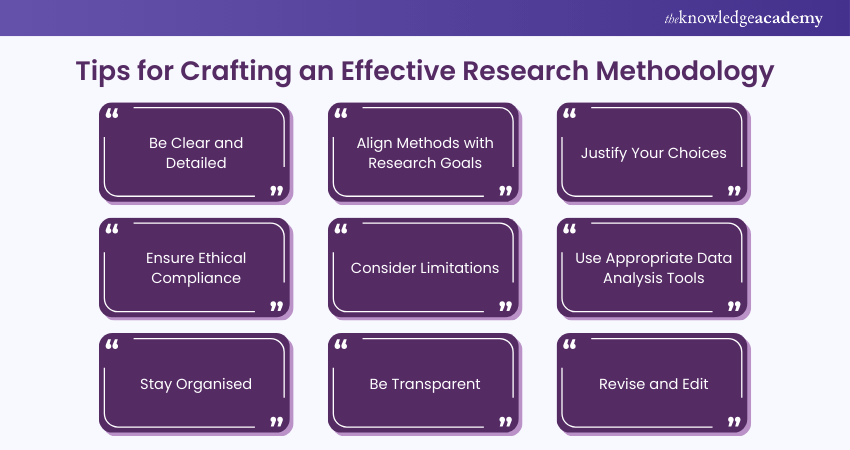
a) Be Clear and Detailed: Provide a clear explanation of the methods you used, including data collection, analysis, and tools. Ensure that enough detail is included so others can replicate your study.
b) Align Methods with Research Goals: Ensure that your methodology aligns with the objectives and research questions. Choose methods that best address your study's purpose.
c) Justify Your Choices: Explain why you selected specific methods, tools, and techniques. This strengthens the credibility of your approach and demonstrates your understanding of the research process.
c) Ensure Ethical Compliance: Address ethical considerations in your methodology, such as informed consent, confidentiality, and data protection, to build trust with your audience.
e) Consider Limitations: Acknowledge potential limitations in your research methods, such as sample size or scope, and explain how you mitigated them.
f) Use Appropriate Data Analysis Tools: Choose the right statistical or analytical tools to analyse your data. Justify your choice of software (e.g., SPSS, R, NVivo) based on the nature of your data.
g) Stay Organised: Present your methodology logically, breaking it into clearly labelled sections like data collection, analysis, and ethical considerations to enhance readability.
h) Be Transparent: Include enough detail so other researchers can replicate your study. This promotes transparency and credibility in your research.
i) Revise and Edit: After writing, review your methodology to ensure clarity and accuracy. A well-polished methodology increases the professionalism and reliability of your research.
Become a certified expert in driving business solutions — Join the Business Analyst Black Belt Course today!
What is the Difference Between Research Method and Research Methodology?
A Research Method involves specific techniques for data collection and analysis, such as surveys, experiments, or case studies. Conversely, Research Methodology is the overarching framework that elucidates the principles, rationale, and approach behind choosing and implementing these methods. While methodology outlines the overall strategy, methods are the tools utilised within this strategy.
Conclusion
Writing a robust Research Methodology ensures your study has a solid foundation. By following this blog, you’ll master How to Write Research Methodology that is clear, justified, and aligned with your research goals. Take your readers on a transparent journey, from hypothesis to analysis, ensuring your work stands out.
Lay the foundation for a successful BA career — Join our Business Analyst Fundamentals Training today!
Frequently Asked Questions
How Do You Ask a Question About Research Methodology?

To ask a question in Research Methodology, clearly define the problem or gap your research addresses. Frame questions that assist your study's purpose and objectives, ensuring they align with the chosen research approach. For example, ask, “What are the factors influencing X?” or “How does Y affect Z?”
What Makes an Effective Methodology?
A practical methodology is explicit, systematic, and well-justified. It aligns with the research objectives, provides detailed explanations of data collection and analysis methods, and addresses potential challenges. A solid methodology ensures the study’s validity, reliability, and replicability, offering transparency and confidence in the results.
What are the Other Resources and Offers Provided by The Knowledge Academy?
The Knowledge Academy takes global learning to new heights, offering over 3,000+ online courses across 490+ locations in 190+ countries. This expansive reach ensures accessibility and convenience for learners worldwide.
Alongside our diverse Online Course Catalogue, encompassing 19 major categories, we go the extra mile by providing a plethora of free educational Online Resources like Blogs, eBooks, Interview Questions and Videos. Tailoring learning experiences further, professionals can unlock greater value through a wide range of special discounts, seasonal deals, and Exclusive Offers.
What is The Knowledge Pass, and How Does it Work?
The Knowledge Academy’s Knowledge Pass, a prepaid voucher, adds another layer of flexibility, allowing course bookings over a 12-month period. Join us on a journey where education knows no bounds.
What are the Related Courses and Blogs Provided by The Knowledge Academy?
The Knowledge Academy offers various Business Analyst Course, including the Statistics Course, Business Process Mapping Training and the Mind Mapping Training. These courses cater to different skill levels, providing comprehensive insights into Critical Success Factors.
Our Business Analysis Blogs cover a range of topics related to Business Analysis, offering valuable resources, best practices, and industry insights. Whether you are a beginner or looking to advance your Business Analysis skills, The Knowledge Academy's diverse courses and informative blogs have got you covered.

William Brown


Senior Business Analyst and Strategic Advisor
William Brown is a senior business analyst with over 15 years of experience driving process improvement and strategic transformation in complex business environments. He specialises in analysing operations, gathering requirements and delivering insights that support effective decision making. William’s practical approach helps bridge the gap between business goals and technical solutions.
View Detail

 If you wish to make any changes to your course, please


