


 Top Rated Course

We may not have the course you’re looking for. If you enquire or give us a call on +358 942454206 and speak to our training experts, we may still be able to help with your training requirements.
How to Manage a Marketing Budget: A Detailed Explanation
James Smith 21 February 2026Do you want to master How to Manage a Marketing Budget like a pro? A well-planned budget ensures every pound spent drives results. But how do you balance costs without cutting impact? From smart allocation to tracking ROI, this blog unveils expert tips to optimise your spendin. Get ready to take control of your marketing finances!

Training Outcomes Within Your Budget!
We ensure quality, budget-alignment, and timely delivery by our expert instructors.
Table of Contents
Imagine this scenario: you're overseeing multiple marketing campaigns with a defined budget. You have ambitious objectives, but the challenge lies in delivering results without exceeding financial constraints. So, How to Manage a Marketing Budget effectively to ensure you stay on track?
In this blog, we will provide a detailed explanation of How to Manage a Marketing Budget, offering practical insights and strategies. It will help you optimise your marketing spend, track progress efficiently, and ultimately, drive successful campaigns within your financial limits. Without further delay, let’s explore the key steps.
Table of Contents
1) What is a Marketing Budget?
2) Understanding How to Manage a Marketing Budget
a) Set Annual Goals Strategically
b) Break Down Budget into Detailed Subcategories
c) Utilise ROI Metrics for Precise Allocations
d) Conduct Thorough Analysis of Previous Years
e) Address Underperforming Initiatives Proactively
f) Maintain Flexibility in Budget Adjustments
3) What to Include in a Marketing Budget?
4) Conclusion
What is a Marketing Budget?
A Marketing Budget is essentially a financial plan that outlines the estimated costs for various marketing activities over a specific period. It includes the funds needed to achieve marketing goals and helps businesses forecast the expenses involved in generating more revenue.
By tracking and managing these budgets, companies can:
a) Assess the Return on Investment (ROI) for advertising campaigns, lead generation, and other marketing strategies.
b) Ensure company revenue is maintained.
c) Account for funds allocated to marketing initiatives.
Effective tracking and planning of marketing costs enable businesses to allocate future funds more efficiently and optimise resource spending to maximise investments. Balancing marketing expenses with overall operational costs is crucial for businesses, and budgets serve as a valuable tool for analysing the performance of marketing efforts.

Understanding How to Manage a Marketing Budget
Managing a Marketing Budget can be challenging, especially if you have limited funds and multiple channels to consider. Here are some tips on how to manage your Marketing Budget effectively:

1) Set Annual Goals Strategically
Before you start allocating your Marketing Budget, you need to have a clear vision of what you want to achieve with your marketing efforts. A structured Startup Marketing Budget helps prioritise essential marketing activities while maintaining financial control. What are your overall business goals for the year? How do they translate into marketing goals? For example, if your business goal is to increase sales by 20%, your marketing goal might be to generate 30% more leads or 15% more conversions.
Once you have your marketing goals, you need to align them with your marketing strategies. How will you reach your target audience and persuade them to buy your products or services? What are the best marketing channels and tactics for your business? For example, if your target audience is young and tech-savvy, you might focus on social media and video marketing, rather than traditional media and print ads.
2) Break Down Budget into Detailed Subcategories
After you have your marketing goals and strategies, you need to break down your budget into detailed subcategories. This will help you to allocate your funds more accurately and efficiently. For each marketing channel and tactic, you need to consider the following factors:
a) The cost of production and distribution
b) The expected reach and impact
c) The potential ROI and conversion rate
d) The relevance and suitability for your audience and brand
3) Utilise ROI Metrics for Precise Allocations
One of the most important aspects of managing a Marketing Budget is measuring the return on investment (ROI) of your marketing activities and campaigns. ROI is the ratio of the profit or revenue generated by a marketing activity to the cost of that activity. For example, if you spend GBP 1000 on a Facebook ad campaign and it generates 2000 GBP in sales, your ROI is 100%.
a) ROI helps you to:
b) Evaluate the effectiveness and efficiency of your marketing spending
c) Compare the performance of different marketing channels and tactics
d) Identify the best practices and areas for improvement
e) Adjust your budget allocations accordingly
4) Conduct Thorough Analysis of Previous Years
Another way to manage your Marketing Budget effectively is to conduct a thorough analysis of your previous years' marketing spending and performance. This will help you to:
a) Understand the trends and patterns of your marketing activities and campaigns
b) Learn from your successes and failures
c) Benchmark your results against your competitors and industry standards
d) Identify the gaps and opportunities for growth and improvement
To conduct a thorough analysis of your previous years' Marketing Budget, you need to collect and organise the data and information related to your marketing spending and performance. You can use tools such as spreadsheets, dashboards, and reports to visualise and summarise your data.
You can also use tools such as Google Analytics, Facebook Insights, and HubSpot to track and measure your online marketing metrics.
Discover innovative strategies that stand out – join our Business Marketing Strategies Training today!
5) Address Underperforming Initiatives Proactively
As you manage your Marketing Budget, you will inevitably encounter some marketing activities and campaigns that are underperforming or not delivering the expected results. Instead of ignoring or dismissing them, you need to address them proactively and take corrective actions. Some of the steps that you can take are:
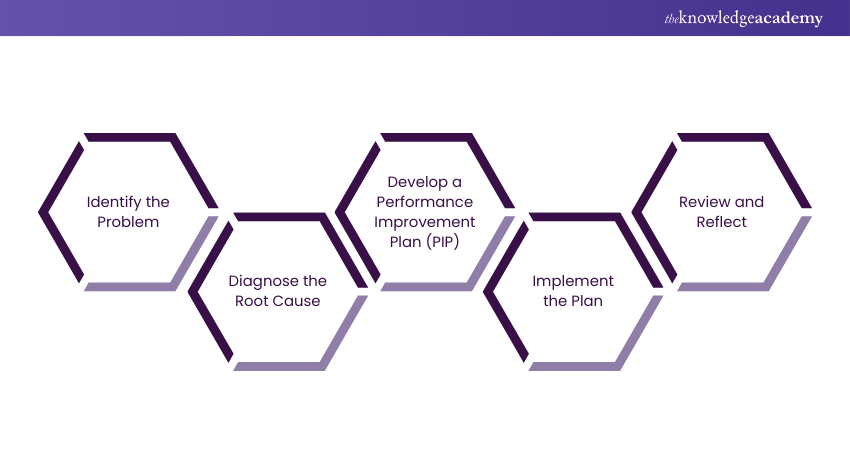
a) Analyse the root causes and reasons for the underperformance
b) Test and experiment with different variables and factors that might affect the performance
c) Implement changes and improvements based on the test results and feedback
d) Monitor and evaluate the impact and outcome of the changes and improvements
e) Scale up or down the budget allocation for the underperforming initiatives accordingly
6) Maintain Flexibility in Budget Adjustments
Finally, managing a Marketing Budget is not a one-time or static process. It is a dynamic and ongoing process that requires constant monitoring and evaluation. As your business and marketing environment changes, you need to be flexible and adaptable in adjusting your budget allocations. Some of the factors that might require you to adjust your budget are:
a) Changes in your business goals and priorities
b) Changes in your target market and customer behaviour
c) Changes in your competitors' strategies and action
d) Changes in the marketing trends and technologies
e) Changes in the external factors and conditions
Craft winning marketing strategies with our Pay Per Click (PPC) Training– Sign up to drive growth and success!
What to Include in a Marketing Budget?
A Marketing Budget is a comprehensive plan that outlines the financial resources allocated for various marketing activities. It covers both digital and traditional marketing expenses, depending on the business's strategies and needs. Here are some key components to include in a Marketing Budget:
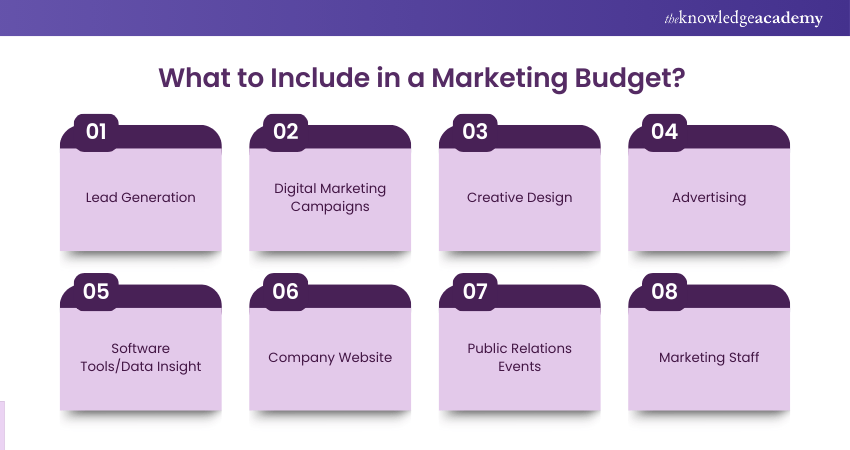
1) Lead Generation
Lead generation involves efforts to convert potential customers into reliable buyers or users. This includes market research to identify target markets and promotional campaigns to attract and convert customers.
The allocation for lead generation varies based on the size and scope of the business. Small or new businesses may allocate more to attract customers, while larger businesses may focus on nurturing existing leads or purchasing high-quality leads.
2) Digital Marketing Campaigns
Digital marketing campaigns are another significant component. These include social media expenditures, email marketing, SEO efforts, and influencer marketing. Content marketing, a subcategory of digital marketing, requires funds for content creation.
SEO efforts are paired with curated content to match keywords and search trends. Freelance or internal content creators are often hired to produce blogs, videos, and audio tracks.
3) Creative Design
Creative design is essential for visual advertisements, packaging, and business graphics. Funds are allocated for in-house and freelance design work. The budget for creative design can fluctuate based on the demand for new designs in specific advertising campaigns, product packaging, or logo updates.
4) Advertising
Advertising expenses cover digital ads, print ads, television, radio, and PPC marketing. Businesses often split their advertising budgets between traditional and digital mediums. Campaign expenses are targeted at specific audiences to maximise impact.
5) Software Tools/Data Insight
Software tools and data insights are crucial for data analysis and consumer marketing insights. Systems for CRM, lead databases, campaign statistics, and other insights are necessary for generating detailed reports that guide marketing decisions. Fees for software purchases or memberships are included in this portion of the budget.
6) Company Website
The company website is a vital part of the Marketing Budget. Website optimisation and operations are essential for maintaining an effective online presence. Due to its importance, website-related expenses are often categorised separately within the Marketing Budget.
7) Public Relations Events
Public relations events, such as trade shows, conferences, and sponsorships, are also included. These events help connect brands with their audience. Expenses for awards and recognition through professional organisations or the press are part of this category.
8) Marketing Staff
Lastly, marketing staff salaries are a significant part of the budget. This includes training costs for onboarding and career development, as well as expenses for staff bonuses, travel, and reimbursements.
By including these components, businesses can create a well-rounded Marketing Budget that supports their overall marketing strategy and goals. If you have any more questions or need further details, feel free to ask!
Explore diverse marketing disciplines in our Marketing Courses – Join now to expand your expertise!
Conclusion
Managing a Marketing Budget is a crucial and challenging task for any business that wants to succeed and grow. A Marketing Budget helps you to plan, execute, and measure your marketing activities and campaigns, and optimise your marketing spending and performance. For a more structured approach, check out our Marketing Budget PDF, which provides detailed guidelines and examples. We hope that this blog has given you a detailed explanation of How to Manage a Marketing Budget, and some examples of marketing costs that you should consider.
Learn to allocate resources effectively by joining our Introduction to Marketing Training – register today!
Frequently Asked Questions
How Should I Determine the Size of my Marketing Budget?

Determine your Marketing Budget size based on revenue, growth goals, industry benchmarks, and market competitiveness. Consider using the percentage of revenue method but adjust it for factors like growth stage and objectives.
How Can I Prioritise Spending Within my Marketing Budget?
Prioritise spending based on marketing objectives and strategies. Allocate resources to initiatives contributing directly to goals while considering potential ROI. Balance various channels and tactics, monitoring performance to optimise spending and reallocate resources as needed for maximum results.
What are the Other Resources and Offers Provided by The Knowledge Academy?
The Knowledge Academy takes global learning to new heights, offering over 3,000 online courses across 490+ locations in 190+ countries. This expansive reach ensures accessibility and convenience for learners worldwide.
Alongside our diverse Online Course Catalogue, encompassing 19 major categories, we go the extra mile by providing a plethora of free educational Online Resources like Blogs, eBooks, Interview Questions and Videos. Tailoring learning experiences further, professionals can unlock greater value through a wide range of special discounts, seasonal deals, and Exclusive Offers.
What is The Knowledge Pass, and How Does it Work?
The Knowledge Academy’s Knowledge Pass, a prepaid voucher, adds another layer of flexibility, allowing course bookings over a 12-month period. Join us on a journey where education knows no bounds.
What are the Related Courses and Blogs Provided by The Knowledge Academy?
The Knowledge Academy offers various Marketing Course, including Marketing Budget, Intergrated Marketing and Business Marketing Strategies Courses. These courses cater to different skill levels, providing comprehensive insights into Business Marketing.

James Smith


Digital Marketing Manager and Trainer
James Smith is a digital marketing professional with over a decade of experience in SEO, content strategy, paid media and analytics. He has supported both SMEs and global brands in transforming their digital presence. James’s writing and training are rooted in results-driven tactics and the latest marketing trends.
View Detail
Upcoming Business Improvement Resources Batches & Dates
Date
 Introduction to Marketing Training
Introduction to Marketing Training
Fri 10th Jul 2026
Introduction to Marketing Training
Fri 11th Sep 2026

 If you wish to make any changes to your course, please


