


 Top Rated Course

We may not have the course you’re looking for. If you enquire or give us a call on +358 942454206 and speak to our training experts, we may still be able to help with your training requirements.
Top 10 Benefits of IT Service Management (ITSM)
The Knowledge Academy 16 July 2026As IT services are becoming an integral part of businesses, organisations are understanding the necessity of embracing IT Service Management Systems. ITSM pilots' business is a crucial practice for organisations. Discover the 10 benefits of IT service management, from enhanced efficiency to reduced risks and improve optimal performance.

Training Outcomes Within Your Budget!
We ensure quality, budget-alignment, and timely delivery by our expert instructors.
Table of Contents
IT Service Management can help companies achieve goals like risk management, increasing resiliency, and proactively resolving issues. ITSM also provides support in meeting businesses' fast-changing needs. Over the years, companies have become increasingly dependent on their internal IT teams to provide a better flow of products and services to consumers.
ITSM allows companies to execute their plans and strategies and achieve desired goals systematically. It is essential to improve competitiveness in this continuously evolving market. This blog delves into 15 key benefits of IT Service Management.
Table of Contents
1) Benefits of IT Service Management
2) What are the ITSM Processes?
3) What is the Standard for IT Service Management?
4) What are the Roles and Responsibilities of ITSM?
5) Conclusion
Benefits of IT Service Management
Embracing an IT Service Management Framework brings numerous benefits for businesses managing their IT operations. These benefits help streamline processes, enhance service delivery, and improve overall efficiency. Moreover, to gauge the effectiveness of these frameworks, understanding key performance indicators is crucial. In this regard, focusing on IT Service Management Metrics can provide valuable insights into how well these frameworks are performing and where improvements can be made. Additionally, considering the IT Service Manager Salary can offer an understanding of the financial rewards tied to managing such frameworks effectively.
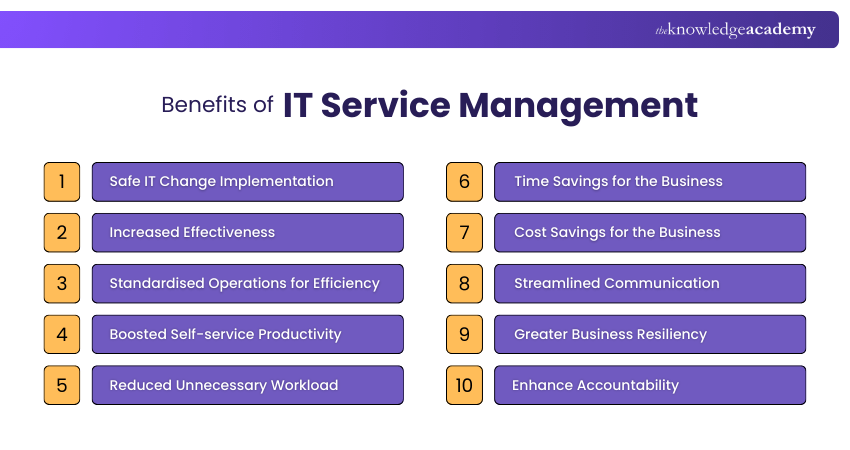
1) Safe IT Change Implementation
Poorly planned IT changes carry the immense risk of disrupting business operations. ITSM frameworks such as the Information Technology Infrastructure Library (ITIL) ensure a systematic layout for your organisation's IT department to implement IT changes so that any damage to business operations can be avoided.

2) Increased Effectiveness
IT Service Management System helps organisations in:
a) Streamlining their IT assets and workflows
b) Keeping track of resources that need specific processes and
c) Rationalising their use of IT resources
These steps help extract the most of the available resources, driving productivity. An unplanned ITSM framework with no clear strategy leads to confusion and inefficiency.
3) Standardised Operations for Efficiency
A correctly implemented IT Service Management standardises ITSM Tools, policies and processes. This standardisation across the organisation improves communication and boosts collaboration amongst all the departments. This, in turn, results in more efficient business operations, increasing agility and saving time and labour on operations.
4) Boosted Self-service productivity
Self-service allows users to resolve issues by themselves without the help of IT operators. It works as an alternative to the traditional help desk model, boosting productivity. Integrating technologies like AI chatbots and portals provides an engaging self-service experience. This leads to reducing ticket resolution costs and increasing customer satisfaction.
5) Reduced Unnecessary Workload
Integrating a well-organised IT Service Management System automates many operations, reducing unnecessary manual workload. ITSM enables the transition from human labour to automated operations, decreasing pressure on IT operators. This provides scope for innovation and investing time in activities that can add value to the organisation.
Learn systematic problem-solving techniques with our Root Cause AnalysisTraining. Sign up now!
6) Time Savings for the Business
ITSM frameworks like ITIL help in saving business time through knowledge management. Knowledge management aims to reduce or eliminate the necessity of already learned information. A neatly maintained knowledge base enables effective information sharing between different departments of the business, saving time.
7) Cost Savings for the Business
ITSM practices empower cost-saving in myriad ways some of which include:
a) Reducing labour costs through automating major manual tasks
b) Saving business time and money through knowledge management and
c) Protecting the company from legal and financial consequences of data breach
Through automation of manual processes, businesses can reduce their reliance on manpower, which results in cost savings and allows the existing manpower to invest in other value-adding areas.
8) Streamlined Communication
The benefits of ITSM can be visible in the communication between IT teams and other business departments. Organizations can achieve this by establishing a centralized IT service desk between the business and IT teams. When preparing for Service Desk Analyst Interview Questions, it's essential to understand the importance of such a centralized structure in facilitating efficient communication and support. This IT desk will allow users to access IT support through a streamlined channel.
9) Greater Business Resiliency
ITSM strategies enable companies to withstand and recover from difficulties quickly. IT Service Management acts as a shield during challenging situations. An example of this is COVID-19, where ITSM allowed remote work, which proved helpful in seamless business operations and reducing the risk of spreading the pandemic.
10) Enhance Accountability by Standardising Processes
Accountability ensures employee productivity and ensures that resources are not misused or misappropriated. ITSM provides transparency in the business processes through standardising processes, which helps increase employee accountability and is beneficial for a more beneficial business operation.
Understand the various ITIL Guiding Principles with our ITIL® 4 Leader: Digital And IT Strategy Certification. Join Now!
What are the ITSM Processes?
IT Service Management or ITSM refers to all the activities, processes, and policies used by IT teams. It is basically used to design, deliver, manage, and improve the way IT services are provided to end-users. These are clearly defined processes that ensure IT aligns with business goals. It is also useful as it maintains service quality and drives value across the organisation.
Here is a list of essential ITSM processes, including the most commonly used ones based on ITIL (IT Infrastructure Library) best practices:
1) Incident Management
a) Focuses on restoring normal service operation as quickly as possible
b) Aims to minimise downtime and its impact on business productivity
c) Ensures consistent logging, classification, prioritisation, and resolution of incidents
2) Request Fulfilment
a) Manages and fulfils service requests from users
b) Typically involves non-urgent, standardised services with predefined steps
c) Enhances user satisfaction through fast and efficient response
3) Problem Management
a) Focuses on identifying and removing the root causes of recurring incidents
b) Reduces the volume and impact of incidents over time
c) Maintains a Known Error Database (KEDB) for faster resolution
4) Change Management / Change Enablement
a) Handles changes to IT systems and infrastructure with minimal disruption
b) Categorises changes (standard, normal, emergency) for better control
c) Uses approval workflows and testing procedures to reduce risk
5) Knowledge Management
a) Creates a central repository of documented solutions, guides, and FAQs
b) Supports faster issue resolution by users and IT staff
c) Reduces repeat queries and training time
6) Configuration Management (CMDB)
a) Maintains a Configuration Management Database (CMDB)
b) Lists all IT assets like hardware software, documentation and their relationships
c) Supports impact analysis and root cause investigations
7) Availability Management
a) Ensures that IT services are available as agreed with users
b) Monitors uptime, downtime, and availability targets to support reliability
c) Example: Guaranteeing 99.9% uptime for cloud-hosted applications
8) Event Management
a) Detects and responds to events that may impact services like alerts, warnings
b) Helps proactively identify issues before they escalate into incidents
c) Example: Monitoring CPU spikes and taking action before server failure
What is the Standard for IT Service Management?
The standard for IT Service Management is ISO/IEC 20000. It provides a globally recognised framework for planning, delivering, and improving IT services related to business needs.
Based on ITIL principles, ISO/IEC 20000 helps organisations improve service quality, increase efficiency, and ensure customer-focused IT service delivery.
What are the Roles and Responsibilities of ITSM?
ITSM roles and responsibilities include managing IT services, ensuring they align with business goals, and maintaining service quality. Key roles involve incident resolution, change control, asset management, service delivery, and user support. For professionals preparing for ITSM careers, reviewing ITSM Interview Questions can help them understand expectations and excel in these responsibilities.
ITSM teams aim to improve efficiency, reduce downtime, and enhance the overall user experience.
Conclusion
We hope you read this blog and gain a clear understanding of the 10 major benefits of IT Service Management (ITSM). An IT Service Manager Job Description highlights how IT Service Management oversees both internal and external communication while ensuring smooth business operations within an organization. Additionally, ITSM enhances user experience and plays a crucial role in swiftly resolving issues.
Learn to align ITIL practices with industry standards for optimal performance with our ITIL® 4 Specialist: Plan, Implement and Control Training. Join now!
Frequently Asked Questions
Why is the IT Service Management necessary?

IT Service Management is necessary as it ensures accountability, standardisation of services, monitoring of IT infrastructure, and improvement of visibility in operations.
What is the Purpose of IT Service Catalog?
The purpose of the IT Service Catalog includes:
a) Providing a one-stop resource for end users, offering clear information on available IT services
b) Specifying associated costs and helping with expense management and decision-making
c) Allowing users to request specific services formally
d) Tracking service usage data for insights and cost optimisation

The Knowledge Academy


Global Training Provider
The Knowledge Academy is a world-leading provider of professional training courses, offering globally recognised qualifications across a wide range of subjects. With expert trainers, up-to-date course material, and flexible learning options, we aim to empower professionals and organisations to achieve their goals through continuous learning.


 If you wish to make any changes to your course, please


