


 Top Rated Course

We may not have the course you’re looking for. If you enquire or give us a call on +34 932716793 and speak to our training experts, we may still be able to help with your training requirements.
Dependency Injection: Definition, Types, and Principles
Richard Harris 22 April 2026Dependency Injection (DI) is a design pattern in which objects receive their dependencies from external sources, promoting loose coupling and easier testing. It makes applications easier to manage, scale, and modify across different environments. Common frameworks include Spring, Angular, and .NET Core, each using DI in unique ways.

Training Outcomes Within Your Budget!
We ensure quality, budget-alignment, and timely delivery by our expert instructors.
Table of Contents
Think back to the last time you returned to your old code, only to find that a single small change broke several other functions. Frustrating, right? That is the trouble with tightly coupled dependencies. When classes rely too heavily on each other, even a tiny update can cause a ripple of unexpected errors.
That's where Dependency Injection offers a smarter approach. Instead of letting classes build their own dependencies, DI gives them what they need from outside sources. This makes it flexible enough to adapt to new changes. In this blog, we’ll explore what Dependency Injection is, its types, key principles, and how it helps create scalable software. Let's get started!
Table of Contents
1) What is Dependency Injection?
2) Types of Dependency Injection
3) Core Principles of Effective Dependency Injection
4) How to Implement Dependency Injection?
5) Key Roles of Dependency Injection
6) Common Use Cases of Dependency Injection
7) What are the Benefits of Dependency Injection?
8) Limitations of Dependency Injection
9) Real-world Examples of Dependency Injection
10) Conclusion
What is Dependency Injection?
Dependency Injection (DI) is a design pattern used in Software Development to make different parts of a program work together without being tightly connected. It allows a class to receive what it needs, called dependencies, from an external source instead of creating them by itself.
For example, instead of a “Car” class creating its own “Engine,” the engine is given to it from outside. The Car just knows it needs an engine. There are two main parts:
1) Client: The object that needs something
2) Dependency: The object that provides it

Types of Dependency Injection
Now, let’s check the types of Dependency Injection:

1) Constructor Injection
Constructor injection is the most common and recommended type of Dependency Injection. In this method, all required dependencies are provided as parameters when creating an object.
How it Works:
Dependencies are passed directly into the class’s constructor during object creation.
Example:
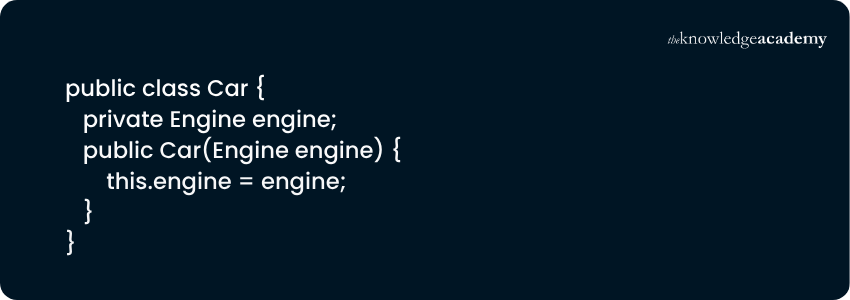
Here, the “Car” receives its “Engine” dependency through the constructor, ensuring that it always has what it needs to work properly.
Advantages:
1) Guarantees that dependencies are not null
2) Ideal for mandatory dependencies
2) Setter Injection
Setter injection provides dependencies after the object has been created, using public setter methods. This gives flexibility to modify dependencies later, though it comes with some trade-offs.
How it Works:
Dependencies are assigned through setter methods that update private variables in the class.
Example:
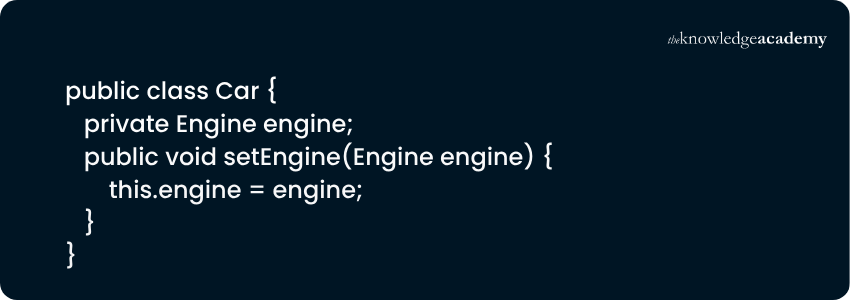
Here, the engine is set after the car object is created, making it possible to change the engine later if needed.
Advantages:
1) Provides flexibility and configurability
2) Allows modifying dependencies after creation
3) Method Injection
Method injection is the least common approach. Here, dependencies are passed directly into specific methods rather than stored as class variables. This is useful when a dependency is only needed for one operation.
How it Works:
The dependency is supplied as a parameter to a method that needs it, often defined through an interface.
Example:
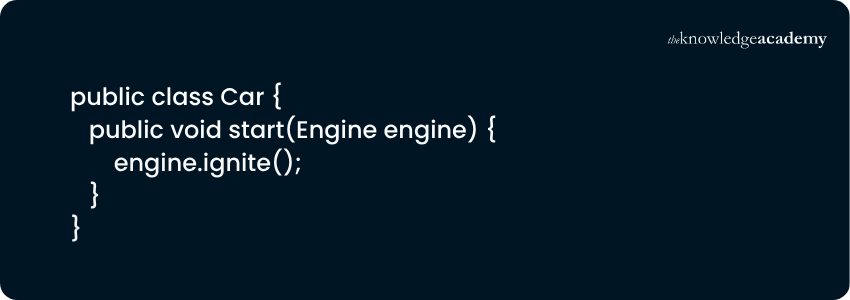
In this case, the “Engine” passes only when the car starts. It is not stored as a field within the class.
Advantages:
1) Reduces unnecessary class-level dependencies
2) Simplifies testing for single methods
Learn the core principles of coding with our Coding Training – Register today!
Core Principles of Effective Dependency Injection
For effective DI practices, here are the five core principles you might need to consider:
1) Program to Interfaces, Not Implementations
Always depend on interfaces or abstractions, not specific classes. This keeps your code open to change. For example, use a Database interface instead of connecting directly to MySQL Database. Later, you can switch to another database without changing your main code. This makes your system more reusable and adaptable.
2) Avoid Creating Unnecessary Instances
A class should only do one thing because that is the Single Responsibility Principle. If a class starts creating its own dependencies, it is doing more than it should. Instead, ask for what you need through Dependency Injection. There are two types of objects to consider:
1) Creatables: Simple, short-lived objects a class can safely create itself.
2) Injectables: Core services or dependencies that should be provided externally through DI.
3) Keep Constructors Clean and Simple
Constructors should only set up dependencies and not run logic. They should just store what is passed in and check for “null” values if needed. If a constructor contains complex conditions or too much code, it is a sign that the class might be doing too much. Simple constructors mean cleaner code, easier testing, and fewer bugs.
4) Don’t Rely on Implementation Details
Dependency Injection works best when classes know only what they need, not how it is implemented. When working with interfaces, avoid making assumptions about what happens behind them. Treat every interface as something that could have its implementation replaced at any time. This approach keeps your system flexible and easier to update.
5) Treat Interfaces as Contracts, Not Just Abstractions
Not all interfaces are real abstractions. If an interface just copies all the public methods of a single class, it isn’t really useful. A good abstraction hides unnecessary details and focuses only on what is needed. Avoid abstractions that reveal how something works internally.
How to Implement Dependency Injection?
Implementing DI typically involves using a framework or manually injecting dependencies. The approach depends on the complexity and scale of your application.
1) Identify Dependencies: Determine which components rely on others (e.g., a UserService needing a UserRepository).
2) Create Interfaces: Define abstractions for your dependencies.
3) Use Injection Mechanisms: Apply constructor, setter, or method injection based on your design.
4) Configure a DI Container: Frameworks like Spring, Guice, or .NET Core automate Dependency Management. They handle object creation, configuration, and Lifecycle Management.
5) Test Your Components Independently: Since DI promotes loose coupling, testing becomes easier through mock objects or stubs.
Build powerful and scalable applications with our C# and .NET Training – Join now!
Key Roles of Dependency Injection
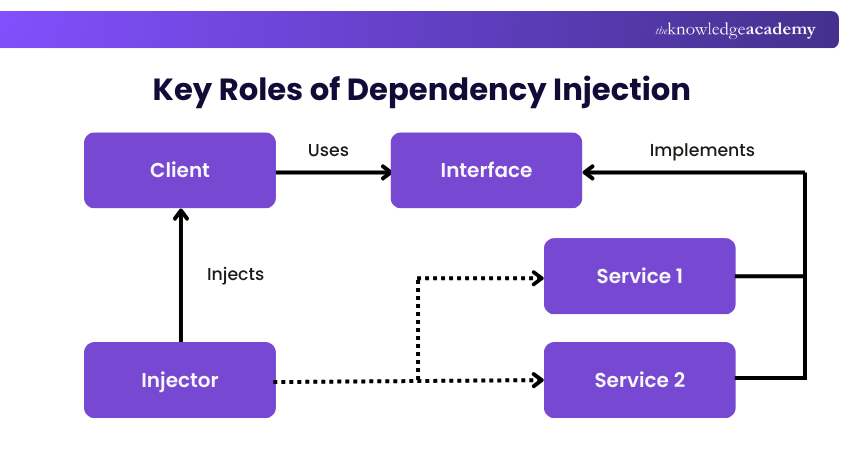
Dependency Injection works by setting clear roles for how different parts of a program connect and share tasks. These roles are Service, Client, Interface, and Injector.
1) Service
1) A service is a class that does a specific job, like sending emails or getting data.
2) It provides features that other classes need.
3) The same class can sometimes act as both a service and a client, depending on the situation.
2) Client
1) A client is a class that depends on a service to do its work.
2) It doesn’t create the service itself. Instead, it just asks for it.
3) For example, a UserController might depend on a UserService to manage users.
3) Interface
1) An interface defines how a client talks to a service without showing the internal details.
2) It acts like a contract that ensures both sides can work together easily.
3) This keeps the system flexible and prevents strong links between classes.
4) Injector
1) The injector is what connects everything.
2) It creates and provides services to clients who need them.
3) Modern frameworks like Spring, Angular, and .NET Core handle this automatically through DI containers.
Common Use Cases of Dependency Injection
You have now explored the main principles and roles of Dependency Injection. Next, let’s look at some of the most common use cases of DI in real-world applications:
1) Managing Service Dependencies: DI automatically provides needed services like loggers or databases instead of creating them manually.
2) Unit Testing and Mocking: DI makes testing easier because you can replace real services with fake ones (mocks) to test safely.
3) Configurable and Reusable Components: With DI, you can change how a part works without changing its code. This makes apps flexible and reusable.
4) Inversion of Control (IoC) Containers: Frameworks like Spring, Angular, and ASP.NET Core use DI containers to create and manage objects automatically.
5) Decoupling and Clean Architecture: DI keeps code clean and separate, so parts don’t depend too much on each other.
Master the fundamentals of software design with our Oriented Programming (OOPs) Course – Sign up soon!
What are the Benefits of Dependency Injection?
Here are the benefits of using Dependency Injection:
1) Testability
1) You can use fake (mock) objects instead of real ones while testing
2) Each class can be tested on its own without affecting others
3) This makes testing faster and reliable
2) Loose Coupling
1) Classes don’t depend directly on each other
2) Each part can work on its own without breaking the rest
3) It is easier to update or replace code when needed
3) Reusability
1) Independent classes can be used in different projects
2) You only need to change the injected parts, not the whole class
3) This saves time and avoids writing the same code again
4) Improved Maintainability
1) Changing one part doesn’t affect the rest of the system
2) You can easily update or fix code when needed
3) This keeps your software stable and reduces future problems
5) Increased Flexibility
1) You can add new features without touching old code
2) Switching to new tools or systems only needs a small setup change
3) The system stays organised and easy to expand
6) Reduced Boilerplate Code
1) DI frameworks automatically create and connect objects
2) You write less setup code and focus on the main logic
3) The result is simple and readable code
Limitations of Dependency Injection
Dependency Injection is helpful, but it also has some limitations:
1) Hard to Find Problems: Since objects are created automatically, it can be tough to see where dependencies come from when something goes wrong.
2) Difficult to Debug: Fixing errors in DI setups or frameworks can take time because the code connections aren’t always clear.
3) Slightly Slower: Some DI frameworks use extra processing, which can make the program start slower and affect code suggestions.
Real-world Examples of Dependency Injection
Now, let’s explore some real-world examples of DI:
1) Spring Framework (Java)
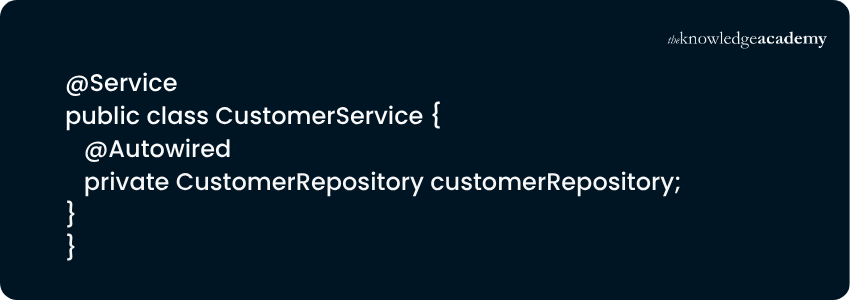
In Java’s Spring Framework, Dependency Injection is a key part of how apps are built. Instead of creating objects manually, Spring creates and provides them automatically using its Inversion of Control (IoC) container.
Example:
2) ASP.NET Core (C#)
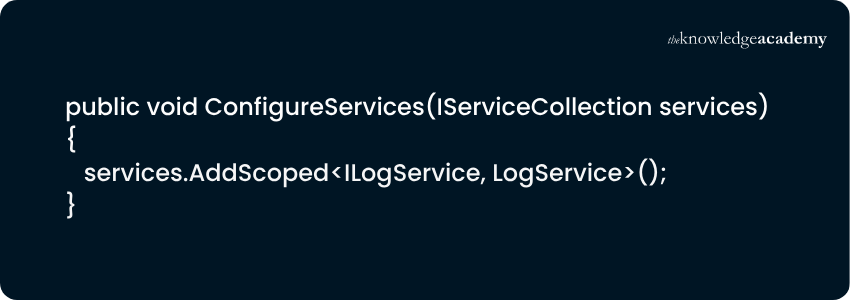
In ASP.NET Core, DI is built into the framework and used to manage everything from configuration and logging to custom services.
Example:
Defining and injecting a logging service:

Conclusion
Dependency Injection is a useful design pattern that makes code easier to manage and update. It helps separate how objects are created from how they are used, keeping your system clean and flexible. With DI, you can reduce repeated code, make testing simpler, and add new features without breaking old ones. When used wisely, it helps you build software that is well-structured and ready for growth.
Understand the fundamentals of programming with our Programming Training – Explore now!
Frequently Asked Questions
What is Dependency Injection in Rest API?

In REST APIs, DI is used to provide services like database connections, authentication or automatic logging to controllers. This reduces repetitive code and improves organisation.
What is Dependency Injection in .NET Core?
In .NET Core, DI is a built-in feature that manages object creation and lifetime. Developers register interfaces and implementations in a service container, and the framework injects them automatically where required.
What are the Other Resources and Offers Provided by The Knowledge Academy?
The Knowledge Academy takes global learning to new heights, offering over 3,000+ online courses across 490+ locations in 190+ countries. This expansive reach ensures accessibility and convenience for learners worldwide.
Alongside our diverse Online Course Catalogue, encompassing 17 major categories, we go the extra mile by providing a plethora of free educational Online Resources like Blogs, eBooks, Interview Questions and Videos. Tailoring learning experiences further, professionals can unlock greater value through a wide range of special discounts, seasonal deals, and Exclusive Offers.
What is The Knowledge Pass, and How Does it Work?
The Knowledge Academy’s Knowledge Pass, a prepaid voucher, adds another layer of flexibility, allowing course bookings over a 12-month period. Join us on a journey where education knows no bounds.
What are the Related Courses and Blogs Provided by The Knowledge Academy?
The Knowledge Academy offers various Programming Training, including Spring Framework Training, C# and .NET Training and Coding Training. These courses cater to different skill levels, providing comprehensive insights into Open Source Software.
Our Programming & DevOps Blogs cover a range of topics related to Dependency Injection, offering valuable resources, best practices, and industry insights. Whether you are a beginner or looking to advance your Programming skills, The Knowledge Academy's diverse courses and informative blogs have got you covered.

Richard Harris


Senior Full Stack Developer and Technology Educator
Richard Harris is a highly experienced full-stack developer with deep expertise in both frontend and backend technologies. Over his 12-year career, he has built scalable web applications for startups, enterprises and government organisations. Richard’s writing combines technical depth with clear explanations, ideal for developers looking to grow in modern frameworks and tools.

Upcoming Programming & DevOps Resources Batches & Dates
Date
 Spring Framework Training
Spring Framework Training
Thu 1st Oct 2026
Spring Framework Training
Thu 17th Dec 2026

 If you wish to make any changes to your course, please


