


 Top Rated Course

We may not have the course you’re looking for. If you enquire or give us a call on +45 89870423 and speak to our training experts, we may still be able to help with your training requirements.
Autocratic Leadership: A Full Guide to Traits and Impact
Benjamin Walker 26 February 2026Autocratic Leadership is a management style where one leader makes decisions independently, using strict control and authority over the team. Employees follow clear instructions and have limited input in decision-making. This approach can improve speed and discipline but may reduce creativity and morale in collaborative settings.

Training Outcomes Within Your Budget!
We ensure quality, budget-alignment, and timely delivery by our expert instructors.
Table of Contents

In fast-paced workplaces, clear direction and quick decisions are essential. Understanding 'What is Autocratic Leadership' helps explain why some organisations rely on a single, authoritative decision-maker. Used in high-pressure or structured environments, this style prioritises control, discipline, and efficiency. Let’s explore how it works, its key traits, and where it fits best.
Table of Contents
1) What is Autocratic Leadership?
2) Characteristics of Autocratic Leadership
3) Advantages of Autocratic Leadership
4) Disadvantages of Autocratic Leadership
5) Be Successful with Autocratic Leadership
6) How to Avoid Being an Autocratic Leader?
7) Can Autocratic Leadership Impact Employee Performance?
8) Conclusion
What is Autocratic Leadership?
Autocratic Leadership is a centralised approach where the decisions made are not discussed with the employees or related teams. A single person or a very small group of individuals have the authority to make decisions in an Autocratic Leadership system. Although this approach is considered quick and efficient, it does prove to be less collaborative and innovative.
The significance of this type of Leadership depends upon the context and the specific needs of the organisation or situation. Often, leaders are required to adapt to the principles of Autocratic Leadership based on the strengths and weaknesses of the team or workplace.
Based on the qualities of the leaders, autocratic approaches can be integrated whenever necessary to ensure that the overall functioning of the organisation is not affected.

Characteristics of Autocratic Leadership
Autocratic Leadership is a type of Leadership which provides a high degree of control over teams. To understand What is Autocratic Leadership, it is crucial to understand the key characteristics of this type of Leadership. The following is the list of its characteristics, so let’s have a quick look at them:
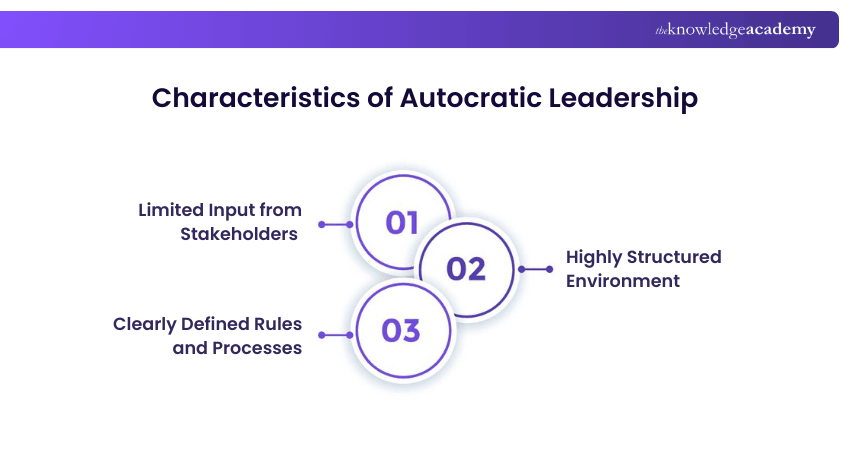
1) Limited Input from Stakeholders
The autocratic leader makes most, if not all, decisions, allowing little to no room for feedback. While this can increase efficiency by speeding up Decision-making, it doesn’t enhance team morale. When employees aren’t trusted with decisions or significant tasks, they may question their value to the company and might decide to take their skills elsewhere.
2) Highly Structured Environment
A highly structured environment is essential for any organisation. However, in an autocracy, this structure can become excessively rigid. The clear chain of command in this leadership style can lead to faster task completion, which is a positive aspect. On the downside, the work setting can become overly strict.
For example, if team members are aware that their performance is under constant scrutiny, fear might be their primary motivator to complete tasks.
3) Clearly Defined Rules and Processes
In an organisation the one thing that is evident under an autocrat is that he or she is the final decision maker, no matter whether it be a large business decision, or the decision of how the business is to be run. In this kind of leadership style setting, roles, rules and processes work effectively since one person is the decision maker.
Learn essential leadership skills to empower your career with our Women's Leadership Training – Join now!
However, if too much decision-making power is delegated to a middle manager in an effort to solve a problem, then possible thoughts from the next great employee idea could be overlooked.
Advantages of Autocratic Leadership
While the concept of Autocratic Leadership is highly criticised for several reasons, it is important to consider some of its advantages. Its advantages include the following:
1) Provides Direction
Group projects often run more smoothly when one person is designated as the leader or naturally steps into the role. By defining clear roles, assigning tasks, and setting deadlines, the group is more likely to complete the project on time, ensuring that everyone contributes equally.
2) Relieves Pressure
This leadership style is also effective in high-pressure situations. In particularly stressful scenarios, such as military conflicts, group members might favour an autocratic approach. This allows them to concentrate on specific tasks without the burden of making complex decisions.
3) Offers Structure
The autocratic style can also be advantageous in manufacturing and construction work. In these fields, it’s crucial for each individual to have a clearly defined task, a set deadline, and specific rules to follow.
Disadvantages of Autocratic Leadership
Autocratic Leadership, characterised by its unbalanced authoritative and central approach, has several significant drawbacks and limitations. In modern businesses where collaboration, Innovation, and partnerships are highly valued, an Autocratic system would not be a suitable choice. Some of the drawbacks of this type of Leadership are as follows:
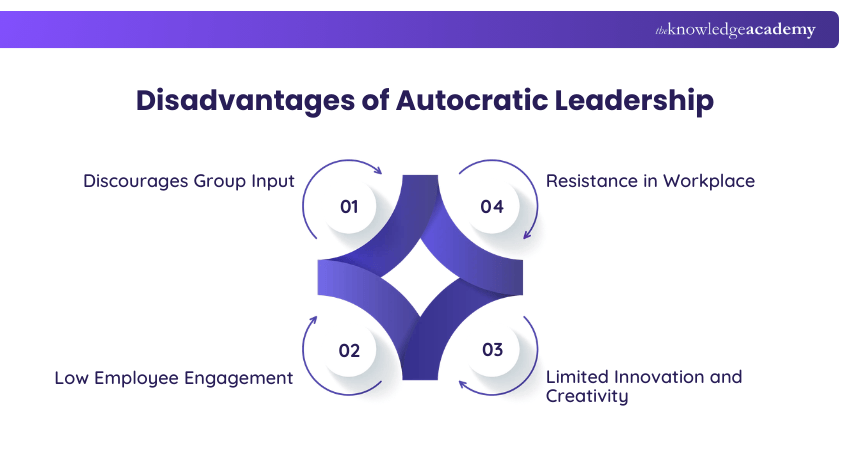
1) Discourages Group Input
Autocratic leadership inherently discourages group input. As a result, group members might feel unable to offer creative solutions to problems and may believe their knowledge and expertise are being ignored. Research has confirmed this outcome.
2) Low Employee Engagement
Autocratic Leadership depends solely on the decision-making capabilities of the leaders. The lack of participation of employees and teams in the Decision-making Process can lead to a disengaged workforce. Over time, this can reduce Employee Engagement, leading to lower motivation and job satisfaction.
3) Limited Innovation and Creativity
Autocratic Leadership can totally choke innovative and creative approaches in any business. When employees are not encouraged to share their ideas and perspectives on the novel solution, the overall creativity of the organisation can suffer. This also can hinder the organisation’s ability to adapt to the changing market to stay competitive.
4) Resistance in Workplace
Employees working under an Autocratic leader might become resistant to their directives, which can lead to workplace conflict or tension; often, when employee feel their voice is not being heard and their views do not make any impact in the organisation, a sense of discontent and resistance can spread in the workplace.
Develop decision-making skills to address technical challenges with our Technical Team Leading Training – Join now!
Be Successful with Autocratic Leadership
Here are key strategies to make Autocratic Leadership work effectively:
a) Listen to Team Members: Even if you don’t take their advice, let people share concerns openly. This makes them feel heard and respected, reducing feelings of being ignored or undervalued.
b) Establish Clear Rules: Set and communicate guidelines so everyone knows expectations, responsibilities, and procedures. Clear rules help teams stay aligned and disciplined.
c) Provide Tools and Training: Ensure team members have the skills and resources to complete tasks. Offering training or oversight fills knowledge gaps and boosts performance.
d) Be Reliable and Consistent: Follow through on commitments and enforce rules fairly. Consistency builds trust and makes team members more likely to respect your leadership.
e) Recognise Success, not Just Mistakes: Acknowledge accomplishments more often than pointing out errors. This motivates your team and improves morale, even in a directive environment.
By combining strict direction with respect, communication, and support, you can lead clearly while still motivating and developing your team.
How to Avoid Being an Autocratic Leader?
Leadership isn’t about you. This might surprise autocratic leaders, but true leadership focuses on your people, colleagues, and teams. As demonstrated by styles like Servant Leadership and transformational leadership, successful leaders build trust, listen actively, celebrate their team’s achievements, and offer continuous Coaching.
a) Establish Trust: Trust is essential for empowering people. As a leader, I often emphasise that my goal is to hire individuals who are smarter than I am, offer them coaching, resources, and support, and then step aside to let them excel.
b) Actively Listening: Great leaders actively listen to those around them, fostering a culture of collaboration and creativity. Genuinely listening to each idea and experiences, creating a strong sense of community.
c) Recognise and Celebrate Accomplishments: Effective leaders acknowledge and celebrate the achievements of others, giving credit where it’s deserved. They take the time to listen to their team members and understand how they prefer to be recognised.
d) Provide Ongoing Coaching: A successful leader provides continuous coaching and invests in the growth of their team’s talent. By focusing on enhancing the skills, knowledge, and perspectives of their team members, leaders equip them with the tools for success and prepare them for future challenges.
Learn effective motivation frameworks to inspire teams with our Staff Motivation Training – Register today!
Can Autocratic Leadership Impact Employee Performance?
Autocratic Leadership strongly influences employee performance and often works like a double-edged sword. It can boost productivity in short-term or high-pressure situations where quick decisions are needed. However, over time it may lower morale, limit creativity, and reduce employee engagement.
Conclusion
Autocratic Leadership can be powerful when speed, structure, and clear direction are essential. Understanding 'What is Autocratic Leadership' helps organisations apply it wisely without harming team motivation. Used at the right time and in the right setting, it can guide teams efficiently while still leaving room for growth.
Build structured and logical decision-making skills with our Decision Making Course – Join now!
Frequently Asked Questions
When Should Autocratic Leadership Not be Used?

Autocratic leadership is unsuitable for situations where team creativity, input, and collaboration are crucial, such as in innovation-driven projects. It can negatively impact morale and motivation if employees require autonomy or expertise to make informed decisions, resulting in disengagement and decreased productivity.
What Jobs Use Autocratic Leadership?
Jobs in high-stakes, fast-paced environments often use autocratic leadership. Examples include military roles, emergency services, construction project management, and manufacturing supervisors. These roles require quick decisions, strict guidelines, and clear authority to ensure safety and efficiency.
What are the Other Resources and Offers Provided by The Knowledge Academy?
The Knowledge Academy takes global learning to new heights, offering over 3,000+ online courses across 490+ locations in 190+ countries. This expansive reach ensures accessibility and convenience for learners worldwide.
Alongside our diverse Online Course Catalogue, encompassing 17 major categories, we go the extra mile by providing a plethora of free educational Online Resources like Blogs, eBooks, Interview Questions and Videos. Tailoring learning experiences further, professionals can unlock greater value through a wide range of special discounts, seasonal deals, and Exclusive Offers.
What is The Knowledge Pass, and How Does it Work?
The Knowledge Academy’s Knowledge Pass, a prepaid voucher, adds another layer of flexibility, allowing course bookings over a 12-month period. Join us on a journey where education knows no bounds.
What are the Related Courses and Blogs Provided by The Knowledge Academy?
The Knowledge Academy offers various Leadership Courses, including the Leadership Skills Course, High-Performing Teams Training, and Agile Leadership Training. These courses cater to different skill levels, providing comprehensive insights into Business Strategy.
Our Business Skills Blogs cover a range of topics related to Autocratic Leadership, offering valuable resources, best practices, and industry insights. Whether you are a beginner or looking to advance your Communication Skills, The Knowledge Academy's diverse courses and informative blogs have got you covered.

Benjamin Walker


Leadership Development Coach and Management Consultant
Benjamin Walker is a leadership coach and business consultant with over 18 years of experience in guiding organisations through strategic growth and transformation. He specialises in developing leadership capabilities at all levels, from emerging managers to executive teams. Benjamin’s work focuses on practical leadership, team dynamics, and performance management.
View Detail
Upcoming Business Skills Resources Batches & Dates
Date
 Leadership Skills Training
Leadership Skills Training
Fri 27th Mar 2026
Leadership Skills Training
Fri 29th May 2026
Leadership Skills Training
Fri 31st Jul 2026
Leadership Skills Training
Fri 2nd Oct 2026
Leadership Skills Training
Fri 27th Nov 2026

 If you wish to make any changes to your course, please


