


 Top Rated Course


We may not have the course you’re looking for. If you enquire or give us a call on +45 89870423 and speak to our training experts, we may still be able to help with your training requirements.
Delegated Legislation: A Complete Guide with Examples
Benjamin Walker 27 March 2026Delegated Legislation is law made by ministers under Acts of Parliament, enabling detailed and technical rules via Statutory Instruments without full debate. It allows faster updates and flexibility, helping laws remain practical and responsive to change. Parliament retains control through scrutiny and approval procedures.

Training Outcomes Within Your Budget!
We ensure quality, budget-alignment, and timely delivery by our expert instructors.
Table of Contents

Have you ever wondered who really makes the detailed rules that shape everyday life, from traffic regulations to workplace safety? While Parliament passes the main laws, much of the practical detail is handled through Delegated Legislation. It works quietly in the background, yet plays a huge role in how laws are applied and experienced in real life.
Understanding Delegated Legislation shows how governments stay efficient and flexible. It explains faster decision-making, the use of expert knowledge, and safeguards against misuse. Let’s break it down simply to see how it works and why it matters!
Table of Contents
1) What is Delegated Legislation?
2) History of Delegated Legislation
3) Types of Delegated Legislation
4) What are Statutory Instruments?
5) What is Parliament's Role in Delegated Legislation?
6) Factors Responsible for the Rapid Growth of Delegated Legislation
7) Advantages and Disadvantages of Delegated Legislation
8) Examples of Delegated Legislation in the UK
9) How is Delegated Legislation Controlled?
10) What is Judicial Review in Delegated Legislation?
11) Conclusion
What is Delegated Legislation?
Delegated Legislation, also known as "subordinate" or "secondary" legislation, is a type of law in the UK that complements primary legislation, such as Acts of Parliament. It is distinct from primary legislation because it is created by Government Ministers or other authorised individuals and bodies, rather than by Parliament itself.
This form of legislation can only be made if specific powers have been granted by an Act of Parliament. Delegated Legislation allows for the creation of detailed rules and regulations, enabling swift and flexible lawmaking without the need for Parliament to pass a new Act for every adjustment or clarification, showcasing the importance of Delegating Effectively.

History of Delegated Legislation
The history of Delegated Legislation shows its shift from limited use to a key part of modern governance. As complexity grew, legislatures granted powers to the executive for detailed rule-making. Let’s explore its key historical stages:
1) Early Foundations (18th–19th Century):
Delegation existed early on. The U.S. First Congress used it for technical matters like debt and patents, while UK laws such as the 1832 Prevention of Cholera Act gave powers to manage public health emergencies.
2) Expansion in the 20th Century:
With growing government responsibilities, especially during wartime (e.g., War Measures Act 1914), Delegated Legislation expanded rapidly. It became essential for handling complex and urgent issues.
3) Judicial Acceptance (U.S.):
Courts initially resisted delegation but later accepted it as necessary. The U.S. Supreme Court allowed it where clear guidelines existed, as seen in Mistretta v. United States (1989).
4) Control and Scrutiny:
Concerns about misuse led to safeguards. The UK’s 1932 Committee on Ministers’ Powers supported delegation but recommended stronger parliamentary control.
5) Modern Use:
Today, Delegated Legislation is indispensable. It ensures efficiency and flexibility while remaining controlled through parliamentary scrutiny and judicial review (ultra vires).
Develop essential leadership skills with our Leadership Skills Training - Join today!
Types of Delegated Legislation
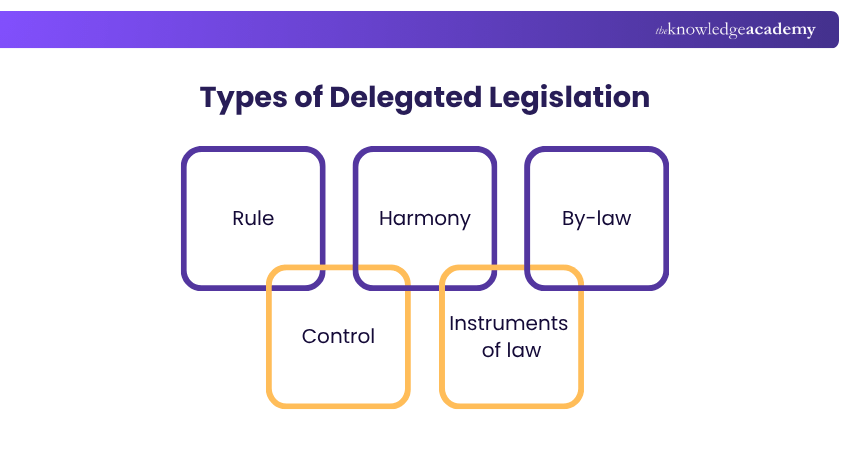
Delegated Legislation includes several types, each serving a specific role in law and governance. These categories help ensure efficient, detailed, and specialised legal administration. Let’s explore the main types in detail:
1) Rule
Rules are the most widely used form of Delegated Legislation, providing detailed instructions on how laws should be applied in practice. They operate within the scope of the parent Act, ensuring consistency, clarity, and proper implementation across different legal and administrative contexts.
2) Harmony
Harmony ensures that Delegated Legislation aligns closely with the purpose and intent of the parent Act. This alignment maintains consistency across the legal system, preventing contradictions and ensuring that all secondary laws fully support the overall objectives of primary legislation.
3) By-law
By-laws are laws created by local authorities or public bodies under statutory powers. They address local issues such as public safety and behaviour, and are enforceable within specific areas, reflecting the unique needs and conditions of local communities effectively and appropriately.
4) Control
Control mechanisms ensure that Delegated Legislation is properly monitored and regulated. These include parliamentary scrutiny, ministerial approval, and procedural requirements, which help maintain accountability, prevent misuse of powers, and ensure that delegated authority is exercised within legal limits.
5) Instruments of law
Instruments of law are the formal tools used to implement delegated powers, including orders, regulations, and codes of practice. Each instrument is carefully designed for specific purposes, allowing precise, flexible, and effective application of laws in various technical and administrative areas.
What are Statutory Instruments?
Statutory Instruments (SIs) are the most common type of Delegated Legislation. They are created by Ministers or other authorised individuals or bodies who have been granted the power to do so, usually by an Act of Parliament.
An SI serves as a legal tool or "container" that brings into law the specific measures proposed by Ministers or other authorised bodies. These measures often include Regulations, Orders, or Rules.
What is Parliament's Role in Delegated Legislation?
Delegated Legislation can only be created using powers granted by an Act of Parliament (the ‘parent Act’). These powers outline who can make the Delegated Legislation, what it may or must do, the parliamentary scrutiny process it may undergo, and any other requirements for its creation.
Problems with the Process:
There are issues with both the review of the resultant Statutory Instruments (SIs) and the delegation of authority to create Delegated Legislation. This report highlights key problems that need addressing in both areas.
Stages of the Delegated Legislation System:
a) Delegation of Powers: Parliament passes Acts that delegate powers.
b) Use of Powers: Ministers and other authorised bodies use these powers to create Delegated Legislation, primarily through SIs.
Parliament’s Role:
a) First Stage: Parliament passes the Acts that delegate powers.
b) Second Stage: Parliament scrutinises and sometimes must approve many of the SIs created using those powers.
Transform your leadership style with our Agile Leadership Training - Join now!
Factors Responsible for the Rapid Growth of Delegated Legislation
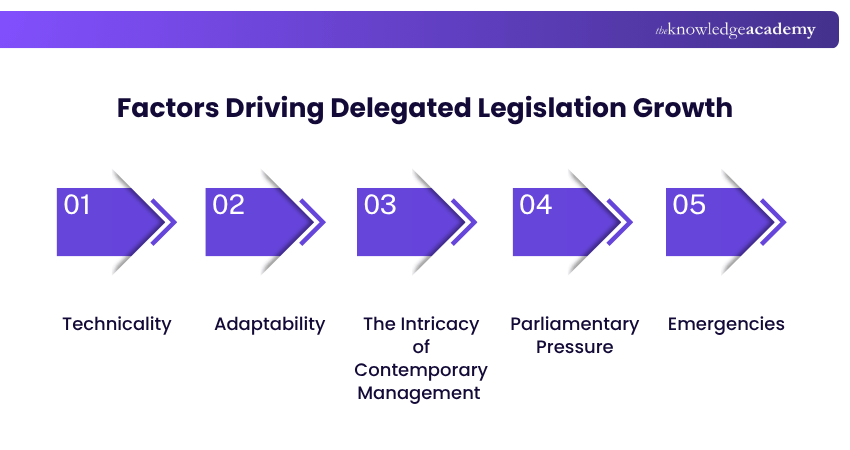
Factors have contributed to the rapid growth of Delegated Legislation, reflecting the evolving needs and complexities of modern governance.
1) Technicality
Modern governance requires precise Legislation, often beyond what parliaments create, due to its technical complexities. Governance involves intricate and specialist areas, ranging from environmental regulations to digital privacy laws. These areas require expertise that typical legislative bodies might not possess.
Delegated Legislation allows expert bodies or individuals to develop these detailed regulations under the authority of a broader legislative framework. This approach ensures that laws are not only comprehensive but also crafted with the precision necessary to effectively manage complex, technical issues in a rapidly evolving world.
2) Adaptability
Delegated Legislation facilitates swift adjustments to evolving circumstances, including advancements in technology and shifts in societal norms. This agility ensures that the legal framework remains relevant and effective amidst rapid changes, allowing authorities to address emerging issues promptly.
Whether it's updating regulations to accommodate new innovations or responding to shifting public attitudes, Delegated Legislation offers a dynamic and responsive approach to governance. This adaptability is important for maintaining the effectiveness and legitimacy of the legal system in an ever-changing world.
3) The Intricacy of Contemporary Management
The intricacy of contemporary management demands adaptable legal frameworks to navigate the complexities of modern governance. With rapid advancements in technology, global interconnectedness, and diverse societal needs, traditional legislative processes may prove inadequate.
Delegated Legislation offers a solution by empowering authorities to respond swiftly to emerging challenges, enact specialised regulations, and address intricate issues with precision. This flexibility ensures that laws remain relevant and effective in an ever-evolving landscape, allowing governments to meet the demands of their citizens while maintaining regulatory coherence and consistency.
4) Parliamentary Pressure
Parliamentary pressure refers to the influence exerted by legislative bodies on the need for Delegated Legislation. As parliaments grapple with heavy workloads and intricate policy matters, they may delegate certain legislative functions to expedite the process. This pressure can arise from various factors, including time constraints, political priorities, and the need for specialised expertise.
Delegated Legislation enables parliamentarians to focus on overarching policy issues while delegating the details to relevant authorities. Maintaining a balance between parliamentary oversight and administrative efficiency ensures legislative accountability and transparency in Delegated Legislation.
5) Emergencies
During times of crises or emergencies, including natural disasters or public health emergencies, swift action is imperative to safeguard the well-being of citizens. Delegated Legislation provides a vital mechanism for governments to respond promptly and effectively.
By granting authorities the power to enact temporary measures or regulations, Delegated Legislation facilitates the rapid deployment of resources. It allows for the coordination of emergency response efforts and the implementation of necessary protocols or restrictions to mitigate the impact of the crisis. This flexibility ensures that governments can adapt swiftly to unforeseen circumstances, prioritising public safety and welfare above bureaucratic hurdles.
Get a deep understanding of how to better manage your time management skills with our Practical Thinking Course – Register now!
Advantages and Disadvantages of Delegated Legislation
Here are the Advantages and Disadvantages of Delegated Legislation:

Advantages of Delegated Legislation
The following are the advantages of Delegated Legislation:
1) Speedy Implementation: Enables rapid legal changes and quick responses to urgent matters, allowing faster adaptation compared to traditional primary legislation.
2) Flexible Amendments: Provides easy modification of regulations to reflect changing requirements and emerging developments without complex legislative procedures.
3) Reduced Parliamentary Workload: Allows Parliament to focus on broader policy issues by delegating detailed regulatory management to specialised bodies, improving overall legislative efficiency.
4) Specialised Procedural Approach: Facilitates sector-specific regulations that can address unique characteristics and demands of different industries with greater precision and technical expertise.
Disadvantages of Delegated Legislation
The following are the disadvantages of Delegated Legislation:
1) Insufficient Time for Review: The sheer volume of secondary legislation can overwhelm Parliament, making it difficult to thoroughly review each statutory instrument. This can result in potentially problematic rules being passed without adequate scrutiny.
2) Political Considerations: Legislative oversight may be influenced by the political composition of parliamentary committees, leading to biased or compromised evaluations of Delegated Legislation.
3) Negative Resolution Procedure: This common procedure allows a statutory instrument to become law unless it is expressly rejected within a specified time frame, usually around 40 days. Critics argue that this approach discourages active parliamentary engagement and scrutiny.
4) Rubber-stamping: Some procedures for Delegated Legislation allow little scope for amendment or discussion, leading to a rubber-stamping effect where parliamentary approval is granted without comprehensive scrutiny.
Enhance your delegation skills with our comprehensive Delegation Training!
Examples of Delegated Legislation in the UK
Delegated Legislation plays a crucial role in shaping the UK’s legal framework across various sectors. Here are some prominent examples:
1) Health and Safety at Work Regulations
Developed by the Health and Safety Executive, these regulations establish laws and requirements to protect employees and the public from potential workplace risks.
2) Building Regulations
Set by the Ministry of Housing, Communities and Local Government, these regulations govern the construction, design, and energy efficiency of buildings, ensuring they meet essential safety and accessibility standards.
3) Environmental Regulations
A range of environmental regulations, such as the Environmental Permitting Regulations and the Air Quality Regulations, set out standards and practices to manage pollution, safeguard natural resources, and address climate change.
4) Taxes and Financial Regulations
Gain familiarity with the tasks, responsibilities, and empowerment of teams with our High Performing Teams Training – Join now!
How is Delegated Legislation Controlled?
It is controlled through parliamentary oversight and judicial review to ensure legal limits and accountability. Key control mechanisms include:
1) Parliamentary Control:
a) Enabling Act: Defines the scope and limits of delegated powers
b) Affirmative Procedure: Requires Parliament’s approval before taking effect
c) Negative Procedure: Becomes law unless rejected within a set period
d) Scrutiny Committees: Review for errors or misuse of power
e) Super Affirmative Procedure: Involves a deeper review and consultation
2) Judicial Control (Judicial Review):
a) Ultra Vires: Invalid if powers are exceeded
b) Procedural Ultra Vires: Invalid if required steps are not followed
c) Substantive Ultra Vires: Invalid if content exceeds authority
d) Unreasonable Ultra Vires: Invalid if irrational or unreasonable
What is Judicial Review in Delegated Legislation?
Judicial review is the process by which courts examine Delegated Legislation to ensure it stays within the limits of the parent Act and the law. It prevents misuse of delegated powers and maintains legal accountability.
The key principle is ultra vires (“beyond powers”). Courts can invalidate laws if authority is exceeded, procedures are not followed, or the law is unreasonable or unlawful. If so, it is declared null and void.
Conclusion
Delegated Legislation provides flexibility and efficiency in rulemaking yet raises concerns about accountability and legal complexities. Striking a balance between administrative efficiency and democratic principles is crucial to ensure effective governance and responsiveness to societal needs. This balance is key to ensuring laws are both effective and just.
Equip yourself with Anti-Social Behaviour Management Training - join now!
Frequently Asked Questions
How Does Delegated Legislation Undermine Parliamentary Supremacy?

Delegated Legislation can undermine parliamentary supremacy by allowing ministers or bodies to make laws without full parliamentary scrutiny. This potentially bypasses democratic processes and concentrates power in the hands of the executive.
What are the Three Ways in Which Parliament Can Control Delegated Legislation?
Parliament can control Delegated Legislation through three main methods:
a) Affirmative resolution (approval required)
b) Negative resolution (opposition required to block)
c) Scrutiny committees (examine and report on legislation)
What are the Other Resources and Offers Provided by The Knowledge Academy?
The Knowledge Academy takes global learning to new heights, offering over 3,000+ online courses across 490+ locations in 190+ countries. This expansive reach ensures accessibility and convenience for learners worldwide.
Alongside our diverse Online Course Catalogue, encompassing 19 major categories, we go the extra mile by providing a plethora of free educational Online Resources like Blogs, eBooks, Interview Questions and Videos. Tailoring learning experiences further, professionals can unlock greater value through a wide range of special discounts, seasonal deals, and Exclusive Offers.
What is The Knowledge Pass, and How Does it Work?
The Knowledge Academy’s Knowledge Pass, a prepaid voucher, adds another layer of flexibility, allowing course bookings over a 12-month period. Join us on a journey where education knows no bounds.
What are the Related Courses and Blogs Provided by The Knowledge Academy?
The Knowledge Academy offers various Leadership Courses, including the Delegation Training, Agile Leadership Training, and the High Performing Teams Training. These courses cater to different skill levels, providing comprehensive insights into How to Build an Effective Team.
Our Business Skills Blogs cover a range of topics related to Delegated Legislation, offering valuable resources, best practices, and industry insights. Whether you are a beginner or looking to advance your Legislative knowledge, The Knowledge Academy's diverse courses and informative blogs have got you covered.

Benjamin Walker


Leadership Development Coach and Management Consultant
Benjamin Walker is a leadership coach and business consultant with over 18 years of experience in guiding organisations through strategic growth and transformation. He specialises in developing leadership capabilities at all levels, from emerging managers to executive teams. Benjamin’s work focuses on practical leadership, team dynamics, and performance management.
View Detail

 If you wish to make any changes to your course, please


