


 Top Rated Course

We may not have the course you’re looking for. If you enquire or give us a call on +49 8000101090 and speak to our training experts, we may still be able to help with your training requirements.
What is Discrimination? Types, Laws, and Legal Protection
The Knowledge Academy 27 December 2025Discrimination is unfair treatment based on race, gender, age, religion or disability, limiting equal rights, opportunities at work, education, and in society. Understanding What is Discrimination is integral to eliminating everyday discriminatory issues in real life and ensuring fair and equal treatment for every individual.

Training Outcomes Within Your Budget!
We ensure quality, budget-alignment, and timely delivery by our expert instructors.
Table of Contents
Discrimination is a reality shaping lives and careers. Shockingly, over two-thirds (69%) of ethnic minority respondents in the UK report facing discrimination, whether at work (61%), during job applications (65%) or both. So these numbers aren’t mere statistics; they are stories of lost opportunities and systemic bias.
In this blog, we’ll unpack What is Discrimination, explore its many forms, and explore in detail the laws designed to protect individuals from such rampant injustice. So read on and be the craftsman behind fairer public and workplace environments.
Table of Contents
1) What is Discrimination?
2) Different Types of Discrimination
3) When and Where Are You Protected from Discrimination?
4) How to Deal with Discrimination?
5) Conclusion
What is Discrimination?
Discrimination is the unfair treatment of groups or individuals on the basis of various characteristics. It includes race, gender, age, disability, religion, or sexual orientation. It means treating someone in an inferior manner due to the characteristic or group they belong to.
Understanding What is Discrimination can help to recognise why it happens. Naturally, human beings categorise people to make sense of the world, but these can raise differences that affect people negatively. It develops through social influences and must be unlearned to take meaningful steps towards fairness, inclusion, and equality.

Different Types of Discrimination
Understanding the different types will enable an insightful recognition of What is Discrimination. Let's look at the important types of discrimination below.
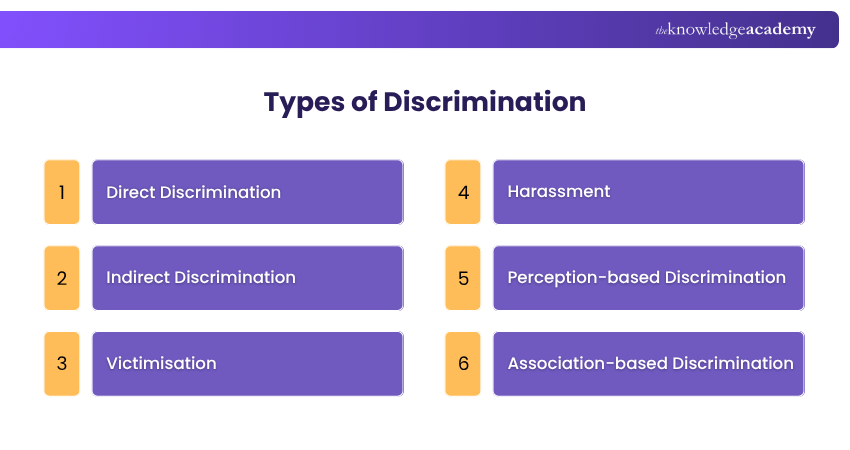
1) Direct Discrimination
Direct Discrimination is the unfair treatment of groups and individuals due to a disability. There must be a clear link between disability and the way the person is treated. There is a clear indication that disability is be the main reason for unfavourable treatment.
For Example: Lena is denied promotion because she has depression, while another individual without depression is promoted despite being less qualified.
2) Indirect Discrimination
Indirect Discrimination refers to the policy or practice that is applied to everyone but puts people with a disability at a disadvantage compared to others. This can be a form of discrimination even if the organisation did not intend to treat unfairly.
For Example: An advice centre offers face-to-face support, which puts people with agoraphobia at a disadvantage.
3) Victimisation
Victimisation occurs when an individual or group is treated unfairly because they made a complaint about discrimination. It can also be victimisation if you support someone else who did.
For Example: Sarah complains about discriminatory behaviour at a supermarket. This led both Sarah and the friend who supported her to be told that they must shop elsewhere.
4) Harassment
Harassment is an unwanted behaviour related to disability that violates a person’s dignity or creates an intimidating, offensive, or degrading environment. It does not have to relate to disability that a person has.
For Example: A tutor makes offensive comments about eating disorders in front of his students.
5) Perception-based Discrimination
Perception-based Discrimination occurs when a person is treated unfairly because someone believes they have a particular characteristic. This is based on assumption rather than fact and is driven by the perception, even if it is wrong.
For Example: A bank refuses a loan because it wrongly believes the applicant has a mental health condition.
6) Association-based Discrimination
Association-based Discrimination occurs when someone is treated worse because of their connection with another person. It might be due to the disability of the other person, even if the individual who faced discrimination does not have those characteristics themselves.
For Example: A cafeteria denies service to a solicitor because she works with people who have mental health conditions.
Turn every legal jargon into a competitive advantage for your business. Learn how in our Commercial Law Training - Sign up now!
When and Where are you Protected from Discrimination?
In the Equality Act 2010, individuals are legally protected from discrimination in many areas of everyday life. This applies across both public and private sectors to promote fair treatment, equal access to services, and equal opportunities for everyone. It covers situations, such as employment, education, and services.
Also, the law protects people from being treated unfairly because of specific protected characteristics. These include age, disability, race, religion, sexual orientation, maternity, and more. Recognising these characteristics ensures the Equality Act protects an individual's dignity, ensures fairness, and equality for everyone.
Key Disability Protections Under the Equality Act 2010
The Equality Act 2010 provides specific rights and protections for people with disabilities. It requires employers, service providers, and public bodies to make adjustments on removing barriers that may disadvantage a disabled person. This could include physical changes to buildings, providing accessible information, or adjusting work duties or hours.
The Act also protects against indirect discrimination, where workplace policies or practices disadvantage certain groups, even if unintentionally. Workplace protections ensure a fair, respectful environment and promote equality of opportunity for all employees. But employers must regularly review their practices to ensure fair treatment is present.
Key Workplace Protections Under the Equality Act 2010
In the workplace, the Equality Act 2010 protects employees, job applicants, and contract workers from discrimination, harassment, and victimisation. Employers must not discriminate during recruitment, pay decisions, promotions, training opportunities, or when dismissing staff. The Act also protects against indirect discrimination, where workplace policies or practices disadvantage certain groups, even if unintentionally. Workplace protections ensure a fair, respectful environment and promote equality of opportunity for all employees.
When is It Not Considered Discrimination?
Not all less favourable treatment is legally considered discrimination. There are certain exceptions under the Equality Act 2010. For example, if a policy or action that appears discriminatory can be objectively justified as a means of achieving a legitimate aim, like health and safety, it may be lawful.
Similarly, some jobs may require specific characteristics for genuine occupational requirements, such as a women’s support service requiring a female worker. In such cases, the treatment must still be reasonable and justified under the law. This ensures such requirements are applied to the role and not used as a reason for unfair exclusion.
Transform into an advanced employment law practitioner with Employment Law Trainingregister today!
How to Deal with Discrimination?
The positive aspect is it can be dealt with through a cautious and consistent disciplinary approach. Below, we have listed those steps:
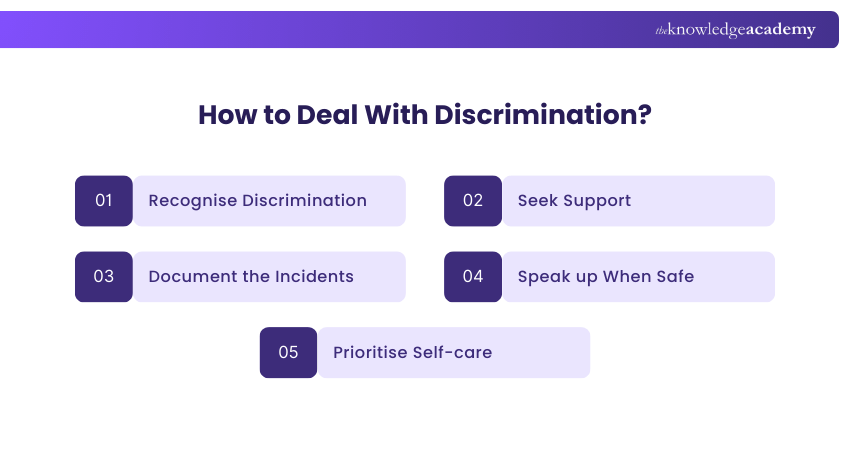
1) Recognise Discrimination: You should immediately recognise when you face mistreatment due to race, gender, or other personal characteristics.
2) Seek Support: Contact your friends, family, or colleagues and talk about your experience. You can even consider professional therapies and support.
3) Document the Incidents: Keep a detailed record of discriminatory actions, such as dates, times, and specifics of happenings.
4) Speak up When Safe: Whenever you feel comfortable and safe, address the person or organisation responsible for the discrimination against you.
5) Prioritise Self-care: Engage in activities prioritising relaxation to maintain mental and physical health while dealing with discrimination.
Lead the fight against bribery—register today for our Anti-Bribery Training!
Conclusion
Understanding What is Discrimination is integral to building a respectful and inclusive environment at work and in society. Recognising the different types of discrimination and knowing the protections offered can help to prevent ongoing discrimination. Being aware empowers people to challenge unfair behaviour and encourages organisations to uphold dignity and equal opportunity for all.`
Strengthen understanding of workplace legislation and compliance with practical Employment Law Courses – Join today!
Frequently Asked Questions
What is the Other Meaning of Discrimination?

Aside from unfair treatment, discrimination can also mean the ability to recognise subtle differences between things, such as in taste, sound, or judgement ,reflecting a refined awareness or perceptive skill.
What is an Example of Discrimination?
An example of discrimination is refusing to hire a qualified candidate because of their gender, race, age, or religion. This results in unequal opportunities and violates principles of fairness and equality.
What are the Other Resources and Offers Provided by The Knowledge Academy?
The Knowledge Academy takes global learning to new heights, offering over 3,000 online courses across 490+ locations in 190+ countries. This expansive reach ensures accessibility and convenience for learners worldwide.
Alongside our diverse Online Course Catalogue, encompassing 19 major categories, we go the extra mile by providing a plethora of free educational Online Resources like Blogs, eBooks, Interview Questions and Videos. Tailoring learning experiences further, professionals can unlock greater value through a wide range of special discounts, seasonal deals, and Exclusive Offers.
What is The Knowledge Pass, and How Does it Work?
The Knowledge Academy’s Knowledge Pass, a prepaid voucher, adds another layer of flexibility, allowing course bookings over a 12-month period. Join us on a journey where education knows no bounds.
What are the Related Courses and Blogs Provided by The Knowledge Academy?
The Knowledge Academy offers various Employment Law Courses, including the Direct and Indirect Discrimination Training, Commercial Law Training Course, and Anti-Bribery Training Course. These courses cater to different skill levels, providing comprehensive insights into Employee Rights and Responsibilities.
Our HR Resources Blogs cover a range of topics related to Discrimination, offering valuable resources, best practices, and industry insights. Whether you are a beginner or looking to advance your HR skills, The Knowledge Academy's diverse courses and informative blogs have got you covered.

The Knowledge Academy


Global Training Provider
The Knowledge Academy is a world-leading provider of professional training courses, offering globally recognised qualifications across a wide range of subjects. With expert trainers, up-to-date course material, and flexible learning options, we aim to empower professionals and organisations to achieve their goals through continuous learning.

Upcoming HR Resources – Learn about Human Resources Batches & Dates
Date
 Direct and Indirect Discrimination Training
Direct and Indirect Discrimination Training
Fri 3rd Jul 2026
Direct and Indirect Discrimination Training
Fri 2nd Oct 2026

 If you wish to make any changes to your course, please


