


 Top Rated Course

We may not have the course you’re looking for. If you enquire or give us a call on +49 8000101090 and speak to our training experts, we may still be able to help with your training requirements.
What is a Project Charter: Guide, Examples and Template
Grace Mitchell 17 April 2026A Project Charter is a critical document that formally authorises a project, defines its objectives, scope, stakeholders, and assigns authority to the project manager. This comprehensive blog covers the structure, benefits, and creation process of a Project Charter, with real-life examples and a downloadable template to support your planning.

Training Outcomes Within Your Budget!
We ensure quality, budget-alignment, and timely delivery by our expert instructors.
Table of Contents

What’s the first step to turning a great idea into a successful project? It all begins with a solid Project Charter. This essential document lays the groundwork by defining the project’s purpose, scope, objectives, stakeholders, and overall direction. Without it, even the best ideas risk getting lost in confusion and misalignment. In this blog, you'll discover what a Project Charter is, why it's so important, see real-world examples, and get access to a practical template to kick-start your own projects with clarity and confidence.
Table of Contents
1) What is a Project Charter?
2) What is the Purpose of a Project Charter?
3) Project Charter vs. Project Plan
4) How to Create an Effective Project Charter?
5) Tips to Create a Project Charter
6) Can You Start a Project Without a Project Charter?
7) What is the Difference Between Project Charter and Business Plan?
8) Conclusion
What is a Project Charter?
The Project Management Institute (PMI) defines a Project Charter as is a document issued by the project initiator or sponsor that formally authorises the existence of a project and grants the project manager authority to apply organisational resources to project activities.
A Project Charter is created after a business case has been developed and reviewed by stakeholders. It outlines what the project aims to achieve and how those goals will be accomplished. Once the business case is approved, the charter serves as the official document that allows project work to begin.
The charter must be signed by a project sponsor, as this provides formal permission to use organisational resources such as staff, budget, technology, and tools. Although the content and structure may vary between projects, a well-written charter should give any reader a clear understanding of the project scope, goals, and approach.

What is the Purpose of a Project Charter?
The Project Charter serves as a foundational document that initiates and defines a project at a high level. It not only sets the stage for detailed planning but also provides clear direction, authority, and alignment among stakeholders. Here are its core purposes:
a) Establishing Vision and Scope
It outlines the project’s objectives, scope, and boundaries, offering a shared understanding of what the project aims to accomplish. This initial clarity helps align team efforts and stakeholder expectations from the outset.
b) Authorising the Project
The charter formally approves the project, granting the Project Manager the authority to use organisational resources. It acts as an elevator pitch to stakeholders, justifying the project’s value and return on investment.
c) Acting as a Sales Document
It provides a high-level summary that stakeholders can use to advocate for the project internally. This shared reference helps secure support and resources, guiding conversations and decisions throughout the lifecycle.
d) Supporting Project Planning
Serving as the basis for detailed planning, it informs the development of comprehensive Project Management plans, including scope, schedule, and resource allocation.
e) Aligning Stakeholders
The charter documents key deliverables, roles, timelines, and responsibilities, minimising misunderstandings and facilitating stakeholder alignment early in the project.
f) Identifying Key Stakeholders
It highlights primary stakeholders and clarifies their roles and interests, setting the foundation for effective communication and engagement strategies.
g) Outlining Resources and Budget
By providing a preliminary view of the budget, resources, and constraints, the charter guides efficient resource distribution and financial planning.
h) Setting Milestones and Timeline
It maps out major milestones and a high-level timeline, helping stakeholders visualise progress expectations and key delivery phases.
i) Documenting Risks and Assumptions
Initial risks, assumptions, constraints, and dependencies are recorded to support early risk management and contingency preparation.
j) Serving as a Reference Tool
Throughout the project, the charter remains a touchstone document. It supports scope management and is frequently referred to in meetings and progress reviews.
Project Charter vs. Project Plan
Here is a comprehensive table that will help you understand the key differences between Project Charter vs. Project Plan:

How to Create an Effective Project Charter?
There are a few steps involved in creating an effective Project Charter. These steps are as follows:

1) Defining Clear and Achievable Objectives
Determine the project's scope and the project's vision. This phase is essential to developing a Project Charter because it establishes goals and limitations within the project scope, setting the tone for the remainder of the project.
2) Assigning Roles and Responsibilities
Enumerate all the project's critical roles, such as those of the daily project team, customers, and stakeholders. To guarantee that the project team understands their tasks, the Project Charter should explicitly state what each team member is expected to do. It also guarantees and fosters excellent communication.
3) Present a Business Case
A project's Business Case outlines reasons for undertaking it. Thus, the Project Charter should include this to elucidate business requirements, like financial gains and stakeholder Return on Investment (ROI). Including a Business Case in your Charter is crucial for conveying project significance to sponsors and stakeholders.
4) Identifying Risks and Assumptions
Acknowledge project risks and assumptions in the Charter to proactively address challenges. Document potential risks and project conditions to develop mitigation strategies, ensuring smoother progress and preventing issues from escalating. This proactive approach enables the project team to develop mitigation strategies, addressing potential challenges before they escalate.
5) Review and Refinement
Review the initial Project Charter draft with stakeholders, gathering feedback for refinement. Collaboratively addressing concerns can ensure the final Charter reflects stakeholder consensus. In addition, it might foster a shared understanding and commitment to project goals.
6) Establishing Project Scope
You should consider and clearly establish the project's scope and objectives. This might let the project team and stakeholders better comprehend the project's aims and progress. But you must remember that a little change in the project’s scope can impact the work breakdown structure.
Elevate your expertise to new heights with our Project Management Training - join now!
A well-crafted Project Charter provides a strong foundation for any initiative by outlining its objectives, scope, and key elements. The following examples illustrate how Project Charters are structured across different project types and industries.
Example: 1
Company ABC Project Charter
Project Name: “Sustainable Living: A Guide for Beginners” eBook Launch
Project Description:
A downloadable eBook offering practical tips and strategies for consumers beginning their sustainability journey, written in collaboration with environmental experts.
Business Case:
Supports company goals by:
a) Enhancing brand credibility in the eco-conscious market
b) Driving 15% increase in newsletter signups
c) Providing a valuable lead magnet for email marketing efforts
Project Deliverables:
a) Professionally designed eBook (PDF format)
b) Landing page for downloads
c) Email nurture series post-download
Project Benefits:
a) Increased audience engagement
b) Growth in qualified leads
c) Improved brand authority in the sustainability niche
Project Risks:
a) Delays in content approval from contributors
b) Graphic design bottlenecks due to limited internal resources
Project Budget:
Not to exceed £4,000
Project Milestones:
a) Content finalised: August 20, 2025
b) Design complete: August 30, 2025
c) Landing page live: September 2, 2025
d) Launch campaign begins: September 5, 2025
Project Team Members:
a) Project Manager: Emma L.
b) Content Lead: Raj M.
c) Graphic Designer: Zoe T.
d) Email Marketing Manager: Marcus W.
e) Sustainability Expert Contributor: Helen F.
f) Web Developer: Josh K.
g) Social Media Lead: Tasha B.
Example: 2
TechNova Inc. Project Charter
Project Name: “ClientHub” CRM Software Development
Project Description:
Development of a lightweight CRM (Customer Relationship Management) web application tailored for small service-based businesses to manage leads, clients, and follow-ups more effectively.
Business Case:
Supports company goals by:
a) Expanding our SaaS portfolio
b) Generating £50,000 in new MRR within 6 months of launch
c) Filling a market gap for affordable, intuitive CRM tools for SMEs
Project Deliverables:
a) Functional CRM web app (MVP version)
b) Admin dashboard with role-based access
c) Client and lead management modules
d) API integrations for email and scheduling tools
Project Benefits:
a) Increased revenue stream
b) Competitive edge in the SME software market
c) Stronger SaaS brand identity
Project Risks:
a) Delays due to backend integration issues
b) Scope creep from continuous feature requests
c) Potential underestimation of QA testing requirements
Project Budget:
Not to exceed £120,000
Project Milestones:
a) Wireframes & tech specs: July 5, 2025
b) Backend & frontend dev start: July 15, 2025
c) MVP completion: September 20, 2025
d) Beta testing phase: September 25 to October 10, 2025
e) Public launch: October 15, 2025
Project Team Members:
a) Project Manager: Anika R.
b) Lead Developer: Martin Y.
c) UX/UI Designer: Chloe M.
d) QA Lead: Daniel F.
e) Product Owner: Reema K.
f) Marketing Strategist: Jonah L.
g) Support Specialist: Asha V.
Tips to Create a Project Charter
If you want to create a Project Charter, you must take note of some crucial tips. Let’s talk about those steps in detail:
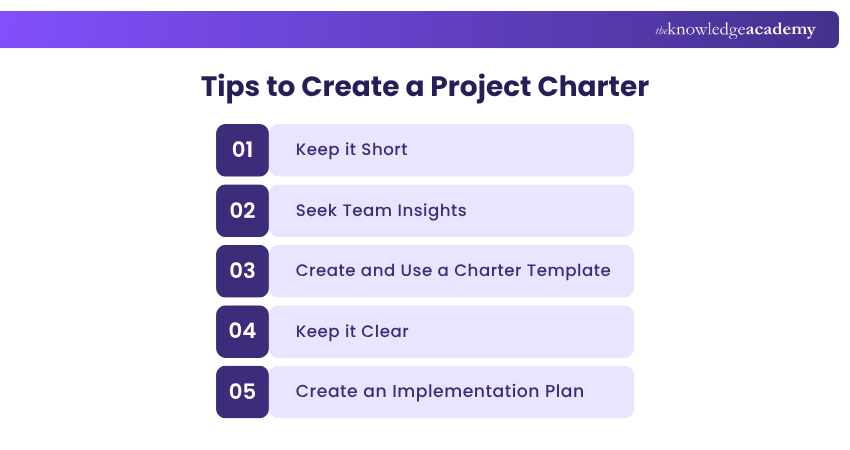
a) Keep it Short: Try to make it short and informative. The Charter must consist of only a few sentences for each component. A Project Charter ought to be a high-level synopsis rather than a detailed analysis.
b) Seek Team Insights: Ask for team insights since identifying potential project risks and setting reasonable goals are advantageous. You can facilitate communication with the Project team members through this tactic.
c) Create and Use a Charter Template: With the help of a template, you can make proper Project Charters in the future. You can also ensure that they are more succinct and easier to understand.
d) Keep it Clear: Arrange the charter in a way that others find easily comprehensible. To keep it clear and better for understanding, you can give a name to every part of the charter for easier access of data.
e) Create an Implementation Plan: Make an execution plan. To do this, you should start thinking about how to apply the organised Charter. This entails speaking with stakeholders and project participants as well as obtaining funding and resources.
Can You Start a Project Without a Project Charter?
Yes, but it is not recommended. A Project Charter formally authorises the project, defines its purpose and scope, and aligns stakeholders. Without it, projects risk confusion, lack of direction, and weak accountability.
What is the Difference Between Project Charter and Business Plan?
A Project Charter outlines the scope, objectives, and stakeholders of a specific project, while a business plan defines the overall strategy, goals, market, and operations of an entire organisation or business initiative
Conclusion
Creating an effective Project Charter demands meticulous planning, open communication, and collaboration. Through this blog, we hope you understood What is a Project Charter and how it serves as a unifying document that aligns Project stakeholders. It also clarifies objectives and establishes the groundwork for successful Project execution.
Master financing strategies with our Project and Infrastructure Financing Training – Register now!
Frequently Asked Questions
What is the Next Step After a Project Charter?

The next step is detailed project planning. This involves creating a project management plan, defining tasks, resources, timelines, budgets, and risk strategies. It transitions the project from initiation to execution by outlining how objectives in the charter will be achieved.
Does a Project Charter Include a Timeline?
Yes, a Project Charter includes a high-level timeline with key milestones and an estimated schedule. It provides a broad timeframe for project phases but doesn't detail specific tasks. A more comprehensive and detailed timeline is developed during the project planning stage.
What are the Other Resources and Offers Provided by The Knowledge Academy?
The Knowledge Academy takes global learning to new heights, offering over 3,000+ online courses across 490+ locations in 190+ countries. This expansive reach ensures accessibility and convenience for learners worldwide.
Alongside our diverse Online Course Catalogue, encompassing 17 major categories, we go the extra mile by providing a plethora of free educational Online Resources like Blogs, eBooks, Interview Questions and Videos. Tailoring learning experiences further, professionals can unlock greater value through a wide range of special discounts, seasonal deals, and Exclusive Offers.
What is The Knowledge Pass, and How Does it Work?
The Knowledge Academy’s Knowledge Pass, a prepaid voucher, adds another layer of flexibility, allowing course bookings over a 12-month period. Join us on a journey where education knows no bounds.
What are the Related Courses and Blogs Provided by The Knowledge Academy?
The Knowledge Academy offers various Project Management Courses, including Certified Digital Services Project Manager Course, Certified Global Project Manager Training, and Project Management Office Fundamentals Certification Course. These courses cater to different skill levels, providing comprehensive insights into Project Management Methodologies.
Our Project Management Blogs cover a range of topics related to Project Charter, offering valuable resources, best practices, and industry insights. Whether you are a beginner or looking to advance your Project Management skills, The Knowledge Academy's diverse courses and informative blogs have you covered.

Grace Mitchell


Senior Project Management Consultant and Author
Grace Mitchell is a highly experienced project management professional with over 15 years of expertise in leading large-scale projects across industries, including construction, IT, and finance. With qualifications in PRINCE2®, PMP®, AgilePM®, and MSP®, Grace specialises in delivering complex programmes with precision and clarity. Her writing is grounded in real-world application and focuses on helping learners build confidence in project delivery and stakeholder management.
View Detail
Upcoming Project Management Resources Batches & Dates
Date
 Introduction to Project Management Course
Introduction to Project Management Course
Fri 17th Jul 2026
Introduction to Project Management Course
Fri 14th Aug 2026
Introduction to Project Management Course
Fri 11th Sep 2026
Introduction to Project Management Course
Fri 16th Oct 2026
Introduction to Project Management Course
Fri 13th Nov 2026
Introduction to Project Management Course
Fri 18th Dec 2026

 If you wish to make any changes to your course, please


