


 Top Rated Course

We may not have the course you’re looking for. If you enquire or give us a call on +49 8000101090 and speak to our training experts, we may still be able to help with your training requirements.
ISO 9001 Requirements: Standards for Quality Management Systems
The Knowledge Academy 14 July 2026ISO 9001 requirements for a Quality Management System (QMS) to help organisations consistently provide products and enhance customer satisfaction. It focuses on process efficiency, continual improvement, and compliance with customer and regulatory requirements, ensuring long-term business success and competitive advantage.

Training Outcomes Within Your Budget!
We ensure quality, budget-alignment, and timely delivery by our expert instructors.
Table of Contents

Every business dream of thriving on unwavering quality and trust. But is there a surefire blueprint to ensure that? International Organization for Standardization (ISO) 9001 provides an answer. As the world's most recognised Quality Management standard, it offers a framework for organisations to deliver consistent, high-quality products and services. In this blog, we’ll unpack the key ISO 9001 Requirements in a way that’s easy to grasp, ensuring you are ready to turn quality aspirations into reality. So read on and unlock the secrets of delivering excellence, one requirement at a time!
Table of Contents
1) What are the Requirements for ISO 9001?
2) Structure of ISO 9001
3) What are the Six Mandatory Procedures for ISO 9001?
4) Is ISO 9001 a Regulatory Requirement?
5) Does ISO 9001 Require a Quality Manual?
6) Conclusion
What are the Requirements for ISO 9001?
The ISO 9001 standard focuses on documented evidence of processes rather than dictating how to implement them. This flexibility allows organisations to design aQuality Management System (QMS) that suits their specific needs while ensuring compliance with the standard’s requirements.
1) Scope of the QMS
Define the scope of your QMS by outlining operations, products, and services covered. Specify boundaries, departments, sites, and processes included within the system.

2) Quality Policy
Establish a clear statement of quality goals, commitment to requirements, and dedication to continual improvement to deliver consistent service.
3) Quality Objectives and Plans
Set measurable, achievable objectives with actionable plans. Assign responsibilities, allocate resources, and create roadmaps to meet these goals.
4) Control of External Providers
Implement a procedure to evaluate, select, and monitor suppliers. Keep records to ensure products, services, and processes from external sources meet quality standards.
5) Maintenance and Calibration Records
Document equipment maintenance and calibration activities. Include evidence of compliance with recognised standards and details of approved service providers.
6) Competence Records
Maintain up-to-date records of employee training and skills. Identify and arrange additional training where required for quality performance.
7) Product/Service Requirements & Reviews
Record all customer requirements, including updates and changes. Include purchase orders, tender requests, and customer feedback to ensure alignment with expectations.
8) Design and Development Records
Document design inputs, outputs, controls, and changes. Ensure processes meet specified requirements and that evaluations are recorded.
9) Evaluation of External Providers
Regularly assess supplier performance. Keep detailed evaluation records, results, and ongoing monitoring reports.
10) Product/Service Characteristics
Record the key characteristics and conditions for your products or services. Provide evidence of quality control measures in place.
11) Customer Property Records
Maintain records of storage, usage, and care of customer property. Document any incidents, such as damage, to demonstrate responsibility.
12) Production/Service Changes
Document any changes in production or service delivery. Record the impact, approvals, and steps taken to address adjustments.
13) Product/Service Conformity Evidence
Provide documented proof that products or services meet requirements. Identify the personnel authorised to approve release.
14) Nonconformity Records
Log all instances of nonconformance and actions taken. Maintain evidence showing how compliance was restored.
15) Performance Monitoring
Outline procedures to track QMS performance. Keep records of what is measured, how, and when, ensuring effective process control.
16) Internal Audits
Plan and conduct regular internal audits to evaluate QMS effectiveness. Keep audit schedules, reports, and improvement actions on file.
17) Management Reviews
Document senior management reviews, including meeting notes, objectives, audit results, and progress reports, to ensure continued QMS effectiveness.
Build a strong foundation in quality management – join our ISO 9001 Foundation Course now!
Structure of ISO 9001
The ISO 9001 Plastic Injection Moulding Standard requires that your organisation address the 10 ISO 9001 clauses, which are designed to drive continual improvement within your Quality Management System (QMS). These clauses, supported by Quality Management principles, enable your business to implement an effective QMS. Let's explore them in detail:

Clauses 0 – 3: Introduction, Scope, References, Terms and Definitions
Clauses numbered 0 to 3 of the ISO 9001 Standard offer foundational elements, setting the stage for the remaining ISO 9001 Requirements. While they are not mandatory for implementation, having a good grasp of them can help your organisation effectively use the standard. This is especially true when considering the differences between AS9100 vs ISO 9001, as understanding both can enhance your ability to leverage the standards to their full potential. Here’s a breakdown:
a) Introduction (Clause 0):
This clause delivers an overview of the Standard, its purpose, and the advantages of implementing a QMS. Additionally, it introduces key concepts, like the Plan-Do-Check-Act (PDCA) cycle, the process approach, and risk-based thinking.
b) Scope (Clause 1):
This clause outlines the scope of the ISO 9001 Standard by outlining what it covers and doesn’t cover.
c) References (Clause 2):
This section outlines any normative references. These are external documents that ISO 9001 refers to for additional information.
d) Terms and Definitions (Clause 3):
This clause highlights prominent terms used throughout the Standard to ensure clarity and consistent understanding.
Take the lead in quality assurance – become a certified expert with our ISO 9001 Lead Auditor Training.
Clause 4: Context of the Organisation
Clause 4 is where you set out your business's purpose and strategic direction regarding quality. It covers the following points:
a) Determining the internal and external factors as spotlighted by ISO 9001 Internal Audit that impact the quality of your services.
b) Identifying stakeholders in your business including suppliers, staff, and other interested parties.
c) Understanding customers and their needs.
Clause 5: Leadership and Commitment
This section on Leadership Requirements and Commitments explains the Requirements of top management. These include the following:
a) Fostering an organisation-wide customer focus
b) Creating and upholding a quality policy that sets direction and alignment
c) Identifying responsibilities and authorities across the QMS to offer clarification regarding who has the decision-making authority and what's expected of the functions operating within the system.
Do you wish to unlock your organisation's potential? Grab the chance with ISO 9001 Certification Courses - register now!
Clause 6: Planning for the QMS
An effective QMS operates on risk-based thinking, putting measures in place to address risks and opportunities. As an important part of the ISO 9001 Clauses, clause 6 requires companies to:
a) Document potential risks, including their chance of occurrence and severity.
b) Plan for prevention or reduction of undesired effects.
c) Integrate plans for enhancing desirable effects.
Clause 7: Support and Resource Management
ISO 9001 Clause 7 states that your organisation offers adequate resources to operate an effective QMS. This includes providing resources for:
a) Robust infrastructure
b) Efficient working environments
c) Effective HR Management
Clause 8: Operational Planning and Control
Clause 8, or the operation section within ISO 9001:2015, describes a company's work developing and delivering goods or services to its customers. The ISO 9001 processes will set out:
a) The requirements and quality objectives of products or services.
b) The process guides, resources and documents employees need to successfully create products or services.
c) The monitoring, inspection or testing the company needs to ensure top quality of products and services.
d) The rules governing the development and storage of records.
Clause 9: Performance Evaluation
This section outlines the ISO Quality Standards for measuring customer satisfaction, internal audit, monitoring, analysis, and process performance as outlined in this section, align with the ISO 9001 Audit Checklist. The prerequisites for the management review, such as the inputs and outputs, are also mentioned.
Clause 10: Improvement Actions
The final ISO 9001 Clause focuses on the importance of continual improvement within a business. Clause 10 states that measures must be put in place to:
a) Improve products and services for the growth of the business.
b) Better match customer needs and improve customer satisfaction.
c) Identify instances of processes not achieving the goals and update them accordingly.
Want to become an expert in Internal Auditing? Join ISO 9001 Internal Auditor Training now!
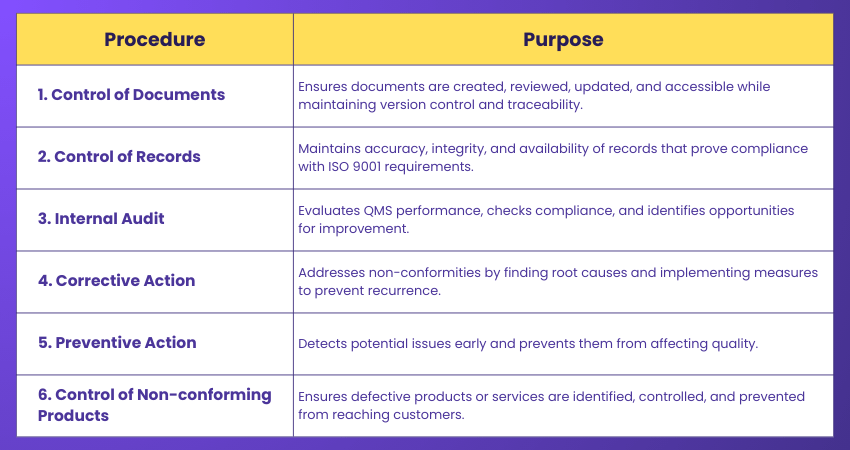
What are the Six Mandatory Procedures for ISO 9001?
Despite ISO 9001:2015 introducing more flexibility than the 2008 version, there remain six core procedures that are essential for maintaining a robust Quality Management System (QMS):
Discover the essential guidelines to elevate your company's quality! Download the ISO 9001 PDF and begin your journey toward excellence today.
Is ISO 9001 a Regulatory Requirement?
ISO 9001 is not a mandatory regulatory requirement. It is a voluntary global standard for Quality Management Systems (QMS). However, certain industries or contractual agreements may require ISO 9001 certification as a prerequisite to ensure adherence to quality and customer satisfaction standards.
Does ISO 9001 Require a Quality Manual?
ISO 9001:2015 does not specifically require a quality manual. Unlike earlier versions, it offers flexibility, allowing organisations to document their QMS in a format that suits their operations. Many organisations still use a quality manual as a best practice to maintain clarity and process structure.
Conclusion
In essence, achieving ISO 9001 Requirements isn’t just a compliance exercise; it’s a commitment to delivering quality at every level. It streamlines processes, builds customer trust, and sets businesses apart in a competitive market. When quality becomes a habit, success follows naturally.
Lead the way in quality excellence – Get Our ISO 9001 Lead Implementer Certification and make a lasting impact!
Frequently Asked Questions
What are the Seven Principles of Quality Management?

The seven principles of quality management in ISO 9001 are: Customer Focus, Leadership, Engagement of People, Process Approach, Improvement, Evidence-Based Decision Making, and Relationship Management. These principles help organisations enhance efficiency and ensure continuous improvement in quality performance.
Who Needs to Comply With ISO 9001?
ISO 9001 applies to any organisation—regardless of size or industry—that wants to improve quality, efficiency, and customer satisfaction. While compliance is voluntary, businesses in regulated sectors, government contracts, or competitive industries often seek certification to meet stakeholder expectations and industry requirements.

The Knowledge Academy


Global Training Provider
The Knowledge Academy is a world-leading provider of professional training courses, offering globally recognised qualifications across a wide range of subjects. With expert trainers, up-to-date course material, and flexible learning options, we aim to empower professionals and organisations to achieve their goals through continuous learning.


 If you wish to make any changes to your course, please


