Who Should Attend Asana Training?
This course is designed for professionals seeking to improve their project management and collaboration skills using Asana. The ideal audience includes:
- Project Managers
- Team Leaders
- Operations Managers
- IT Managers
- Product Managers
- Business Analysts
- Administrative Professionals
Prerequisites of Asana Training
There are no formal prerequisites for attending this Asana Training course. However, having prior knowledge of computer skills and project management principles.
Asana Training Course Overview
The Asana Training course is designed to provide professionals with the knowledge and skills to utilise Asana effectively for project management and team collaboration. Asana is a leading project management tool that offers a wide range of features to help teams plan, track, and manage their work. This course aims to equip participants with the ability to set up and manage their Asana account, create and customise projects, facilitate efficient communication, integrate with other tools, and ensure effective task management. By mastering these Asana capabilities, participants can significantly advance their careers, opening up new opportunities in project management and team leadership.
This 1-day Asana Training course content is structured into detailed modules covering an introduction to Asana, project management, collaboration and communication, automation and integrations, reporting and analytics, and advanced features. Participants will gain practical knowledge on setting up Asana, managing projects, adding comments and attachments, using automation rules, generating reports and dashboards, and customising their Asana experience. Real-world examples and case studies will demonstrate the effective use of Asana in various professional settings.
Course Objectives
- Understand the key features and terminologies of Asana.
- Learn to create and customise projects, tasks, and sections.
- Develop skills to add comments, attachments, and integrate with other tools.
- Explore the use of automation rules and advanced integration techniques.
- Gain insights into generating reports, tracking progress, and making data-driven decisions.
- Customise Asana to enhance the user experience and optimise workflows.
By the end of this course, learners will be proficient in using Asana to enhance project management and team collaboration. They will understand how to set up and manage their Asana account, utilise various project management and collaboration features, integrate with other productivity tools, and implement automation rules. This course will empower professionals to leverage Asana effectively, ensuring they stay at the forefront of project management and collaboration technologies.
Benefits of Asana Course
Asana Training equips learners with practical skills to plan, track, and deliver work efficiently using Asana. It also improves task organisation, strengthens team collaboration, and enhances overall workflow effectiveness.
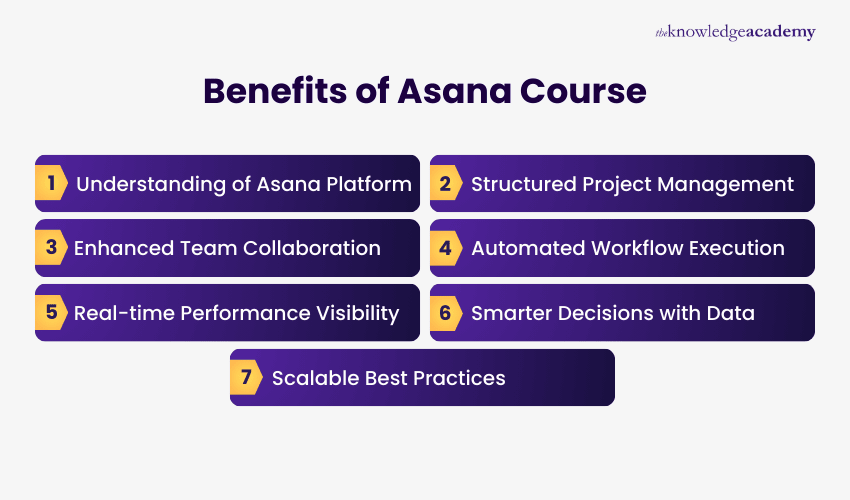
Below are the core benefits of this training:
- Understanding of Asana Platform: Professionals build strong foundations by understanding Asana’s interface, features, and terminology to configure workspaces confidently.
- Structured Project Management: Create and customise projects using tasks, subtasks, and sections to maintain clarity, ownership, and consistent project structure.
- Enhanced Team Collaboration: Enable seamless communication through comments, attachments, and integrations, reducing email dependency while keeping teams aligned and informed.
- Automated Workflow Execution: Streamline repetitive actions with rules and integrations, accelerating workflows, reducing errors, and ensuring tasks progress seamlessly across projects.
- Real-time Performance Visibility: Generate dashboards and reports to track progress, workloads, and performance metrics, providing continuous visibility across teams.
- Smarter Decisions with Data: Use real-time data to identify risks, balance resources, and support informed decision-making throughout project lifecycles.
- Scalable Best Practices: Apply advanced features and proven best practices to optimise workflows, improve consistency, and scale project management effectively.





 If you miss out, enquire to get
yourself
on the waiting list for the next day!
If you miss out, enquire to get
yourself
on the waiting list for the next day!













 If you wish to make any changes to your course, please


