


 Top Rated Course

We may not have the course you’re looking for. If you enquire or give us a call on +420 210012971 and speak to our training experts, we may still be able to help with your training requirements.
What is Velocity in Scrum? The Ultimate Guide for Teams
The Knowledge Academy 07 May 2026Velocity in Scrum is the measure of completed story points in a sprint, calculated by adding story points of finished tasks, helping teams assess productivity and forecast future workload. This blog unpacks its role in agile planning, how to calculate it effectively, and best practices to improve consistency across sprints.

Training Outcomes Within Your Budget!
We ensure quality, budget-alignment, and timely delivery by our expert instructors.
Table of Contents

Velocity in scrum is a major project metric used in the management of a project that depicts the completeness of work being done by a team over a sprint. Consider it to be the speed of the team- displaying what they can do in a sprint cycle. It is not about speed only, but it brings out the ability of a group to accomplish a task, how far the group has come, and the capacity that the group must tackle the challenge. The concept of velocity in Scrum allows for predicting future performance and even indicates how throughput can be achieved.
Table of Contents
1) What Is Velocity in Scrum?
2) How to Calculate Velocity in Scrum
3) Factors that can Affect Scrum Velocity
4) Using Velocity in Scrum
5) Fluctuations in Velocity
6) Conclusion
What is Velocity in Scrum?
Velocity in Scrum is an important measurement that assists teams to determine the amount of work that can be done within a sprint. It is founded on previous output and is usually calculated in terms of story points that depict the complexity and effort involved in every task. In the process of sprint planning, teams discuss their past velocity to make their decision on the number of product backlog items they can commit to. This assists in setting realistic objectives and timelines. The actual velocity after every sprint is revisited and is utilised to improve the subsequent planning, thereby establishing a loop of formidable growth.
The story points serve as a gauge of complexity of the task. The speed differs according to experience of the team, challenges of the task, and cooperation. Keeping the velocity tracked then the teams will be able to make more accurate predictions and manage the expectations as well as a consistent workflow in the project.

How to Calculate Velocity in Scrum
To determine the Velocity in Scrum, you add the story points for all the tasks the team finished in a sprint. Here’s a simpler way to understand the steps:
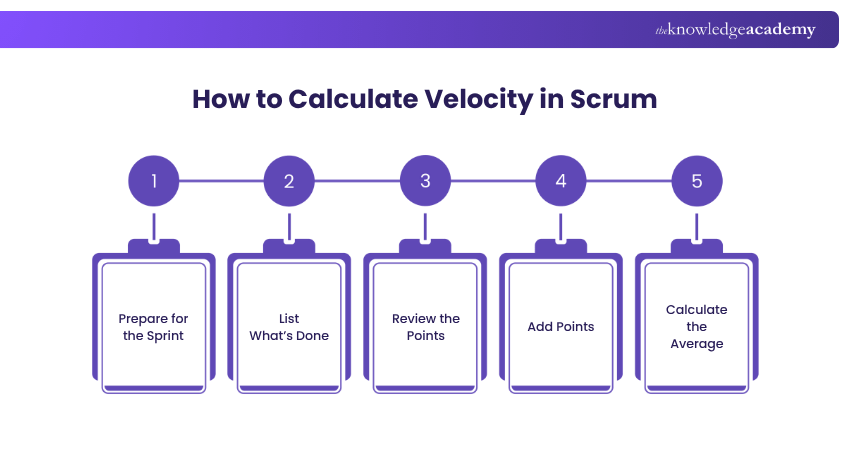
a) Prepare for the Sprint:
Assign story points to each task based on its size and complexity. For example, a basic task might be 5 points, while a more complex one could be 13 or 21. The team then selects tasks they can realistically complete, considering past performance and any upcoming constraints.
b) List What’s Done:
The tasks that have been accomplished fully and were accepted by the Product Owner or by the team leads should all be documented at the end of the sprint.
c) Review the Points:
Ensure that every task done has received the right story point. Now do whatever modification or alteration you may feel is necessary to accomplish accuracy.
d) Add Points:
Add up the story points of all completed tasks. For example, if tasks worth 5, 8, and 3 points were done, the sprint velocity would be 16.
e) Calculate the Average:
Use velocity of the previous several sprints to average them to have a forecast of the capacity. As an example, when the most recent sprint velocities have been 14, 16, and 15, the average comes to (14 + 16 + 15) 3 = 15 points.
Gain a deep understanding of the Scrum teams with our Scrum Product Owner Course -Join today!
Factors that can Affect Scrum Velocity
Velocity in Scrum can change due to various internal and external influences. Understanding these factors helps teams improve sprint planning, forecasting, and delivery accuracy over time.
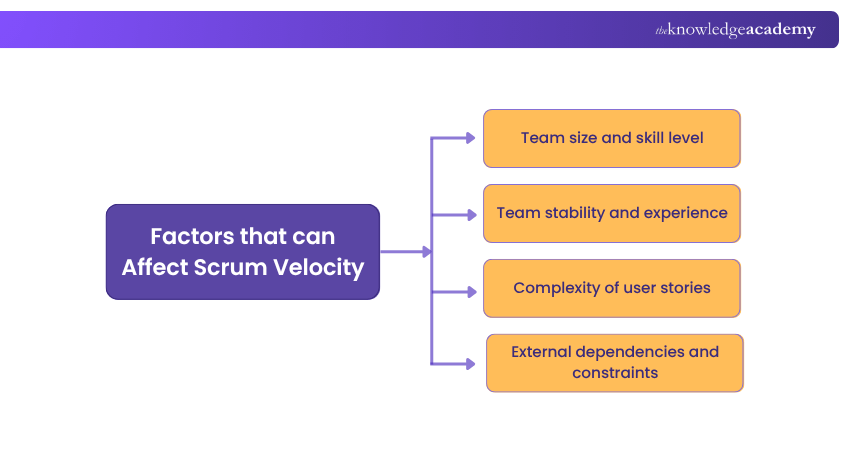
Team Size and Skill Level
Teams that are large have the ability to handle larger amounts of work but might be accompanied by a hitch in communication as well as coordination. In general, small teams having high skills tend to conclude higher velocity because they are more focused and have fewer bottlenecks. Optimality in team size and capacity has a significant influence and impact on total sprint output.
Team Stability and Experience
Loyal teams achieve trust, smoother workflow, and faster decision-making. Knowledge of tools and positions, experience in previous sprints thus enables closer cooperation and reduced mistakes. Such unity may result in constant or improved velocity over time.
Complexity of User Stories
The more complex the stories are, the longer it takes to implement them, and of course may decrease the velocity during that sprint. Velocity measurement can be distorted by an inaccurate estimation of story complexity. Integrating easy and hard tasks makes the goals of the sprint very realistic and achievable.
External Dependencies and Constraints
Technical reliance or the division of the other teams will cause a block in development. Unproductive time is abridged due to off days such as holidays or any other team events. Knowledge and preparation of these considerations allow for keeping the velocity stable.
Enhance your organisational efficiency through our Scrum For Teams Course - join today!
Using Velocity in Scrum
Understanding your team’s Velocity in Scrum is crucial for effective sprint planning and Project Management. Let’s take a look:

Estimating Future Sprints
Monitoring the speed of Scrum can eliminate speculation in the sprint preparation. On average your team has 50 story points in a sprint, thus you are safe to base the upcoming sprints around that topic.
Forecasting Project Timelines
The average velocity combined with the backlog size means you can expect to finish the project in four sprints, as well as be able to give the stakeholders concrete and well-informed timelines.
Identifying Overcommitment and Under Commitment
Spikes and sudden drops in velocity are indicators of misalignment. A declining velocity can be an indication of overloading the team, whereas a sudden surge in the velocity can imply that the tasks are too easy or that they are underestimated.
Tracking Improvement and Iterative Progress
Keeping a check on Scrum Velocity changes can enable teams to test how effective the process changes are. Even growth indicates an opportunity to achieve better results, whereas no progress probably means more investigation.
Fluctuations in Velocity
The unstable velocity at the beginning of the sprints is natural when teams find a groove. Other disruptions may also be caused by major changes such as staffing shifts. Usually, the velocity on Scrum becomes stable at a point after matching three successive sprints, especially on a dedicated and self-organized company. Some typical causes of slowing down Scrum Velocity involve:
1) The number of people in a team and regularity
2) Team size and consistency
3) Complexity of project and user story
4) The backlog clarity and health
5) Engagement of product Owners
6) Team focus and involvement
7) Problems with the system or unexpected absence
Such factors are the ones that can either improve or deteriorate the capacity of a team to sustain a sustainable rate of delivery.
Boost your Agile projects skills with our Managing Agile Projects With Scrum Course - join today!
Conclusion
Velocity in Scrum transcends mere numerical value; it encapsulates a team’s synchronised efforts and ability to achieve milestones. It mirrors the collective cadence and the proficiency with which a team navigates through sprints. This metric is a testament to a team’s agility, resilience, and commitment to continuous improvement. The rhythm propels teams forward, harmonising their skills to orchestrate a symphony of successful deliveries.
To be an expert at Scrum, sign up for our Scrum Master Certification today!
Frequently Asked Questions
What is Velocity time in Scrum?

Velocity in Scrum refers to the amount of work a team can complete in a single sprint, usually measured in story points. While “velocity time” isn’t a standard term, it could refer to tracking velocity across time to understand delivery trends and forecast future work more accurately.
Is Sprint Velocity in Scrum the same as productivity?
Many people confuse velocity with productivity, but they aren't the same. Velocity in Scrum simply reflects how much work (in story points) a team completes in a sprint. Productivity, on the other hand, takes into account the quality of the work, how efficiently it was done, and the value it brings to the user or business.
What are the other resources and offers provided by The Knowledge Academy?
The Knowledge Academy takes global learning to new heights, offering over 3,000+ online courses across 490+ locations in 190+ countries. This expansive reach ensures accessibility and convenience for learners worldwide.
Alongside our diverse Online Course Catalogue, encompassing 17 major categories, we go the extra mile by providing a plethora of free educational Online Resources like Blogs, eBooks, Interview Questions and Videos. Tailoring learning experiences further, professionals can unlock greater value through a wide range of special discounts, seasonal deals, and Exclusive Offers.
What is the Knowledge Pass, and how does it work?
The Knowledge Academy’s Knowledge Pass, a prepaid voucher, adds another layer of flexibility, allowing course bookings over a 12-month period. Join us on a journey where education knows no bounds.
What are related courses and blogs provided by The Knowledge Academy?
The Knowledge Academy offers various Scrum Certification Training, including Scrum Master Certification Course, Scrum Product Owner Training and Scrum Developer Training. These courses cater to different skill levels, providing comprehensive insights into Agile Project Management With Scrum.
Our Project Management Blogs cover a range of topics related to Scrum, offering valuable resources, best practices, and industry insights. Whether you are a beginner or looking to advance your Project Management skills, The Knowledge Academy's diverse courses and informative blogs have you covered.

The Knowledge Academy


Global Training Provider
The Knowledge Academy is a world-leading provider of professional training courses, offering globally recognised qualifications across a wide range of subjects. With expert trainers, up-to-date course material, and flexible learning options, we aim to empower professionals and organisations to achieve their goals through continuous learning.

Upcoming Project Management Resources Batches & Dates
Date
 Scrum Master Certification
Scrum Master Certification
Thu 9th Jul 2026
Scrum Master Certification
Thu 23rd Jul 2026
Scrum Master Certification
Thu 6th Aug 2026
Scrum Master Certification
Thu 20th Aug 2026
Scrum Master Certification
Thu 3rd Sep 2026
Scrum Master Certification
Thu 17th Sep 2026
Scrum Master Certification
Thu 1st Oct 2026
Scrum Master Certification
Thu 15th Oct 2026
Scrum Master Certification
Thu 29th Oct 2026
Scrum Master Certification
Thu 12th Nov 2026
Scrum Master Certification
Thu 26th Nov 2026
Scrum Master Certification
Thu 10th Dec 2026
Scrum Master Certification
Wed 23rd Dec 2026

 If you wish to make any changes to your course, please


