


 Top Rated Course


We may not have the course you’re looking for. If you enquire or give us a call on +420 210012971 and speak to our training experts, we may still be able to help with your training requirements.
Ocaml vs Haskell: What's the Difference?
The Knowledge Academy 02 December 2025Read this blog to understand the main features, similarities, and differences between two popular Functional Programming languages: OCaml and Haskell. It also provides guidance on choosing the best language for your needs and preferences.

Training Outcomes Within Your Budget!
We ensure quality, budget-alignment, and timely delivery by our expert instructors.
Table of Contents
When it comes to Functional Programming, you have many options to choose from. OCaml and Haskell stand out among them due to their expressive, elegant, and powerful paradigms. Choosing between these languages can be challenging, as they have different characteristics, advantages, and disadvantages. To make an informed decision, you must first understand the differences between OCaml vs Haskell.
If you are curious to learn the differences between Haskell vs OCaml, then this blog is for you. In this blog, you will learn the differences between OCaml vs Haskell in great detail. Let's dive in deeper to learn more about them!
Table of Contents
1) What is OCaml?
2) What is Haskell?
3) OCaml vs Haskell: Key differences
4) Which one should you choose?
5) Conclusion
What is OCaml?
OCaml is a multi-paradigm language that supports functional, imperative, and object-oriented programming. It is a descendant of the ML family of languages, which originated in the 1970s. OCaml stands for Objective Caml, where Caml is an acronym for Categorical Abstract Machine Language. OCaml is known for its powerful type of system, which includes parametric polymorphism, algebraic data types, and modules.
OCaml also has a native code compiler that produces efficient executables. OCaml is widely used in academia and industry, especially for applications that require high performance, reliability, and expressiveness. Some examples of OCaml projects are Coq, a proof assistant, and Facebook’s Infer, a static analysis tool.

What is Haskell?
Haskell is a purely Functional Programming language that enforces the separation of side effects from pure computations. It is named after the logician Haskell Curry, known for his work on combinatory logic and currying. Haskell was created in the late 1980s as a common standard for the research and development of functional languages.
Haskell is characterised by its lazy evaluation, which allows for infinite data structures, modular design, and elegant reasoning. It also features a rich and expressive type system, supporting parametric polymorphism, type classes, and higher-kinded and dependent types.
Haskell is used for various applications is widely seen in academia, industry, and open-source projects, particularly for tasks involving complex logic, data analysis, and domain-specific languages. Some notable examples of Haskell projects include GHC, the Glasgow Haskell Compiler; Pandoc, a universal document converter; and Xmonad, a tiling window manager.
Unlock the full potential of Functional Programming with our Haskell Programming – Sign up now!
OCaml vs Haskell: Key differences
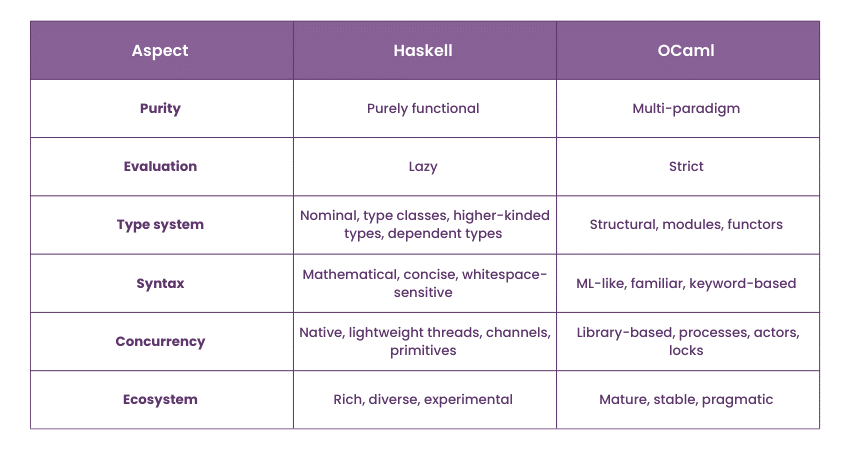
OCaml and Haskell are two popular Functional Programming languages that have many similarities and differences. They both offer powerful features, such as parametric polymorphism, algebraic data types, and type inference, but they also differ in their purity, evaluation, type system, syntax, concurrency, and ecosystem. Here is an explanation of the key differences between them:
Purity
Haskell is a purely functional language, meaning all Haskell Functions are free of side effects and depend only on their inputs. This makes Haskell programs easier to reason about, test, and verify. However, it also means that Haskell programs must use special constructs like monads to handle impure operations, such as input/output, state, and randomness.
OCaml is a multi-paradigm language which allows for imperative and object-oriented features, such as mutable variables, exceptions, and classes. This gives OCaml more flexibility, interoperability, complexity, and potential errors. OCaml programmers have to be careful about managing side effects and avoiding bugs.
Evaluation
Haskell is a lazy language, meaning that expressions are evaluated only when needed. This allows for infinite data structures and modular composition. However, it also introduces more overhead and unpredictability. Haskell programmers must be aware of lazy evaluation's performance and memory implications and use strictness annotations or evaluation strategies to control it.
OCaml is a strict language, which means that expressions are evaluated as soon as they are defined. This makes OCaml programs more predictable and efficient but also less expressive and modular. OCaml programmers must use recursion or higher-order functions to achieve the same effects as lazy evaluation.
Type system
Both OCaml and Haskell have powerful type systems but differ in some aspects. OCaml has a structural type system, which means that types are determined by their shape and contents. Haskell has a nominal type system, which means that types are determined by their names and declarations. OCaml also has a module system, allowing abstract types and functions.
Haskell has a type class system, which allows for ad-hoc polymorphism and overloading. Both languages also support advanced features, such as algebraic data types, generics, and type inference, but Haskell goes further with features such as higher-kinded types and dependent types.
Syntax
OCaml and Haskell have different syntaxes, which reflect their different philosophies. OCaml has a syntax influenced by ML and C, making it familiar to many programmers. Haskell has a syntax influenced by mathematics and logic, making it concise and elegant. OCaml uses keywords, parentheses, and semicolons to delimit blocks and expressions.
Haskell uses indentation, whitespace, and operators to do the same. OCaml also has more syntactic sugar and infix operators than Haskell, which can make it more readable or more confusing, depending on your preference.
Concurrency
Haskell supports concurrency and parallelism natively, using lightweight threads, channels, and primitives for synchronisation and communication. This makes Haskell programs more scalable and responsive but also more complex and error-prone. Haskell programmers must use concurrency libraries or frameworks like STM, Async, or MVar to manage concurrency and avoid deadlocks or race conditions.
OCaml supports concurrency and parallelism through libraries using processes, actors, or locks. This makes OCaml programs more portable and interoperable but also more limited and dependent. To achieve concurrency and parallelism, OCaml programmers have to use external tools or libraries, such as Lwt, Async, or OCamlMPI.
Ecosystem
Haskell has a rich and diverse ecosystem, with many libraries and tools for various domains and purposes. However, it also has a steep learning curve and a fast-changing environment. Haskell programmers must keep up with the latest developments and trends and deal with compatibility and stability issues. OCaml has a mature and stable ecosystem, with a few well-established libraries and tools for common tasks and problems.
However, it also has a smaller and more conservative community and a slower pace of innovation. OCaml programmers have to rely on fewer resources and options and cope with the lack of some features or libraries.
Master the art of designing robust software systems with our Object Oriented Programming (OOPs) Course – Sign up now!
Which one should you choose?
There is no definitive answer to which language is better, as it depends on your goals, preferences, and background. However, here are some general guidelines that might help you decide:
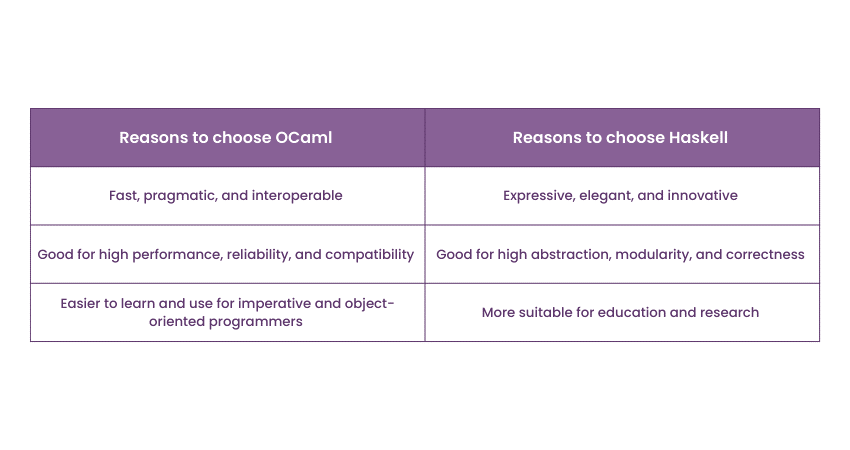
1) Choose OCaml if you want a fast, pragmatic, and interoperable language. OCaml is a good choice for applications that require high performance, reliability, and compatibility with existing code bases. OCaml is also easier for programmers familiar with imperative and object-oriented languages to learn and use.
2) Choose Haskell if you want an expressive, elegant, and innovative language. Haskell is a good choice for applications that require high abstraction, modularity, and correctness. Haskell is Used For teaching and research, as it exposes many concepts and techniques from Functional Programming and computer science.
Prepare for success with Haskell Interview Questions!
Conclusion
We hope you read and understood the differences between OCaml vs Haskell. Both are two popular Functional Programming languages that have many similarities and differences. They both offer powerful features and benefits, but they also have their own drawbacks and differences. In any case, learning either of them will enrich your programming skills and knowledge.
Empower your coding journey with our Programming Training – Sign up now!
Frequently Asked Questions

The Knowledge Academy


Global Training Provider
The Knowledge Academy is a world-leading provider of professional training courses, offering globally recognised qualifications across a wide range of subjects. With expert trainers, up-to-date course material, and flexible learning options, we aim to empower professionals and organisations to achieve their goals through continuous learning.


 If you wish to make any changes to your course, please


