


 Top Rated Course

We may not have the course you’re looking for. If you enquire or give us a call on +420 210012971 and speak to our training experts, we may still be able to help with your training requirements.
How to Make French Press Coffee at Home
The Knowledge Academy 18 April 2026French press coffee uses coarse grounds steeped in hot water, then filtered with a plunger, producing a rich, full-bodied brew with bold flavors and oils. Wondering How to Make French Press Coffee? This simple method preserves antioxidants, boosts aroma, and creates a fresher, richer, full-bodied cup with bold flavours.

Training Outcomes Within Your Budget!
We ensure quality, budget-alignment, and timely delivery by our expert instructors.
Table of Contents

What if your morning coffee could feel like a café ritual right at home? Learning How to Make French Press Coffee is your ticket to bold flavours, rich aromas, and fresher sips that awaken the senses. Each plunge unlocks antioxidants and a full-bodied taste that instant coffee can’t match. It’s not just brewing, it’s creating a moment to savour. Ready to elevate your coffee experience? Let’s get started.
Table of Contents
1) How to make French Press coffee?
2) What is French Press Coffee?
3) What Kind of Equipment Will You Need?
4) Cleaning your French Press
5) Pros and Cons of a French Press Coffee
6) What are the Health Benefits of French Press Coffee?
7) Conclusion
How to make French Press coffee?
Are you ready for the experience of superior coffee? Let’s start our journey with the best French Press Coffee recipe you will find on the internet. It will lead you through the step-by-step process, so follow along to brew perfection.
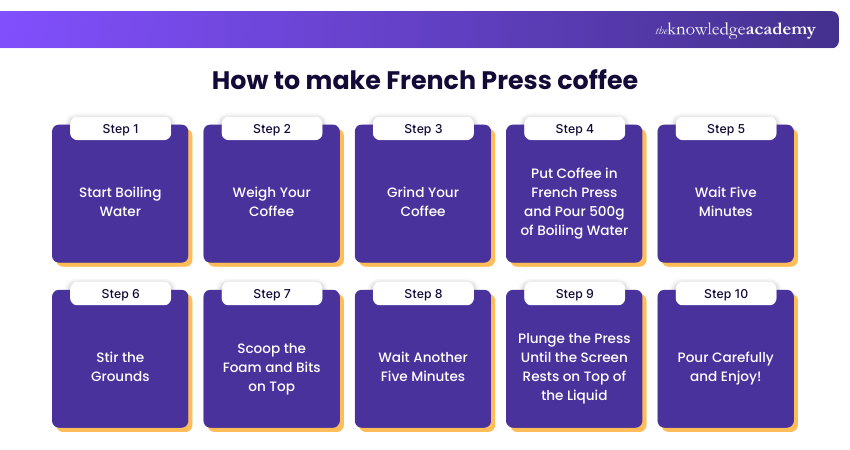
Step 1: Start Boiling Water
Boil fresh, filtered water to the right temperature, ideally around 96°C, ensuring it’s hot enough to extract coffee flavours without scalding, which helps achieve a balanced, rich taste.

Step 2: Weigh Your Coffee
Accurately measure about 30g of coffee beans for 500ml of water. Correct ratios are crucial to balance strength and flavour, preventing coffee from tasting overly bitter or unpleasantly weak.
Step 3: Grind Your Coffee
Grind the beans coarsely, resembling breadcrumbs. A coarse grind avoids over-extraction, prevents bitterness, and ensures smooth plunging. Consistency in grind size is essential for even flavour release during brewing.
Step 4: Put Coffee in French Press and Pour 500g of Boiling Water
Place ground coffee into the French press, then pour 500g of boiling water evenly. Saturating grounds evenly helps extract optimal flavour, creating a balanced and aromatic coffee profile.
Step 5: Wait Five Minutes
Allow the coffee to steep undisturbed. This resting time enables flavours to fully develop, releasing oils and aromas. Proper steeping ensures rich extraction without the risk of over-brewing bitterness.
Step 6: Stir the Grounds
After five minutes, stir gently to break the crust formed at the top. Stirring ensures even extraction, prevents clumps, and integrates coffee grounds with water for balanced flavour.
Step 7: Scoop the Foam and Bits on Top
Remove foam and floating grounds from the surface before plunging. This step ensures cleaner coffee, improves clarity, and reduces unwanted residue, giving a smoother and more enjoyable cup.
Step 8: Wait Another Five Minutes
Let the coffee rest again. This settling period allows fine particles to sink, improving clarity and smoothness, while flavours stabilise, resulting in a well-rounded, balanced, and delicious brew.
Step 9: Plunge the Press Until the Screen Rests on Top of the Liquid
Slowly press the plunger down until the filter rests above the coffee. Gentle plunging prevents agitation, keeps sediments at the bottom, and ensures a smoother, grit-free coffee texture.
Step 10: Pour Carefully and Enjoy!
Carefully pour your coffee into cups to avoid stirring up grounds. Savour the rich aroma and flavour, appreciating the smooth, clean, and full-bodied taste of a perfect French press.
What is French Press Coffee?
French press coffee is a simple yet traditional brewing method that delivers a rich and full-bodied flavour. It uses a glass or steel carafe, a plunger, and a metal mesh filter. Coarsely ground coffee is steeped in hot water, allowing natural oils and flavours to remain in the brew.
Unlike drip methods that use paper filters, the French press retains more aroma and depth, producing a bold, aromatic cup. It also gives users greater control over brewing time and coffee-to-water ratio, making it easy to customise taste. This method is eco-friendly, versatile, and valued by coffee enthusiasts worldwide.
What Kind of Equipment Will You Need?
To brew a perfect cup of French press coffee, you’ll need a few essential tools and ingredients that ensure precision, consistency, and flavour. Here’s are the equipments you should have ready:
a) Fresh roasted whole-bean coffee
b) French press (cafetière)
c) Kettle (for boiling water, gooseneck kettle recommended for precision)
d) Kitchen scale (measuring in grams)
e) Coffee grinder (burr-style preferred)
f) Two spoons (for stirring and skimming)
g) Timer (or phone timer)
h) Small bowl (to hold skimmings)
Are you interested in shaping a career out of Coffee? Master the art and become a Coffee professional with our Basic Barista Course now!
Cleaning your French Press
Keeping your French press clean is essential for preserving flavour, ensuring smooth brewing, and maintaining the longevity of your equipment.
Materials You’ll Need
a) Spatula or wooden spoon
b) Mild dish soap
c) Warm water
d) Soft sponge or bottle brush
e) Baking soda (optional for deeper cleaning)
f) White vinegar (optional for hard water stains)
Steps to Clean a French Press
1) Let It Cool: Allow the French press to cool completely before careful handling to avoid burns from hot glass or metal.
2) Remove the Grounds: Scoop out grounds with a spatula or hand. Avoid metal utensils to prevent damage. Dispose of grounds in the bin or compost, not the sink.
3) Quick Daily Wash: Add dish soap and warm water to the carafe. Insert the plunger and pump several times to create foam that loosens oils and residue.
4) Rinse and Scrub: Empty the soapy water, rinse thoroughly, then gently scrub the carafe and plunger using a sponge or bottle brush. Rinse again until water runs clear.
5) Deep Weekly Clean: Disassemble the plunger. Make a baking soda paste and scrub each part individually for a fresh, odour-free clean. Rinse thoroughly before drying.
6) Handle Hard Water Build-Up: For chalky deposits, clean with a 50/50 vinegar and water mix. Scrub all parts, then rinse thoroughly to eliminate any vinegar scent.
7) Reassemble and Store: Once fully dry, reassemble all components. Your French press is now clean and ready for the next brew.
Pros and Cons of a French Press Coffee
While it might be one of the finest and simplest brewing methods globally, French Press coffee equipment could also be a bane and a boon at the same time. So, let's see some pros and cons of a French Press.
Pros
The French Press is not only a great coffee for your taste buds, it also has other benefits. Here is a list of a few:
1) Flavour profile: French press coffee retains natural oils and fine coffee particles, resulting in a fuller, more robust flavour compared to drip coffee.
2) Control over brewingtime: You have complete control over the brewing time, allowing you to adjust the strength and flavor to your preference.
3) Eco-friendly: It doesn’t require paper filters, reducing waste and making it an environmentally friendly option.
4) Simple and affordable: The French press is a straightforward device that is relatively inexpensive and easy to use, making it accessible for most coffee enthusiasts.
5) The waste can be recycled: The used ground after the brew can be utilised to make home-made coffee liquor or put in small quantities in potted plants to chase away pests with the strong scent and provide nutrition value to your plants.
Cons
As Spider man said, “With great power, comes great responsibility!”, with great coffee comes a few cons. Here is a list of a few:
1) Sediment in Coffee: The lack of a paper filter means fine coffee grounds can end up in your cup, resulting in a gritty texture.
2) Higher cholesterol compounds: It retains cafestol and kahweol, which can raise cholesterol levels if consumed in large amounts.
3) Requires attention: Brewing with a French press requires careful attention to timing and water temperature, which can be inconvenient for some.
4) Not ideal for large quantities: It’s best suited for making small batches, so it may not be practical for brewing large quantities of coffee at once.
What are the Health Benefits of French Press Coffee?
French Press coffee isn’t just about bold flavour, it also delivers a variety of health-boosting benefits thanks to its nutrient-rich brewing method.
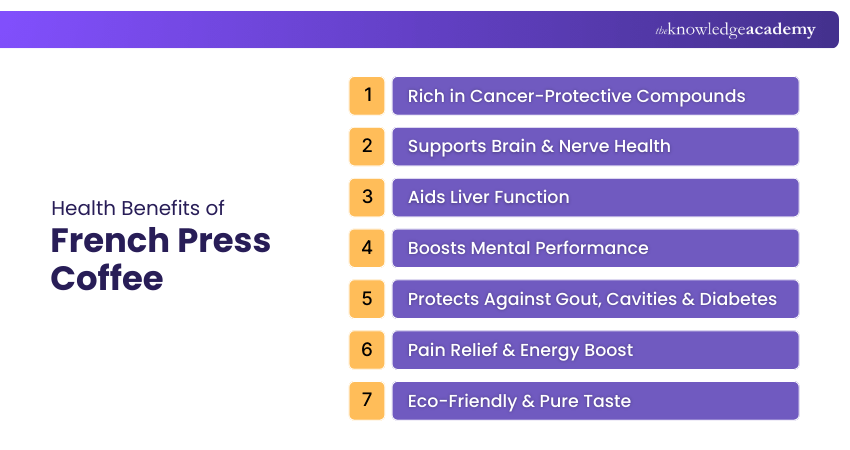
a) Rich in Cancer-Protective Compounds
Contains methylpyridinium, an antioxidant linked to lowering risks of cancers in the mouth, throat, and oesophagus.
b) Supports Brain & Nerve Health
Packed with lipophilic antioxidants and chlorogenic acid lactones that help protect neurons, reducing the chances of dementia, Parkinson’s disease, and cognitive decline.
c) Aids Liver Function
Regular intake is associated with a reduced risk of liver cancer and supports regeneration of liver tissue.
d) Boosts Mental Performance
Improves focus, sharpens reaction times, and enhances short-term memory, acting as a natural brain booster.
e) Protects Against Gout, Cavities & Diabetes
Tannins help oral health, while compounds lower gout risks and reduce the likelihood of Type II diabetes.
f) Pain Relief & Energy Boost
The caffeine content enhances the effectiveness of painkillers and relieves headaches and migraines.
g) Eco-Friendly & Pure Taste
No paper filters mean fewer chemicals and less waste. Coffee grounds can even be reused as fertiliser, making it sustainable and rich in flavour.
Conclusion
This blog encapsulated the essence of a well-made French Press Coffee, with its rich and full body flavours. It gave you step by step instructions on How to Make French Press Coffee, and how you can spice it up to add more flavours to the mix. It also gave you a little insight into its historical conflicts and the urban legend of its origins. Hopefully, you will enjoy your concoction of the perfect brew.
Learn fundamental floral design techniques with our Introduction to Floristry Course – Join now!
Frequently Asked Questions
How much coffee do I put in my French press?

The quantity of the coffee to add may vary based on how much quantity of coffee you wish to make. The ideal coffee-to-water ratio should be 1:15.
How Long Does French Press Coffee Stay Fresh After Brewing?
French Press coffee is best enjoyed immediately after brewing for maximum flavour and freshness. At room temperature, it stays fresh for about 30 minutes before turning bitter. If stored in an airtight container in the fridge, it can last up to 24 hours as iced coffee.
What are the Other Resources and Offers Provided by The Knowledge Academy?
The Knowledge Academy takes global learning to new heights, offering over 3,000 online courses across 490+ locations in 190+ countries. This expansive reach ensures accessibility and convenience for learners worldwide.
Alongside our diverse Online Course Catalogue, encompassing 19 major categories, we go the extra mile by providing a plethora of free educational Online Resources like Blogs, eBooks, Interview Questions and Videos. Tailoring learning experiences further, professionals can unlock greater value through a wide range of special discounts, seasonal deals, and Exclusive Offers.
What is the Knowledge Pass, and how does it work?
The Knowledge Academy’s Knowledge Pass, a prepaid voucher, adds another layer of flexibility, allowing course bookings over a 12-month period. Join us on a journey where education knows no bounds.
What is the Knowledge Pass, and how does it work?
The Knowledge Academy offers various Industry Training courses, including a Basic Barista Course, Facilitation Skills Training, and Floristry Introduction. These courses cater to different skill levels, providing comprehensive insights into What is Coffee.
Our Business Skills blogs cover a range of topics related to Barista, offering valuable resources, best practices, and industry insights. Whether you are a beginner or looking to advance your skills as a Barista, The Knowledge Academy's diverse courses and informative blogs have you covered.

The Knowledge Academy


Global Training Provider
The Knowledge Academy is a world-leading provider of professional training courses, offering globally recognised qualifications across a wide range of subjects. With expert trainers, up-to-date course material, and flexible learning options, we aim to empower professionals and organisations to achieve their goals through continuous learning.

Upcoming Business Skills Resources Batches & Dates
Date
 Basic Barista Course
Basic Barista Course
Fri 24th Jul 2026
Basic Barista Course
Fri 16th Oct 2026

 If you wish to make any changes to your course, please


