


 Top Rated Course

We may not have the course you’re looking for. If you enquire or give us a call on +357 26030221 and speak to our training experts, we may still be able to help with your training requirements.
What is a Subordinating Conjunction? A Complete Guide
Charlotte Wilson 19 March 2026Subordinating Conjunction links a dependent clause to an independent clause, showing relationships like cause, contrast, condition, or time. They help connect ideas clearly and show how one part of a sentence depends on another. Learning to use them improves sentence structure and makes writing clearer and more organised.

Training Outcomes Within Your Budget!
We ensure quality, budget-alignment, and timely delivery by our expert instructors.
Table of Contents
Ever struggled to connect your ideas in a sentence? Wondering why some words seem to join clauses while others don’t? The answer lies in understanding What is a Subordinating Conjunction? These linguistic connectors play a crucial role in forming complex sentences and expressing nuanced thoughts.
This comprehensive blog will explore What is a Subordinating Conjunction, explaining their function, types, and how to use them effectively. We’ll provide you with the knowledge needed to master these essential grammatical connectors, whether you're a student, a writer, or simply looking to enhance your grammar skills. Let’s dive in and enhance your grammar skills!
Table of Contents
1) What are Subordinating Conjunctions?
2) Types of Subordinating Conjunctions in English Grammar
3) How to Construct a Subordinate Clause?
4) List of Subordinating Conjunctions for Everyday Use
5) Examples of Subordinating Conjunctions
6) What is the Full Form of Fanboys?
7) How Do You Use Subordinating Conjunctions in a Sentence?
8) How Do you Identify a Subordinating Conjunction?
9) Conclusion
What are Subordinating Conjunctions?
Subordinating Conjunctions link a subordinate clause to a main clause, enhancing sentence clarity and flow. Examples include although, because, if, and when. For instance, He was annoyed because the train had stopped connects cause and effect. These conjunctions express relationships like time, reason, or condition, making sentences more cohesive and meaningful.
Types of Subordinating Conjunctions in English Grammar
Subordinating Conjunctions can be classified based on the relationship they show between the dependent clause and the main clause. These conjunctions serve to explain when, why, or in what condition something occurs. They present these relationships by displaying sentences in a better manner, making them clear and meaningful.
Below are some of the common subordinating conjunctions used in the English grammar:
1) Subordinating Conjunctions of Time: These conjunctions show when an action happens in relation to another action. They assist in suggesting order or time in a sentence. The typical ones are when, after, before, since, until and while.
Example: I will call you after I reach home.
2) Subordinating Conjunctions of Cause or Reason: These conjunctions explain why something happens. They associate an argument in the dependent clause with the main one. The use of words like because, since, and as are very common.
Example: She stayed home because she was feeling unwell.
3) Subordinating Conjunctions of Condition: These conjunctions come with a precondition to the main clause to take place. Some typical examples are as follows: if, unless, provided that and in case.
Example: You can go outside if you finish your homework.
4) Subordinating Conjunctions of Contrast or Concession: These conjunctions present contrast between two ideas. They indicate that one action happens despite another situation. Some of them are although, though, even though, and whereas.
Example: Although it was raining, they continued playing the match.
5) Subordinating Conjunctions of Place: These conjunctions describe where something happens. Words such as where and wherever are used to connect the place-related clause with the main clause.
Example: You can sit wherever you feel comfortable.
6) Subordinating Conjunctions of Purpose: These conjunctions are used to justify the purpose, or intention of an action. Common examples include so that and in order that.
Example: He spoke slowly so that everyone could understand him.
These various kinds of Subordinating Conjunctions make them understand how to construct complicated sentences and explain their ideas more effectively in written and spoken English.
How to Construct a Subordinate Clause?
A subordinate clause starts with a Subordinating Conjunction followed by a subject and a verb. The clause provides additional information to the main clause but cannot stand alone as a complete thought. Here’s how to construct a subordinate clause:
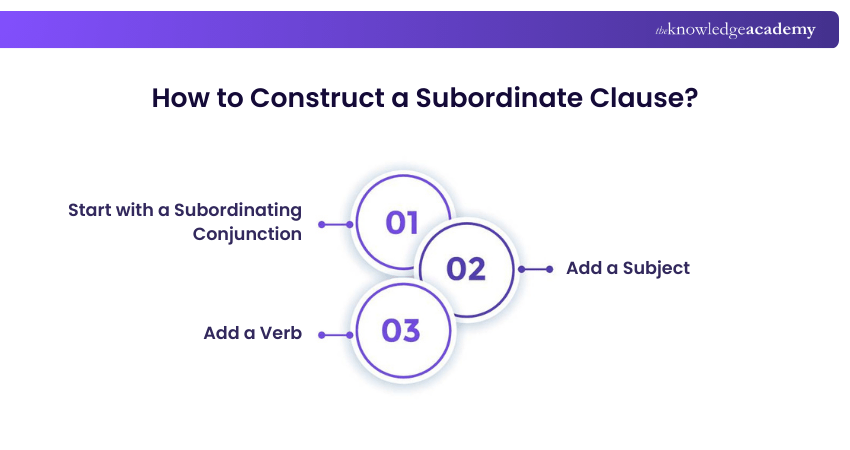
a) Start with a Subordinating Conjunction: Choose a Subordinating Conjunction that fits the relationship you want to express.
b) Add a Subject: Identify the subject of the clause.
c) Add a Verb: Include the verb to complete the clause.
For Example:Because (Subordinating Conjunction) she was tired (subject + verb), she went to bed early.
In this sentence, "because she was tired" is the subordinate clause providing a reason for the action in the main clause, "she went to bed early."
Ready to take your grammar skills to the next level? Sign up for our English Grammar Course today and become a master of language!
List of Subordinating Conjunctions for Everyday Use
Subordinating Conjunctions are commonly used in everyday English to connect a dependent clause with an independent clause. They help show relationships such as time, cause, condition, or contrast within a sentence. After, before, when, because, since, although, if, unless, while, until, once, whenever, and so that are the common subordinating conjunctions. These words clarify the sentences by stating how a given action or concept is relative to another.
Examples of Subordinating Conjunctions
The following are a few examples that demonstrate the use of subordinating conjunctions in sentences to relate a dependent clause to the main clause and represent various relationships like time, cause, condition, or contrast.
1) When she called, I was watching television. (Time)
2) Even though he felt tired, he completed his work. (Concession)
3) She is more intelligent than her classmates. (Comparison)
4) As it was getting late, we decided to leave. (Cause)
5) Unless you hurry, we will miss the bus. (Condition)
6) They built a house where the old one once stood. (Place)
These examples demonstrate how subordinating conjunctions link clauses and help express relationships between ideas in a sentence.
What is the Full Form of Fanboys?
The full form of FANBOYS represents the seven coordinating conjunctions in English:
1) F – For
2) A – And
3) N – Nor
4) B – But
5) O – Or
6) Y – Yet
7) S – So
Unlock your potential—Join our English Speaking Course today!
How Do You Use Subordinating Conjunctions in a Sentence?
A complex sentence is a sentence where a dependent clause is attached to an independent clause by way of subordinating conjunctions. The conjunction normally comes before the dependent clause, and expresses the connection between the two clauses, such as cause, time, condition, or contrast.
The subordinating conjunction may come either at the start of a sentence or at the middle of a sentence, depending on the location of the dependent clause. When the dependent clause appears in the first place, it is normally preceded by a comma before the main clause. However, when the independent clause comes first, a comma is generally not required.
For Example:
1) Because it was raining, we stayed indoors.
2) We stayed indoors because it was raining.
3) When the meeting ends, I will call you.
4) I will call you when the meeting ends.
The subordinating conjunction presents the dependent clause in every sentence and states the relationship between the dependent clause and the main idea to make the sentences more understandable and more organised.
How Do you Identify a Subordinating Conjunction?
A Subordinating Conjunction bridges a dependent clause to the main clause, providing context like time, cause, or condition. To identify one, look for words like because, although, if, or when that link additional information to the main clause
Conclusion
Understanding What is a Subordinating Conjunction is essential for creating complex sentences that add depth and clarity to writing. By linking dependent clauses to independent clauses, they help express various relationships, such as time, cause, condition, concession, comparison, and place. Understanding how to use Subordinating Conjunctions effectively can improve your writing, making it more precise and engaging.
Achieve your dream score and open doors to new opportunities—Join our comprehensive TOEFL Training today!
Frequently Asked Questions
Can You Have Two Subordinate Conjunctions in One Sentence?

Yes, a sentence can contain two Subordinating Conjunctions if it includes multiple subordinate clauses. For example, "Because it was raining and since we had no umbrellas, we decided to stay indoors."
Is it Acceptable to Begin a Sentence With a Subordinating Conjunction?
Yes, starting a sentence with a Subordinating Conjunction is perfectly acceptable and common in English. For instance, "Although it was raining, we decided to go for a walk."
What are the Other Resources and Offers Provided by The Knowledge Academy?
The Knowledge Academy takes global learning to new heights, offering over 3,000+ online courses across 490+ locations in 190+ countries. This expansive reach ensures accessibility and convenience for learners worldwide.
Alongside our diverse Online Course Catalogue, encompassing 17 major categories, we go the extra mile by providing a plethora of free educational Online Resources like Blogs, eBooks, Interview Questions and Videos. Tailoring learning experiences further, professionals can unlock greater value through a wide range of special discounts, seasonal deals, and Exclusive Offers.
What is The Knowledge Pass, and How Does it Work?
The Knowledge Academy’s Knowledge Pass, a prepaid voucher, adds another layer of flexibility, allowing course bookings over a 12-month period. Join us on a journey where education knows no bounds.
What are the Related Courses and Blogs Provided by The Knowledge Academy?
The Knowledge Academy offers various Communication Skills Courses, including the English Grammar Course, B2B Communications Training and the Executive Communication Training. These courses cater to different skill levels, providing comprehensive insights into Types of Communication.
Our Business Skills Blogs cover a range of topics related to English Grammar, offering valuable resources, best practices, and industry insights. Whether you are a beginner or looking to advance your Communication skills, The Knowledge Academy's diverse courses and informative blogs have got you covered.

Charlotte Wilson


Soft Skills and Business Training Manager
Charlotte Wilson is an expert in soft skills development, with over 14 years of experience helping individuals and teams improve communication, productivity and emotional intelligence in the workplace. Her training content is focused on enhancing interpersonal effectiveness and fostering positive, collaborative environments across all levels of an organisation.
View Detail
Upcoming Business Skills Resources Batches & Dates
Date
 English Grammar Course
English Grammar Course
Fri 14th Aug 2026
English Grammar Course
Fri 6th Nov 2026

 If you wish to make any changes to your course, please


