


 Top Rated Course

We may not have the course you’re looking for. If you enquire or give us a call on +357 26030221 and speak to our training experts, we may still be able to help with your training requirements.
What is Democratic Leadership Style: A Complete Guide
Benjamin Walker 27 March 2026Democratic Leadership is a participative style in which leaders involve their teams in decision-making, fostering engagement, innovation, and shared success. It encourages open communication, values diverse opinions, and involves team members in problem-solving. This approach helps build trust, accountability, and stronger collaboration.

Training Outcomes Within Your Budget!
We ensure quality, budget-alignment, and timely delivery by our expert instructors.
Table of Contents
When talking about leadership, you might picture it as a person, bossing over the masses in a rather comical manner. What if someone told you, there is a form of leadership that takes into account the input of the masses when it comes to making the decisions that affect them? That is exactly the way Democratic Leadership works. But What is Democratic Leadership Style?
This leadership style helps leaders actively involve their team members in the decision-making process. Among the many forms of Leadership, one that truly stands out for its uniqueness is Democratic Leadership. In this blog, we will explore What is Democratic Leadership Style, its characteristics and benefits to drive better organisational outcomes. Let's dive in!
Table of Contents
1) What is Democratic Leadership Style?
2) Characteristics of Democratic Leadership
3) Benefits of Using Democratic Leadership
4) Challenges of the Democratic Leadership Style
5) How to Apply For Democratic Leadership?
6) When to Use Democratic Leadership Style?
7) How Can Democratic Leadership Improve Employee Performance?
8) What Skills are Required to Become a Democratic Leader?
9) Conclusion
What is Democratic Leadership Style?
The term democracy signifies “governed by the people.” This leadership style involves allowing multiple individuals to engage in the decision-making process, ensuring a broad range of perspectives are considered. Democratic Leadership, also recognised as participative leadership, is characterised by its inclusive approach. Many of the world’s most democratic leaders are either heads of state or leaders of major corporations. These leaders understand the value of collective input and strive to create an environment where every team member’s voice is heard.
By seeking input from all team members, democratic leaders make decisions that reflect the collective will, much like voting on governmental policies. This approach not only fosters a sense of ownership and accountability among team members but also leads to more well-rounded and effective decision-making. In essence, Democratic Leadership is about harnessing the power of collective wisdom to guide and shape the direction of an organisation or nation.

Characteristics of Democratic Leadership
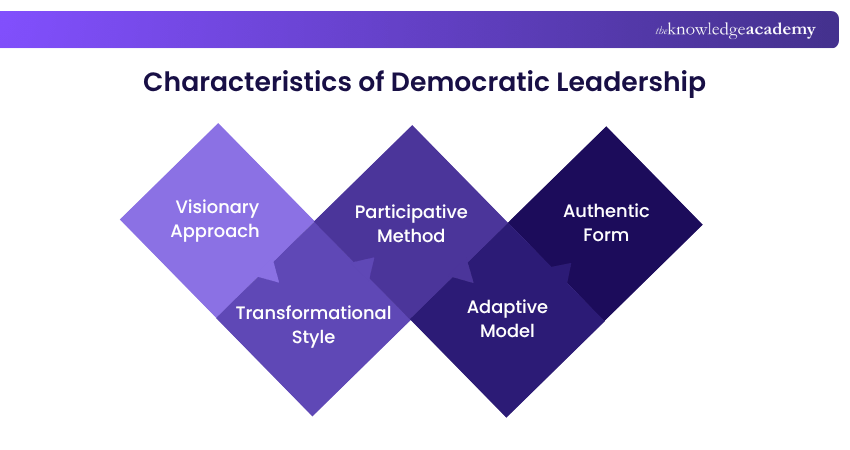
There are numerous leadership styles, each differing significantly from the others. The Democratic Leadership style is particularly effective for those who wish to involve their team in problem-solving and decision-making processes. Let’s examine its characteristics:
1) Visionary Approach
Visionary Democratic Leaders inspire and motivate their followers with a clear and compelling sense of direction. They communicate their vision effectively and persuasively, aligning the group’s actions and values with shared goals.
They also empower their followers to pursue the vision independently and creatively while providing guidance and support when needed.
2) Transformational Style
As the name suggests, this form of leadership aims to transform a group of people. It does so by posing a common issue to stimulate and challenge the followers to achieve higher performance and potential. They appeal to the followers’ intrinsic motivation, values, and ideals and foster a sense of purpose, commitment, and loyalty.
This leadership style is highly effective in building team morale, as it creates a positive and supportive environment. As a result, team members feel valued, supported, and motivated to contribute their best.
3) Participative Method
Participative Democratic Leaders involve their followers in every aspect of the decision-making process. They solicit and consider the input and suggestions of the followers, and they delegate authority and responsibility to them.
They also share information and resources with their followers, encouraging collaboration and teamwork. This approach helps build trust and strengthen relationships within the team.
4) Adaptive Model
Adaptive Democratic Leaders adjust their leadership style and behaviour according to the changing needs and demands of the situation. They are flexible and responsive to the feedback and signals from the followers, the environment, and the task.
They also enable their followers to adapt and cope with the changes and provide them with the necessary resources and support. This approach helps teams stay resilient and maintain performance even in uncertain situations.
5) Authentic Form
Authentic Democratic Leaders are genuine and transparent in their leadership. They are all about showing their true self and what they believe in. They do not wish to pretend or manipulate their masses. They also respect and appreciate their followers' authenticity and encourage them to express their true selves, values, and beliefs, even if it is critical of the leadership.
This helps establish and maintain high trust and integrity with the people. It also makes sure they are free to voice their opinions by modelling the behaviour they wish to see in their people.
Benefits of Using Democratic Leadership
Democratic Leadership offers numerous advantages to teams. Now that you know What is Democratic Leadership Style, here are a few of those benefits:
a) Wide Range of Ideas: Democratic Leaders can foster brainstorming sessions, gathering a broad spectrum of ideas from team members. This approach can lead to innovation, unique problem-solving methods, and creative solutions.
b) Empowerment of Team Members: Democratic Leadership empowers team members by creating an environment where individuals from diverse viewpoints can share opinions that might not have been considered initially.
c) Collaborative Problem-solving: This leadership style encourages team members to combine their unique ideas to develop creative solutions. A diverse, multi-faceted team is more likely to collaboratively devise innovative solutions, rather than tackling problems in isolation.
d) Increased Job Satisfaction: When leaders adopt a Democratic Leadership style, team members tend to be more satisfied with their jobs. This is because it values and incorporates everyone’s thoughts and opinions, fostering a sense of inclusion and appreciation.
Challenges of the Democratic Leadership Style
While Democratic Leadership has many advantages, it also comes with its own set of challenges. Here are some of the key challenges associated with it:
a) Extensive discussions and consultations can slow decision-making, challenging in urgent situations.
b) Multiple opinions increase the potential for disagreements and conflicts, requiring strong mediation skills.
c) The inclusive nature can lead to inefficiency if consensus is hard to reach, delaying important decisions.
d) Relies on active participation from all members; disengaged members can compromise effectiveness.
e) Leaders may struggle to maintain authority and control, leading to a lack of clear direction.
Become a leader who inspires ethical behaviour and accountability – Join our Ethical Leadership Training!
How to Apply For Democratic Leadership?
Democratic Leadership can be applied in various settings and situations, such as:
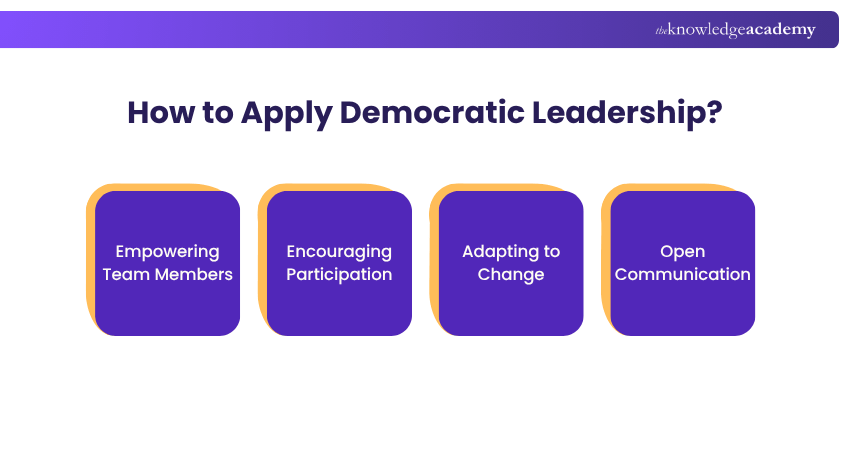
1) Empowering Team Members
Democratic Leaders can empower their team members by involving them in the planning, executing, and evaluating the team’s work. They can also delegate responsibilities and tasks to them and give them feedback and recognition for their work.
It can increase the team members’ motivation, engagement, and satisfaction, as well as their performance and productivity.
2) Encouraging Participation:
Democratic Leaders can encourage participation by creating a safe and supportive space for their followers to share their opinions, ideas, and feedback. They can also ask questions, listen actively, and acknowledge and appreciate the contributions of their followers.
It can enhance the followers’ sense of belonging, ownership, and empowerment, as well as their creativity and innovation.
3) Adapting to Change
Democratic Leaders can adapt to change by being flexible and responsive to the feedback and signals from their followers, the environment, and the task. They can also involve their followers in the change process and communicate the vision, goals, and benefits of the change.
It can reduce the followers’ resistance and anxiety and increase their readiness and commitment to the change.
4) Open Communication
Democratic Leaders can cultivate open communication by practising honesty and transparency in all their communication and actions. They can also share information and knowledge with their followers and solicit and consider their input and suggestions.
It can build trust and rapport with their followers and improve the quality and effectiveness of communication.
Transform your Leadership approach and drive success in Agile environments with our Agile Leadership Training. Join today!
When to Use Democratic Leadership Style?
Democratic Leadership is most effective in situations where collaboration, creativity, and team involvement are essential for success. It works best when leaders want to encourage participation and make team members feel valued, rather than simply directing tasks. It can be used in these situations also:
1) In creative environments that require innovation and diverse perspectives
2) When building trust, engagement, and a positive workplace culture is a priority
3) In organisations that value open communication and transparency
4) When decisions benefit from multiple viewpoints and collective input
5) During team development phases to encourage participation and ownership
6) When there is enough time to gather input and reach a consensus
How Can Democratic Leadership Improve Employee Performance?
Democratic Leadership helps improve employee performance by creating an environment where people feel valued, heard, and motivated to contribute. Here are the ways it can improve your employee performance:
1) Increased Engagement: When employees are making their contribution to decisions, they feel more connected to their work. This sense of involvement drives higher levels of participation and effort.
2) Better Decision-making: Incorporating diverse perspectives leads to more informed and balanced decisions. Employees contribute ideas that can improve outcomes and reduce errors.
3) Higher Motivation Levels: Being recognised and included boosts morale. Employees are more motivated to perform well when they feel their opinions matter.
4) Improved Creativity and Innovation: Open discussions encourage new ideas and solutions. This leads to innovative thinking and better problem-solving within teams.
5) Stronger Accountability: When employees take part in decisions, they feel responsible for the outcomes. This increases commitment and ownership of tasks.
6) Enhanced Team Collaboration: Democratic Leadership promotes teamwork and mutual respect. Employees work more effectively together, improving overall performance.
7) Better Job Satisfaction: A supportive and inclusive environment increases satisfaction, which directly impacts productivity and retention.
What Skills are Required to Become a Democratic Leader?
To become an effective Democratic Leader, you might need a mix of communication, interpersonal, and decision-making skills. Here are the skills that are required:
1) Strong Communication Skills: The ability to clearly express ideas and actively listen to others is essential. Leaders must ensure that everyone understands goals and feels heard.
2) Active Listening: Democratic Leaders need to genuinely consider team members’ opinions. This builds trust and encourages open communication.
3) Decision-making Ability: While input is gathered from the team, leaders must still make final decisions. Balancing different viewpoints is key.
4) Emotional Intelligence: Understanding and managing emotions helps leaders handle conflicts and build strong relationships within the team.
5) Collaboration Skills: Encouraging teamwork and cooperation is central to this leadership style. Leaders should be able to bring people together effectively.
6) Open-mindedness: Being open to new ideas and different perspectives helps create an inclusive and innovative environment.
7) Conflict Resolution: Differences in opinions are common, so leaders must be skilled at resolving conflicts fairly and constructively.
8) Adaptability Skills: Democratic Leaders should be flexible and adjust their approach based on team needs and situations.
Conclusion
In conclusion, Democratic Leadership offers a powerful way to apply the collective wisdom of your team, fostering innovation and engagement. By understanding What is Democratic Leadership Style, its characteristics, pros, and cons, you can decide if this inclusive approach is the right fit for your organisation. When implemented effectively, this leadership style can significantly enhance team morale.
Improve your ability to make effective decisions in any situation – sign up for our Decision Making Course!
Frequently Asked Questions
Which Leadership Style is the Best?

There’s no single “best” leadership style; effective leadership depends on context and the needs of the team. The most successful leaders adapt their approach to achieve goals and foster a positive, productive work environment.
Who Defined Democratic Leadership?
Democratic Leadership was first defined by psychologist Kurt Lewin in 1939. He described it as a leadership style where leaders involve group members in decision-making. Lewin’s research highlighted its impact on participation, collaboration, and group behaviour, making it one of the foundational leadership theories.
What are the Other Resources and Offers Provided by The Knowledge Academy?
The Knowledge Academy takes global learning to new heights, offering over 3,000+ online courses across 490+ locations in 190+ countries. This expansive reach ensures accessibility and convenience for learners worldwide.
Alongside our diverse Online Course Catalogue, encompassing 17 major categories, we go the extra mile by providing a plethora of free educational Online Resources like Blogs, eBooks, Interview Questions and Videos. Tailoring learning experiences further, professionals can unlock greater value through a wide range of special discounts, seasonal deals, and Exclusive Offers.
What is The Knowledge Pass, and How Does it Work?
The Knowledge Academy’s Knowledge Pass, a prepaid voucher, adds another layer of flexibility, allowing course bookings over a 12-month period. Join us on a journey where education knows no bounds.
What are the Related Courses and Blogs Provided by The Knowledge Academy?
The Knowledge Academy offers various Leadership Courses, including Leadership Skills Training, Agile Leadership Training, and Executive Leadership Coaching Training. These courses cater to different skill levels, providing comprehensive insights into Organisational Leadership.
Our Business Skills Blogs cover a range of topics related to Democratic Leadership Style, offering valuable resources, best practices, and industry insights. Whether you are a beginner or looking to advance your Leadership skills, The Knowledge Academy's diverse courses and informative blogs have got you covered.

Benjamin Walker


Leadership Development Coach and Management Consultant
Benjamin Walker is a leadership coach and business consultant with over 18 years of experience in guiding organisations through strategic growth and transformation. He specialises in developing leadership capabilities at all levels, from emerging managers to executive teams. Benjamin’s work focuses on practical leadership, team dynamics, and performance management.
View Detail
Upcoming Business Skills Resources Batches & Dates
Date
 Leadership Skills Training
Leadership Skills Training
Fri 31st Jul 2026
Leadership Skills Training
Fri 2nd Oct 2026
Leadership Skills Training
Fri 27th Nov 2026

 If you wish to make any changes to your course, please


