


 Top Rated Course

We may not have the course you’re looking for. If you enquire or give us a call on +44 1344 203999 and speak to our training experts, we may still be able to help with your training requirements.
What is Django and Why is it So Popular?
Richard Harris 01 May 2026Django is a free and open-source Python framework that helps Developers build secure and scalable web applications quickly using powerful built-in features. It supports rapid development through reusable components. Its strong security and reliable structure make it ideal for modern web projects today worldwide.

Training Outcomes Within Your Budget!
We ensure quality, budget-alignment, and timely delivery by our expert instructors.
Table of Contents
Related Courses
The simplest answer to the question 'What is Django?' is that it's the powerhouse behind some of the world’s most dynamic websites. It's about building complex, secure and scalable web applications without drowning in endless lines of code. That’s the power Django brings to Developers everywhere.
Its simplicity, speed and “batteries-included” philosophy have made it a favourite in the tech world. If you want to take a deep dive into what is Django and why it dominates the web development scene, you've come to the right place. This blog will spotlight Django's role in So read on and building fast, reliable digital experiences. So read on!
Table of Contents
1) What is Django?
2) Essential Features of Django
3) How Does Django Work?
4) Core Components of Django
5) dvantages of Django
6) Structure of Django Project
7) Comparison Between Django and Other Popular Web Frameworks
8) Real-world Examples of Django
9) Challenges Faced by Django Developers
10) What is the Salary of a Django Developer?
11) When not to Use Django?
12) Conclusion
What is Django?
Django is a fast and user-friendly Python-based web framework designed for high productivity. It offers well-structured and efficient methods to create Web Applications, simplifying many common development tasks. Django Interview Questions often explore how Django is widely used for functions such as data processing in databases and URL handling.
This environment allows Developers to build Web Applications with a comprehensive set of built-in features and tools. This not only eases the development process but also reduces the cost of creating complex and scalable Web Applications.
 .
.
Essential Features of Django
Django comes with a ready-to-use admin interface, an ORM for smooth database interactions, and a customisable template system that allows rapid development of dynamic pages. The combination of these tools allows Developers to create applications in a shorter time with neat and orderly code.
Django's robust security mechanisms protect against CSRF, XSS and SQL injection attacks come with user-friendly URL routing and a modular framework. This feature makes Django a perfect choice for web applications that are secure, scalable and easy to maintain.
How Does Django Work?
A Web Application comprises two main parts: server code and client code. When a user types a URL into their browser, they send a request to the web server hosting the Web Application. The server processes this request using a database and sends back a response to the client. The client's browser then displays the information as a web page.
Django manages this request-response cycle using the Model-View-Template (MVT) architecture.
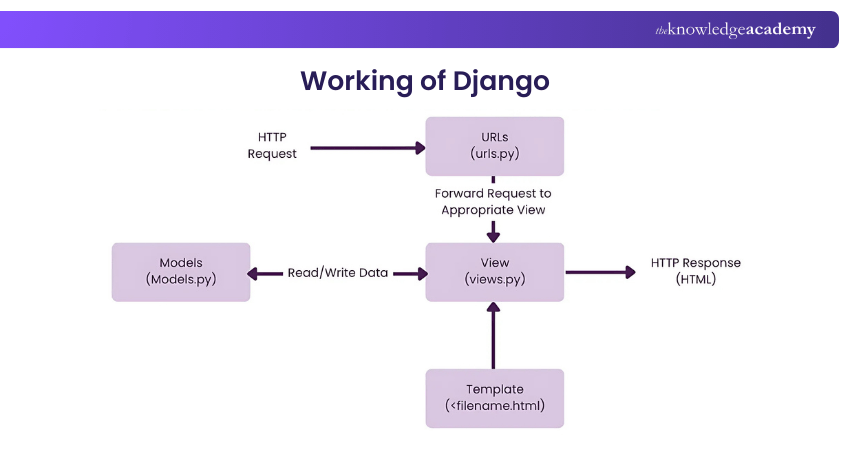
1) Model
Django models serve as the bridge between the server code and the database. They define the structure of your data, including the fields and operations required to interact with the database. Essentially, models convert database tables into Python classes or objects through Object-relational Mapping (ORM), which is a key concept when learning to Create a Superuser in Django.
For example, if your website needs to manage employee details, you could have:
a) An Employee table with fields for employee names and addresses.
b) An Employee model class with attributes for Name and Address.
Each model typically maps to a single database table, and its attributes represent the fields in that table.
2) View
Django views handle the processing of requests using models. You can create a view function for each type of request your website supports. A view function takes the request as input and returns a response, which could be data, an image, a file, or an error code. When preparing for Django Interview Questions, understanding how view functions operate is crucial, as they form the backbone of handling requests and responses in a Django application.
Django uses a URL mapper (URL dispatcher) to link view functions to specific URLs. You define URL patterns in a URL mapper file like this:

For instance, to display a list of employees for a specific year, you set up a URL path (e.g., employee/year) and write a corresponding view function (e.g., year_archive). When a user enters "yourwebsitename.com/employee/2020", the following steps occur:
a) The request will reach your Web Application.
b) Django extracts the year and view function name from the URL mapper.
c) It executes the view function year_archive for the year 2020.
d) The year_archive function uses the Employee model to retrieve employee data from the database for 2020.
e) Django sends this data back as a response.
3) Template
Django templates manage how web pages are presented in the browser. Most web pages use HTML, and Django templates are written in a similar style. A template file includes:
a) Static parts of the final HTML output (e.g., images, buttons, headers).
b) Special syntax to insert dynamic content that changes with each request.
The Django template system comprises two main components:
a) Template Language: The programming language used to write HTML template code. Django supports its own Template Language and Jinja2.
b) Template Engine: Processes the template file to create the final HTML output, incorporating data from the response.
For example, if a user requests employee information, the Django template will populate the web page with the website header, a table listing employee names and addresses, and a "Next" button.
Core Components of Django
Django is built to simplify Web Development by providing a structured framework that ensures code reusability and separation of concerns. Its core components include:
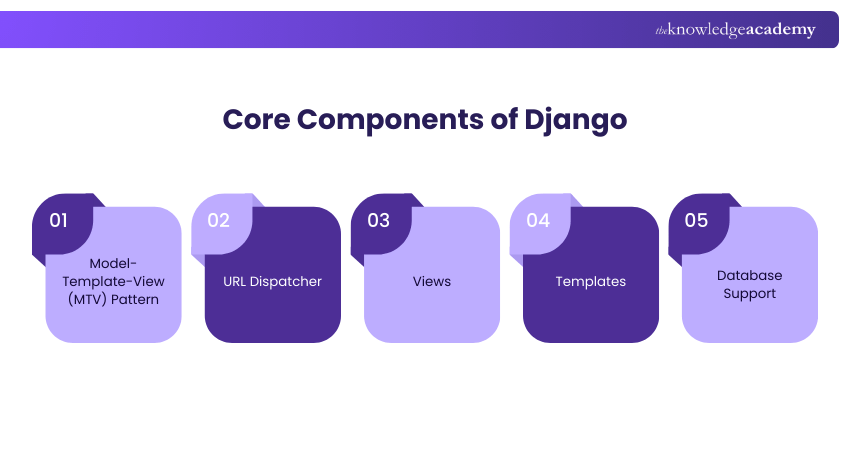
1) Model-Template-View (MTV) Pattern:
Django follows the MTV pattern, which is similar to the Model-View-Controller (MVC) structure. In this pattern, the Model manages the data, the Template handles the presentation, and the View processes user requests and returns responses. This clear division keeps the codebase organised and easy to maintain.
2) URL Dispatcher:
Django's URL dispatcher maps incoming requests to the appropriate view based on the URL. This system ensures that URLs are clean and readable while also efficiently routing requests to the correct handler.
3) Views:
Views in Django are Python functions or classes that handle web requests and return web responses. They act as the business logic layer, processing the necessary data and determining what content should be presented to the user.
4) Templates:
Templates specify the structure and layout of the web pages. These HTML files can include Django Template Language to generate dynamic content, allowing Developers to separate the logic of the application from its design.
5) Database Support:
Django provides an Object-Relational Mapping (ORM) system, allowing Developers to define their database structure using Python classes. This simplifies database interactions by eliminating the need to write raw SQL queries.
By understanding and using these core components, Developers can make powerful and scalable web applications with greater efficiency.
Advantages of Django
Django offers several key advantages that make it a popular choice for Web Developers:
a) Quick Development: Guided by the "Don't Repeat Yourself" principle, Django reduces code redundancy. This allows for faster development since Developers can write less code to achieve more functionality.
b) Strong Security: Django is highly secure, and all necessary precautions are taken to help Developers evade typical security vulnerabilities such as SQL injection, XSS, and CSRF. For instance, it includes a secure user authentication system to ensure safe account and password management.
c) Scalable: Thanks to its component-based architecture, Django can scale efficiently to meet the demands of any project, whether it is a small application or a large, complex system. Django is always prepared to handle these challenges.
d) Versatility: Django's versatility makes it useful in multiple applications, from Content Management Systems (CMS) to social networks and scientific computing platforms.
e) Active and Extensive Community: Django boasts a large and active community, along with a rich ecosystem of packages and plugins. This support network significantly eases the development process, saving Developers from having to create solutions from scratch.
f) Excellent Documentation: Django is renowned for its clear and comprehensive documentation, which is invaluable for both beginners and experienced developers. The high-quality documentation helps new users learn quickly and allows seasoned developers to derive significant value from it.
Learn the principles of OOP with our Object Oriented Programming (OOPs) Course – Register today!
Structure of Django Project
Understanding the structure of the Django Project is essential for efficiently building and managing Web Applications using this powerful framework. Here's an overview of the typical structure of a Django Project:
1) Project Directory
The top-level directory of a Django project usually contains the following files and directories:
1) manage.py: A command-line utility that lets you interact with your Django project. It's used for running server commands, such as running the development server, applying migrations, and creating apps.
2) Project Directory: A directory named after your project (e.g., myproject). This contains the settings and configuration for your entire project. Inside this directory, you'll find:
a) init.py: An empty file that indicates that the directory should be treated as a Python package.
b) settings.py: Contains all the configuration for your Django project, including database settings, installed apps, middleware, and templates.
c) urls.py: Defines the URL patterns for your project. It maps URLs to views.
d) wsgi.py: An entry-point for WSGI-compatible web servers to serve your project. WSGI stands for Web Server Gateway Interface.
e) asgi.py: Similar to wsgi.py but for ASGI servers, which support asynchronous web protocols.
2) Apps
Django projects are typically divided into smaller, reusable components called apps. Each app has a specific purpose and encapsulates related functionality. An app directory usually contains:
a) migrations/: A directory that contains database migration files. These files are used to propagate changes you make to your models (e.g., adding a field) into the database schema.
b) init.py: An empty file that indicates that this directory should be treated as a Python package.
c) admin.py: Contains the configuration for the Django admin interface.
d) apps.py: Contains the configuration for the app itself.
e) models.py: Defines the data models for your application. Each model corresponds to a database table.
f) tests.py: Contains the tests for your application.
g) views.py: Contains the view functions or classes. Views handle the logic of processing user requests and returning responses.
h) urls.py: Defines URL patterns specific to this app.
i) forms.py: (Optional) Contains forms used in the app.
j) templatetags/: (Optional) Contains custom template tags and filters.
3) Templates
Django uses a templating system to separate the presentation layer from the business logic. Templates are generally stored in a templates/ directory within each app or in a project-wide templates/ directory. They contain HTML with Django Template Language (DTL) for dynamic content rendering.
4) Static Files
Static files (e.g., CSS, JavaScript, images) are stored in a static/ directory within each app or in a project-wide static/ directory. These files are served as-is and have not been processed by Django.
5) Middleware
Middleware is a method to process requests globally. This is done before they reach the view or after the view has processed them. Middleware components are defined in the settings.py file under the MIDDLEWARE setting.
6) Settings
The settings.py file is crucial for configuring your Django project. It includes settings for:
a) DATABASES: Configuration for database connections.
b) INSTALLED_APPS: A list of all the apps that are enabled in your Django project.
c) MIDDLEWARE: A list of middleware components.
d) TEMPLATES: Configuration for the templating system.
e) STATIC_URL and STATICFILES_DIRS: Settings for static files.
Example Structure
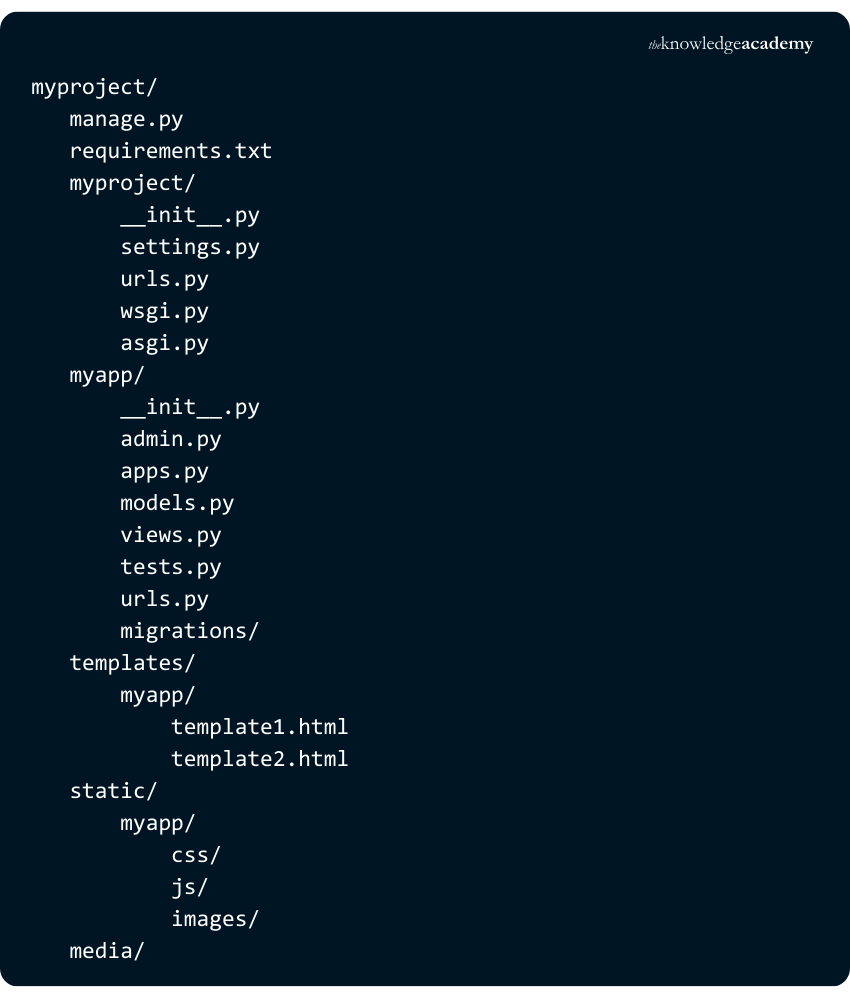
Here's a simplified example of a Django project structure:
Understanding this structure will help you navigate and organise your Django projects efficiently, making development and maintenance more manageable.
Try our Python with Machine Learning Training and begin your Data Science journey!
Comparison Between Django and Other Popular Web Frameworks
1) Django vs Ruby on Rails
a) Built-in Tools vs Configuration Freedom: Django, with its built-in features, has a great advantage in terms of speeding up the development process, while Rails, with its configuration freedom, allows but requires making many decisions in the process.
b) Language Rcosystem and Versatility: Django’s dependency on Python makes it more versatile since Python is an in-demand language for data science and automating tasks. Therefore, the web is just one of the areas where Django can work.
c) Security and Maintainability: Django advises its Developers to be careful with their code, not only in terms of security but also in terms of the readability of the code. Rails take the same approach but usually have more tuning for the stability of the codebase.
d) Flexibility vs Structure: Rails are very permissive in the use of plugins. In contrast, Django provides a more detailed framework that simplifies the project.
2) Django vs Flask
a) Full-featured vs Minimalist: Django comes with ORM, admin and templates all in one. Flask remains minimalist and lets you implement only what is necessary.
b) Best Project Size: Flask is appropriate for tiny and uncomplicated projects. Django is capable of handling big and complex projects more effectively.
c) Flexibility vs Convention: Flask allows total freedom in the selection of tools and arrangement. Django adheres to established patterns that enhance uniformity.
d) Speed of Development: Django allows for rapid installation with integrated features. Flask, on the other hand, requires more manual setting up to attain the same level of configuration.
3) Django vs. Laravel
a) Language Differences: Django is based on Python, which is easy to understand and is used by many people. On the other hand, Laravel is based on PHP, which has been around for a long time and is still one of the main choices for web development.
b) Similar Built-in Features: The two frameworks provide operations like routing, ORM and templates as part of their features. It is then possible to use fewer libraries.
c) Scalability Strength: Django has the ability to deal with very large and very active workloads at times. It is the right choice for a project that is going to be in the market for a long time and will grow continually.
d) Ecosystem Advantages: Laravel has the strong backing of PHP support, which comes in the form of Laravel. Django grants the use of Python libraries, which allow for connecting with other systems.
4) Django vs Nodejs
a) Framework vs Runtime: Node.js is server-side JavaScript. Django is a complete Python-based framework with organised development.
b) Request Processing: Node.js is the king of real-time and simultaneous connections. Django uses a classic request model that is good for data-centred applications.
c) The Development Approach: Django makes the work faster with its embedded tools. Node.js lets you pick and choose each component of your stack.
d) Ideal Usage: Django is the best option for systems that are rigidly defined and heavy on data. Node.js is the right choice for real-time apps and I/O operations with huge volumes.
Real-world Examples of Django
Django Framework powers many popular websites thanks to its scalability, security and rapid development features. Here are some real-world examples where Django is effectively used:
1) Instagram:
Originally developed in just two weeks, Instagram uses Django to handle millions of user associations daily, thanks to its scalability.
2) Pinterest:
Built on Django, Pinterest supports over 400 million monthly active users, relying on Django’s performance to manage large data.
3) Google:
Django powers Google Search, helping the platform process over 40,000 queries per second.
4) The Onion:
This satirical news site switched to Django in 2009 for its simplicity, ease of maintenance, and clean code.
5) NASA:
Django supports NASA’s high-definition video and image-rich website, ensuring top-notch security and performance.
6) Eventbrite:
Eventbrite uses Django to offer a seamless ticketing and event management services.
These examples demonstrate how Django's flexibility and robustness support both large-scale projects and smaller applications.
Challenges Faced by Django Developers
While Django is a powerful framework, it does come with certain challenges that Developers must navigate:
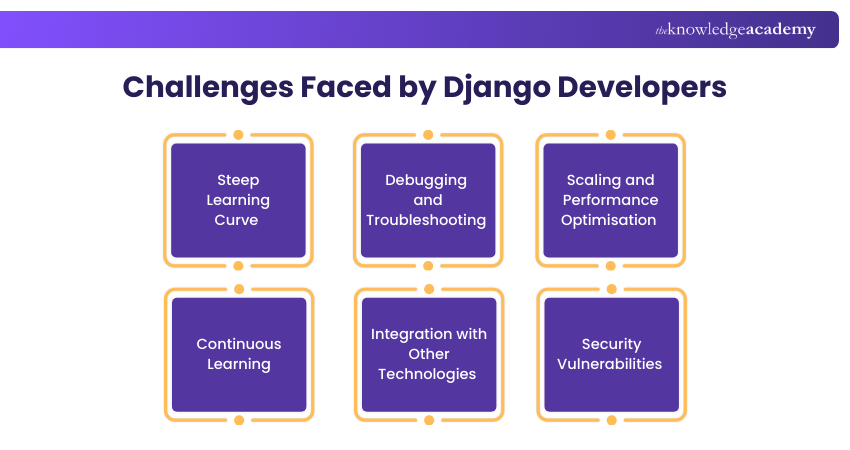
Steep Learning Curve
a) Django offers numerous features like automatic admin interfaces and security tools, which can overwhelm beginners.
b) The reliance on Python, with its strict syntax and object-oriented programming principles, adds to the complexity.
c) Mastering Django's full potential requires time and experience, making it challenging for new developers.
Debugging and Troubleshooting
a) Debugging errors in Django can be tricky, despite its robust error-handling tools.
b) Tools like the Django Debug Toolbar are helpful, but mastering them requires time and practice.
c) Troubleshooting can be a challenge, especially for developers who are not familiar with these tools.
Scaling and Performance Optimisation
a) Django is built for scalability, but optimising it for large-scale applications can be challenging.
b) Developers need to fine-tune both code and infrastructure to handle high-traffic loads effectively.
c) Ensuring the system maintains performance without slowing down requires ongoing adjustments and optimisation.
Continuous Learning
a) Django evolves rapidly, with regular updates and new features.
b) Developers must stay updated on the latest changes to ensure security and performance.
c) Keeping up with frequent updates and best practices can be overwhelming for many developers.
Integration with Other Technologies
a) Integrating Django with other technologies can be complex.
b) As a full-stack framework, Django may not align easily with other technologies that use different programming languages or data formats.
c) Developers often need to write custom code or use APIs to bridge these gaps.
Security Vulnerabilities
a) Django Developers face security risks like Cross-Site Scripting (XSS), SQL injection, and session management.
b) Careful attention is required to address these issues.
c) Implementing best practices like input validation and regular updates is essential for mitigating security risks and protecting user data.
Despite these challenges, Django’s powerful features and flexibility make it a popular Web Development choice, especially when developers stay updated and follow best practices.
Gain hands-on experience working with real-world projects and technologies with our Programming Training – Join now!
What is the Salary of Django Developer?
The average salary for a Django Framework Developer in the UK is around £41K annually. Entry-level positions start at £32K, while experienced Developers earn up to £54K. It’s important to remember that salaries vary by location and experience.
When not to Use Django?
Django web framework may not be suitable for microservices architectures, as it is designed for monolithic applications. For simple projects without complex features or databases, lighter frameworks like Flask may be more appropriate. If you prefer building from scratch, Django’s built-in features might be unnecessary.
Conclusion
Django continues to be a trustworthy framework for web development that is both secure and scalable. The architecture of this framework facilitates the fast development of applications that are not only easy to read but also easy to maintain. A proper understanding of What is Django provides the students with a solid ground for the creation of modern and efficient web solutions.
Dissect Python’s intricacies with our comprehensive Python Course - Sign up today!
Frequently Asked Questions
How to Deploy a Django Application?

Users frequently seek guidance on deploying Django applications to various hosting environments. This includes setting up the server, configuring static files, and using services like AWS Elastic Beanstalk or other platforms for deployment.
How to Create and Manage Forms in Django?
Another common inquiry involves creating and managing forms. This covers everything from basic form creation using Django forms to handling form submissions and integrating forms with models for database interactions.
What are the Other Resources and Offers Provided by The Knowledge Academy?
The Knowledge Academy takes global learning to new heights, offering over 3,000+ online courses across 490+ locations in 190+ countries. This expansive reach ensures accessibility and convenience for learners worldwide.
Alongside our diverse Online Course Catalogue, encompassing 19 major categories, we go the extra mile by providing a plethora of free educational Online Resources like Blogs, eBooks, Interview Questions and Videos. Tailoring learning experiences further, professionals can unlock greater value through a wide range of special discounts, seasonal deals, and Exclusive Offers.
What is The Knowledge Pass, and How Does it Work?
The Knowledge Academy’s Knowledge Pass, a prepaid voucher, adds another layer of flexibility, allowing course bookings over a 12-month period. Join us on a journey where education knows no bounds.
What are the Related Courses and Blogs Provided by The Knowledge Academy?
The Knowledge Academy offers various Programming Courses, including the Python Course, PHP Course, and ReactJS Course. These courses cater to different skill levels, providing comprehensive insights into Floor Division in Python.
Our Programming & DevOps Blogs cover a range of topics related to Django, offering valuable resources, best practices, and industry insights. Whether you are a beginner or looking to advance your Programming & DevOps skills, The Knowledge Academy's diverse courses and informative blogs have got you covered.

Richard Harris


Senior Full Stack Developer and Technology Educator
Richard Harris is a highly experienced full-stack developer with deep expertise in both frontend and backend technologies. Over his 12-year career, he has built scalable web applications for startups, enterprises and government organisations. Richard’s writing combines technical depth with clear explanations, ideal for developers looking to grow in modern frameworks and tools.

Upcoming Programming & DevOps Resources Batches & Dates
Date
 Python Django Training
Python Django Training
Thu 6th Aug 2026
Python Django Training
Thu 1st Oct 2026

 If you wish to make any changes to your course, please


