


 Top Rated Course

We may not have the course you’re looking for. If you enquire or give us a call on +44 1344 203999 and speak to our training experts, we may still be able to help with your training requirements.
What is Data Annotation? Types, Advantages and Disadvantages
Lily Turner 17 April 2026Data Annotation labels images, text, video, or audio to help AI and Machine Learning models learn patterns and make accurate predictions from complex data. It improves accuracy and gives reliable AI insights. Understanding what Data Annotation helps organisations build more efficient, scalable, and intelligent AI systems.

Training Outcomes Within Your Budget!
We ensure quality, budget-alignment, and timely delivery by our expert instructors.
Table of Contents

Have you ever wondered how your smartphone can recognise your face or how self-driving cars can navigate through busy streets? The answer lies in a crucial process known as Data Annotation. But What is Data Annotation, and why is it so important? In Artificial Intelligence and Machine Learning (ML), Data Annotation is key to helping machines interpret and understand vast amounts of data.
In this blog, we’ll dive into What is Data Annotation and explore its various types, tools, and technologies. Along the way, we’ll uncover how this behind-the-scenes process drives the cutting-edge innovations shaping our world today. Get ready to discover the unsung hero of the Artificial Intelligence (AI) revolution!
Table of Contents
1) What is Data Annotation?
2) Types of Data Annotation
3) Data Annotation Tools
4) Advantages and Disadvantages of Data Annotation
5) Best Practices for Data Annotation
6) Data Annotation Services
7) The Impact of AI Annotation in the Future
8) Conclusion
What is Data Annotation?
Data Annotation is the process of Labelling Data to train AI models, ensuring they understand text, images, or video accurately. It involves tagging datasets with meaningful labels to make them understandable for Machine Learning algorithms. While once less critical due to reliance on structured data, its importance has grown significantly with the rise of unstructured data like images, text, and audio.
Data Annotation helps AI systems navigate and process vast data volumes effectively. As data generation accelerates globally, annotation has become vital for businesses and organisations to remain competitive by enabling accurate, context-driven AI and Machine Learning Applications.

Why is Data Annotation Important?
The importance of Data Annotation cannot be overstated. Accurate Data Annotation ensures:
a) Improved Model Accuracy: Machine Learning models rely on annotated data to learn patterns, improving their ability to deliver precise outputs.
b) Scalability of AI Systems: Annotated datasets allow AI systems to scale across industries, including healthcare, finance, retail, and transportation.
c) Contextual Understanding: Properly annotated data adds context, which is vital for Natural Language Processing (NLP), sentiment analysis, and image recognition tasks.
d) Enhanced Automation Capabilities: Annotated data allows AI to automate repetitive tasks with precision, such as detecting defects in manufacturing or processing claims in insurance.
e) Better Decision-making: Well-annotated data enables AI systems to deliver actionable insights, aiding decision-making processes in business analytics and strategic planning.
f) Foundation for Deep Learning Models: Complex AI models, such as those in Deep Learning, require vast amounts of annotated data to identify intricate patterns and nuances.
Learn the fundamentals of AI to stay ahead in an ever-evolving digital landscape with our Introduction To AI Course – Join now!
Types of Data Annotation
The following are the different types of Data Annotation:
1) Image Annotation
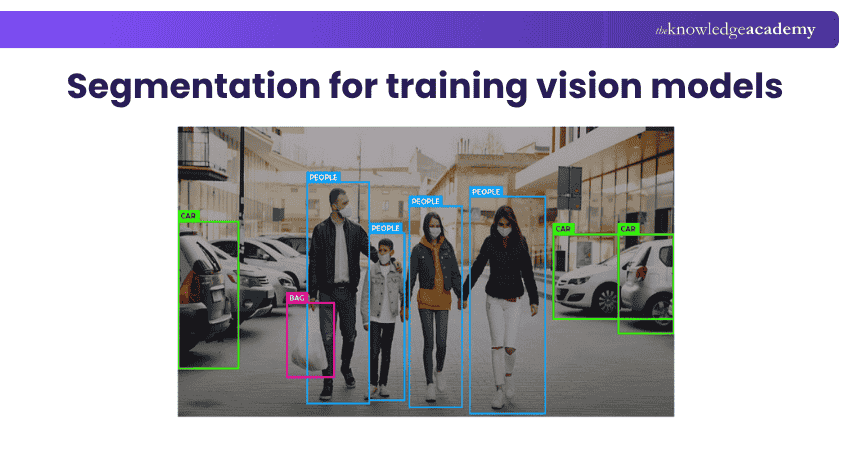
Tags object in images using bounding boxes, polygons, or segmentation for training computer vision models.
Characteristics:
a) Annotates static images with metadata for object detection, classification, and feature recognition.
b) Employs techniques like semantic segmentation, instance segmentation, and polygons for precision.
Importance:
a) Enables Machine Learning models to recognise objects, people, or environments in visual data.
b) Essential for improving accuracy in applications like autonomous systems and security surveillance.
Use Cases:
a) Autonomous Vehicles: Identifying road signs, pedestrians, and other vehicles
b) Healthcare: Analysing medical scans to detect anomalies
c) Retail: Implementing visual search features and shelf monitoring systems
2) Video Annotation
Frame-by-frame labelling of objects and actions for tracking movement and recognising temporal patterns.
Characteristics:
a) Annotates dynamic content across video frames
b) Tracks object movement, behaviours, and spatial relationships
Importance:
a) Facilitates activity recognition and motion prediction in AI models
b) Critical for temporal analysis in fields like sports, surveillance, and robotics
Use Cases:
a) Autonomous Driving: Tracking vehicles and predicting pedestrian movement
b) Sports Analytics: Analysing player movements and strategies
c) Security: Identifying suspicious activity in surveillance footage
3) Text Annotation
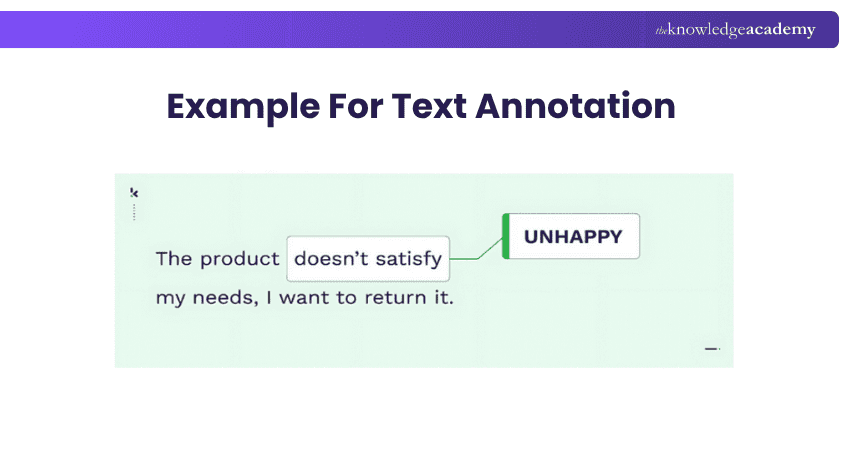
Labels text data for natural language understanding, such as sentiment analysis, entity extraction, and intent detection.
Characteristics:
a) Identifies keywords, entities, and grammar structure within text
b) Adds linguistic context to improve AI language processing
Importance:
a) Powers applications like chatbots, translation tools, and sentiment analysis systems
b) Enhances AI’s understanding of human language complexities
Use Cases:
a) Customer Support: Training virtual assistants for better communication.
b) Marketing: Conducting sentiment analysis for consumer feedback
c) Healthcare: Extracting key data from patient records
4) Audio Annotation
Labels audio files for speech-to-text conversion, speaker identification, and sound classification.
Characteristics:
a) Tags sound data with transcripts, timestamps, or emotion indicators
b) Supports multilingual and emotion-based analysis
Importance:
a) This is crucial for voice recognition systems and audio-based applications.
b) Improves interaction quality in AI-powered virtual assistants.
Use Cases:
a) Voice Assistants: Enhancing accuracy in speech recognition.
b) Customer Service: Monitoring sentiment during support calls.
c) Accessibility Tools: Creating real-time transcription for the hearing impaired.
5) LiDAR Annotation
Labels 3D point cloud data to identify objects, dimensions, and spatial relationships in real-world environments.
Characteristics:
a) Captures depth and spatial information with high accuracy
b) Highlights objects within complex 3D environments
Importance:
a) Essential for autonomous systems requiring depth perception
b) Aids in creating realistic 3D representations for simulations
Use Cases:
a) Autonomous Vehicles: Mapping surroundings for navigation.
b) Urban Planning: Analysing spatial layouts for development.
c) Robotics: Improving spatial awareness in AI-driven machines.
6) Segmentation Techniques
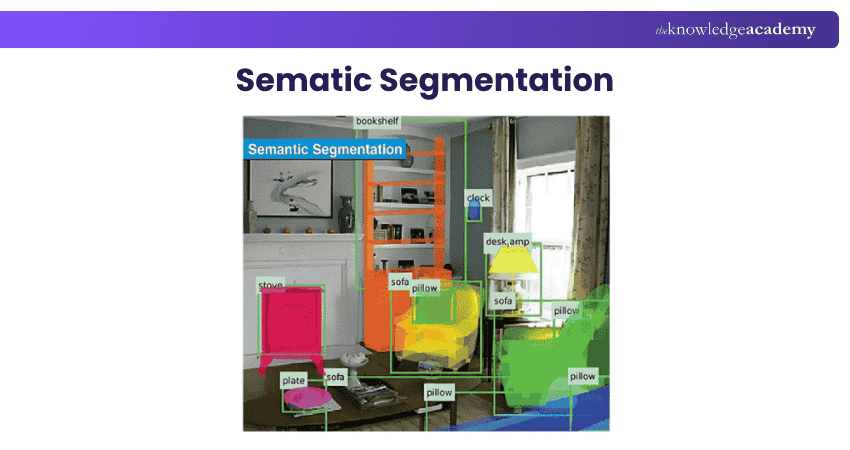
Divide data into distinct segments for detailed analysis and model training.
Characteristics:
a) Includes methods like semantic segmentation and instance segmentation
b) Separates objects for a more granular understanding
Importance:
a) Provides detailed insights by isolating objects from backgrounds or other entities
b) Critical for tasks requiring object-level precision
Use Cases:
a) Medical Imaging: Identifying tumours or affected areas in scans
b) Satellite Imagery: Analysing terrain and detecting changes
c) Augmented Reality: Enhancing real-time object overlays
7) Bounding Box Annotations
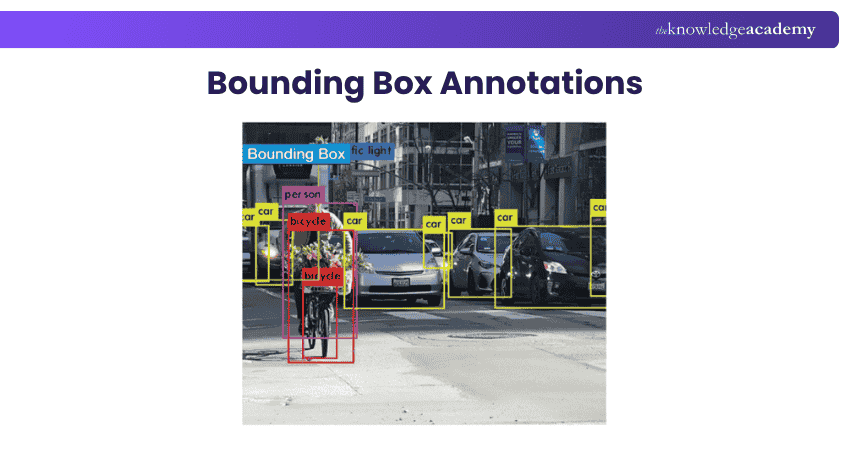
Bounding box annotation involves drawing rectangular boxes around objects in an image to identify their size and location. These annotations provide coordinates of the box, which helps AI models recognise and classify objects.
Characteristics:
a) Simple and widely used for object detection and localisation.
b) Provides basic geometric data about objects in images or videos.
c) Suitable for tasks where precision around object contours is less critical.
Importance:
a) Forms the foundation of many object detection models
b) Allows AI to differentiate between objects in a given space
c) Provides scalable and efficient annotations for large datasets
Use Cases:
a) Autonomous Vehicles: Detecting vehicles, pedestrians, and road signs
b) Retail: Identifying products on shelves
c) Security: Monitoring and identifying objects in surveillance footage
d) Agriculture: Detecting pests, animals, or crops in agricultural fields
Master Machine Learning concepts and tools to unlock limitless career possibilities with our Machine Learning Course - Start your journey now!
8) PDF Annotation
Characteristics:
a) Involves adding comments, highlights, tags, and metadata to PDF documents
b) Helps organise and structure large volumes of information for easier access
Importance:
a) Enhances document clarity and accessibility by providing contextual insights
b) Supports efficient document management and review processes
Use Cases:
a) Legal: Reviewing contracts and agreements
b) Finance: Auditing and compliance documentation
c) Government: Managing digital records and official files
9) Website Annotation
Characteristics:
a) Tags and classifies web content based on categories such as topic or safety
b) Structures unorganised online data for analysis and monitoring
Importance:
a) Supports content moderation by identifying harmful or inappropriate material
b) Ensures compliance and improves quality of digital platforms
Use Cases:
a) Social Media: Filtering harmful or offensive content
b) Search Engines: Improving content relevance and ranking
c) Content Platforms: Monitoring and categorising user-generated data
10) Time Series Annotation
Characteristics:
a) Labels data that changes over time, including trends and sequences
b) Marks patterns, anomalies, and key events within time-based datasets
Importance:
a) Enables accurate trend analysis and forecasting
b) Helps detect anomalies and irregular patterns in data
Use Cases:
a) Finance: Analysing stock price movements and trends
b) Healthcare: Monitoring patient vitals and health data
c) IoT: Tracking sensor data and detecting system irregularities
11) Medical Data Annotation
Characteristics:
a) Involves labelling medical images, records, and diagnostic data
b) Requires domain expertise to ensure accuracy and reliability
Importance:
a) Supports the development of accurate AI models for diagnosis and treatment
b) Improves precision in healthcare analysis and decision-making
Use Cases:
a) Radiology: Analysing X-rays, CT scans, and MRI images
b) Clinical Research: Processing patient records and medical data
c) Healthcare Systems: Supporting AI-driven diagnostics and treatment planning
Data Annotation Tools
Data Annotation tools play a crucial role in streamlining the process of preparing high-quality training datasets for Machine Learning models. They support text, image, audio, and video annotation, ranging from manual to AI-assisted systems. Additionally, understanding how to use Text Mining Tools enhances text data processing, leading to improved annotation accuracy. Some of these tools include:
Manual Annotation Tools
These tools allow humans to label data by hand. They provide interfaces for tasks like drawing bounding boxes, segmenting images, and labelling objects. Examples include:
a) LabelImg: An open-source tool for labelling objects in images with bounding boxes.
b) VGG Image Annotator (VIA): A standalone tool for various types of image annotations, such as points, rectangles, circles, and polygons.
c) LabelMe: An online tool for detailed image labelling, popular for tasks like segmentation.
Semi-automated Annotation Tools
These tools use pre-trained models to assist in the annotation process, making it faster and easier.
a) CVAT (Computer Vision Annotation Tool): An open-source tool with automated annotation capabilities.
b) MakeSense.ai: A free online tool with semi-automated features for various Data Annotation tasks.
Advantages and Disadvantages of Data Annotation
The following are the advantages and disadvantages of Data Annotation:
Advantages of Data Annotation
Here are the advantages of Data Annotation:
a) Improved Model Accuracy: High-quality annotations lead to better-trained models.
b) Versatility: Applicable to various data types and industries.
c) Enhanced AI Capabilities: Enables more sophisticated and reliable AI systems.
Disadvantages of Data Annotation
Here are the disadvantages of Data Annotation:
a) Time-consuming: Manual annotation can be labour-intensive and time-consuming.
b) Costly: High-quality annotation often requires significant resources.
c) Human Error: Annotations are subject to human error, which can affect model performance.
Develop skills in AI-driven automation with our Artificial Intelligence (AI) For DevOps Course – Join now!
Best Practices for Data Annotation
Here are the essential tips and techniques for accurate and efficient Data Annotation to improve AI outcomes:
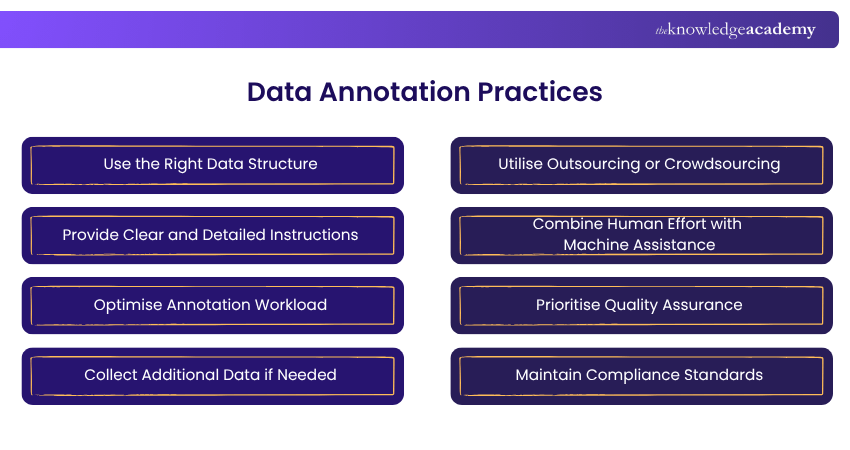
1) Use the Right Data Structure
Create data labels that are specific enough to be meaningful but general enough to encompass variations across datasets. A well-structured approach simplifies the annotation process and improves consistency.
2) Provide Clear and Detailed Instructions
Develop comprehensive and easy-to-understand guidelines for annotators. This ensures consistency and accuracy across annotations, especially when working with large teams or diverse data types.
3) Optimise Annotation Workload
Since Data Annotation can be resource-intensive, explore cost-effective alternatives. For instance, partnering with a data collection service offering pre-labelled datasets can reduce time and expenses.
4) Collect Additional Data if Needed
Insufficient data can hinder the performance of Machine Learning models. Work with data collection providers to gather diverse and comprehensive datasets to ensure robust training.
5) Utilise Outsourcing or Crowdsourcing
When annotation tasks become too large or time-consuming for internal teams, consider outsourcing or using crowdsourcing platforms to scale the process efficiently.
6) Combine Human Effort with Machine Assistance
Integrate Machine Learning algorithms with human oversight in a human-in-the-loop (HITL) approach. Machines handle simpler cases, while humans focus on complex or nuanced annotations, enhancing both efficiency and data diversity.
7) Prioritise Quality Assurance
Regularly test annotations for quality and accuracy. Introduce peer reviews, where multiple annotators validate each other’s work, to maintain high standards and consistency.
8) Maintain Compliance Standards
Ensure adherence to data protection and privacy regulations when working with sensitive data, such as images of individuals or health records. Non-compliance can harm your organisation's reputation and result in legal consequences.
Build future-ready expertise with our Artificial Intelligence Courses – Register today!
Data Annotation Services
Data Annotation services provide specialised support for labelling and organising data required to train AI and machine learning models. Understanding what is Data Annotation highlights how these services improve accuracy, save time, and ensure high-quality datasets for reliable model performance.
The Impact of AI Annotation in the Future
AI annotation is expected to become more automated and efficient, reducing manual effort while improving speed and scalability. Understanding what is Data Annotation helps organisations address key challenges, as it plays a vital role in advancing AI capabilities by enabling more accurate, intelligent, and data-driven systems.
Conclusion
Data Annotation is the silent architect behind AI’s incredible capabilities, transforming raw data into meaningful insights. Understanding what data Annotation is and the applications of Data Annotation highlights their crucial role in shaping groundbreaking innovations. As AI continues to evolve, Data Annotation remains the foundation, powering smarter and more transformative technologies.
Learn Deep Learning concepts, sharpen your AI expertise, and build solutions that shape the future with the Deep Learning Course – Sign Up now!
Frequently Asked Questions
Is Data Annotation a Good Career?

Yes, Data Annotation offers promising career opportunities as it is essential for AI development. The growing demand in tech-driven industries highlights the need for detail-oriented and problem-solving professionals in this field.
Which Annotation Tool is Best?
Popular tools like Labelbox, SuperAnnotate, and CVAT are widely used, but the right tool is the one that best fits your workflow, accuracy needs, and budget.
What are the Other Resources and Offers Provided by The Knowledge Academy?
The Knowledge Academy takes global learning to new heights, offering over 3,000+ online courses across 490+ locations in 190+ countries. This expansive reach ensures accessibility and convenience for learners worldwide.
Alongside our diverse Online Course Catalogue, encompassing 17 major categories, we go the extra mile by providing a plethora of free educational Online Resources like Blogs, eBooks, Interview Questions and Videos. Tailoring learning experiences further, professionals can unlock greater value through a wide range of special discounts, seasonal deals, and Exclusive Offers.
What is The Knowledge Pass, and How Does it Work?
The Knowledge Academy’s Knowledge Pass, a prepaid voucher, adds another layer of flexibility, allowing course bookings over a 12-month period. Join us on a journey where education knows no bounds.
What are the Related Courses and Blogs Provided by The Knowledge Academy?
The Knowledge Academy offers various Artificial Intelligence & Machine Learning, including Introduction to AI Course, Machine Learning Course, Neural Networks with Deep Learning Training and Deep Learning Course. These courses cater to different skill levels, providing comprehensive insights into Goals of Artificial Intelligence.
Our Data, Analytics & AI Blogs cover a range of topics related to Data Annotation, offering valuable resources, best practices, and industry insights. Whether you are a beginner or looking to advance your Artificial Intelligence skills, The Knowledge Academy's diverse courses and informative blogs have got you covered.

Lily Turner


Senior AI/ML Engineer and Data Science Author
Lily Turner is a data science professional with over 10 years of experience in artificial intelligence, machine learning, and big data analytics. Her work bridges academic research and industry innovation, with a focus on solving real-world problems using data-driven approaches. Lily’s content empowers aspiring data scientists to build practical, scalable models using the latest tools and techniques.
View Detail
Upcoming Data, Analytics & AI Resources Batches & Dates
Date
 Deep Learning Course
Deep Learning Course
Fri 17th Jul 2026
Deep Learning Course
Fri 13th Nov 2026

 If you wish to make any changes to your course, please


