
ISO 42001 Training Course

Online Instructor-led (1 days)

Classroom (1 days)

Online Self-paced (8 hours)

ISO 42001 Foundation Exam

ISO 42001 Foundation Training Course Outline

Module 1: Fundamentals of ISO 42001

  • Purpose and Benefits of an Artificial Intelligence Management System
  • Scope and Application of ISO 42001
  • AI Concepts, Principles and Terminology
  • Responsible Development, Provision and Use of AI Systems
  • AI System Lifecycle
  • Relationship with Other Management Systems

Module 2: Organisational Context and AI Governance

  • Understanding the Organisation and Its Environment
  • Identifying Interested Parties and Their Requirements
  • Determining the AIMS Scope
  • Establishing AIMS Processes
  • Leadership and Commitment
  • AI Policy
  • Roles, Responsibilities and Authorities

Module 3: AIMS Planning, Support and Operation

  • Risks and Opportunities
  • AI Risk Assessment and Treatment
  • AI Objectives and Plans
  • Resources, Competence and Awareness
  • Communication and Documented Information
  • Operational Planning and Control
  • Management of Organisational and Technological Changes

Module 4: Performance Evaluation and Improvement

  • Monitoring, Measurement, Analysis and Evaluation
  • Internal Audit Requirements
  • Management Review
  • Nonconformity and Corrective Action
  • Continual Improvement
  • Maintaining AIMS Effectiveness
  • Foundation-Level Knowledge Assessment

Show moredown

Who Should Attend this ISO 42001 Foundation Training Course?

The ISO 42001 Foundation Training course is ideal for individuals looking to expand their understanding of managing and auditing artificial intelligence systems as per global standards. It is particularly beneficial for:

  • AI System Managers
  • IT Security Professionals
  • Risk Management Specialists
  • Compliance and Ethics Officers
  • Quality Assurance Managers
  • AI Researchers and Developers
  • Project Managers involved with AI Projects

Prerequisites of ISO 42001 Foundation Training Course

There are no formal prerequisites to attend this ISO 42001 Foundation Training Course.

ISO 42001 Foundation Training Course Overview

ISO 42001 is an international standard that outlines requirements for implementing responsible artificial intelligence management systems. Its importance stems from providing a structured framework to guide organisations in ethical AI usage, ensuring compliance with global standards. For organisations, this training offers strategic insights into integrating AI practices seamlessly into business processes, enhancing governance and risk management. Individuals benefit by acquiring specialised knowledge and skills in AI management, making them valuable assets to their teams. Moreover, for delegates, achieving ISO 42001 Foundation Certification opens up new career pathways in AI governance and compliance, enhancing their professional standing and opportunities in a rapidly evolving field.

In this ISO 42001 Foundation Certification course, delegates will dive deep into the essentials of managing artificial intelligence within organisational frameworks. The training covers the evolution of AI management systems, the core principles and requirements of ISO 42001, and the broader implications of AI technology in compliance and auditing. Essential auditing skills and understanding the certification process are also key components of the curriculum.

Course Objectives

  • To grasp the evolution and importance of AI management systems
  • To understand ISO 42001's role in global standards
  • To identify requirements for AI system management integration
  • To learn effective auditing methodologies within AI frameworks
  • To analyse the impact of technologies like IoT on AI audit
  • To prepare for ISO 42001 certification process effectively

After attending this training, delegates will be equipped to apply the principles of ISO 42001 in managing AI systems more responsibly and effectively. They will have a clear understanding of how to integrate these systems within their organisational processes to comply with international standards.

Show moredown

What’s included in this ISO 42001 Foundation Training Course?

  • World-Class Training Sessions from Experienced Instructors
  • ISO 42001 Foundation Training Certificate
  • Digital Delegate Pack

Show moredown

ISO 42001 Foundation Training Exam

To achieve the ISO 42001 Foundation Training Course, candidates will need to sit for an examination. The exam format is as follows: 

  • Question Type: Multiple Choice 
  • Total Questions: 30 
  • Total Marks: 30 Marks 
  • Pass Mark: 50%, or 15/30 Marks 
  • Duration: 40 Minutes  
  • Open Book/ Closed Book: Closed Book  

Show moredown

Online Instructor-led (5 days)

Classroom (5 days)

Online Self-paced (40 hours)

ISO 42001 Lead Auditor Exam

ISO 42001 Lead Auditor Training Course Outline

Module 1: Fundamentals of ISO 42001

  • Purpose and Benefits of an Artificial Intelligence Management System
  • Scope and Application of ISO 42001
  • AI Concepts, Principles and Terminology
  • Responsible Development, Provision and Use of AI Systems
  • AI System Lifecycle
  • Relationship with Other Management Systems

Module 2: Organisational Context and AI Governance

  • Understanding the Organisation and Its Environment
  • Identifying Interested Parties and Their Requirements
  • Determining the AIMS Scope
  • Establishing AIMS Processes
  • Leadership and Commitment
  • AI Policy
  • Roles, Responsibilities and Authorities

Module 3: AIMS Planning, Support and Operation

  • Risks and Opportunities
  • AI Risk Assessment and Treatment
  • AI Objectives and Plans
  • Resources, Competence and Awareness
  • Communication and Documented Information
  • Operational Planning and Control
  • Management of Organisational and Technological Changes

Module 4: Performance Evaluation and Improvement

  • Monitoring, Measurement, Analysis and Evaluation
  • Internal Audit Requirements
  • Management Review
  • Nonconformity and Corrective Action
  • Continual Improvement
  • Maintaining AIMS Effectiveness
  • Foundation-Level Knowledge Assessment

Module 5: Internal Audit Principles

  • Purpose of an AIMS Internal Audit
  • Audit Principles Based on ISO 19011:2026
  • Integrity, Confidentiality and Independence
  • Evidence-Based and Risk-Based Auditing
  • Auditor Competence and Professional Judgement
  • Roles and Responsibilities of Internal Auditors
  • Maintaining Objectivity During Audits

Module 6: Planning an Internal AIMS Audit

  • Establishing an Internal Audit Programme
  • Defining Audit Objectives, Scope and Criteria
  • Reviewing AIMS Documented Information
  • Identifying Significant AI Risks and Processes
  • Preparing an Audit Plan
  • Developing Audit Checklists and Trails
  • Selecting Representative Samples

Module 7: Conducting the Internal Audit

  • Conducting Opening Meetings
  • Interviewing Responsible Personnel
  • Observing AI-Related Activities
  • Reviewing Policies, Procedures and Records
  • Evaluating AI Risk Management Processes
  • Reviewing AI System Impact Assessments
  • Collecting and Verifying Audit Evidence

Module 8: Internal Audit Reporting and Follow-Up

  • Evaluating Evidence Against Audit Criteria
  • Identifying Conformity and Nonconformity
  • Drafting Clear Audit Findings
  • Preparing the Internal Audit Report
  • Conducting the Closing Meeting
  • Reviewing Corrective Action Plans
  • Verifying Corrective Action Effectiveness

Module 9: Initiating and Planning AIMS Implementation

  • Establishing the Organisational Need for an AIMS
  • Conducting an Initial Gap Assessment
  • Defining the AIMS Scope and Objectives
  • Establishing the Implementation Team
  • Assigning Roles and Responsibilities
  • Developing an Implementation Roadmap
  • Allocating Resources and Setting Milestones

Module 10: Establishing AIMS Processes and Documentation

  • Developing the AI Policy
  • Establishing AI Governance Arrangements
  • Designing Required AIMS Processes
  • Developing Documented Information
  • Establishing Communication Mechanisms
  • Managing Organisational and Technological Changes
  • Integrating AIMS Processes with Existing Operations

Module 11: Implementing AI Risk, Impact and Lifecycle Management

  • Developing an AI Risk Management Methodology
  • Identifying, Analysing and Evaluating AI Risks
  • Selecting and Implementing Risk Treatment Measures
  • Conducting AI System Impact Assessments
  • Applying ISO 42005:2025 Guidance
  • Managing AI System Design, Development and Deployment
  • Establishing Operation, Monitoring and Retirement Controls

Module 12: Implementing Data and Third-Party Controls

  • Establishing AI Data Requirements
  • Managing Data Quality and Provenance
  • Managing Training, Validation and Test Data
  • Verifying and Validating AI Systems
  • Establishing Human Oversight
  • Managing AI Suppliers and Service Providers
  • Allocating Responsibilities Across Third-Party Relationships

Module 13: Evaluating and Improving the AIMS

  • Establishing Performance Indicators
  • Monitoring and Measuring AIMS Performance
  • Evaluating Control Effectiveness
  • Conducting Internal Audits
  • Completing Management Reviews
  • Managing Nonconformities and Corrective Actions
  • Preparing the Organisation for Certification Assessment

Module 14: Lead Audit Principles and Programme Management

  • First-, Second- and Third-Party Audits
  • Audit Principles Under ISO 19011:2026
  • ISO 42006:2025 Certification Considerations
  • Lead Auditor Roles and Responsibilities
  • Auditor Competence and Impartiality
  • Selecting Auditors and Technical Experts
  • Establishing and Managing an Audit Programme

Module 15: Preparing and Initiating an AIMS Audit

  • Establishing Contact with the Auditee
  • Determining Audit Feasibility
  • Defining Audit Objectives, Scope and Criteria
  • Reviewing AIMS Documented Information
  • Preparing the Audit Plan
  • Developing Sampling Plans and Audit Trails
  • Allocating Audit Team Responsibilities
  • Conducting the Opening Meeting

Module 16: Stage 1 and Stage 2 Certification Audits

  • Assessing Organisational Readiness
  • Confirming the AIMS Scope
  • Reviewing AI Policy and Governance Arrangements
  • Evaluating Risk and Impact Assessment Processes
  • Assessing Internal Audit and Management Review
  • Planning Detailed Audit Activities
  • Interviewing Personnel and Examining Evidence
  • Evaluating AIMS Implementation and Effectiveness

Module 17: Audit Evidence, Findings and Reporting

  • Collecting Sufficient and Appropriate Evidence
  • Evaluating Digital and System-Generated Evidence
  • Applying Representative Audit Sampling
  • Identifying and Documenting Nonconformities
  • Applying the Certification Body’s Finding Classification Rules
  • Reaching Audit Conclusions
  • Preparing the Audit Report
  • Conducting the Closing Meeting

Module 18: Audit Follow-Up and Certification Activities

  • Reviewing Corrections and Root Cause Analysis
  • Evaluating Corrective Action Plans
  • Verifying Corrective Action Effectiveness
  • Closing Audit Findings
  • Surveillance and Recertification Audits
  • Special and Follow-Up Audits
  • Managing Changes Affecting Certification

Show moredown

Who Should Attend this ISO 42001 Lead Auditor Training Course?

The ISO 42001 Lead Auditor Training Course is perfectly suited for professionals eager to deepen their understanding of artificial intelligence management systems and auditing processes according to global standards. It is particularly beneficial for:

  • Quality Assurance Managers
  • Risk Management Professionals
  • Compliance Officers
  • IT Security Managers
  • AI System Developers
  • Organisational Policy Makers
  • Internal and External Auditors
  • AI Technology Consultants

Prerequisites of ISO 42001 Lead Auditor Training Course

There are no formal prerequisites to attend this ISO 42001 Lead Auditor Training Course.

ISO 42001 Lead Auditor Training Course Overview

ISO (International Organisation for Standardisation) is a global federation of national standards bodies that develops and publishes international standards. Its importance lies in providing a consensus-based, market-relevant framework that supports innovation and provides solutions to global challenges. For organisations, ISO 42001 Lead Auditor Training enhances compliance, improves risk management, and drives the effectiveness of AI management systems. Individuals benefit from this training by gaining critical auditing skills, increasing their value to employers, and enhancing their understanding of AI systems. For delegates, this training paves the way for career advancement opportunities, positioning them as experts in AI system auditing and compliance.

In the ISO 42001 Lead Auditor Training course, delegates will delve into the intricacies of auditing artificial intelligence management systems as prescribed by the ISO/IEC 42001 standard. The training covers a comprehensive curriculum, starting from the basics of AI technologies and ethical considerations to advanced auditing techniques. Participants will explore the certification process, the specific requirements of the ISO standard, and the role of auditors in ensuring compliance and promoting continuous improvement within organisations.

Course Objectives

  • To understand ISO/IEC 42001 and its applicability
  • To learn effective AI system auditing techniques
  • To assess compliance with global standards
  • To identify and mitigate AI-related risks
  • To develop evidence-based audit findings
  • To enhance AI system management and security

After attending this training, delegates will be equipped with the skills to conduct thorough and effective audits of AI management systems. They will be capable of planning and executing audits that assess compliance with ISO/IEC 42001, identifying non-conformities, and recommending improvements.

Show moredown

What’s included in this ISO 42001 Lead Auditor Training Course?

  • World-Class Training Sessions from Experienced Instructors
  • ISO 42001 Lead Auditor Training Certificate
  • Digital Delegate Pack


Show moredown

ISO 42001 Lead Auditor Training Course Exam Information

To achieve the ISO 42001 Lead Auditor Training Course, candidates will need to sit for an examination. The exam format is as follows: 

  • Question Type: Multiple Choice 
  • Total Questions: 30 
  • Total Marks: 30 Marks 
  • Pass Mark: 50%, or 15/30 Marks 
  • Duration: 40 Minutes  
  • Open Book/ Closed Book: Closed Book

Show moredown

Online Instructor-led (2 days)

Classroom (2 days)

Online Self-paced (16 hours)

ISO 42001 Internal Auditor Exam

ISO 42001 Internal Auditor Training Course Outline

Module 1: Fundamentals of ISO 42001

  • Purpose and Benefits of an Artificial Intelligence Management System
  • Scope and Application of ISO 42001
  • AI Concepts, Principles and Terminology
  • Responsible Development, Provision and Use of AI Systems
  • AI System Lifecycle
  • Relationship with Other Management Systems

Module 2: Organisational Context and AI Governance

  • Understanding the Organisation and Its Environment
  • Identifying Interested Parties and Their Requirements
  • Determining the AIMS Scope
  • Establishing AIMS Processes
  • Leadership and Commitment
  • AI Policy
  • Roles, Responsibilities and Authorities

Module 3: AIMS Planning, Support and Operation

  • Risks and Opportunities
  • AI Risk Assessment and Treatment
  • AI Objectives and Plans
  • Resources, Competence and Awareness
  • Communication and Documented Information
  • Operational Planning and Control
  • Management of Organisational and Technological Changes

Module 4: Performance Evaluation and Improvement

  • Monitoring, Measurement, Analysis and Evaluation
  • Internal Audit Requirements
  • Management Review
  • Nonconformity and Corrective Action
  • Continual Improvement
  • Maintaining AIMS Effectiveness
  • Foundation-Level Knowledge Assessment

Module 5: Internal Audit Principles

  • Purpose of an AIMS Internal Audit
  • Audit Principles Based on ISO 19011:2026
  • Integrity, Confidentiality and Independence
  • Evidence-Based and Risk-Based Auditing
  • Auditor Competence and Professional Judgement
  • Roles and Responsibilities of Internal Auditors
  • Maintaining Objectivity During Audits

Module 6: Planning an Internal AIMS Audit

  • Establishing an Internal Audit Programme
  • Defining Audit Objectives, Scope and Criteria
  • Reviewing AIMS Documented Information
  • Identifying Significant AI Risks and Processes
  • Preparing an Audit Plan
  • Developing Audit Checklists and Trails
  • Selecting Representative Samples

Module 7: Conducting the Internal Audit

  • Conducting Opening Meetings
  • Interviewing Responsible Personnel
  • Observing AI-Related Activities
  • Reviewing Policies, Procedures and Records
  • Evaluating AI Risk Management Processes
  • Reviewing AI System Impact Assessments
  • Collecting and Verifying Audit Evidence

Module 8: Internal Audit Reporting and Follow-Up

  • Evaluating Evidence Against Audit Criteria
  • Identifying Conformity and Nonconformity
  • Drafting Clear Audit Findings
  • Preparing the Internal Audit Report
  • Conducting the Closing Meeting
  • Reviewing Corrective Action Plans
  • Verifying Corrective Action Effectiveness


Show moredown

Who Should Attend this ISO 42001 Internal Auditor Training Course?

The ISO 42001 Internal Auditor Training Course is ideal for individuals interested in deepening their expertise in auditing artificial intelligence management systems according to international standards. It is particularly beneficial for:

  • Quality Assurance Managers
  • Risk Management Professionals
  • Compliance Officers
  • IT Security Managers
  • AI System Developers
  • Organisational Policy Makers
  • Internal and External Auditors
  • AI Technology Consultants

Prerequisites of ISO 42001 Internal Auditor Training Course

There are no formal prerequisites to attend this ISO 42001 Internal Auditor Training Course.

ISO 42001 Internal Auditor Training Course Overview

ISO (International Organisation for Standardisation) is an independent, non-governmental international organisation that develops and publishes globally recognised standards. Its importance stems from its role in ensuring quality, safety, and efficiency in both products and services across various sectors. For organisations, the ISO 42001 Internal Auditor Training equips teams with the necessary skills to audit and enhance AI management systems, ensuring they meet international standards and integrate seamlessly with existing processes.

Individuals benefit from this training by gaining specialised knowledge in AI system auditing, significantly boosting their expertise and confidence in handling complex audit scenarios. For delegates, completing this training provides a significant career advantage, enhancing their qualifications for roles in quality assurance, risk management, and compliance, making them valuable assets to any organisation focused on AI technology and management systems.

In the ISO 42001 Internal Auditor Training course, delegates will gain a comprehensive understanding of the standards and practices necessary for auditing artificial intelligence management systems. The course covers everything from the basic principles and terminology of AI to the specific requirements of the ISO/IEC 42001 standard, along with effective audit strategies and risk management. Participants will learn about the ethical considerations, lifecycle management of AI systems, and the integration of AI technologies with organisational processes.

Course Objectives

  • To master the essentials of ISO/IEC 42001 and its scope
  • To apply effective AI system audit methodologies
  • To evaluate AI ethics and compliance with standards
  • To identify and manage risks in AI systems
  • To conduct and report on evidence-based audits
  • To develop strategies for continuous system improvement

After attending this training, delegates will be equipped to effectively plan and conduct internal audits of AI management systems. They will be able to assess compliance with ISO/IEC 42001 standards, identify areas for improvement, and implement strategies to mitigate risks associated with AI technologies.

Show moredown

What’s included in this ISO 42001 Internal Auditor Training Course?

  • World-Class Training Sessions from Experienced Instructors
  • ISO 42001 Internal Auditor Training Certificate
  • Digital Delegate Pack

Show moredown

ISO 42001 Internal Auditor Training Course Exam

To achieve the ISO 42001 Internal Auditor Training Course, candidates will need to sit for an examination. The exam format is as follows: 

  • Question Type: Multiple Choice 
  • Total Questions: 30 
  • Total Marks: 30 Marks 
  • Pass Mark: 50%, or 15/30 Marks 
  • Duration: 40 Minutes  
  • Open Book/ Closed Book: Closed Book 

Show moredown

Online Instructor-led (3 days)

Classroom (3 days)

Online Self-paced (24 hours)

ISO 42001 Lead Implementer Exam

ISO 42001 Lead Implementer Training Course Outline

Module 1: Fundamentals of ISO 42001

  • Purpose and Benefits of an Artificial Intelligence Management System
  • Scope and Application of ISO 42001
  • AI Concepts, Principles and Terminology
  • Responsible Development, Provision and Use of AI Systems
  • AI System Lifecycle
  • Relationship with Other Management Systems

Module 2: Organisational Context and AI Governance

  • Understanding the Organisation and Its Environment
  • Identifying Interested Parties and Their Requirements
  • Determining the AIMS Scope
  • Establishing AIMS Processes
  • Leadership and Commitment
  • AI Policy
  • Roles, Responsibilities and Authorities

Module 3: AIMS Planning, Support and Operation

  • Risks and Opportunities
  • AI Risk Assessment and Treatment
  • AI Objectives and Plans
  • Resources, Competence and Awareness
  • Communication and Documented Information
  • Operational Planning and Control
  • Management of Organisational and Technological Changes

Module 4: Performance Evaluation and Improvement

  • Monitoring, Measurement, Analysis and Evaluation
  • Internal Audit Requirements
  • Management Review
  • Nonconformity and Corrective Action
  • Continual Improvement
  • Maintaining AIMS Effectiveness
  • Foundation-Level Knowledge Assessment

Module 5: Internal Audit Principles

  • Purpose of an AIMS Internal Audit
  • Audit Principles Based on ISO 19011:2026
  • Integrity, Confidentiality and Independence
  • Evidence-Based and Risk-Based Auditing
  • Auditor Competence and Professional Judgement
  • Roles and Responsibilities of Internal Auditors
  • Maintaining Objectivity During Audits

Module 6: Planning an Internal AIMS Audit

  • Establishing an Internal Audit Programme
  • Defining Audit Objectives, Scope and Criteria
  • Reviewing AIMS Documented Information
  • Identifying Significant AI Risks and Processes
  • Preparing an Audit Plan
  • Developing Audit Checklists and Trails
  • Selecting Representative Samples

Module 7: Conducting the Internal Audit

  • Conducting Opening Meetings
  • Interviewing Responsible Personnel
  • Observing AI-Related Activities
  • Reviewing Policies, Procedures and Records
  • Evaluating AI Risk Management Processes
  • Reviewing AI System Impact Assessments
  • Collecting and Verifying Audit Evidence

Module 8: Internal Audit Reporting and Follow-Up

  • Evaluating Evidence Against Audit Criteria
  • Identifying Conformity and Nonconformity
  • Drafting Clear Audit Findings
  • Preparing the Internal Audit Report
  • Conducting the Closing Meeting
  • Reviewing Corrective Action Plans
  • Verifying Corrective Action Effectiveness

Module 9: Initiating and Planning AIMS Implementation

  • Establishing the Organisational Need for an AIMS
  • Conducting an Initial Gap Assessment
  • Defining the AIMS Scope and Objectives
  • Establishing the Implementation Team
  • Assigning Roles and Responsibilities
  • Developing an Implementation Roadmap
  • Allocating Resources and Setting Milestones

Module 10: Establishing AIMS Processes and Documentation

  • Developing the AI Policy
  • Establishing AI Governance Arrangements
  • Designing Required AIMS Processes
  • Developing Documented Information
  • Establishing Communication Mechanisms
  • Managing Organisational and Technological Changes
  • Integrating AIMS Processes with Existing Operations

Module 11: Implementing AI Risk, Impact and Lifecycle Management

  • Developing an AI Risk Management Methodology
  • Identifying, Analysing and Evaluating AI Risks
  • Selecting and Implementing Risk Treatment Measures
  • Conducting AI System Impact Assessments
  • Applying ISO 42005:2025 Guidance
  • Managing AI System Design, Development and Deployment
  • Establishing Operation, Monitoring and Retirement Controls

Module 12: Implementing Data and Third-Party Controls

  • Establishing AI Data Requirements
  • Managing Data Quality and Provenance
  • Managing Training, Validation and Test Data
  • Verifying and Validating AI Systems
  • Establishing Human Oversight
  • Managing AI Suppliers and Service Providers
  • Allocating Responsibilities Across Third-Party Relationships

Module 13: Evaluating and Improving the AIMS

  • Establishing Performance Indicators
  • Monitoring and Measuring AIMS Performance
  • Evaluating Control Effectiveness
  • Conducting Internal Audits
  • Completing Management Reviews
  • Managing Nonconformities and Corrective Actions
  • Preparing the Organisation for Certification Assessment

Show moredown

Who Should Attend this ISO 42001 Lead Implementer Training Course?

The ISO 42001 Lead Implementer Training course is particularly well-suited for professionals who are involved in the design, implementation, management, or auditing of Artificial Intelligence systems within their organisations. It is highly beneficial for:

  • AI System Managers
  • Compliance and Ethics Officers
  • IT Security Professionals
  • Risk Management Specialists
  • Quality Assurance Managers
  • AI Project Managers
  • Senior IT Managers
  • AI Researchers and Developers

Prerequisites of ISO 42001 Lead Implementer Training Course

There are no formal prerequisites to attend this ISO 42001 Lead Implementer Training Course.

ISO 42001 Lead Implementer Training Course Overview

ISO/IEC 42001 is a standard that provides guidelines for implementing and managing artificial intelligence (AI) systems within organisations. Its importance lies in establishing a globally recognised framework that ensures the responsible, ethical, and effective use of AI technologies. For organisations, this training enhances compliance and operational efficiency while promoting a deeper understanding of AI's potential risks and benefits. Individuals benefit from gaining specialised knowledge that enhances their skillset in managing AI systems according to international standards. Finally, for delegates, achieving ISO 42001 Lead Implementer Certification opens up advanced career opportunities in AI management and governance, setting them apart in a rapidly evolving technological landscape.

In this comprehensive ISO 42001 Lead Implementer Certification course, delegates will learn how to navigate the complexities of AI management systems. The curriculum covers everything from the fundamental concepts and principles of artificial intelligence to the specific requirements of the ISO/IEC 42001 standard, including ethical considerations, audit methodologies, and risk-based auditing strategies.

Course Objectives

  • To understand ISO/IEC 42001's structure and intent
  • To apply AI management system standards effectively
  • To conduct and manage ISO-compliant AI audits
  • To assess AI risks and implement mitigation strategies
  • To enhance AI system integration with business processes
  • To prepare for and lead ISO/IEC 42001 certification audits

After attending this training, delegates will be equipped with the skills necessary to effectively implement and manage AI systems according to the ISO/IEC 42001 standard. They will be able to conduct thorough audits, assess compliance with the standard, and identify areas for improvement within AI implementations. Delegates will also gain the ability to guide their organisations in achieving and maintaining ISO/IEC 42001 certification, thereby enhancing the reliability and security of AI applications.

Show moredown

What’s included in this ISO 42001 Lead Implementer Training Course?

  • ISO 42001 Lead Implementer Examination
  • World-Class Training Sessions from Experienced Instructors
  • ISO 42001 Lead Implementer Training Certificate
  • Digital Delegate Pack

Show moredown

ISO 42001 Lead Implementer Training Course Exam Information

To achieve the ISO 42001 Lead Implementer Training Course, candidates will need to sit for an examination. The exam format is as follows: 

  • Question Type: Multiple Choice 
  • Total Questions: 30 
  • Total Marks: 30 Marks 
  • Pass Mark: 50%, or 15/30 Marks 
  • Duration: 40 Minutes  
  • Open Book/ Closed Book: Closed Book 

Show moredown

Not sure which course to choose?

Speak to a training expert for advice if you are unsure of what course is right for you. Give us a call on +41 315281584 or Enquire.

Core Concepts Covered in ISO 42001 Courses

ISO 42001 Courses provide a structured understanding of the Artificial Intelligence Management System (AIMS) and equip learners with the skills to implement, manage, and audit responsible AI practices. Key concepts include:

  • AIMS Framework and Structure: Learn the purpose and scope of an Artificial Intelligence Management System, including governance requirements, documentation expectations and alignment with organisational objectives.
  • AI Governance and Accountability: Understand roles, responsibilities, and oversight functions needed to ensure AI systems operate ethically and in a manner consistent with organisational values.
  • AI Risk Identification and Controls: Gain the ability to identify AI-related risks such as bias, model drift, security vulnerabilities and unintended impacts, applying controls to reduce harm and strengthen system reliability.
  • AI Lifecycle Management Requirements: Learn how ISO 42001 guides the management of AI throughout its lifecycle, including data acquisition, model development, deployment, monitoring and retirement.
  • Operational Requirements for AI Systems: Explore requirements for performance monitoring, data quality management, security measures and model validation to maintain safe, stable, and predictable AI behaviour.
  • Internal Audit of AIMS: Develop skills to plan, conduct and report internal AIMS audits, evaluate system conformity and identify areas requiring strengthened oversight or control.
  • Continuous Improvement in AI Systems: Understand how organisations maintain ongoing compliance through review, corrective action and improvement activities that enhance AI safety over time.
     

Benefits of ISO 42001 Training

ISO 42001 Training enhances AI governance capability, strengthens risk controls and prepares teams to manage AI systems responsibly across their lifecycle.

Benefits of ISO 42001 Training

Key benefits for professionals and organisation include:

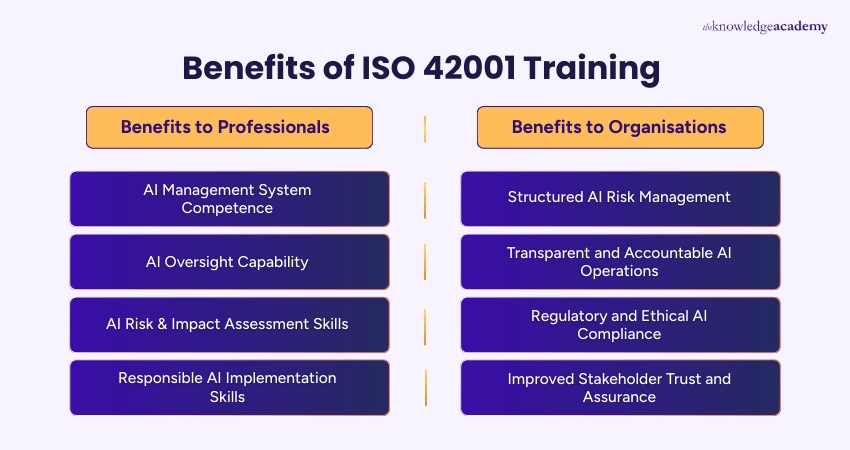
Benefits to Professionals

  • AI Management System Competence: ISO 42001 Training help professionals develop strong understanding of ISO 42001’s AIMS structure, including documented controls, operational procedures, transparency requirements, and governance practices for managing responsible AI systems.
  • AI Oversight Capability: Professionals gain the ability to transition into roles such as AI System Managers, IT Security Professionals, or Risk Management Specialists, ensuring systems operate ethically, transparently, and in alignment with regulatory expectations.
  • AI Risk & Impact Assessment Skills: Develop the capability to identify AI-related risks, conduct algorithmic impact assessments, evaluate data quality, and implement monitoring mechanisms that maintain trustworthy performance.
  • Responsible AI Implementation Skills: These training courses develops practical ability to embed fairness, accountability, explainability, and preparedness to support ongoing review and compliance audits.

Benefits to Organisations

  • Structured AI Risk Management: ISO 42001-trained teams can implement systematic processes for identifying, assessing, and reducing AI-related risks, ensuring safer and more predictable deployment of AI systems.
  • Transparent and Accountable AI Operations: Training supports the creation of clear documentation, traceability mechanisms, and explainability controls, enabling AI decisions to remain auditable and aligned with governance expectations.
  • Regulatory and Ethical AI Compliance: An ISO 42001-aligned AIMS strengthens readiness for evolving AI regulations, ethical requirements, and societal expectations, reducing exposure to compliance failures or reputational risk.
  • Improved Stakeholder Trust and Assurance: Implementation of ISO 42001 controls enhance the reliability and transparency of AI systems, increasing confidence among clients, partners, regulators, and end-users.
Show more blue-arrow

ISO 42001 Training Course FAQs

ISO 42001 certification helps organisations establish, implement, maintain, and improve an Anti-Bribery Management System. It provides a systematic approach to prevent, detect, and address bribery, contributing to legal compliance and trust from stakeholders.

This training is vital for compliance officers, legal advisors, and any professionals involved in governance, risk management, and compliance. It is also beneficial for organisational leaders aiming to instil a robust anti-bribery culture.

It equips professionals with the knowledge and skills to foster a transparent and ethical business environment. This proactive approach minimizes business risks and enhances organisational credibility and security.

You will learn to plan, conduct, report, and follow up on an audit that complies with ISO 42001. This includes understanding how to assess an organisation's anti-bribery policies, direct audit teams, and effectively communicate findings to management.

There are no formal prerequisites for the Foundation training. It is suitable for anyone interested in understanding the basics of the ISO 42001 standard and its application in preventing organisational bribery.

The Knowledge Academy is one of the Leading global training provider for ISO 42001 Training Course.

The training fees for ISO 42001 Training Course in Switzerland starts from CHF1595

Show more down

Why we're the go to training provider for you

icon

Best price in the industry

You won't find better value in the marketplace. If you do find a lower price, we will beat it.
icon

Trusted & Approved

Recognised by leading certification bodies, we deliver training you can trust.

icon

Many delivery methods

Flexible delivery methods are available depending on your learning style.

icon

High quality resources

Resources are included for a comprehensive learning experience.

barclays Logo
deloitte Logo
Thames Water Logo

"Really good course and well organised. Trainer was great with a sense of humour - his experience allowed a free flowing course, structured to help you gain as much information & relevant experience whilst helping prepare you for the exam"

Joshua Davies, Thames Water

santander logo
bmw Logo
Google Logo

Looking for more information on ISO 42001 Training Course

cross

Upgrade Your Skills. Save More Today.

superSale Unlock up to 40% off today!

WHO WILL BE FUNDING THE COURSE?

close

close

Thank you for your enquiry!

One of our training experts will be in touch shortly to go over your training requirements.

close

close

Press esc to close

close close

Back to course information

Thank you for your enquiry!

One of our training experts will be in touch shortly to go overy your training requirements.

close close

Thank you for your enquiry!

One of our training experts will be in touch shortly to go over your training requirements.