


We may not have the course you’re looking for. If you enquire or give us a call on +31 208081674 and speak to our training experts, we may still be able to help with your training requirements.
IT Governance Roles and Responsibilities Explained
ByThe Knowledge AcademyLast updated on: 17 November 2026
Explore the key IT governance roles and responsibilities involved in aligning technology with business goals, managing risks, ensuring accountability and supporting informed IT decisions.
At a Glance
1. IT governance ensures technology aligns with business goals and delivers value.2. Key roles include the Board of Directors, IT governance committee, CIO, CISO and IT Governance Manager.3. Core responsibilities include IT alignment, risk oversight, compliance and performance monitoring.4. IT governance sets direction and accountability, while IT management handles implementation and daily operations.
Technology plays a major role in how organisations operate, make decisions and achieve business goals. However, managing IT resources alone is not enough. Organisations also need clear direction, accountability and oversight to ensure their technology investments deliver value and address potential risks.
This is where IT governance roles and responsibilities become essential. From establishing IT objectives to overseeing risks and ensuring regulatory compliance, effective governance helps organisations make informed technology decisions. This blog explores the key roles and responsibilities involved in effective IT governance.
Key IT Governance Roles
IT governance involves individuals and groups responsible for directing, overseeing and evaluating technology-related activities. Their responsibilities differ according to the organisation's size, structure and business requirements. Here are the important roles commonly involved in IT governance:
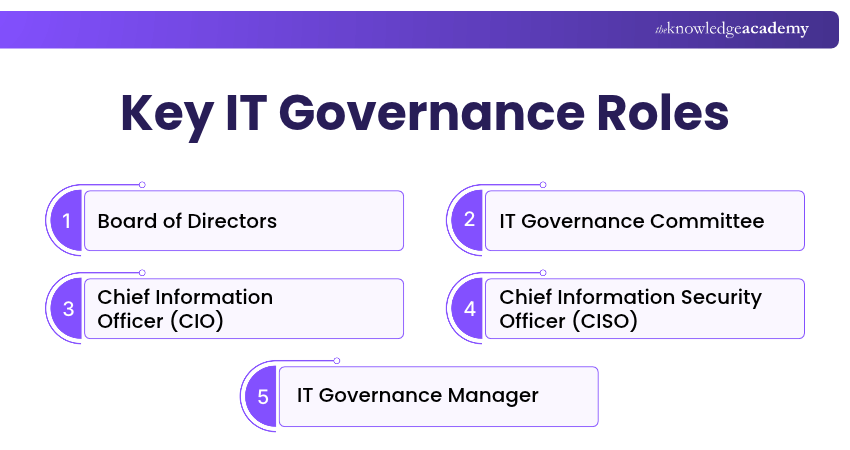
1) Board of Directors
The Board of Directors plays a key role in overseeing how technology supports organisational objectives. It provides strategic direction and reviews significant IT-related risks, investments and performance outcomes. The Board also ensures that suitable governance arrangements are established and that management remains accountable for delivering agreed objectives.

2) IT Governance Committee
The IT governance committee oversees technology-related decisions and ensures alignment with business priorities. It reviews IT strategies, investments, risks and performance while supporting collaboration between business leaders and IT management. It may also approve investments within its delegated authority.
3) Chief Information Officer (CIO)
The Chief Information Officer (CIO) is a senior executive responsible for leading an organisation's IT strategy and management activities. The CIO helps connect business objectives with technology capabilities and supports the implementation of governance decisions.
4) Chief Information Security Officer (CISO)
The Chief Information Security Officer (CISO) is responsible for leading an organisation's information security programme and supporting oversight of cyber security risks. The CISO works with senior leadership, risk management teams and IT professionals to ensure that security measures align with business requirements and applicable obligations.
5) IT Governance Manager
An IT Governance Manager coordinates governance policies, processes and reporting arrangements to help ensure that IT activities follow organisational requirements. The role involves working with senior leadership, IT teams and other departments to support governance frameworks, monitor compliance and identify opportunities for improvement.
Pro Tip
Create a responsibility matrix that identifies who makes IT decisions, who implements them and who monitors their outcomes. This helps prevent overlapping duties, unclear approvals and gaps in accountability.
Key IT Governance Responsibilities
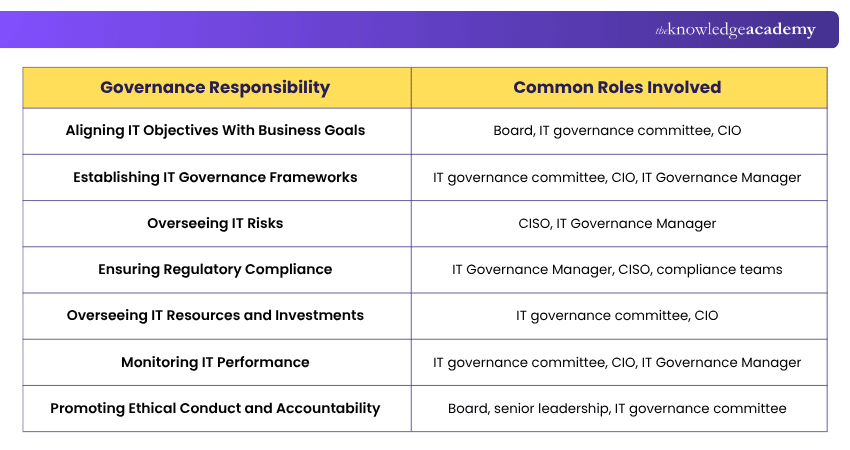
IT governance responsibilities focus on ensuring that technology contributes to organisational objectives while maintaining accountability, managing risks and supporting responsible resource utilisation. The following table highlights seven major governance responsibilities and the roles commonly involved in overseeing them:
1) Aligning IT Objectives With Business Goals
One of the primary responsibilities of IT governance is ensuring that technology objectives support the organisation's overall strategy. This involves working with senior executives and other stakeholders to identify priorities and determine how IT can contribute to business success.
For example, an organisation focused on digital transformation may prioritise cloud adoption, process automation or improved cybersecurity. By establishing clear objectives, IT governance helps ensure that technology initiatives and investments support measurable business outcomes.
2) Establishing IT Governance Frameworks
IT governance involves establishing structures, policies and decision-making processes that guide the responsible use of technology. Frameworks such as COBIT and standards such as ISO/IEC 38500:2024 can help organisations establish governance principles, clarify accountability and evaluate IT-related decisions.
This responsibility includes defining governance roles, establishing reporting arrangements and overseeing the implementation of appropriate controls. A well-structured governance framework helps organisations maintain consistency, transparency and accountability across their IT activities.
Govern technology with confidence and lead every IT decision with purpose by signing up for the ISO 38500 Training today!
3) Overseeing IT Risks
IT governance plays an important role in overseeing technology-related risks that could affect business operations, information security or organisational performance. These risks may involve cyber threats, system failures, data breaches, third-party dependencies or unsuccessful technology investments.
Governance bodies establish risk expectations, review significant exposures and monitor whether appropriate actions are being taken. This helps organisations make informed decisions about risk acceptance, mitigation and other appropriate responses.
Trainer Insight
Organisations can strengthen IT governance through COBIT for aligning IT with business goals, ISO/IEC 38500:2024 for responsible IT oversight, and ITIL (Version 5) for improving digital product and service management.
4) Ensuring Regulatory Compliance
IT governance helps organisations oversee compliance with applicable laws, regulations, industry standards and internal policies. This involves identifying relevant obligations, establishing accountability and monitoring whether appropriate compliance measures are in place.
For example, governance arrangements may support oversight of data protection requirements, information security controls and audit findings. Regular reviews and reporting help identify compliance gaps and support timely corrective action.
5) Overseeing IT Resources and Investments
IT governance ensures that technology resources and investments are directed towards organisational priorities. This involves reviewing significant IT expenditure, evaluating expected benefits and overseeing whether resources are used responsibly.
For example, when considering a new software system, governance bodies may assess its expected business value, implementation risks and long-term costs before approving the investment through the appropriate decision-making authority.
6) Monitoring IT Performance
Monitoring IT performance is essential for determining whether technology activities are achieving their intended outcomes. IT governance involves evaluating performance reports, reviewing relevant indicators and identifying areas requiring management attention.
These indicators may include service reliability, project outcomes, cybersecurity risk exposure and the benefits delivered by technology investments. Regular performance monitoring helps governing bodies assess whether IT activities remain aligned with organisational expectations and deliver expected business value.
Build stronger governance frameworks and make every IT decision count by joining the COBIT 7 Foundation Training today!
7) Promoting Ethical Conduct and Accountability
IT governance supports ethical behaviour, transparency and responsible decision-making across technology-related activities. This includes establishing expectations for data privacy, information security, professional conduct and appropriate use of organisational resources.
Governance bodies also help promote a culture in which individuals understand their responsibilities and remain accountable for their decisions. By encouraging ethical practices and clear accountability, organisations can strengthen stakeholder trust and support responsible technology use.
Checklist: Are Your IT Governance Responsibilities Clearly Defined?
□ Are IT objectives aligned with business priorities?□ Are governance roles and decision-making authorities clearly assigned?□ Is an appropriate IT governance framework established?□ Are significant IT risks identified and regularly reviewed?□ Are compliance responsibilities and controls clearly documented?□ Are major IT investments evaluated against expected business value?□ Is IT performance monitored using relevant measures?□ Are governance decisions and corrective actions reviewed regularly?

The Knowledge Academy develops accessible learning content across Project Management, IT, Cybersecurity, Data Science, Business Analysis, HR, Accounting and Finance, Leadership and Health and Safety. Its resources combine subject research with clear explanations to help professionals build practical knowledge across a wide range of disciplines.
View Detail

 If you wish to make any changes to your course, please


