


 Top Rated Course

We may not have the course you’re looking for. If you enquire or give us a call on +44 1344 203 999 and speak to our training experts, we may still be able to help with your training requirements.
Lean Six Sigma Belts Explained: Roles & Responsibilities
James Smith 21 October 2025Lean Six Sigma Belts represent various expertise levels in process improvement, including White, Yellow, Green, Black, and Master Black Belts. Each belt signifies specific roles and responsibilities, focusing on project management, problem-solving, and leadership skills to enhance efficiency, reduce waste, and drive operational excellence.

Training Outcomes Within Your Budget!
We ensure quality, budget-alignment, and timely delivery by our expert instructors.
Table of Contents
Ever wondered what Lean Six Sigma “belts” mean? No, it’s not martial arts, but it does involve discipline, precision, and powerful transformations. In the world of process improvement, belts represent different levels of expertise and responsibility. Here, the belt colours represent levels of knowledge and leadership that drive operational excellence.
This blog unpacks the roles, responsibilities, and impact of each belt, from fresh White Belts to seasoned Master Black Belts. Whether you’re just starting or planning your next promotion, this blog will help you master the lingo and the ladder. Dive into this blog and discover which belt fits your future.
Table of Contents
1) What are Lean Six Sigma Belts?
2) Is There any Difference Between Lean Six Sigma Belts and Six Sigma Belts?
3) The Essence of Lean Six Sigma Belts: Roles and Duties
4) The Comparison Between the Various Lean Six Sigma Belts
5) Choosing the Right Belt: Guide for Aspiring Lean Six Sigma Professionals
6) Lean Six Sigma Certification: Process, Benefits, and Opportunities
7) How to Get Lean Six Sigma Certified?
8) What is the Salary Difference Between Green Belt and Black Belt Holders?
9) What Tools are Used in Lean Six Sigma?
10) Conclusion
What are Lean Six Sigma Belts?
Lean Six Sigma Belts represent a structured hierarchy of expertise within the Lean Six Sigma methodology, which combines Lean’s focus on eliminating waste with Six Sigma’s emphasis on reducing variation and improving quality. Each "belt" level signifies a person’s training, skillset, and role in continuous improvement projects. At the entry level, White Belts have a basic understanding of Lean Six Sigma concepts and support larger project teams.
Here are the various Lean Six Sigma Belts in order:
1) Six Sigma white Belt
2) Six Sigma Yellow Belt
3) Six Sigma Green Belt
4) Six Sigma Black Belt
5) Six Sigma Master Black Belt
Is There any Difference Between Lean Six Sigma Belts and Six Sigma Belts?
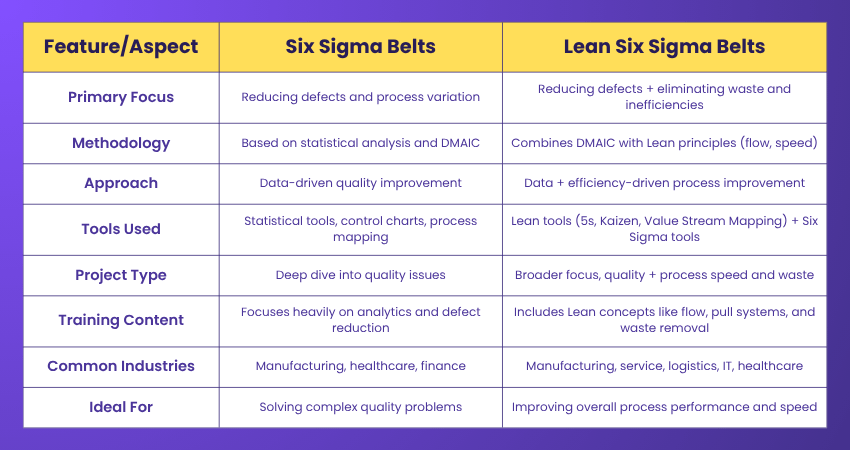
Yes, there is a difference between the two. Six Sigma belts focus primarily on improving quality by reducing process variation and defects using data-driven methods and statistical tools. The DMAIC (Define, Measure, Analyse, Improve, Control) framework is central to Six Sigma projects.
Lean Six Sigma Belts combine Six Sigma’s focus on quality with Lean methodology, which targets eliminating waste and improving process speed and efficiency. This dual approach allows for a broader impact across cost, time, and quality.
The Essence of Lean Six Sigma Belts: Roles and Duties
When you hear “belts” in the world of business improvement, we’re not talking about martial arts, though the inspiration is similar. Just like in karate, Lean Six Sigma Belts represent levels of skill and responsibility. Whether you’re just getting started or planning to lead major transformation projects, understanding these belts is your first step into the world of process improvement.
Let’s break down each belt, what it means, and how it fits into the bigger picture of Lean Six Sigma.
Lean Six Sigma White Belt: Beginning the Journey towards Operational Excellence
The White Belt is where the journey begins. This is the introductory level for individuals who are new to Lean Six Sigma. White Belts may not participate directly in core projects, but they are essential in creating a culture of improvement within a team or organisation. Think of them as the supportive foundation, aware, engaged, and ready to contribute where needed.
Roles and Responsibilities:
1) Learn basic concepts of Lean and Six Sigma
2) Understand how process improvement works
3) Support local problem-solving efforts
4) Help collect data or provide insights from the ground level
5) White Belts often receive short training sessions or workshops
6) This is to familiarise themselves with the terms and tools
Lean Six Sigma Yellow Belt: Active Participation in Process Improvement
Once you’ve dipped your toes in the Lean Six Sigma waters, the Yellow Belt is your next step. Yellow Belts have a deeper understanding of Lean Six Sigma principles and often support improvement projects led by Green or Black Belts.
Roles and Responsibilities:
1) Participate in process improvement projects
2) Help collect and analyse data
3) Identify potential areas of waste
4) Support solution implementation
5) Bridge the gap between strategic project leads and day-to-day operations
6) Their insights help shape practical, people-focused solutions
Lean Six Sigma Green Belt: Leading Projects with Expertise
The Green Belt represents a major step forward, as people begin to lead their own Lean Six Sigma projects. Green Belts work on improvement projects part-time while maintaining their regular job duties.
Roles and Responsibilities:
1) Lead improvement projects within their departments
2) Use tools like DMAIC (Define, Measure, Analyse, Improve, Control)
3) Analyse root causes of process issues
4) Implement data-driven solutions
5) Guide Yellow Belts and team members
6) Green Belts are trained in more complex analytical tools and methodologies
7) They reduce waste, improving quality, and boosting efficiency
Lean Six Sigma Black Belt: Mastery in Strategy and Mentorship
Black Belts are full-time problem solvers and change agents within an organisation. They not only lead large-scale, cross-functional projects but also serve as mentors to Green and Yellow Belts.
Roles and Responsibilities:
1) Lead major improvement initiatives across departments
2) Solve high-impact, complex problems
3) Train and coach Green and Yellow Belts
4) Use advanced statistical tools and software
5) Work closely with leadership to align projects with business goals
6) Black Belts are analytical, strategic, and excellent communicators
7) They have measurable effects on cost, quality, and customer satisfaction
Lean Six Sigma Master Black Belt: The Pinnacle of Lean Six Sigma Expertise
At the top of the Lean Six Sigma ladder is the Master Black Belt. This is a senior-level role focused not only on projects but on building the Lean Six Sigma capability of the entire organisation.
Roles and Responsibilities:
1) Develop a Lean Six Sigma strategy at the organisational level
2) Train and certify Black and Green Belts
3) Identify project opportunities with the executive team
4) Monitor project progress across business units
5) Ensure best practices and consistency across teams
Lean Six Sigma Training - Champion Belt
The Champion Belt plays a strategic and leadership role when Lean Six Sigma Belts focus to execute and manage improvement projects. Champions are typically senior managers or executives who sponsor Lean Six Sigma projects.
Roles and Responsibilities:
1) Champions Belt ensures projects align with overall business objectives and priorities
2) Ensure teams have the support and resources needed to succeed
3) Use their authority to remove obstacles that may delay progress
4) Monitor the success of projects at a high level, focusing on ROI, customer impact
5) Promise a continuous improvement mindset throughout the organisation
The Comparison Between the Various Lean Six Sigma Belts
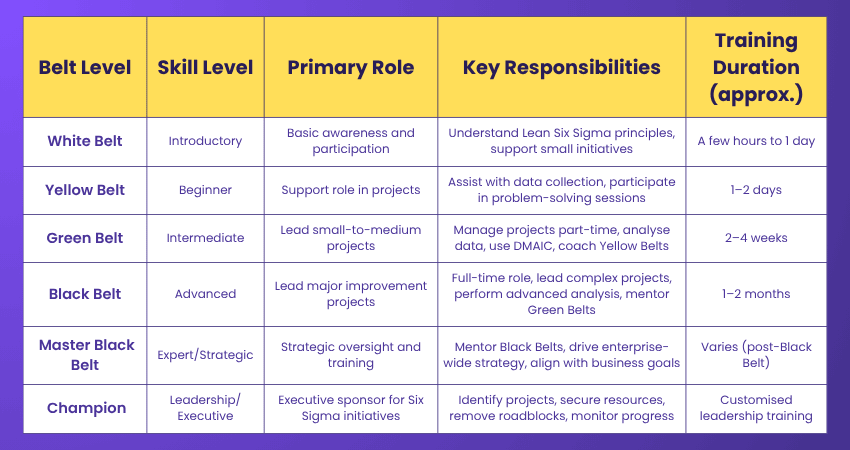
The Lean Six Sigma belt system creates a clear path for growth, from basic awareness to expert-level strategy. Each belt plays a unique role in organisational improvement. White and Yellow Belts support projects, Green Belts lead smaller initiatives, while Black Belts drive larger, cross-functional improvements.
Master Black Belts focus on strategic oversight and training, and Champions ensure alignment with business goals. Together, these roles form a collaborative structure that drives continuous improvement across the organisation.
Whether you're new to process improvement or leading at the executive level, there's a belt that matches your skills, goals, and impact potential within the Lean Six Sigma framework.
Choosing the Right Belt: Guide for Aspiring Lean Six Sigma Professionals
If you want to start your Lean Six Sigma journey, choosing the right belt is key to setting yourself up for success. Each belt level serves a different purpose and suits a different stage in your career. Let's have a closer look:
1) Yellow Belt is ideal for professionals who want to support improvement projects. It’s perfect for team players and those new to Lean Six Sigma concepts.
2) It understands the tools used in process analysis. It’s great for team players and first-time learners.
3) Green Belt is perfect for those ready to lead smaller projects or take a more hands-on role in process improvement.
4) It’s great for managers or professionals who want to blend Lean Six Sigma into their regular job.
5) The Black Belt level is designed for professionals who want to make process improvement their full-time focus.
6) You’ll need strong leadership, analytical thinking, and project management skills.
7) Master Black Belt is best for experienced Black Belts who want to take on mentoring, training, and strategic planning responsibilities across the organisation.
8) Champion is the go-to belt for executives and senior managers who want to sponsor projects and drive long-term change at a leadership level.
Tip: Start where you are. If you're unsure, begin with a Yellow or Green Belt and get to higher levels as you gain experience and confidence.
Get hands-on expertise in problem solving with our Lean Six Sigma Green Belt Course, Start your journey now!
Lean Six Sigma Certification: Process, Benefits, and Opportunities
Earning a Lean Six Sigma Certification is about becoming a smarter problem solver, a more efficient leader, and an asset to any organisation. Whether you're eyeing a promotion or aiming to lead impactful projects, this certification can open powerful new doors.
The Certification Process:
1) Start with the belt that matches your experience and career goals. White, Yellow, Green, Black, or Master Black Belt.
2) Join an accredited training provider, where you'll learn Lean Six Sigma tools, principles, and real-world applications.
3) Demonstrate your knowledge by passing a certification exam that covers your belt level’s key concepts and methodologies.
4) For higher belts, you may be required to complete a real-world project to prove your skills in action.
Benefits of Lean Six Sigma Certification:
1) Certified professionals are highly influencial in industries like manufacturing, healthcare, IT, and finance.
2) Many Lean Six Sigma certified professionals earn higher salaries due to their efficiency and problem-solving capabilities.
3) Learn how to identify root causes, eliminate waste, and make processes better, faster, and cheaper.
4) Gain the tools to lead improvement projects, make data-driven decisions, and deliver measurable results.
5) Lean Six Sigma is used by top companies around the world—your certification is valuable no matter where your career takes you.
Career Opportunities After Certification:
With a Lean Six Sigma Certification, you can take on roles such as:
1) Process Improvement Specialist
2) Quality Analyst or Manager
3) Project Manager
4) Operations Manager
5) Business Analyst
6) Continuous Improvement Consultant
How to Get Lean Six Sigma Certified?
The first step is choosing the right belt level based on your current skills and goals. For a complete beginner, the White or Yellow Belt is perfect for learning the basics. If you want to lead improvement projects, a Green Belt is ideal.
However, a Black Belt is suited for professionals managing large, cross-functional initiatives. Master Black Belts and Champions are more strategic roles focused on mentoring or executive sponsorship.
For Green and Black Belts, some programs may also require you to complete a real-world project. This hands-on experience can significantly boost your confidence and credibility. Once you pass the exam and submit your project, if required, you’ll earn your Lean Six Sigma Certification.
After certification, apply your skills in real projects, showcase the value, and progress to the next belt level as you grow in your career. Whether you’re solving small problems or leading enterprise-wide change, Lean Six Sigma gives you the tools to make a measurable difference.
Prepare for success with our expert guide on Start practising today!
What is the Salary Difference Between Green Belt and Black Belt Holders?
The estimated total pay for a Six Sigma Black Belt is £48,696 per year, with an average salary of £45,074 per year. Whereas the basic page range of a Green belt Holder is £29K – £42K per year for the Lead Operations Specialist Manager.
What Tools are Used in Lean Six Sigma
Lean Six Sigma uses tools like DMAIC, process mapping, root cause analysis, Pareto charts, fishbone diagrams, control charts, 5 Whys, and value stream mapping. These help teams identify problems, reduce waste, improve quality, and control processes more efficiently.
Conclusion
Lean Six Sigma Belts represent different levels of expertise and responsibility within process improvement initiatives. From White to Master Black Belt, each role plays a vital part in driving efficiency, reducing waste, and improving quality across an organisation. Understanding these roles helps teams work better together and ensures the right people lead the right projects for lasting impact.
Build a strong foundation in process improvement with our Lean Six Sigma Yellow Belt Course, Sign-up Now!
Frequently Asked Questions
What is the Pass Rate for Lean Six Sigma Exams?

The pass rate for Lean Six Sigma exams can vary depending on the certification level and the organisation administering the exam. Generally:
a) Green Belt exams have a pass rate of around 70%.
b) Black Belt exams also tend to have a pass rate in the range of 70% to 100%, depending on factors such as the country, company, industry, and the experience of the candidates.
Does Six Sigma Certification Expire?
Some Six Sigma Certifications do expire, depending on the provider. For example, IASSC certifications are valid for three years and require recertification, while ASQ Certifications also typically require recertification every three years. It’s important to check the policy of the organisation you certify with, as renewal may involve fees, training, or proof of continued practice.
What are the Other Resources and Offers Provided by The Knowledge Academy?
The Knowledge Academy takes global learning to new heights, offering over 3,000 online courses across 490+ locations in 190+ countries. This expansive reach ensures accessibility and convenience for learners worldwide.;
Alongside our diverse Online Course Catalogue, encompassing 19 major categories, we go the extra mile by providing a plethora of free educational Online Resources like Blogs, eBooks, Interview Questions and Videos. Tailoring learning experiences further, professionals can unlock greater value through a wide range of special discounts, seasonal deals, and;Exclusive Offers.
What is The Knowledge Pass, and How Does it Work?
The Knowledge Academy’s Knowledge Pass, a prepaid voucher, adds another layer of flexibility, allowing course bookings over a 12-month period. Join us on a journey where education knows no bounds.
KnowledgePass
What are the Related Courses and Blogs Provided by The Knowledge Academy?
The Knowledge Academy offers various Lean Six Sigma Certification, including the Lean Six Sigma Yellow Belt Course, Lean Six Sigma Master Black Belt Course and the Lean Six Sigma Black Belt Course. These courses cater to different skill levels, providing comprehensive insights into Lean Kanban.
Our Business Improvement Blogs cover a range of topics related to Business, offering valuable resources, best practices, and industry insights. Whether you are a beginner or looking to advance your Business skills, The Knowledge Academy's diverse courses and informative blogs have got you covered.

James Smith


Digital Marketing Manager and Trainer
James Smith is a digital marketing professional with over a decade of experience in SEO, content strategy, paid media and analytics. He has supported both SMEs and global brands in transforming their digital presence. James’s writing and training are rooted in results-driven tactics and the latest marketing trends.
View Detail
Upcoming Business Improvement Resources Batches & Dates
Date
 Lean Six Sigma Green Belt
Lean Six Sigma Green Belt
Mon 23rd Mar 2026
Lean Six Sigma Green Belt
Mon 30th Mar 2026
Lean Six Sigma Green Belt
Tue 7th Apr 2026
Lean Six Sigma Green Belt
Mon 13th Apr 2026
Lean Six Sigma Green Belt
Mon 20th Apr 2026
Lean Six Sigma Green Belt
Mon 27th Apr 2026
Lean Six Sigma Green Belt
Tue 5th May 2026
Lean Six Sigma Green Belt
Mon 11th May 2026
Lean Six Sigma Green Belt
Mon 18th May 2026
Lean Six Sigma Green Belt
Tue 26th May 2026
Lean Six Sigma Green Belt
Mon 1st Jun 2026
Lean Six Sigma Green Belt
Mon 8th Jun 2026
Lean Six Sigma Green Belt
Mon 15th Jun 2026
Lean Six Sigma Green Belt
Mon 22nd Jun 2026
Lean Six Sigma Green Belt
Mon 29th Jun 2026
Lean Six Sigma Green Belt
Mon 6th Jul 2026
Lean Six Sigma Green Belt
Mon 13th Jul 2026
Lean Six Sigma Green Belt
Mon 20th Jul 2026
Lean Six Sigma Green Belt
Mon 27th Jul 2026
Lean Six Sigma Green Belt
Mon 3rd Aug 2026
Lean Six Sigma Green Belt
Mon 10th Aug 2026
Lean Six Sigma Green Belt
Mon 17th Aug 2026
Lean Six Sigma Green Belt
Mon 24th Aug 2026
Lean Six Sigma Green Belt
Tue 1st Sep 2026
Lean Six Sigma Green Belt
Mon 7th Sep 2026
Lean Six Sigma Green Belt
Mon 14th Sep 2026
Lean Six Sigma Green Belt
Mon 21st Sep 2026
Lean Six Sigma Green Belt
Mon 28th Sep 2026
Lean Six Sigma Green Belt
Mon 5th Oct 2026
Lean Six Sigma Green Belt
Mon 12th Oct 2026
Lean Six Sigma Green Belt
Mon 19th Oct 2026
Lean Six Sigma Green Belt
Mon 26th Oct 2026
Lean Six Sigma Green Belt
Mon 2nd Nov 2026
Lean Six Sigma Green Belt
Mon 9th Nov 2026
Lean Six Sigma Green Belt
Mon 16th Nov 2026
Lean Six Sigma Green Belt
Mon 23rd Nov 2026
Lean Six Sigma Green Belt
Mon 30th Nov 2026
Lean Six Sigma Green Belt
Mon 7th Dec 2026
Lean Six Sigma Green Belt
Mon 14th Dec 2026
Lean Six Sigma Green Belt
Mon 21st Dec 2026
Lean Six Sigma Green Belt
Tue 29th Dec 2026

 If you wish to make any changes to your course, please


