


 Top Rated Course

We may not have the course you’re looking for. If you enquire or give us a call on +55 8000201623 and speak to our training experts, we may still be able to help with your training requirements.
What is CISSP: Certified Information Professional
John Davies 13 July 2026Certified Information Systems Security Professional (CISSP) is a globally recognised cybersecurity certification focused on Information Security Management. It validates the ability to design, implement, and manage secure systems within an organisation. It covers domains such as risk management, network security, and governance.

Training Outcomes Within Your Budget!
We ensure quality, budget-alignment, and timely delivery by our expert instructors.
Table of Contents
If you're exploring a career in information security, you’ve likely asked yourself: What is CISSP? The Certified Information Systems Security Professional (CISSP) is one of the most prestigious and globally recognised certifications in the cybersecurity field, designed for experienced professionals who protect organisations from evolving digital threats.
This blog provides information on the Certified Information Systems Security Professional credential. We’ll explore what CISSP entails, who it’s for, the career benefits it offers, and why it’s become the benchmark for excellence in the cybersecurity industry. Be it a technical leadership position that you aspire to attain or a certification that would back your experience in the field, CISSP may be the next career step.
Table of Contents
1) What is CISSP Certification?
2) What are the Benefits of Getting the CISSP Certification?
3) CISSP Requirements
4) CISSP Exam
5) CISSP Certification Salary
6) What are the 5 Pillars of CISSP?
7) What After the CISSP Certification?
8) Conclusion
What is CISSP Certification?
Certified Information Systems Security Professional (CISSP) is a well-known worldwide credential in the field of cybersecurity, offered by the International Information System Security Certification Consortium (ISC2). It focuses on building a broad understanding of Information Security.
The CISSP helps learners understand how security works not just technically, but also from a management and governance perspective. In other words, it goes beyond configuring tools or fixing vulnerabilities. The learners are expected to assess risks, create security policies, align security practices with business objectives, and ensure regulatory compliance
A Brief History
Around the late 1980s, the increased complexity of information security stimulated a group of organisations to sketch a standardised and vendor-neutral certification for the professionals in the area. Some industry organisations united in 1988 to establish the International Information System Security Certification Consortium, more commonly called (ISC) ², which is a non-profit making organisation focused on the enhancement of cybersecurity.
As of 1989, ISC2, started to create the Common Body of Knowledge (CBK), which would be the basis of a globally recognised certification. The initial version of CBK was concluded in 1992. So, in 1994, ISC2 officially rolled out a project named Certified Information Systems Security Professional (CISSP), which is meant to certify professionals with a high level of knowledge and industrial experience in the Information Security field.

Changes in CISSP Certification Over the Course of Time
Following its introduction, CISSP has constantly been updated to conform to international standards, receiving some major accreditation and awards along the way. These milestones have built its fame to be viewed as a gold standard in Cybersecurity Certification.
1) 2004: CISSP gained ANSI (American National Standards Institute) accreditation under ISO/IEC 17024, an internationally credible accreditation standard.
2) 2004: U.S.-based NSA (National Security Agency) implemented CISSP as the basis of its own ISSEP (Information Systems Security Engineering Professional).
3) 2005: CISSP was sanctioned by the U.S. Department of Defense under DoD Directive 8570.1 (the current equivalent is 8140) as a compulsory certification to perform certain cybersecurity functions.
4) 2017: CISSP English language exam shifted to Computerised Adaptive Testing (CAT) with the result that the exam is shorter and more efficient without loss of rigour.
5) 2019: ISC2 certifications, such as CISSP, were internationally accepted by the International Accreditation Forum (IAF), which proves their international quality.
6) 2020: UK NARIC (now Ecctis) recognised CISSP as a Level 7 qualification on the RQF at the same level as a Master qualification in the UK. The recognition will enable professionals to accumulate credits into postgraduate programmes.
What are the Benefits of Getting the CISSP Certification?
Let’s come back to CISSP. If you’ve been wondering whether you should invest in a CISSP Certification, let us discuss some of the benefits of CISSP Certification:
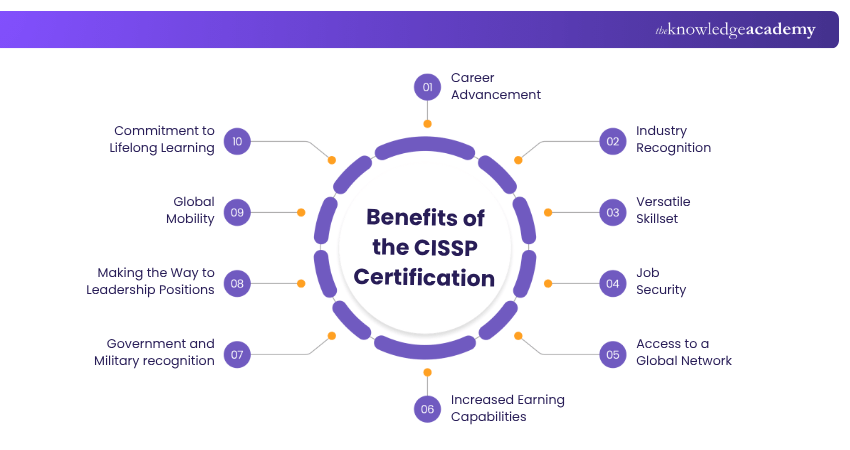
1) Career Advancement: CISSP validates deep expertise across multiple security domains, opening doors to senior and specialised roles. It boosts job prospects and long-term career progression in cybersecurity.
2) Industry Recognition: As a globally respected certification, CISSP enhances your credibility with employers and peers. It reflects your commitment to the profession and high ethical standards.
3) Versatile Skillset: From risk management to compliance and technical security, CISSP covers it all. This equips you to handle diverse cybersecurity challenges across industries.
4) Job Security: CISSP professionals are in high demand due to a global shortage of skilled security experts. Their specialised knowledge makes them less vulnerable to layoffs.
5) Access to a Global Network: Certified professionals join an elite community with access to resources, events, and mentorship. This network supports continuous learning and professional growth.
6) Increased Earning Capabilities: The specialists who have passed the CISSP examination tend to have a better paid position than those without a certificate. It is regularly cited as one of the highest-paying IT credentials in the world.
7) Government and Military recognition: CISSP fulfill government and defence standards requirements in various professions like the U.S. DoD 8140 requirements, thus making it critical in the field of the security sector professionals of the government.
8) Making the Way to Leadership Positions: CISSP focuses on strategy, policy and risk management which makes professionals not only ready to work in technical jobs, but also as leaders and even in executive positions.
9) Global Mobility: It is the certification accepted in more than 140 countries that allows professionals to work abroad to find a job in a foreign country, and work as a consultant in multinational companies.
10) Commitment to Lifelong Learning: CISSP has Continuing Professional Education (CPE) requirements, and through it, the programme can motivate you to know the latest threats, technologies, and best practices to always update your skills so that they can remain relevant.
Advance toward high-level security designs with CISSP-ISSAP Training – Register today!
CISSP Requirements
To earn the CISSP certification, learners need to meet certain requirements set by ISC2. The certification is designed for experienced cybersecurity professionals, so it requires both an understanding of security concepts and real work experience in the field. Now that you know what is CISSP, here are its requirements:
1) Work Experience
1) Professionals need to have at least five years of cumulative paid work experience in two or more CISSP domains.
2) You can also get a one-year experience waiver if you have a bachelor's or master’s degree in computer science, Information Technology (IT) or related fields; or if you get an additional credential from the ISC2 approved list such as CompTIA, Certified Information Security Manager (CISM), Certified Cloud Security Professional (CCSP), etc.
3) Professionals who pass the CISSP Exam but do not yet have the required work experience can become an Associate of ISC2. They then have up to six years to gain the needed experience and receive the full CISSP certification.
4) Part-time jobs and internships are also counted towards your work experience.
2) Endorsement Process
After passing the exam, professionals need to be endorsed by an existing ISC2 member, who can verify their professional experience.
3) Code of Ethics
Professionals should agree to follow the ISC2 Code of Ethics, which requires protecting society, acting honourably, and maintaining integrity in their work.
4) Continuing Professional Education (CPE)
After certification, professionals need to maintain the credential by earning Continuing Professional Education (CPE) credits and paying an annual maintenance fee. This ensures professionals stay updated with evolving cybersecurity threats and industry practices.
CISSP Exam
The CISSP exam is a comprehensive exam that evaluates a candidate’s understanding of core cybersecurity concepts. It covers the eight domains of the ISC2 Common Body of Knowledge (CBK), which represent the main areas of knowledge required for Information Security professionals.
The exam is now conducted through Computerised Adaptive Testing (CAT) for three hours. It consists of 100-150 questions in multiple-choice and advanced types, and you have to score a minimum of 700 out of 1000 points to pass the exam.
CISSP Exam Domains and Weightage
1) Security and Risk Management – 16% 2) Asset Security – 10%
3) Security Architecture and Engineering – 13%
4) Communication and Network Security – 13%
5) Identity and Access Management (IAM) – 13%
6) Security Assessment and Testing – 12%
7) Security Operations – 13%
8) Software Development Security – 10% Gain the skills required to control an Information Security framework. Join our Chief Information Security Office Training today!
CISSP Certification Salary
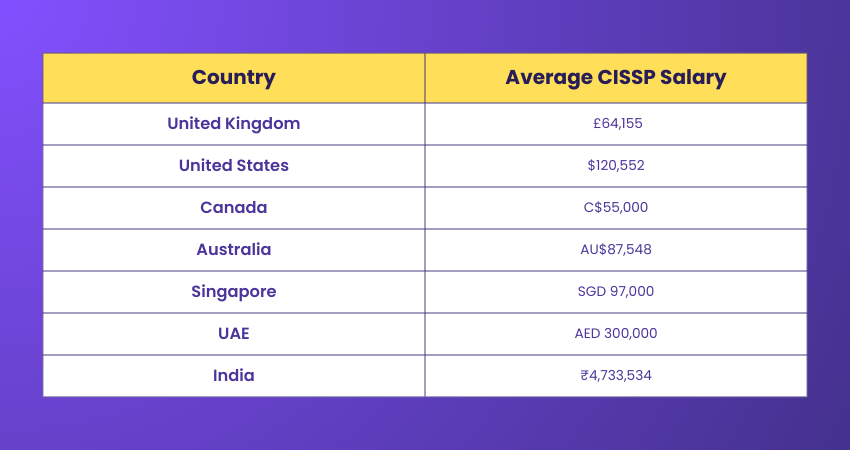
The ISC2 conducts the ISC2 Cyber Security Workforce Study every year. This study also reveals the Average CISSP Salaries around the world. Let’s take a look at CISSP salaries based on the region.
Source: Glassdoor
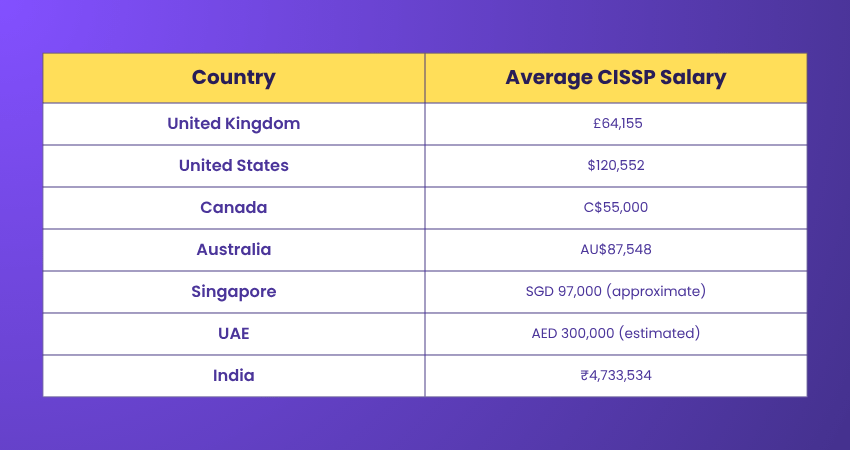
Let’s look at the average annual CISSP salary from different countries.
Source: Glassdoor
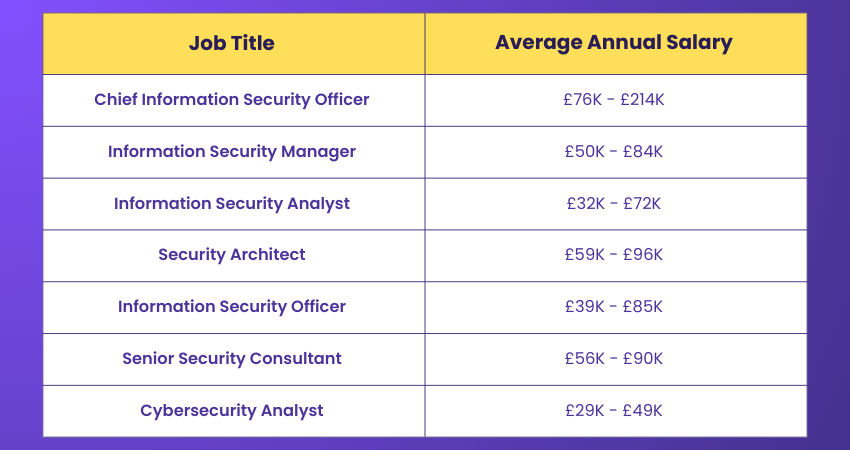
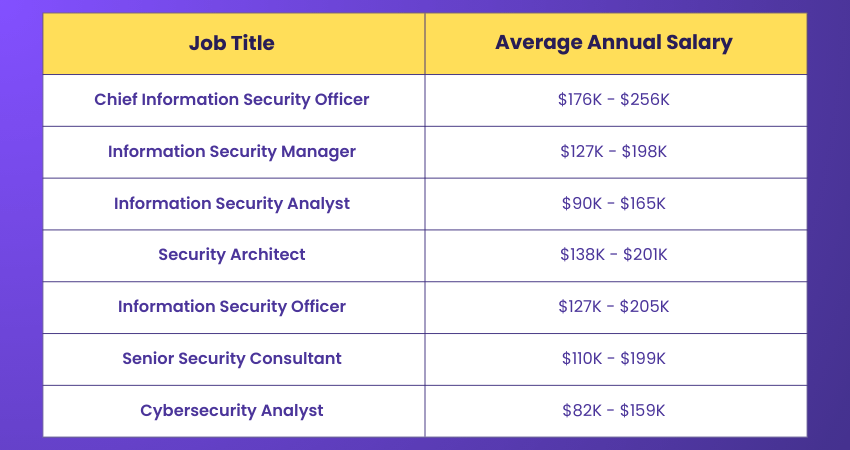
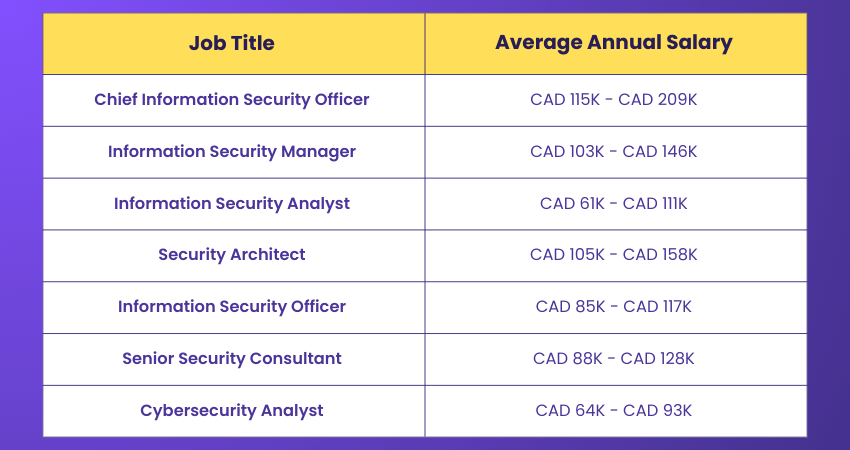
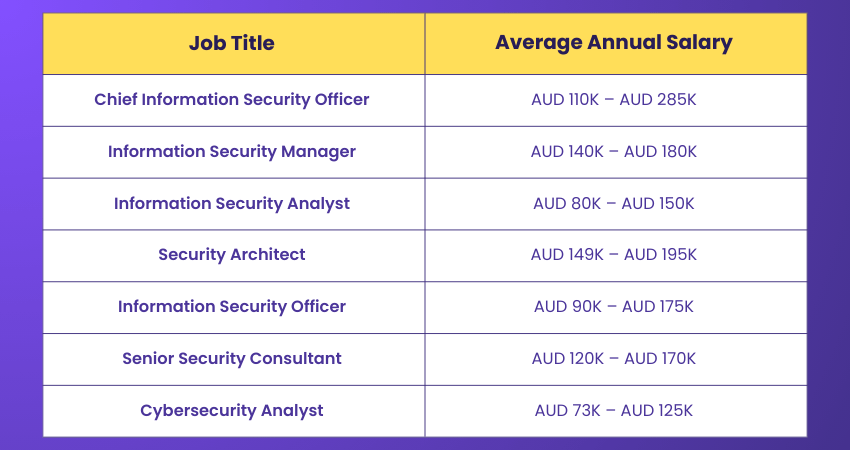
Now, let’s look at the average salaries according to the different CISSP job roles in each of these countries:
CISSP Salary in the UK
Here’s the average CISSP salary according to job titles.
Source: Glassdoor
United States of America
Here’s the average CISSP salary in the USA according to job titles.
Source: Glassdoor
Canada
Here’s the average CISSP salary according to job titles.
Source: Glassdoor
Australia
Here’s the average CISSP salary according to job titles.
Source: Glassdoor
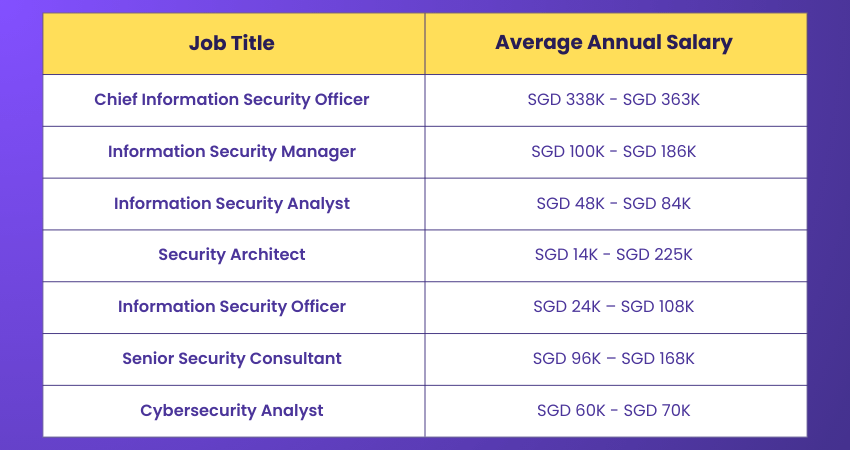
Singapore
Here’s the average CISSP salary according to job titles.
Source: Glassdoor
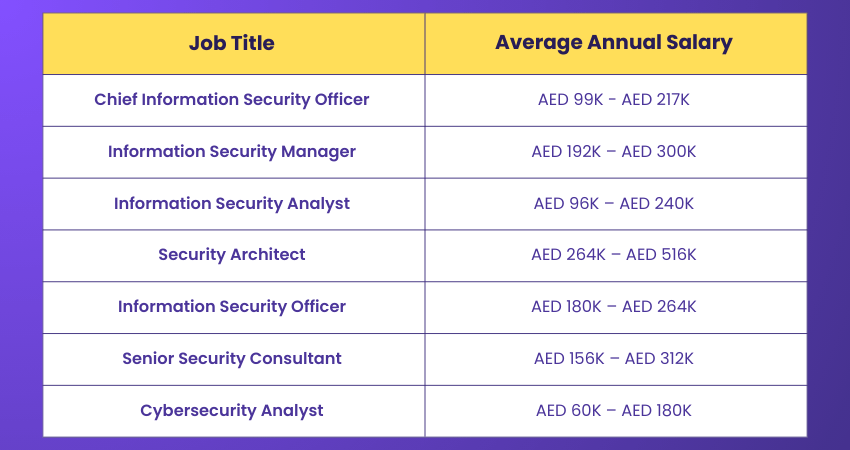
UAE
Here’s the average CISSP salary according to job titles.
Source: Glassdoor
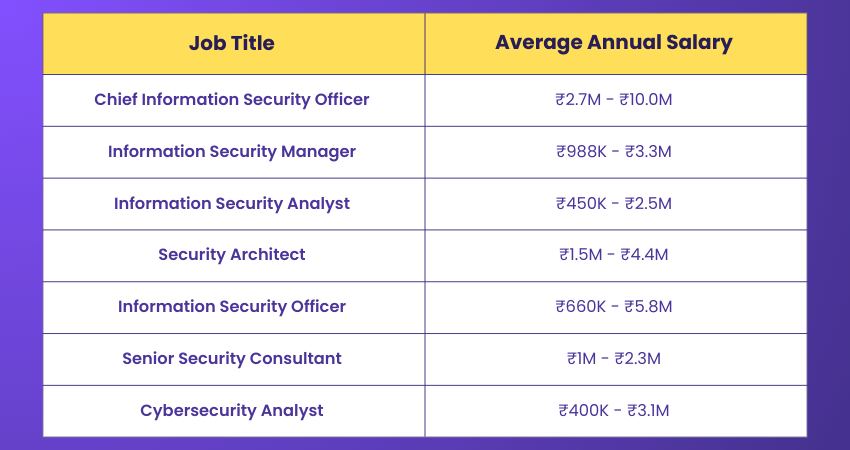
India
Here’s the average CISSP salary according to job titles.
Source: Glassdoor
What are the Five Pillars of CISSP?
The five pillars represent the essential objectives of Information Security that CISSP professionals are expected to understand and apply when protecting systems and data when they have a proper knowledge on what is CISSP. They form the foundation on which security policies, controls, and risk management practices are built. Those are listed below:
1) Confidentiality
Confidentiality means keeping information private. Only authorised people should be able to see or use sensitive data. For example, employee records or customer payment details should not be accessible to everyone.
2) Integrity
Integrity means keeping data accurate and unchanged unless properly updated. Information should not be altered, deleted, or damaged without permission. This ensures organisations can trust the data they use for decisions.
3) Availability
Availability means making sure systems and data are accessible when needed. If a system is down or data cannot be accessed, work can stop. Backups and system monitoring help maintain availability.
4) Authenticity
Authenticity means confirming that users or systems are genuine. It ensures that a person logging in or sending information is really who they claim to be.
5) Non-repudiation
Non-repudiation means that someone cannot deny performing an action. For example, if a person sends an important message or approves a transaction, there should be proof that they did it.
Together, these five pillars explain the main goals of Information Security and help organisations protect their systems and data effectively.
What After the CISSP Certification?
Earning CISSP is a major career milestone, but learning what is CISSP and its upgrades are not the end of the journey. The certification often opens the door to senior and leadership roles in cybersecurity because it shows both technical knowledge and management understanding. Here's a simple overview of what you can expect after your CISSP certification:
Career Opportunities:
After CISSP, professionals can move into higher-level security positions such as Information Security Manager, Security Consultant, Security Architect, IT Risk Manager, etc. These roles usually involve decision-making, policy development, risk assessment, and managing security teams rather than only technical tasks.
Specialisations and Advanced Certifications:
Many professionals also choose to specialise further. These are advanced CISSP certifications that can help you gain in-depth knowledge in your chosen domain. You can get into a specific area of cybersecurity such as:
ISSAP: Information Systems Security Architecture Professional (ISSAP) focuses on designing secure enterprise systems, security frameworks, and infrastructure. You learn how to integrate security into network design, cloud environments, and business applications from the planning stage rather than adding security later.
ISSEP: Information Systems Security Engineering Professional (ISSEP) explores how to build security into the software and system lifecycle, perform security testing, and ensure systems meet security requirements.
ISSMP: Information Systems Security Management Professional (ISSMP) focuses on governance, risk management, security strategy, and team management. It emphasises decision-making and organisational security planning.
Maintaining the Certification:
After earning CISSP, you need to maintain it by earning Continuing Professional Education (CPE) credits and paying an annual maintenance fee. This ensures you stay updated with new technologies, threats, and security practices.
Conclusion
This blog provides a clear understanding of What is CISSP certification and why it’s considered one of the most prestigious credentials in cybersecurity. The CISSP validates advanced knowledge in Information Security and sets you apart in a competitive job market. Compared to entry-level options, CISSP offers greater recognition, higher earning potential, and access to senior roles and a global professional network making it a powerful investment in your long-term cybersecurity career.
Elevate your skills and protect the digital world with our ISSMP Training – Join now!
Frequently Asked Questions
Does CISSP Require Coding?

No, CISSP does not require coding proficiency. It focuses on Cyber Security management, policies, procedures, and best practices rather than programming skills.
Which is Better, CISSP or Security+?
Choosing between CISSP and Security+ depends on career goals and experience. CISSP is more advanced and ideal for experienced professionals, while Security+ is entry-level and suitable for beginners.

John Davies


Cyber Security Governance & Assurance Specialist
John Davies is a cybersecurity expert specialising in governance, risk management, and compliance. With over 15 years in the field, he has led enterprise-wide security programmes across finance, healthcare and public sector organisations. His content provides practical guidance on building secure environments, managing risk and aligning with regulatory frameworks.


 If you wish to make any changes to your course, please


