


 Top Rated Course

We may not have the course you’re looking for. If you enquire or give us a call on +55 8000201623 and speak to our training experts, we may still be able to help with your training requirements.
Business Architecture with the ArchiMate® Modelling Language
James Smith 03 June 2026Business Architecture is an important aspect of organisations. It allows efficiency and productivity. Understand what business architecture means and the purpose of the ArchiMate® Modelling Language. Explore the power of the ArchiMate® Modelling Language in business architecture and uncover its key concepts, applications, and best practices.

Training Outcomes Within Your Budget!
We ensure quality, budget-alignment, and timely delivery by our expert instructors.
Table of Contents

The ArchiMate® Business Architecture is a modelling language especially designed for representing and analysing the business aspects of an organisation. It provides a comprehensive framework for visualising and documenting various business architecture elements, including processes, roles, functions, and organisational structures.
It enables clear communication and collaboration among stakeholders, facilitating strategic decision-making and alignment of business goals with its standardised notations and semantics. It helps organisations analyse their current state, design future state, and identify opportunities for improvement. Enhance your understanding of the ArchiMate® Business Architecture by reading this comprehensive blog and prepare to excel in this domain.
Table of Contents
1) What is the ArchiMate® Modelling Language?
2) What is Business Architecture?
3) How Business Architects Use the ArchiMate® Modelling Language
4) Benefits of Using the ArchiMate® Modelling Language in Business Architecture
5) What are Some Key Concepts of the ArchiMate® Modelling Language?
6) Conclusion
What is the ArchiMate® Modelling Language?
At its core, the ArchiMate® 3 bridges the business and IT domains, enabling organisations to align their business strategies with their technology capabilities. It allows architects to depict and understand the relationships and dependencies between different elements of the enterprise, such as Business Processes, organisational structure, information flows, applications, and technology infrastructure.
It provides a common language for Stakeholders from different disciplines and departments. It offers a rich set of concepts, relationships, and viewpoints that allow architects to represent various business elements' structure, behaviour, and interdependencies. This common language fosters effective communication, collaboration, and shared understanding among stakeholders, ensuring everyone works towards the same goals.
It enables organisations to analyse and evaluate their business architecture more effectively. It facilitates the identification of gaps, redundancies, and opportunities for improvement in the architecture. Architects can explore different scenarios and assess their impact, aiding in informed decision-making.

What is Business Architecture?
Business Architecture is a discipline dedicated to analysing and modelling a business's structure, processes, capabilities, and goals. It serves as a blueprint or framework for organising and aligning different facets of an organisation,its strategy, operations, the ArchiMate® Core Framework, technology, and people.
Business Architecture enables a holistic business view, allowing stakeholders to analyse and optimise its components and relationships. It helps identify areas for improvement, streamline processes, and enhance overall efficiency. It bridges the gap between business strategy and execution, thereby guiding decision-making, facilitating change management, and supporting the organisation in achieving its objectives.
How Business Architects Use the ArchiMate® Modelling Language?
The ArchiMate® modelling language is an independent Enterprise Architecture language. It allows a Business Architect to confirm whether requested changes by experts or strategists align with high-level organisational goals, a key responsibility in the Business Architect Role. Let's know more:
1) Analyse Current State
The primary element here is to understand the need for change. The "Analyse Current State" task according to the Business Analysis Body of Knowledge (BABOK) guide, helps to understand why a business needs to change. Followed by which processes might be impacted. This analysis identifies areas needing improvement and the effects of changes.
For example:
|
Sample situation: Considering a hypothetical company. This company has two domains to interact with customers - 1) Self Care webpage: Customers can update their profile (name, age, address, phone number) and their preferences. 2) Call Center: Customers can call to schedule a meeting with their profile assistant. Company Strategy: The company has two main strategies - 1) Strategy 1: This strategy aims to provide multi-channel customer services. It includes improving customer-facing IT systems. This results in customer satisfaction. This strategy is led by the CEO. 2) Strategy 2: It focuses on reducing IT complexity and costs. This has two benefits. It increases customer satisfaction and works on cost optimisation. This strategy is driven by the CIO. Change wanted: The business wants to let customers schedule meetings with their profile managers through the Self Care web page itself. This can be integrated with the existing phone service for a smooth workflow. The ArchiMate® Modelling Language for Documentation comes into play: The ArchiMate® Modelling Language helps to document the entire plan. This includes thoughts behind this change, goals, requirements, and other constraints. The internal driver of the ArchiMate® Modelling Language can represent strategies, as drivers motivate change. Goals: Each thought or point of drive (for example: customer satisfaction) is linked to goals. This can be further broken down into sub-goals or objectives. |
By using the ArchiMate® Modelling Language, a Business Architect can track all business requirements back to the organisation's strategy. It ensures proper change management.
2) Define Future State
Let's have a look at a step-by-step process:
1) Analyse the Current State: This step is about understanding how the business operates presently and then identify areas that need improvement.
2) What Needs to be Done: This step includes designing a new business model that has the ability to meet the new requirements. These requirements were identified in the first step.
3) Create Solutions: Next step is to develop different ways to achieve the new business model.
4) Design: After all other steps, the best solution gets chosen. Here, the designing part comes into play. Designing the future state ensures that it aligns with the organisation's need for change.
5) Role of the ArchiMate® Modelling Language:
a) Requirement Element: It represents all the new requirements.
b) Core Elements: These are the business services, processes, application components, etc. These are used to fulfil the requirements.
c) Enterprise Architecture Blueprint: Combines all elements. This is needed to create a complete model of the future state.
Benefits of Using the ArchiMate® Modelling Language in Business Architecture
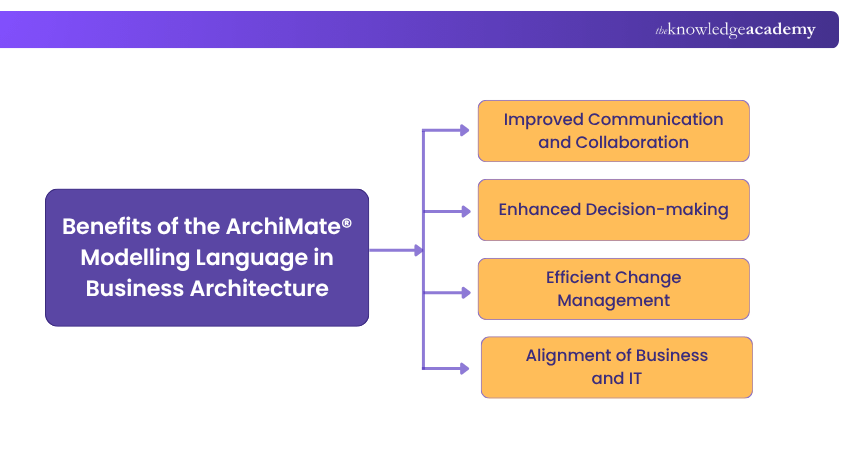
a) Improved Communication and Collaboration: It offers a common language for stakeholders across different departments and disciplines, enabling effective communication and collaboration. With the ArchiMate® diagrams, business architects can bridge the gap between business and IT stakeholders, ensuring a shared understanding of business objectives and facilitating informed decision-making.
b) Enhanced Decision-making: It visualises business architecture, making it easier to analyse and evaluate different scenarios. Decision-makers can assess the impact of potential changes or investments, identify bottlenecks, and optimise processes to align with strategic goals. The ArchiMate®'s rich set of relationships allows for comprehensive modelling, supporting well-informed decision-making.
c) Efficient Change Management: Business architects can model and analyse the impact of changes in a controlled environment by using the ArchiMate® Framework . This helps organisations effectively manage change initiatives, reduce risks, and ensure smooth transitions. It identifies dependencies, potential conflicts, and process gaps, allowing for proactive planning and mitigation strategies.
d) Alignment of Business and IT: The ArchiMate® Modelling Language bridges business and IT architectures, allowing organisations to align their business strategies with IT systems and applications. Business architects can use it to map business processes to IT components, identify opportunities for digital transformation, and ensure that IT investments support the organisation's objectives, which can also influence their Business Architect salary.
Take your ArchiMate® skills to the next level with the ArchiMate® 3 Training Course: Level 2– sign up today!
Key ArchiMate® Modelling Concepts for Business Architecture
To effectively use the ArchiMate® Modelling Language in Business Architecture, it is essential to understand its key concepts:
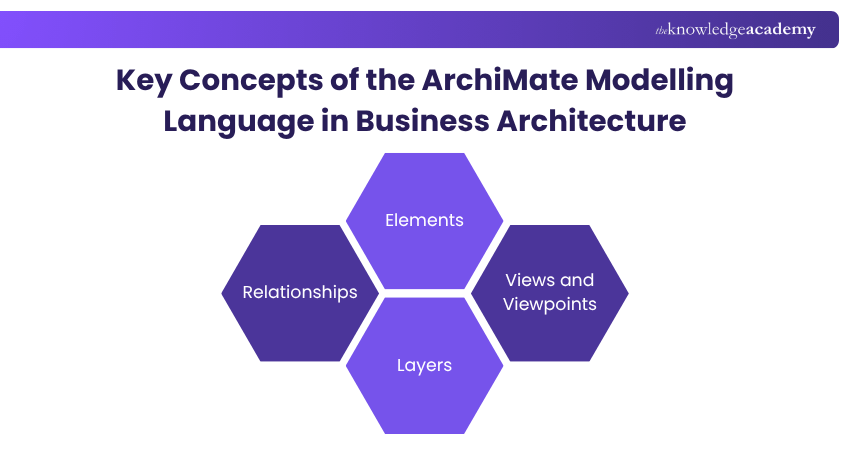
To effectively use Business Architecture the ArchiMate®, it is essential to understand its key concepts:
a) Elements: It consists of business, application, and technology elements. Each element represents a distinct aspect of the business architecture and its relationships with other elements. Examples of the ArchiMate® elements include organisation, business process, product, application service, and infrastructure service.
b) Relationships: These depict the associations, dependencies, and interactions between elements. They help illustrate how different elements contribute to the overall business architecture. Its relationships include composition, aggregation, specialisation, association, flow, and trigger.
c) Views and Viewpoints: It allows the creation of different views and viewpoints to cater to various stakeholders' perspectives. Views focus on specific aspects of business architecture, while viewpoints define the conventions and rules for constructing and interpreting those views. Examples of viewpoints in the ArchiMate® include the business process, application cooperation, and technology.
d) Layers: It organises business architecture into layers, each representing a specific aspect of the organisation. The core layers in the ArchiMate® are the business, application, and technology layers. This layering approach helps in the modular design and analysis of the business architecture.
Join our ArchiMate® 3 Training Course to learn the basics of ArchiMate® modelling languages!
Conclusion
In this blog, we explored the key concepts of Business Architecture in the ArchiMate® Modelling Language, discussed the benefits and challenges of using it in Business Architecture, and provided best practices for its implementation. By following these guidelines and leveraging its tools and techniques, and designs from the ArchiMate® Cookbook organisations can unlock the full potential of their business architecture and drive success.
Enhance your enterprise architecture expertise with the ArchiMate® 3 Training courses – Register now!
Frequently Asked Questions
How Can Businesses Effectively Implement and Leverage the ArchiMate® Modelling Language for Strategic Planning and Decision-making?

Businesses can effectively implement and leverage the ArchiMate® Modelling Language for strategic planning and decision-making by using standardised models to connect business goals, processes, applications, and technology. This helps stakeholders assess impacts, manage risks, and make better decisions aligned with strategy and operations.
How is the ArchiMate® Modelling Language Helpful?
The ArchiMate® modelling language offers a structured framework. There is concept of layers, like business strategy, technology, and implementation, and aspects like active structure and passive structure. It also fulfils the requirements for modelling a business architecture.
What are the Other Resources and Offers Provided by The Knowledge Academy?
The Knowledge Academy takes global learning to new heights, offering over 3,000+ online courses across 490+ locations in 190+ countries. This expansive reach ensures accessibility and convenience for learners worldwide.
Alongside our diverse Online Course Catalogue, encompassing 17 major categories, we go the extra mile by providing a plethora of free educational Online Resources like Blogs, eBooks, Interview Questions and Videos. Tailoring learning experiences further, professionals can unlock greater value through a wide range of special discounts, seasonal deals, and Exclusive Offers.
What is the Knowledge Pass, and how does it work?
The Knowledge Academy’s Knowledge Pass, a prepaid voucher, adds another layer of flexibility, allowing course bookings over a 12-month period. Join us on a journey where education knows no bounds.
What are related courses and blogs provided by The Knowledge Academy?
The Knowledge Academy offers The ArchiMate® Training on various courses including the ArchiMate® 3 Training Course, the ArchiMate® 3 Training Course: Level 1, and the ArchiMate® 3 Training Course: Level 2. These courses cater to different skill levels, providing comprehensive insights into the Business Architect Salary.
Our Business Improvement Blogs cover a range of topics related to the Business Architecture, offering valuable resources, best practices, and industry insights. Whether you are a beginner or looking to advance your Business Improvement skills, The Knowledge Academy's diverse courses and informative blogs have got you covered.

James Smith


Digital Marketing Manager and Trainer
James Smith is a digital marketing professional with over a decade of experience in SEO, content strategy, paid media and analytics. He has supported both SMEs and global brands in transforming their digital presence. James’s writing and training are rooted in results-driven tactics and the latest marketing trends.
View Detail
Upcoming Business Improvement Resources Batches & Dates
Date
 ArchiMate® 3 Training Course
ArchiMate® 3 Training Course
Thu 27th Aug 2026
ArchiMate® 3 Training Course
Thu 19th Nov 2026

 If you wish to make any changes to your course, please


