


 Top Rated Course

We may not have the course you’re looking for. If you enquire or give us a call on +55 8000201623 and speak to our training experts, we may still be able to help with your training requirements.
AI in Financial Reporting: A Complete Guide for Finance Teams
Lily Turner 23 May 2026AI in Financial Reporting helps finance teams work faster, improve data accuracy, and gain better insights through real-time reporting and forecasting. By using AI, it automates routine tasks, reduces manual work, and minimises the chances of human error. Overall, this supports better financial reporting and planning.

Training Outcomes Within Your Budget!
We ensure quality, budget-alignment, and timely delivery by our expert instructors.
Table of Contents

Every month-end brings the same routine: spreadsheets, number chasing, and endless error checks. Sound familiar? For many finance teams, this cycle is not only repetitive but also time-consuming. As businesses grow and data volumes increase, relying on manual processes makes Financial Reporting very challenging.
This is where Artificial Intelligence (AI) is making a real impact. It helps finance teams automate tasks, process data faster, and improve overall accuracy. To understand this further, in this blog, we’ll explore what is AI in Financial Reporting, its key benefits, and how every business can use it to work effectively. Let's dive in!
Table of Contents
1) What is AI in Financial Reporting?
2) How AI is Used in Financial Reporting?
3) How AI Can Improve the Financial Reporting Process?
4) Role of AI in Modern Finance
5) How to Implement AI in Financial Reporting?
6) Benefits of AI in Financial Reporting
7) Future of AI in Financial Reporting
8) Conclusion
What is AI in Financial Reporting?
Financial Reporting is the process of recording, summarising, and presenting a company’s financial information in a clear and structured way. It includes preparing key documents such as income statements, balance sheets, and cash flow statements to show how a business is performing.
Artificial Intelligence (AI) in Financial Reporting refers to the use of advanced technologies such as Machine Learning (ML) and Data Analytics to automate, streamline, and improve financial processes. Instead of relying solely on manual data entry and traditional tools, AI enables finance teams to collect, process, and analyse large volumes of financial data quickly and accurately.

How is AI Used in Financial Reporting?
AI is used in many stages of Financial Reporting, from collecting data to analysing it and preparing reports. Its main strength is that it reduces manual work and improves accuracy. Let's now check how AI is used by finance teams:
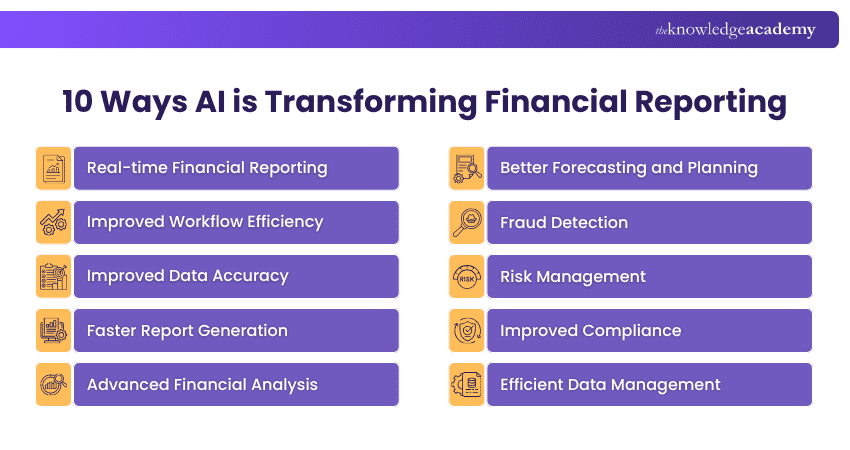
1) Real-time Financial Reporting and Analysis
One of the biggest advantages of AI in Financial Reporting is its real-time reporting. Instead of waiting until the end of the month, finance teams can see updated financial data at any time. AI systems collect and process data continuously, so reports always reflect the latest situation.
For example, if there is a sudden drop in revenue or an increase in costs, teams can spot it quickly and take action.
2) Internal Audit and Fraud Detection
AI plays a major role in improving internal audits and detecting fraud in Financial Reporting. AI systems can analyse large volumes of financial data quickly and continuously. This helps identify unusual patterns, duplicate entries or suspicious activities that may go unnoticed in manual audits.
For example, if the AI system finds many transactions with the same amount in a short time or payments made to unknown vendors, it can mark them as suspicious for review.
3) Financial Risk Assessment
Assessing financial risk is another area where AI excels. By analysing historical data alongside current trends, AI can predict potential risks such as cash flow shortages, credit risks, or market volatility. This allows finance teams to know the possible risks before they become serious issues.
For example, if AI notices a sudden increase in expenses over a short period, it can alert the team about possible budget issues.
How AI Can Improve the Financial Reporting Process?
AI is transforming the Financial Reporting process. Here is how it is improving it:
1) Speeds up the Creation of Financial Reports
Creating financial reports manually can be time-intensive, especially when dealing with multiple data sources. AI automates data aggregation, reconciliation, and report generation, significantly reducing the time required.
This helps finance teams complete reports faster and meet deadlines easily. Instead of spending hours on preparation, they can focus on understanding the results.
2) Improves Data Collection and Management
Accurate financial reporting depends on clean and well-managed data. AI systems can get data from multiple sources, standardise formats, and eliminate duplicates or inconsistencies.
By ensuring data integrity, AI reduces the chances of errors that often happen during manual data entry. It also creates a centralised data environment, making it easier for teams to access and use information.
3) Enables Accurate Financial Forecasting and Budget Planning
AI enhances forecasting by analysing historical patterns and external factors such as market trends or economic conditions. This aims for accurate predictions and better-informed budget planning.
Finance teams can use these insights to allocate resources effectively and plan for future growth. The ability to explore different scenarios also helps organisations prepare for uncertainties.
4) Strengthens Regulatory Compliance Reporting
Regulatory requirements are becoming complex, and non-compliance can lead to serious consequences. AI helps organisations stay compliant by automating the preparation of regulatory reports and ensuring data accuracy.
It can also track changes in regulations and adjust reporting processes accordingly. This minimises the burden on finance teams and lowers the risk of errors in compliance reporting.
Start building faster and smarter reports with our AI Automation for Reporting Course – Register today!
Role of AI in Modern Finance
AI is not limited to Financial Reporting. It plays a broader role in transforming the entire finance function. Let's check the role of AI in modern finance:
1) Automating Repetitive Tasks
Daily tasks such as data entry, invoice processing and reconciliation can take a lot of time. AI automates these processes, freeing up finance professionals to focus on more strategic activities. This helps finance teams focus on more important work, such as analysis and decision-making.
2) Processing Vast Amounts of Data
Modern organisations generate huge volumes of financial data. AI systems are built to manage large volumes of data, allowing them to process and analyse information quickly and efficiently. This ensures that no important information is missed and helps in creating accurate reports.
3) Driving Insights for Financial Functions
AI in Financial Reporting does not just process data. It also provides useful insights. It can identify trends, highlight performance issues, and suggest improvements. These actions help businesses make better financial decisions and improve performance.
4) Enhancing Transparency and Compliance
Transparency is critical in Financial Reporting, especially for stakeholders and regulators. AI improves transparency by providing clear, traceable data and reducing human errors. It also ensures that reports follow rules and standards, which helps in maintaining compliance.
How to Implement AI in Financial Reporting?
Implementing AI in Financial Reporting requires a structured approach to ensure successful adoption. It is not just about introducing new technology but also about understanding existing processes and identifying areas where AI can add value. Here are the steps you can follow while implementing AI for Financial Reporting:
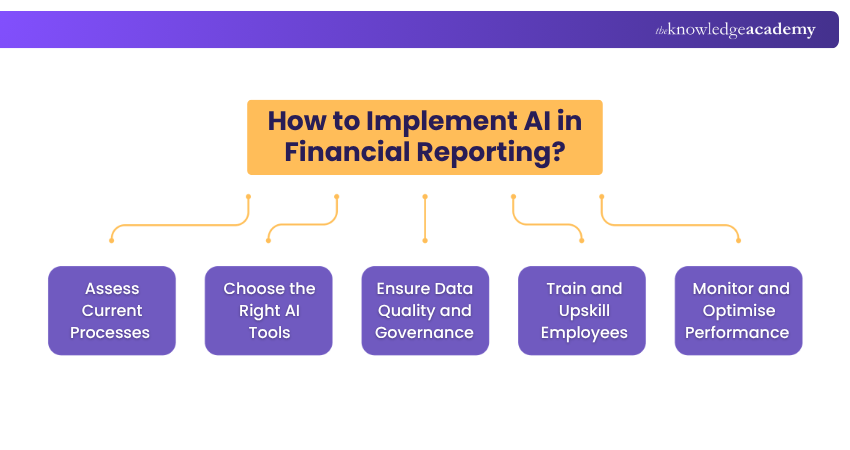
1) Assess Current Processes
The first step is to evaluate your business’s existing Financial Reporting processes. Identify tasks that take too much time or have frequent errors. This helps in understanding where AI can be most useful.
Key Tips:
1) Map out the full reporting cycle from start to finish
2) Track how long each step takes during the month-end closing
3) Check where delays usually happen in the process
4) Review past issues or audit findings for improvement areas
2) Choose the Right AI Tools
There are many AI tools available, and choosing the right one is important. The tool has to match the company’s needs and work well with existing systems. Different AI solutions offer varying capabilities, so it is important to choose the right one.
Key Tips:
1) Request demos or trial versions before selecting a tool
2) Check vendor support, training and onboarding services
3) Evaluate the tool’s reporting dashboards and visual outputs
4) Consider the total cost, including setup and maintenance
3) Ensure Data Quality and Governance
AI works best with high-quality data. Thus, organisations need to have strong data governance practices to ensure accuracy, consistency, and security. This includes setting data standards, implementing validation checks, and maintaining proper documentation.
Key Tips:
1) Remove duplicate or outdated financial records
2) Standardise data formats across departments
3) Set clear ownership for data management
4) Regularly audit data to maintain accuracy
4) Train and Upskill Employees
Successful AI adoption depends on the people using it. Finance teams need to understand how AI tools work and how to interpret the insights they provides. Training helps them learn and adapt to new ways of working with AI.
Key Tips:
1) Start with small pilot teams before full rollout
2) Assign internal team members to support AI adoption
3) Encourage teams to ask questions and share feedback
4) Provide real use-case examples during training
5) Monitor and Optimise Performance
AI implementation is a continuous process that requires regular monitoring and updates. Regular evaluations help understand areas for improvement and ensure that AI for Financial Reporting delivers the expected benefits.
Key Tips:
1) Collect feedback from finance teams using the system
2) Monitor error rates before and after AI implementation
3) Adjust workflows based on performance insights
4) Stay updated with new AI features and upgrades
Reduce manual work and boost productivity with our AI Automation Course for Operations – Sign up soon!
Benefits of AI in Financial Reporting
AI brings several important benefits to Financial Reporting and below are some of them:
1) Faster Month-end Close
AI helps speed up the month-end closing process by automating tasks such as data collection, reconciliation and report generation. Instead of spending days compiling and verifying data, finance teams can complete these activities much faster. This reduces delays and ensures that financial information is available on time for decision-making.
2) Improved Forecasting Accuracy
AI improves forecasting by analysing large amounts of historical and real-time data. It identifies patterns and trends that may not be visible through traditional analysis methods. This helps organisations create more accurate financial forecasts and make better budgeting decisions.
3) Reduced Errors From Manual Entry
Manual data entry often leads to mistakes, especially when dealing with large datasets. AI in Financial Reporting reduces this risk by automating data processing and validation. As a result, financial reports become more accurate and reliable, reducing the need for rework and corrections.
4) Better Audit Preparedness and Grant Reporting
AI helps maintain organised and well-structured financial records, making audits easier. It ensures that all required data is available and traceable when needed. AI also supports accurate reporting by ensuring compliance with funding requirements and reducing the chances of errors.
Future of AI in Financial Reporting
The future of AI in Financial Reporting looks promising, with advancements in technology driving new possibilities. Here is what it can offer for the future:
1) Increased Automation: AI will automate more Financial Reporting tasks, reducing the need for manual work and speeding up processes.
2) Real-time Reporting: Organisations will rely more on real-time data, allowing faster decision-making and better financial control.
3) Smarter Forecasting and Predictions: AI will provide more accurate forecasts by analysing larger and more complex datasets.
4) Better Integration With Technologies: AI will work closely with technologies like cloud computing and blockchain to improve data security and accessibility.
5) Greater Focus on Data-driven Decisions: Finance teams will depend more on AI insights to make strategic business decisions.
6) Evolving Role of Finance Teams: Finance professionals will focus more on analysis and strategy rather than manual reporting tasks.
Conclusion
AI is reshaping Financial Reporting by making it faster and less dependent on manual work. From real-time reporting to better forecasting and risk management, it helps finance teams focus on what truly matters. When implemented effectively, AI in Financial Reporting can turn into a more reliable and insight-driven process.
Discover how AI can simplify your workflows with our AI Automation Training – Start now!
Frequently Asked Questions
What are the AI Tools for Financial Reporting?

Popular AI tools for financial reporting include IBM Cognos Analytics, Oracle Financials Cloud, Microsoft Copilot for Finance, and Tableau. These tools automate data analysis, generate real-time reports, and improve forecasting accuracy, helping finance teams work more efficiently and make better-informed business decisions.
What are the Risks and Limitations of AI in Financial Reporting?
The Risks and Limitations of AI in Financial Reporting include data security concerns, inaccurate outputs from poor-quality data, lack of human judgment, and dependency on technology. AI systems may also face compliance challenges, integration issues, and difficulties handling complex financial decisions requiring professional expertise.
What are the Other Resources and Offers Provided by The Knowledge Academy?
The Knowledge Academy takes global learning to new heights, offering over 3,000+ online courses across 490+ locations in 190+ countries. This expansive reach ensures accessibility and convenience for learners worldwide.
Alongside our diverse Online Course Catalogue, encompassing 17 major categories, we go the extra mile by providing a plethora of free educational Online Resources like Blogs, eBooks, Interview Questions and Videos. Tailoring learning experiences further, professionals can unlock greater value through a wide range of special discounts, seasonal deals, and Exclusive Offers.
What is The Knowledge Pass, and How Does it Work?
The Knowledge Academy’s Knowledge Pass, a prepaid voucher, adds another layer of flexibility, allowing course bookings over a 12-month period. Join us on a journey where education knows no bounds.
What are the Related Courses and Blogs Provided by The Knowledge Academy?
The Knowledge Academy offers various AI Automation Training, including AI Automation Course for Finance and Accounting, AI Automation Course for Product Management and AI Automation Training for Customer Services. These courses cater to different skill levels, providing comprehensive insights into the Future of Artificial Intelligence.
Our Data Analytics & AI Blogs cover a range of topics related to AI in Financial Reporting, offering valuable resources, best practices, and industry insights. Whether you are a beginner or looking to advance your Data Analytics & AI skills, The Knowledge Academy's diverse courses and informative blogs have got you covered.

Lily Turner


Senior AI/ML Engineer and Data Science Author
Lily Turner is a data science professional with over 10 years of experience in artificial intelligence, machine learning, and big data analytics. Her work bridges academic research and industry innovation, with a focus on solving real-world problems using data-driven approaches. Lily’s content empowers aspiring data scientists to build practical, scalable models using the latest tools and techniques.
View Detail
Upcoming Data, Analytics & AI Resources Batches & Dates
Date
 AI Automation Course for Finance and Accounting
AI Automation Course for Finance and Accounting
Fri 28th Aug 2026
AI Automation Course for Finance and Accounting
Fri 20th Nov 2026

 If you wish to make any changes to your course, please


