


 Top Rated Course

We may not have the course you’re looking for. If you enquire or give us a call on +55 8000201623 and speak to our training experts, we may still be able to help with your training requirements.
8 Wastes of Lean Manufacturing: Explained in Detail
William Brown 16 July 2026The 8 Wastes of Lean Manufacturing include defects, overproduction, waiting, non-utilised talent, transportation, inventory, motion, and over-processing. It helps organisations streamline workflows, reduce costs, and improve overall productivity. Ultimately, this supports continuous improvement and stronger customer satisfaction.

Training Outcomes Within Your Budget!
We ensure quality, budget-alignment, and timely delivery by our expert instructors.
Table of Contents
In today’s competitive industrial world, Lean manufacturing aims to improve efficiency while cutting unnecessary costs. At the heart of this methodology lies the concept of the 8 Wastes of Lean, which refers to any activity or resource use that doesn’t add value from the customer’s perspective. Whether it is time lost due to delays, unused materials, or effort wasted on redundant tasks, waste quietly harms profitability and productivity.
To address this, Lean highlights 8 Wastes of Lean, which is the first step toward creating more efficient processes that provide real value. In this blog, we will define each waste in detail and explore how it shows up in your business. Let's get started!
Table of Contents
1) What is Waste in Lean Manufacturing?
2) What are the 8 Wastes of Lean Manufacturing?
a) Defects
b) Overproduction
c) Waiting
d) Non-Utilised Talent
e) Transportation
f) Inventory
g) Motion
h) Excess Processing
3) Conclusion
What is Waste in Lean Manufacturing?
In Lean manufacturing, waste refers to any action, process, or resource usage that does not directly contribute to what the customer values. Lean considers waste to be any activity, material, time, or effort that does not add value from the customer’s perspective.
In simple terms, if a customer is not willing to pay for it, it is considered a waste. This includes unnecessary labour, excessive materials, inefficient processes, non-utilised skills, and poor planning that slows down workflow or increases costs.

What are the 8 Wastes of Lean Manufacturing?
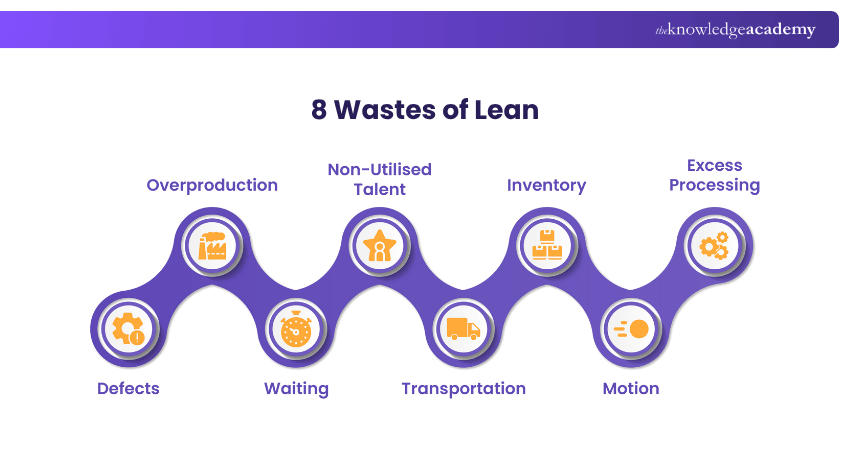
The Lean model recognises eight different types of waste. Originally, seven wastes were identified within the Toyota Production System. After that, an eighth waste was added. Thus, Lean manufacturing has 8 Wastes in today’s practices.
These 8 Wastes of Lean are a simple way to spot problems that slow down work or increase costs in a manufacturing process. Each type of waste points to a common area where businesses lose time, effort, or money. Identifying and eliminating these wastes is central to Lean thinking. Below, we break down each waste in detail:
1) Defects
Defects are products, services, or information that fail to meet the requirements of quality. It may lead to rework, recall of products, delays, or even customer dissatisfaction. They are one of the most expensive types of waste since they require more time, labour, and materials to fix. The usual suspects are bad quality control, machine failure, and incorrect documentation.
To minimise defects, organisations may use standardised work practices, routine audits, and formal document control. Checkpoints on quality at every production step, as well as effective communication with design and engineering departments, also eliminate rework and scrap.
Examples:
1) Making products that do not work
2) Parts that need fixing or redoing
3) Wrong information on labels or documents
4) Poor machine settings causing bad parts
5) Damaged items that cannot be sold
2) Overproduction
Overproduction or Extra Processing occurs when more products or components are created than are needed or produced earlier than required. This waste leads to excess inventory, higher storage costs, and inefficient use of resources. It often hides deeper issues such as poor forecasting, weak interdepartmental coordination, and inefficient scheduling. Overproduction locks up capital, wastes materials, and increases the risk of products becoming obsolete or damaged before use.
To reduce overproduction, organisations should align manufacturing with actual customer demand using Just-in-Time (JIT) practices, improve demand forecasting, and streamline communication across supply chains. Producing only what is needed, when it is needed, ensures resources are used efficiently while reducing clutter and costs.
Examples:
1) Making products before customer orders are confirmed
2) Producing large batches to keep machines running
3) Building up unnecessary stock levels
4) Printing documents or reports that no one uses
5) Manufacturing items based on inaccurate demand forecasts
Gain essential Lean knowledge to optimise processes with our Introduction to Lean Training – Join Now!
3) Waiting
Waiting is identified as the time when people, materials or equipment are idle. This also includes any downtime due to equipment breakdown, slow authorisations, or the waiting time for parts or instructions. Waiting can bring production to a halt and is one of the easiest wastes to spot.
These delays not only affect productivity but also increase lead time and reduce customer satisfaction. Thus, reducing waiting often involves improving scheduling, ensuring proper maintenance, balancing workloads, and improving communication across the organisation.
Examples:
1) Workers standing idle because materials are late
2) Machines stopped and waiting for repair
3) Items sitting in a queue for the next step
4) Teams waiting for approval from managers
5) Operators waiting for tools or instructions
4) Non-Utilised Talent
This waste of Non-Utilised Talent refers to the failure to use employees’ full skills, creativity, and capabilities. This happens when employees are not empowered to contribute ideas, take initiative, or engage in Problem-Solving. It can stem from poor management, inadequate training, or a lack of communication.
Lean principles promote respect for people and continuous improvement. Engaging team members in decision-making and process optimisation not only increases morale but also brings valuable insights from those closest to the work. Training, cross-functional collaboration, and feedback loops ensure every employee’s potential is fully used.
Examples:
1) Skilled people doing very basic tasks
2) Employees’ ideas being ignored
3) Ignoring feedback or solutions from employees
4) No training or growth opportunities
5) Employees not trusted to make small decisions
5) Transportation
Transportation waste refers to any unnecessary movement of materials, tools, or products between locations. While some movement is unavoidable, excessive transportation does not add value and increases the risk of damage, delays, and higher labour costs. Poor plant layout, distant storage areas, and inefficient workflows often contribute to this waste.
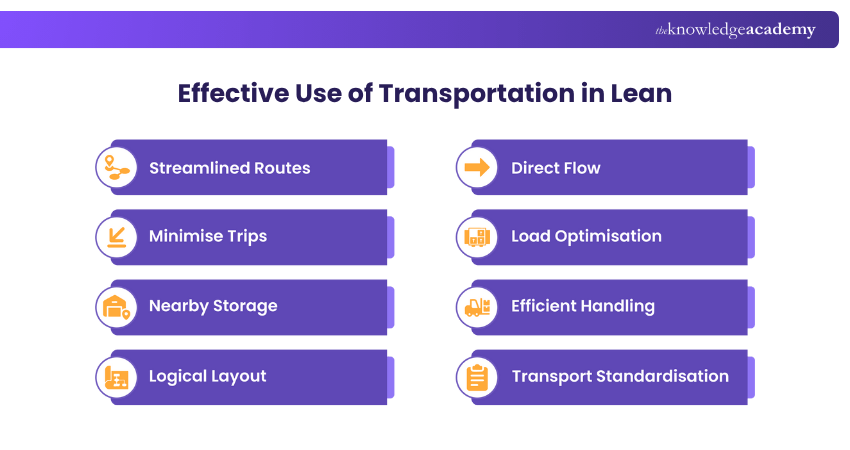
Reducing transportation waste often involves reorganising the layout, placing frequently used items closer to workstations, and designing production flows based on logical, value-adding steps. The goal is to minimise distance and ensure materials move smoothly through the process.
Examples:
1) Moving materials over long distances for no reason
2) Forklifts travelling across the plant too often
3) Sending products between far work areas
4) Shipping items multiple times
5) Poor layout causing unnecessary movement
Discover Lean techniques to reduce errors and improve productivity with our Lean Processes and Tools Training - Register soon!
6) Inventory
Inventory waste involves having more materials, parts, or finished goods than necessary to meet current demand. It ties up money, increases storage space, and raises the risk of spoilage, damage, or obsolescence. This waste typically arises from overproduction, unreliable suppliers, or poor forecasting.
Lean manufacturing encourages a Just-in-Time (JIT) inventory approach, where items are procured and used only when needed. This requires close coordination between manufacturing, purchasing, and planning teams. Managing inventory levels effectively ensures materials are available without creating unnecessary stocks.
Examples:
1) Storing more raw materials than needed
2) Finished goods piling up in storage
3) Too much Work in Progress (WIP)
4) Buying items in huge quantities just in case
5) Items expiring, rusting, or getting damaged
7) Motion
Motion waste refers to any unnecessary movement by employees or machines, such as reaching, walking, bending, stretching, or searching for tools. While each action may seem minor, these repetitive movements accumulate over time, reducing productivity and increasing fatigue. In some cases, they can also raise the risk of workplace injury.
Lean tools such as 5S (Sort, Set in Order, Shine, Standardise, Sustain) are highly effective in reducing motion waste. By organising workspaces, clearly labelling tools, and optimising workstation layouts, organisations can minimise fatigue, lower injury risks, and boost productivity, creating a safer and more efficient working environment.
Examples:
1) Workers walking far to get tools
2) Reaching, stretching, or bending too much
3) Searching for missing items
4) Poor workstation setup
5) Repeating small manual movements all day
Boost your workplace efficiency in the Lean journey with our 6S Training – Sign up now!
8) Excess Processing
Excess Processing or Overprocessing is done when you process more than what is required to satisfy the customers. This can be in the form of reproducing work, taking unnecessary processes, or employing more complicated tools and materials. In many cases, businesses fall into the habit of adding additional checks, approvals, or documentation that provide little benefit.
Excess processing may not be noticed, but it may use a lot of resources. You may try using process mapping and value stream analysis to avoid this. You can also map the workflows, eliminate repetitive steps, and ensure that work is done only to the level of quality that the customer expects.
Examples:
1) Too many approval layers
2) Re-entering data multiple times
3) Extra documentation or quality checks
4) Adding unneeded features
5) Using complex methods when simpler ones would suffice
Conclusion
The 8 Wastes of Lean manufacturing give a powerful framework for exposing inefficiencies that may otherwise go unnoticed. When teams learn to identify and eliminate these wastes, they begin to see operations through a new lens. The key is building a culture where employees are trained to spot waste, empowered to suggest improvements, and encouraged to take responsibility for the processes they work in.
Understand streamlined workflows for enhanced productivity with our Lean Training – Sign up now!
Frequently Asked Questions
What is the Six Sigma Process?

Six Sigma is a data-driven methodology that improves processes by reducing defects and variation. It uses statistical tools and follows the DMAIC cycle – Define, Measure, Analyse, Improve, and Control. This structured approach helps organisations achieve consistent, reliable, and high-quality performance.
What is a Lean Framework?
A Lean framework is a structured approach that focuses on eliminating waste and enhancing efficiency by concentrating only on activities that add value. It includes tools such as Value Stream Mapping, 5S, Continuous Improvement (Kaizen), and Pull Systems. The goal is to build a culture of ongoing improvement where everyone contributes to operational excellence.

William Brown


Senior Business Analyst and Strategic Advisor
William Brown is a senior business analyst with over 15 years of experience driving process improvement and strategic transformation in complex business environments. He specialises in analysing operations, gathering requirements and delivering insights that support effective decision making. William’s practical approach helps bridge the gap between business goals and technical solutions.
View Detail

 If you wish to make any changes to your course, please


