


 Top Rated Course

We may not have the course you’re looking for. If you enquire or give us a call on +1800812339 and speak to our training experts, we may still be able to help with your training requirements.
How to Become an Investment Banker: Complete Guide
The Knowledge Academy 28 April 2026An Investment Banker helps organisations raise capital, manage mergers, and provide strategic financial advice to support clients in achieving financial goals. Becoming one involves earning a relevant degree, strong analytical skills, and experience. Success in this field requires a deep understanding of financial markets.

Training Outcomes Within Your Budget!
We ensure quality, budget-alignment, and timely delivery by our expert instructors.
Table of Contents

Fast-paced deals, boardroom negotiations, and high-stakes financial decisions, the life of an Investment Banker isn’t for the faint-hearted. It is a world where precision, pressure, and performance define success. Behind every major merger and acquisition, they play a significant role in shaping global financial strategies and leading businesses through complex decisions.
If you’re someone who enjoys analysing numbers, solving complex problems, and working at the heart of the financial world, this could be your ideal career. In this bog, you can explore How to Become an Investment Banker, from essential skills to career growth opportunities. Let’s dive in!
Table of Contents
1) Who is an Investment Banker?
2) Roles and Responsibilities of an Investment Banker
3) How to Become an Investment Banker?
4) Skills Required to Become an Investment Banker
5) Salary of an Investment Banker
6) Is it Hard to Get Into Investment Banking?
7) Will Investment Bankers be Replaced by AI?
8) Conclusion
Who is an Investment Banker?
An Investment Banker is a financial professional who helps individuals, companies, and organisations raise capital through various means such as stocks, bonds, and loans. Acting as a liaison between Investors and private or public entities, they analyse market trends, evaluate financial transactions, and advise clients on the best strategies for issuing securities.
Investment Bankers also play a key role in underwriting municipal bonds and managing complex mergers and acquisitions, ensuring each deal aligns with their clients’ financial goals and market opportunities.

Roles and Responsibilities of an Investment Banker
Here are the key roles and responsibilities of an Investment Banker:
1) Raise Capital: Help clients secure funds through issuing stocks, bonds, or loans.
2) Financial Advisory: Provide expert advice on investments, business expansion, and funding strategies.
3) Valuation Analysis: Assess a company’s worth to lead mergers, acquisitions, and financing decisions.
4) Market Research: Conduct in-depth financial and market analysis to identify profitable opportunities.
5) Deal Structuring: Manage mergers, acquisitions, and other corporate transactions.
6) Underwriting: Oversee and manage public offerings such as Initial Public Offerings (IPOs).
7) Documentation: Prepare detailed financial reports, models, and presentations.
8) Regulatory Compliance: Ensure all transactions meet legal and financial regulations.
How to Become an Investment Banker?
If you're harbouring aspirations of becoming an Investment Banker, it's crucial to follow a strategic roadmap that will guide you toward success. Here's a step-by-step instruction on How to Become an Investment Banker:
1) Education
Start by acquiring a solid educational foundation. Pursue a Bachelor's degree in Finance, Economics, or a related field. This foundational understanding is indispensable for your future endeavours. Consider enhancing your qualifications by pursuing a Master's degree in Finance or even a Master of Business Administration (MBA). These advanced degrees can set you apart and provide you with a deeper understanding of the financial landscape.
2) Gain Practical Experience
Practical experience is invaluable in the world of Investment Banking Roles. Seek out internships or entry-level positions within financial institutions. This hands-on knowledge will help you understand the practical applications of your education and provide insights into the industry's dynamics.
3) Develop Essential Skills
Investment Banking requires a unique combination of skills. Hone your analytical abilities to dissect intricate financial data and decipher market trends. Enhance your communication skills to convey difficult concepts to clients and colleagues. Cultivate problem-solving skills to navigate challenges and complexities.
4) Get Licensed
Before working as an Investment Banker in the UK, you need to register with the Financial Industry Regulatory Authority (FINRA) and pass a relevant exam. Earning certifications like the Investment Management Certificate (IMC) and the globally recognised Chartered Financial Analyst (CFA) can further strengthen your credentials and industry knowledge.
5) Secure Entry-level Positions
Start your Investment Banking journey as a Financial Analyst. These positions offer the opportunity to apply your skills and gain real-world experience. Research firms that align with your career goals and values and tailor your applications accordingly.
6) Seek Growth Opportunities
Consider pursuing certifications like the Chartered Financial Analyst (CFA) designation. This not only validates your expertise but also opens doors to more advanced roles. Explore specialisation in areas like mergers and acquisitions or trading to become a subject matter expert.
7) Advance to Higher Positions
Progress to Associate or Vice President roles as you accumulate experience. These positions come with increased responsibilities, including managing client interactions and leading projects.
Make smarter investment decisions for a successful career with our Investment Management Course – Register today!
Skills Required to Become an Investment Banker
Now, let’s check the skills that are required and in demand to become an Investment Banker:
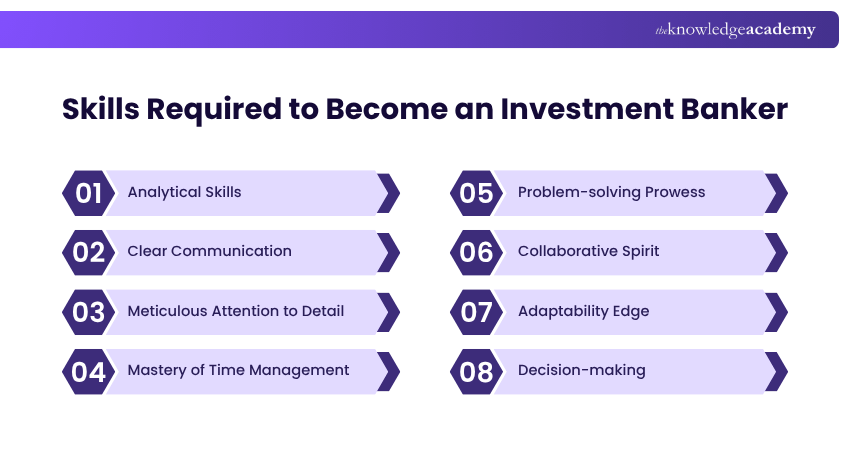
1) Analytical Skills
Investment Bankers decode intricate financial data, assess market trends, and gauge risks and rewards. Adept analytical skills empower you to make informed decisions and offer invaluable insights to clients.
2) Clear Communication
Effective communication is paramount in this profession. Conveying intricate financial concepts clearly to clients, colleagues, and stakeholders is pivotal. Strong communication is a game-changer when presenting findings, negotiating, or drafting reports.
3) Meticulous Attention to Detail
Precision is non-negotiable in finance. A sharp eye for detail means accuracy in financial models, valuations, and reports, fostering confidence in your work.
4) Mastery of Time Management
Juggling multiple projects with tight deadlines is the norm. Effective Time Management is indispensable to balancing tasks, meeting client expectations, and delivering quality outcomes under pressure.
5) Problem-solving Prowess
Navigating intricate financial transactions demands quick thinking. Solid problem-solving skills empower you to surmount complexities, innovate solutions, and tackle challenges head-on.
6) Collaborative Spirit
The financial sector hinges on team collaboration. Working harmoniously with analysts, traders, and experts is pivotal. Leveraging collective expertise fuels success.
7) Adaptability Edge
Finance's fluidity mandates adaptability. Openness to learning, embracing new tech, regulations, and trends ensures your continued relevance and triumph.
8) Decision-making
Investment Bankers play a pivotal role in guiding clients, both individuals and organisations, through crucial decision-making processes. Analysing trends and forecasts is integral to their expertise, enabling them to make informed and strategic investment decisions on behalf of their clients.
Cultivating these skills is an ongoing pursuit. By harnessing and refining these proficiencies, you'll not only thrive but also flourish as a standout Investment Banker, poised to excel in the ever-evolving finance realm.
Analyse markets and make confident investment decisions with our Investment and Portfolio Management Course – Join now!
Salary of an Investment Banker
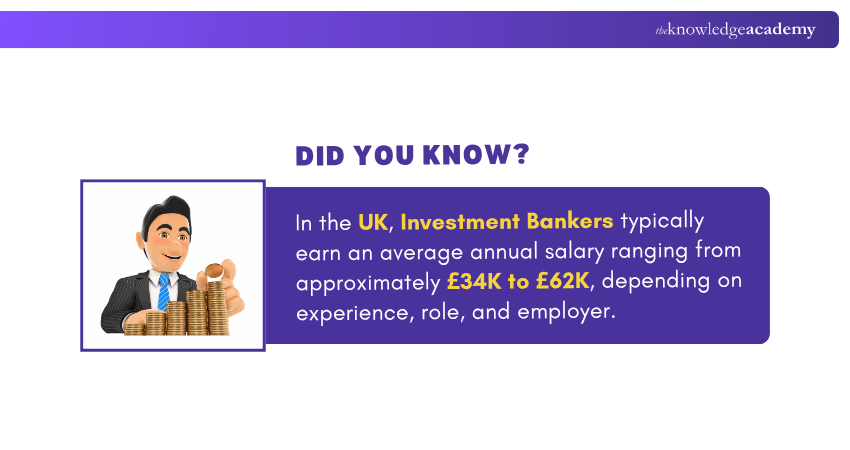
According to Glassdoor, the average annual salary of an Investment Banker in the UK ranges between £34K and £62K depending on the experience and location. Achieving higher pay often requires strong analytical, communication and the ability to manage risky financial transactions effectively.
Is it Hard to Get Into Investment Banking?
Getting into Investment Banking can be quite challenging due to its competitive nature and high entry standards. With limited positions and high standards, securing a role requires exceptional academic performance, strong analytical and communication skills, and relevant experience.
While the process can be demanding, consistent preparation, and gaining hands-on experience through internships can increase your chances of getting a role in this industry.
Will Investment Bankers be Replaced by AI?
While Artificial Intelligence (AI) is changing how financial data is analysed and processed, it’s unlikely to completely replace Investment Bankers. While automation can handle tasks like research and valuations, human skills are still essential for building client relationships, negotiating deals, and making strategic decisions.
Rather than replacing bankers, AI will support them, helping professionals focus more on creative thinking, advisory work, and complex financial strategies.
Conclusion
A career in Investment Banking is about building trust, offering sound financial advice, and contributing to business growth on a global scale. The path of How to Become an Investment Banker can be demanding, but the rewards with professional, intellectual, and financial aspects are substantial. With persistence and a strong work ethic, you can carve out a fulfilling and influential career in one of the world’s most dynamic financial sectors.
Succeed in the world of Investment Banking with our Investment and Trading Training – Explore now!
Frequently Asked Questions
How Long Does it Take to Become an Investment Banker?

Becoming an Investment Banker can typically take around six to eight years, including earning a bachelor’s degree, completing internships, and gaining early career experience. Some professionals also pursue postgraduate qualifications like an MBA or Chartered Financial Analyst (CFA) for advancement.
Do Investment Bankers Get Paid Well?
Yes, Investment Bankers are among the highest earners in finance. They receive substantial base salaries and significant performance-based bonuses, especially at senior levels. Compensation reflects the demanding work, long hours, and critical financial responsibilities of the role.
Do Investment Bankers get paid well?
The Knowledge Academy takes global learning to new heights, offering over 3,000+ online courses across 490+ locations in 190+ countries. This expansive reach ensures accessibility and convenience for learners worldwide.
Alongside our diverse Online Course Catalogue, encompassing 17 major categories, we go the extra mile by providing a plethora of free educational Online Resources like Blogs, eBooks, Interview Questions and Videos. Tailoring learning experiences further, professionals can unlock greater value through a wide range of special discounts, seasonal deals, and Exclusive Offers.
What is Knowledge Pass, and how does it work?
The Knowledge Academy’s Knowledge Pass, a prepaid voucher, adds another layer of flexibility, allowing course bookings over a 12-month period. Join us on a journey where education knows no bounds.
What are the related courses and blogs provided by The Knowledge Academy?
The Knowledge Academy offers various Investment and Trading Training, including Investment Banking Training, Investment Management Course and Stock Trading Course. These courses cater to different skill levels, providing comprehensive insights into Trading.
Our Business Skills Blogs cover a range of topics related to How to Become an Investment Banker, offering valuable resources, best practices, and industry insights. Whether you are a beginner or looking to advance your Investment Banking skills, The Knowledge Academy's diverse courses and informative blogs have got you covered.

The Knowledge Academy


Global Training Provider
The Knowledge Academy is a world-leading provider of professional training courses, offering globally recognised qualifications across a wide range of subjects. With expert trainers, up-to-date course material, and flexible learning options, we aim to empower professionals and organisations to achieve their goals through continuous learning.

Upcoming Advanced Technology Resources Batches & Dates
Date
 Cryptocurrency Trading Training
Cryptocurrency Trading Training
Fri 24th Jul 2026
Cryptocurrency Trading Training
Fri 2nd Oct 2026

 If you wish to make any changes to your course, please


