


 Top Rated Course

We may not have the course you’re looking for. If you enquire or give us a call on +1800812339 and speak to our training experts, we may still be able to help with your training requirements.
12 Bookkeeping Skills: A Quick Guide
Olivia Taylor 10 January 2026Bookkeeping Skills include attention to detail, organisation, accounting software proficiency, Data Entry, problem-solving, communication, and strong integrity. Accurate Bookkeeping supports informed decision-making, smooth operations and helps with budget creation by offering an organised view of income and expenses.

Training Outcomes Within Your Budget!
We ensure quality, budget-alignment, and timely delivery by our expert instructors.
Table of Contents

Imagine running a business where sales are flowing, customers are happy, and growth feels unstoppable. Now picture the chaos if invoices go missing, receipts pile up, or tax deadlines slip through the cracks. That’s where strong Bookkeeping Skills make all the difference.
These skills keep every transaction in check, transform messy numbers into clear financial insights, and give you the confidence to make smarter business decisions. In this blog, we’ll explore 12 essential Bookkeeping Skills that help you stay organised, boost efficiency, and keep your business on the path to lasting success.
Table of contents
1) Important Bookkeeping Skills
2) Highlighting Bookkeeping Skills
3) What are the Five Basic Principles of Bookkeeping?
4) What are the two Major Qualities of a Bookkeeper?
5) Conclusion
Important Bookkeeping Skills
In the domain of Bookkeeping, mastering a range of Bookkeeping Skills is paramount to ensure accuracy, transparency, and overall success in financial management. Let's delve into the 12 pivotal Bookkeeping Skills that distinguish a proficient Bookkeeper:
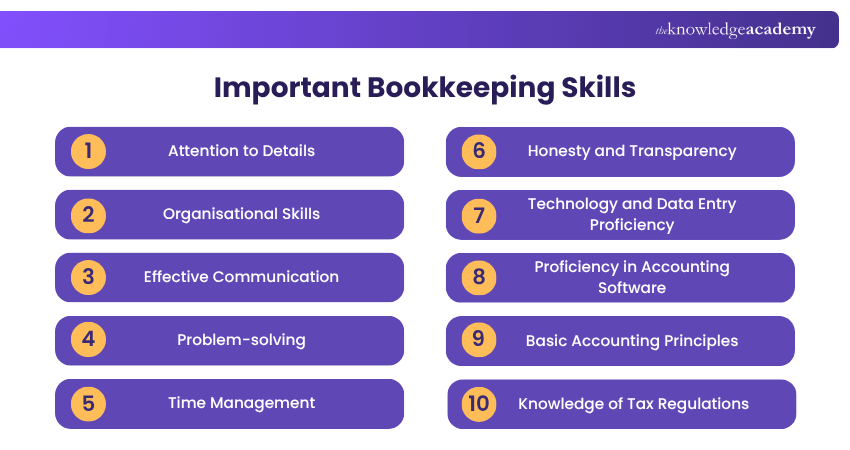
1) Attention to Details
At the core of Bookkeeping lies an unwavering attention to detail. Every figure, every decimal point, and every transaction matters. A skilled Bookkeeper meticulously reviews and analyses financial data, leaving no room for error. This attention to detail ensures that financial records are accurate and reliable, forming the foundation of sound financial management.
2) Organisational Skills
Organisation is the linchpin of effective Bookkeeping. A Bookkeeper deals with vast amounts of data, invoices, and receipts on a daily basis. Without solid organisational skills, chaos can ensue, potentially leading to errors and inefficiencies. Just as Xcode and Swift requires a well-structured approach for smooth development. A well-organised Bookkeeper can swiftly navigate through data, retrieve information, and maintain a systematic order in financial records.

3) Effective Communication
Good communication is among the most basic Bookkeeping Skills but it goes beyond numbers. A Bookkeeper must be able to convey complex financial information in a clear manner, be it to clients, colleagues or Auditors. The ability to articulate financial insights facilitates collaboration and ensures that all the stakeholders are on the same page.
4) Problem-solving
Bookkeepers often find themselves in situations where discrepancies or reconciliation issues arise. The ability to identify problems, analyse their root causes, and implement effective solutions is a hallmark of a skilled Bookkeeper. In fact, these are key areas frequently covered in Bookkeeper Interview Questions asked at every interview. Bookkeepers often find themselves in situations where discrepancies or reconciliation issues arise.
5) Time Management
Bookkeeping requires strong attention to detail, which in turn requires significant amount of time. Meeting deadlines for tax submissions, financial reporting and other obligations requires effective time management. This is why a skilled Bookkeeper prioritises tasks, allocates time efficiently and ensures that every responsibility is met on time. As a result, they contribute to the overarching success of financial operations.
6) Honesty and Transparency
Ethical conduct is non-negotiable in Bookkeeping. Honesty and transparency are pivotal components of a Bookkeeper's character. Upholding the highest ethical standards can help instil trust in clients and stakeholders. Moreover, a transparent approach to financial transactions boosts confidence, ensures the Bookkeeper's credibility and the reliability of the financial data they manage.
8) Proficiency in Accounting Software
Being skilled in accounting software is essential for every Bookkeeper. Widely used platforms like QuickBooks, Xero and Sage can help streamline tasks and improve your accuracy. Keeping up with new updates and features helps Bookkeepers to work efficiently and stay aligned with evolving industry technology.
9) Basic Accounting Principles
A strong foundation in basic accounting principles is the first step toward proper Bookkeeping. Core concepts like Double-entry Accounting, accruals and the matching principle ensure accuracy in financial records. Without this knowledge, maintaining reliable accounts can become significantly difficult. This makes it essential to master the fundamentals before moving into practical tasks.
Make you accounting endeavours effortless with the cutting-edge power of QuickBooks – Sign up for our QuickBooks Training now!
10) Knowledge of Tax Regulations
Tax season is unavoidable, and a competent Bookkeeper must thoroughly understand tax regulations. Keeping up with tax laws can help you maintain compliance and avoid penalties. By knowing the tax impact of various transactions and maintaining precise records, Bookkeepers can ensure a seamless tax filing process.
11) Accounts Payable & Receivable Management
Overseeing accounts payable and receivable is a vital responsibility. It includes monitoring invoices, ensuring timely payments to suppliers and following up with customers on overdue payments. This helps maintain a strong cash flow and strong financial relationships.
12) GAAP
The Generally Accepted Accounting Principles (GAAP) offer a standardised framework for managing financial data. Bookkeepers who understand GAAP can maintain records that align with widely recognised standards. This improves the accuracy, consistency and reliability of financial reports.
Learn about the relevance and power of Xero in today’s financial landscape with our Xero Training - Register now!
Highlighting Bookkeeping Skills
Mastering the art of Bookkeeping is a significant achievement, and effectively showcasing your skills is crucial when seeking new opportunities. So, let’s look at how you can highlight your Bookkeeping Skills in your resume, cover letter, and during interviews:
1) Resume
Crafting an engaging resume is the first step toward landing your desired Bookkeeping role. Here's how you can effectively highlight your Bookkeeping Skills:

a) Bookkeeping Skills Section: Create a dedicated section for your Bookkeeping Skills. You must adjust this section to match the specific requirements of theBookkeeper Job Description you're applying for. Use a blend of technical and soft skills, including attention to detail, proficiency in accounting software, and effective communication.
b) Achievements: Highlight specific achievements that demonstrate your Bookkeeping capabilities. If you streamlined a company's financial reporting process or successfully resolved complex reconciliation issues, showcase these accomplishments with quantifiable results.
c) Tailor for Each Application: Customise your resume for each application. Identify the key Bookkeeping skills outlined in the job description and ensure they are reflected in your resume. This tailoring demonstrates your alignment with the specific requirements of the position.
Shape smarter futures through financial mastery. Sign up for our Financial Management Courses now!
2) Cover Letter
Your cover letter provides a chance to delve deeper into your Bookkeeping Skills and convey your enthusiasm for the role. Let's see how:
a) Skill Highlights: Start by highlighting a few key Bookkeeping Skills in the opening paragraph. This immediately captures the recruiter's attention and sets the rhythm for the rest of the cover letter.
b) Accomplishments: Share specific accomplishments that demonstrate your proficiency. For example, discuss how your attention to detail led to error reduction or how your effective communication facilitated smooth interactions with clients.
c) Tailor to the Company: Research the company's values and goals and align your skills with their needs. If the company emphasises transparency, emphasise your commitment to honest and transparent financial practices.
d) Closing Statement: Complete your cover letter with a solid closing statement that reinforces your eagerness to contribute your Bookkeeping Skills to the company's success. Express your enthusiasm for an interview to discuss your qualifications in more detail.
3) Interview
During the interview, you have the opportunity to elaborate on your Bookkeeping Skills and leave a lasting impression. Here's how you can do that:
a) Real-world Examples: Provide real-world examples of how you've applied your Bookkeeping Skills in previous roles. Discuss specific challenges you've overcome, highlighting your problem-solving abilities.
b) Soft Skills: Emphasise your soft skills, such as communication and organisational abilities. Share instances where effective communication or meticulous organisation positively impacted financial outcomes.
c) Adaptability: Demonstrate your adaptability by discussing how you've embraced new technologies or navigated changes in industry regulations. This showcases your willingness to evolve with the dynamic nature of Bookkeeping.
d) Questions for the Interviewer: Prepare thoughtful questions about the company's financial practices and how your Bookkeeping skills can contribute. This not only shows your interest but also allows you to further highlight your understanding of the role.
What are the Five Basic Principles of Bookkeeping?
The five core elements of accounting form the backbone of every financial system. These include:
1) Assets: Resources owned by a business that hold future economic value.
2) Liabilities: Financial obligations or debts the business is required to repay.
3) Equity: The owner’s stake or residual interest after liabilities are settled.
4) Revenue: Income earned from the business’s core operations and services.
5) Expenses: Costs incurred to generate revenue and keep the business running.
Each element helps paint a clearer picture of a business’s financial position and performance. Understanding how they interact enables businesses to manage finances wisely.
What are the Major Qualities of a Bookkeeper?
Here are the non-negotiable qualities of a good Bookkeeper:
1) Trustworthy: They must handle sensitive financial data with integrity and confidentiality.
2) Knowledgeable: They must understand Bookkeeping principles, industry practices and evolving tools like Cloud Accounting.
3) Organised: They must maintain clear systems, accurate records and efficient reporting.
4) Detail-oriented: They must spot errors quickly and ensure precision in financial entries.
5) Client-centric: They must prioritise business needs, communicates clearly, and support strategic financial decisions.
Conclusion
Mastering the twelve essential Bookkeeping Skills as outlined in this blog is not merely a professional pursuit; it’s a journey towards becoming a proficient and indispensable asset in the world of financial management. From the meticulous attention to detail to the strategic vision required for effective decision-making, each skill plays a non-negotiable role in maintaining the integrity of financial records.
Audit your accounting ambition with our range of Accounting Courses – Sign up now and master real-world roles in Finance and Accounting.
Frequently Asked Questions
Can Bookkeeping Skills be Learned, or are They Innate?

Bookkeeping Skills can be learned and honed through education, training, and practical experience. With consistent practice and exposure to real financial scenarios, anyone can develop strong Bookkeeping abilities. A detail-oriented mindset further enhances the learning process.
How Often Should a Bookkeeper Update Their Knowledge and Skills?
Ideally, Bookkeepers should stay updated with industry changes and refresh their skills annually. Regular learning ensures they remain compliant with new regulations and software updates. Staying informed also boosts efficiency and keeps them competitive in the field.
What are the other resources and offers provided by The Knowledge Academy?
The Knowledge Academy takes global learning to new heights, offering over 3,000 online courses across 490+ locations in 190+ countries. This expansive reach ensures accessibility and convenience for learners worldwide.
Alongside our diverse Online Course Catalogue, encompassing 19 major categories, we go the extra mile by providing a plethora of free educational Online Resources like Blogs, eBooks, Interview Questions and Videos. Tailoring learning experiences further, professionals can unlock greater value through a wide range of special discounts, seasonal deals, and Exclusive Offers.
What is Knowledge Pass, and how does it work?
The Knowledge Academy’s Knowledge Pass, a prepaid voucher, adds another layer of flexibility, allowing course bookings over a 12-month period. Join us on a journey where education knows no bounds.
What are related Bookkeeping courses and blogs provided by The Knowledge Academy?
The Knowledge Academy offers various Accounting Courses, including the Bookkeeping Course, Project Accounting Course and the Cash Management Course. These courses cater to different skill levels, providing comprehensive insights into Bookkeeping.
Our Accounting and Finance Blogs cover a range of topics related to Bookkeeping, offering valuable resources, best practices, and industry insights. Whether you are a beginner or looking to advance your Bookkeeping Skills, The Knowledge Academy's diverse courses and informative blogs have you covered.

Olivia Taylor


Chartered Accountant and Financial Training Specialist
Olivia Taylor is a qualified chartered accountant with over a decade of experience in financial management, auditing and corporate reporting. Having worked with leading firms in both the public and private sectors, Olivia brings clarity to complex financial topics. Her writing focuses on helping professionals build confidence in key areas of accounting, compliance and financial planning.
View Detail
Upcoming Accounting and Finance Resources Batches & Dates
Date
 Finance for Non Financial Managers
Finance for Non Financial Managers
Fri 15th May 2026
Finance for Non Financial Managers
Fri 12th Jun 2026
Finance for Non Financial Managers
Fri 14th Aug 2026
Finance for Non Financial Managers
Fri 18th Sep 2026

 If you wish to make any changes to your course, please


