


 Top Rated Course

We may not have the course you’re looking for. If you enquire or give us a call on +1800812339 and speak to our training experts, we may still be able to help with your training requirements.
Basic Accounting Skills: A Complete Beginner’s Guide
Olivia Taylor 15 July 2026Basic Accounting Skills include understanding core accounting principles, using the accounting equation, preparing financial statements, and mastering Excel. These skills help ensure accurate financial tracking, compliance, and informed business decisions. Developing them builds a strong foundation for careers in accounting and finance.

Training Outcomes Within Your Budget!
We ensure quality, budget-alignment, and timely delivery by our expert instructors.
Table of Contents
Every successful business has one secret ingredient: strong accounting. It is the story behind the numbers, showing where the money comes from, where it goes, and what it means for the future. Without Basic Accounting Skills, even the biggest companies would lose track of their goals, profits, and progress.
In this blog, you’ll explore the fundamental principles of accounting, the significance of Basic Accounting Skills, and how to enhance your accounting skills. You’ll also learn who needs accounting skills and what soft skills an Accountant should have to thrive in today’s financial world.
Table of Contents
1) Accounting- an Overview
2) Essential Basic Accounting Skills
3) The Fundamental Principles of Accounting
4) The Significance of Basic Accounting Skills
5) How to Develop and Enhance Your Accounting Skills?
6) How do I upskill myself as an accountant?
7) What Soft Skills Should an Accountant Have?
8) Conclusion
Accounting- an Overview
Accounting is the process of recording and tracking financial transactions. It involves keeping a detailed record of money coming in (income) and going out (expenses). This information helps individuals and businesses understand their financial health, make informed decisions, and ensure everything adds up correctly. Accounting Study Tips can help you grasp this financial "language" that shows where the money is flowing and how it's being used.

Essential Basic Accounting Skills
There are several Basic Accounting Skills needed to succeed in this field. Below are some key skills every professional should have.

Financial Statement Analysis
Understanding financial statements such as the balance sheet, income statement, and cash flow statement is fundamental. It helps you interpret these documents to assess an organisation's financial health, performance, and liquidity.
This skill isn't limited to financial professionals; it's essential for business owners, managers, investors, and creditors alike. It empowers individuals to understand the company's financial story, allowing for informed decisions that impact long-term success.
Bookkeeping
Basic Bookkeeping Skills involve accurately recording financial transactions. This includes maintaining journals, ledgers, and reconciling accounts. Bookkeeping ensures financial data is organised for analysis and decision-making.
Bookkeeping Outsourcing can be an effective solution for organisations looking to streamline these processes. It involves maintaining ledgers, journals, and other financial records, whether in-house or through external service providers. These play a crucial role in producing key financial statements such as the balance sheet, income statement, and cash flow statement. By keeping an updated book, organisations can track their financial performance, identify areas for cost control or revenue enhancement, and meet regulatory compliance requirements.
Budgeting
Learn the art of creating and managing budgets. Budgets help organisations plan expenses, allocate resources efficiently, and achieve financial goals. Proficiency in budgeting is invaluable for any business-minded individual.
A well-planned budget helps you control your finances and make informed decisions. It allows you to allocate funds to different categories, such as housing, transportation, groceries, entertainment, and savings through effective Category Management. By setting boundaries for each category, you can prevent overspending and ensure that you have enough money to cover all essential expenses.
Basic Knowledge of Taxation
Basic knowledge of taxation is essential, whether for personal finance or business operations. Taxes are compulsory contributions that individuals and businesses make, and understanding taxation is essential for both personal financial management and business operations.
For businesses, it involves understanding the tax implications of various activities, structuring transactions in a tax-efficient manner, and ensuring compliance with tax regulations. A solid understanding of taxation is invaluable for individuals and businesses alike. It helps individuals manage their finances, maximise their income, and remain compliant with the law.
Financial Software
Familiarise yourself with common accounting software packages. Proficiency in tools like QuickBooks, Excel, or cloud-based platforms is highly beneficial in the modern workplace.
More advanced financial software includes Enterprise Resource Planning (ERP) systems, which integrate various aspects of business operations, including finance, supply chain management, human resources, and more. It allows individuals and financial professionals to monitor investments, track performance, and make wise decisions based on market trends.
Communication Skills
Being able to communicate financial information clearly is vital. Whether it's presenting financial reports to colleagues or explaining financial concepts to non-financial stakeholders, strong communication skills are essential for any professional with basic accounting knowledge.
Furthermore, strong communication skills extend beyond the workplace, positively impacting personal relationships and daily interactions. Clear communication helps prevent misunderstandings, encourages empathy, and promotes healthy connections with family, friends, and the community.
Understand Risk Management strategies to safeguard financial integrity. Join our Accounting and Finance Policies Course today!
The Fundamental Principles of Accounting
The fundamental principles of accounting are the standard rules that guide how financial transactions are recorded and reported. They ensure financial information stays accurate, consistent, and easy to understand for both individuals and businesses.
By following these principles, accountants maintain trust and reliability in financial reports. Some of the most important principles include:
1) Separate Entity Principle: Business and personal finances must be kept apart.
2) Accrual Principle: Record income and expenses when they happen, not just when cash changes hands.
3) Consistency Principle: Use the same accounting methods regularly so results are comparable over time.
4) Prudence Principle: Do not overstate income or assets, and always prepare for possible losses.
5) Going Concern Principle: Assume the business will continue to operate in the foreseeable future.
The Significance of Basic Accounting Skills
From managing money effectively to using modern digital tools, Basic Accounting Skills play an important role in many areas. In this section, we’ll explore their key benefits in detail.
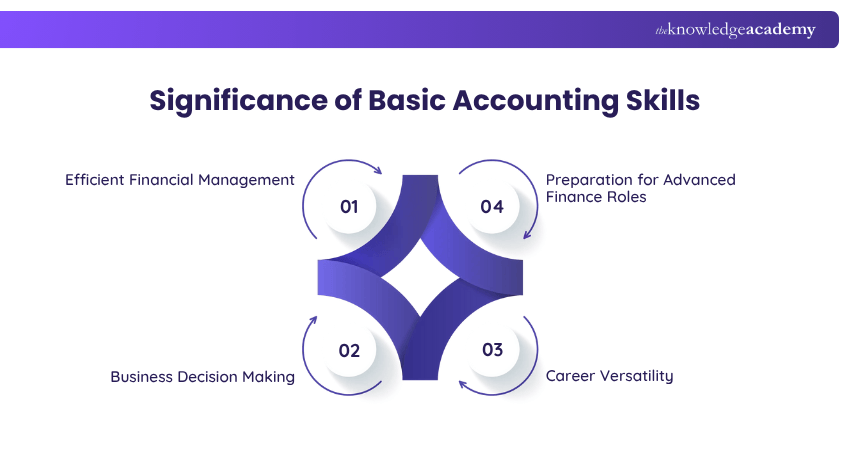
Efficient Financial Management
It is the practice of optimally utilising financial resources to achieve goals, maximise profitability, and ensure long-term sustainability. It involves a strategic approach to handling finances. It empowers individuals to take control of their financial well-being and helps businesses maintain financial health in a competitive marketplace.
For businesses, efficient financial management is a critical component of success. It involves creating and adhering to budgets, monitoring cash flow, and optimising resource allocation. Techniques like Activity-based Costing help businesses identify cost-saving openings and make informed decisions based on financial data.
Business Decision Making
It is a complex yet essential Accounting Process that involves evaluating various factors to make informed choices that impact an organisation's present and future. These decisions span a wide range of areas, including strategic planning, resource allocation, risk management, and innovation.
Strategic decision-making is at the heart of business success. Leaders must analyse market trends, competitive forces, and internal capabilities to set the direction for the company. These decisions often shape the company's growth, market positioning, and long-term goals.
Resource allocation is another important aspect of business decision-making. Whether it's allocating funds, personnel, or time, businesses need to make sure that resources are optimally utilised to achieve the desired outcomes.
Career Versatility
It refers to the ability of an individual to adapt, thrive, and excel in various roles, industries, or job environments throughout their professional journey. Career versatility allows individuals to remain competitive, resilient, and valuable contributors in the ever-evolving job market. Career versatility also improves job security. Professionals with the ability to excel in different roles are less at risk of economic downturns.
They can transfer their skills across sectors, stepping into roles that are in demand even during changing circumstances. It also expands professional networks and opens doors to diverse experiences. By engaging with different industries, roles, and work environments, individuals gain a broader perspective and a wider range of connections, which can be further enhanced by pursuing qualifications like ACCA vs CPA.
Preparation for Advanced Finance Roles
It requires a strategic method to build the skills, knowledge, and experience needed for top finance roles. Positions like Finance Managers, CFOs, and investment analysts demand a strong grasp of complex financial concepts and a strategic mindset.
A strong educational foundation is essential for aspiring finance leaders. Advanced degrees like Master's in Finance, Accounting, or MBA provide deep insights into financial theory, risk management, reporting, and decision-making. These programmes offer real-world exposure, industry trends, and networking.
Relevant professional certifications, such as CFA, CPA, or FRM, demonstrate expertise and commitment, boosting credibility. Additionally, practical experience, particularly in roles with increasing responsibilities, is essential. It helps build a successful track record, refines financial management skills, and prepares individuals for advanced roles in the finance industry. For those pursuing certifications like ACCA, understanding the potential ACCA Salary can also provide insight into the financial rewards of such qualifications.
Gain skills to evaluate financial health and make informed business decisions. Join our Accounting and Financial Statement Analysis Training now!
How to Develop and Enhance Your Accounting Skills?
This involves a combination of education, hands-on experience, continuous learning, and practical application. These steps are essential for individuals looking to excel in accounting roles, whether as professionals in the field or individuals managing their personal finances.
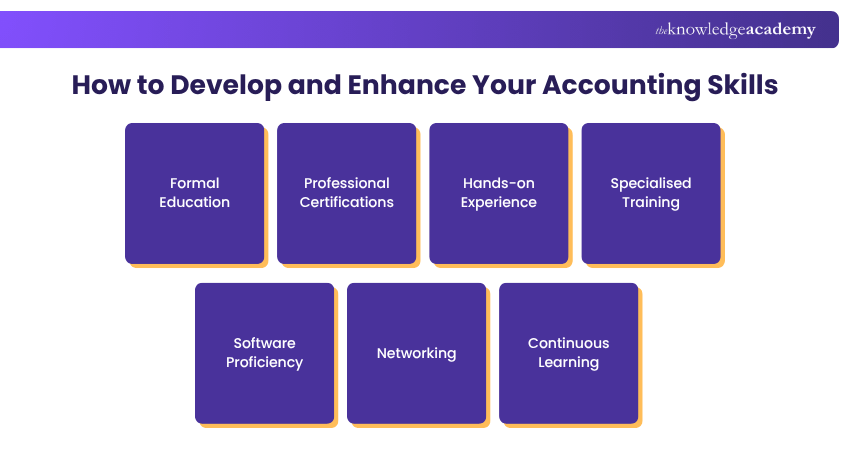
Formal Education
It refers to structured learning that happens in schools, colleges, or other official educational institutions. It's the kind of learning where you attend classes, have teachers or instructors guiding you, and follow a planned curriculum. This type of education usually leads to degrees or qualifications that are recognised by employers and society.
It provides a strong foundation of knowledge and skills in a particular subject, setting you up for future opportunities and a better understanding of the world around you. Whether it's getting a degree, taking courses, or attending workshops, formal education helps you gain important knowledge and opens doors to different career paths.
Professional Certifications
These are official qualifications that demonstrate your expertise and knowledge in a particular field or industry. They are often awarded by recognised organisations or governing bodies and serve as a validation of your skills. These certifications are valuable because they show employers and clients that you've achieved a certain level of competence.
It's a way to stand out in a competitive job market and obtain the trust of those you work with. Certifications can cover a wide range of subjects, from accounting and IT to healthcare and project management. They're an investment in your career that can lead to better job opportunities, better salaries, and increased respect from peers and employers.
Hands-on Experience
It is the practical, real-world learning you gain by actively doing tasks, trying out skills, and being directly involved in activities. It's like learning to ride a bike by getting on the bike and pedalling rather than just reading about it. This kind of experience is essential for gaining a deeper understanding and honing your abilities in various fields, whether it's in a professional job or in everyday life.
Employers highly value hands-on experience. It shows that you've not only studied the subject but have also demonstrated the ability to use that knowledge effectively. It's the difference between understanding the theory of driving a car and actually driving one. Whether you're aiming for career advancement or simply want to master a new skill, hands-on experience is the crucial step.
Specialised Training
It refers to focused, targeted learning that goes deeply into a specific area or skill. It's like receiving advanced instruction in a particular subject, allowing you to become an expert in that field. This type of training goes beyond general knowledge, providing in-depth insights and practical expertise that can be applied to specific tasks or industries.
Specialised training helps professionals looking to enhance their abilities, gain a competitive edge, or enter a specialised field. It's a way to stay ahead in rapidly evolving industries where in-depth knowledge is a must.
Software Proficiency
It is the level of skill and expertise an individual has in using specific software applications effectively. Today, many tasks in various industries are performed using software tools. Being proficient in these tools means you can control them confidently and utilise their features to their fullest potential. This helps you to produce high-quality results.
It's an essential skill listed in many job descriptions, indicating the software you'll need to use on the job. Being proficient in these tools not only makes you more employable but also more adaptable to the digital world. You can gain software proficiency through training, practice, and continuous learning.
Networking
It is the intentional act of building and maintaining relationships with individuals in both professional and personal contexts. It involves connecting with people, sharing information, and cultivating a network of contacts. This can provide support, knowledge, and opportunities. Effective networking is an important skill that can impact your personal and professional growth.
In a professional context, networking is a powerful tool for career development. It can lead to job opportunities, mentorship, collaborations, and industry insights. By attending networking events, joining professional organisations, or simply reaching out to colleagues and peers, you expand your circle of contacts. It increases the chances of finding new opportunities for growth.
Continuous Learning
It is the continuous process of acquiring knowledge, developing skills, and expanding your understanding throughout your life. In accounting, continuous learning is not limited just to formal education but extends to professional development and personal growth.
Technologies, regulations, and industry best practices constantly change, and those who invest in learning and professional development succeed. Whether it's attending workshops, taking online courses, or reading industry publications, continuous learning ensures you're equipped to tackle new challenges.
How do I Upskill Myself as an Accountant?
To upskill yourself as an accountant, start by learning new things like Excel, QuickBooks, or other accounting software. Take online courses or attend workshops to improve your knowledge. Stay updated with the latest tax rules and accounting laws. Practice what you learn and ask for feedback to keep getting better.
What Soft Skills Should an Accountant Have?
Soft skills are important for Accountants to work well with others and handle tasks smoothly. These skills support professional behavior, build trust, and improve workplace communication. Developing strong soft skills helps Accountants become more confident and effective in their roles. Key soft skills include:
Key Soft Skills:
a) Time management and organisation
b) Clear communication and active listening
c) Problem-solving and teamwork
d) Honesty, adaptability, and attention to detail
Conclusion
We hope this blog on Basic Accounting Skills has helped you understand how important these skills are for managing money and making better financial decisions. These foundational skills provide a strong base for handling your own finances or contributing effectively at work. Over time, mastering these skills can also open doors for career growth and new opportunities.
Gain proficiency in budgeting and financial analysis. Join our Accounting Courses today!
Frequently Asked Questions
What are the 5 C's of Accounting?

The 5 C’s of accounting are:
a) Character: Stay honest and ethical
b) Capacity: Manage money wisely
c) Capital: Know available funds
d) Collateral: Understand assets for loans
e) Conditions: Watch market and economic factors
What are the Three Golden Rules of Accounting?
These three golden rules of accounting guide how every transaction is recorded:
a) Personal Account: Debit the recipient, credit the giver
b) Real Account: Debit what gets in, credit what goes out
c) Nominal Account: Debit all expenditures and losses, credit all incomes and gains

Olivia Taylor


Chartered Accountant and Financial Training Specialist
Olivia Taylor is a qualified chartered accountant with over a decade of experience in financial management, auditing and corporate reporting. Having worked with leading firms in both the public and private sectors, Olivia brings clarity to complex financial topics. Her writing focuses on helping professionals build confidence in key areas of accounting, compliance and financial planning.
View Detail

 If you wish to make any changes to your course, please


