




We may not have the course you’re looking for. If you enquire or give us a call on +27 800 780004 and speak to our training experts, we may still be able to help with your training requirements.
Home
 Resources
Accounting and Finance
What is a Neobank: Meaning, Features, Benefits and How it Works
Resources
Accounting and Finance
What is a Neobank: Meaning, Features, Benefits and How it Works
Resources
Accounting and Finance
What is a Neobank: Meaning, Features, Benefits and How it Works
What is a Neobank: Meaning, Features, Benefits and How it Works
ByThe Knowledge AcademyLast updated on: 23 September 2026
A Neobank is a digital-first financial service provider that allows customers to manage money primarily through mobile apps or online platforms. Learn how Neobanks work, their features, benefits, limitations, safety considerations and how they differ from other banking models.
Key Takeaways
• Neobanks provide banking or banking-related services through digital platforms rather than traditional branch networks.• Some Neobanks hold their own banking licences, while others provide services through licensed banking partners.• Mobile-first access, real-time notifications and automated money management are common Neobank features.• Neobanks can offer convenient and simplified banking, but may have limitations around cash, branches and product availability.• Customers should check the provider's regulatory status and applicable deposit protection before opening an account.
When banking can already be done from a smartphone, what makes a Neobank different from any other bank with an app? The distinction is not simply about putting traditional banking services online. Neobanks are built around a digital-first operating model in which technology shapes how accounts are opened, money is managed and customers interact with the provider.
However, the term can also be confusing because not every Neobank operates under the same regulatory structure. Some are licensed banks in their own right, while others are technology companies that work with licensed banks to provide financial services. Understanding these differences is important when comparing accounts, assessing financial protection or deciding whether a Neobank suits your banking needs.
What is a Neobank?
A Neobank is a financial service provider that delivers banking or banking-related services primarily through digital channels, usually a mobile application or web platform. Unlike traditional banks, Neobanks are generally designed without an extensive physical branch network. Customers can typically open accounts, make payments, monitor spending and manage other financial activities digitally.
The word "Neobank" describes a business and service model rather than one universal regulatory category. This distinction matters because companies commonly described as Neobanks can operate differently depending on the country in which they provide services.
Myth: Neobanks are simply traditional banks without branches.Fact: Neobanks are built around a digital-first model, and their regulatory structure can vary. Some are licensed banks, while others provide banking services through partner institutions.
For example, Monzo describes itself as a UK bank and provides current accounts directly to customers. Chime, by contrast, states that it is a financial technology company rather than a bank, with banking services in the United States provided through The Bancorp Bank or Stride Bank.

How Does a Neobank Work?
Neobanks move many activities traditionally carried out through a bank branch into a digital environment. The customer interacts mainly with an application, while a combination of banking systems, payment networks, identity verification technology and regulatory processes operates behind it.
The exact process varies by provider, but a typical Neobank account works through the following stages:
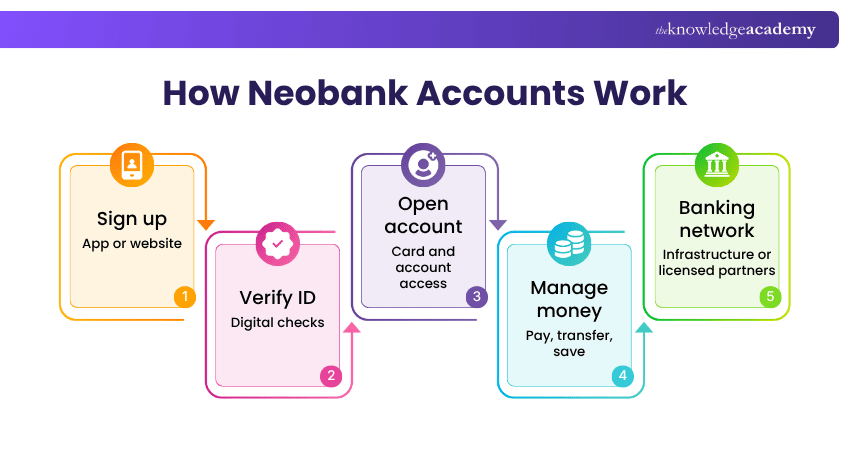
1) Digital Account Registration: A customer downloads an app or visits the provider's website and submits the information required to create an account.
2) Identity Verification: The provider completes identity and regulatory checks. Depending on the market, this can involve submitting identification documents, completing digital verification and providing personal information.
3) Account Creation: Once approved, the customer receives access to the relevant account and may receive a physical or virtual payment card.
4) Digital Money Management: Payments, transfers, savings, card settings and account information can then be managed through the application.
5) Banking Infrastructure: Deposits and financial transactions are supported either by the Neobank's own banking infrastructure or through one or more licensed banking partners.
Tips for Banking with Neobanks
1. Check the provider: Confirm whether it is a licensed bank or uses a banking partner.2. Understand fund protection: Review the deposit protection or safeguarding arrangements that apply.3. Compare fees carefully: Check charges for withdrawals, foreign exchange, premium plans and other services.4. Plan for digital access: Keep alternative payment options available in case of app, device or connectivity issues.
Grow your career with vital knowledge about Finance by signing up for our Accounting Courses now!
Key Features of Neobanks
Neobanks are usually distinguished by how their services are designed and delivered rather than by one financial product. While individual providers differ, several features are commonly associated with the model.
1) Mobile-first Banking
Most Neobanks design their services primarily for smartphones. Instead of treating the app as an additional channel, it becomes the main place where customers check balances, make transfers, manage cards, and contact support.
For example, a customer who loses a debit card may be able to freeze it immediately from the application rather than calling a branch or waiting for replacement procedures to begin.
2) Digital Account Opening
Account applications are generally completed online. Digital identity verification can reduce the need for customers to visit a physical location simply to submit forms or identification.
The process does not mean regulatory checks disappear. It means those checks are completed through digital systems rather than traditional branch-based procedures.
3) Real-time Account Information
Neobanks commonly provide rapid transaction notifications and updated spending information. When a card payment is made, for example, the customer may receive an immediate notification showing the merchant and amount.
This can make account activity easier to monitor and can also help users identify unexpected transactions more quickly.
4) Automated Money Management
Digital-first platforms can integrate budgeting and savings tools directly into everyday banking. Customers may be able to categorise expenditure, establish spending limits or automatically move small amounts of money into savings.
For instance, a round-up feature might convert a £3.60 purchase into £4 and transfer the remaining £0.40 into a designated savings pot. The value lies in automating a small financial habit rather than requiring the customer to make a separate transfer each time.
5) Simplified User Experience
Neobanks often aim to make routine financial information easier to understand. Spending can be grouped into categories such as food, transport or subscriptions, while account settings may be presented through a simpler interface.
This differs from merely providing a digital version of a conventional statement. The information is organised so customers can take action from within the same platform.
6) Digital Integrations
Some Neobanks connect with other financial tools, payment systems or accounting platforms. Business-focused providers, for example, may offer integrations that help companies organise expenses or transfer transaction information into bookkeeping systems.
The availability of these functions varies, so customers should compare individual providers rather than assuming every Neobank offers the same technology.
Basically, What Makes a Neobank Different?
Neobanks are not defined by one feature alone. Their main distinction is that banking is designed around the digital experience from the start. Mobile access, real-time information, automated money tools, simpler interfaces and integrations work together to make everyday banking more immediate and self-service.
What Services Do Neobanks Offer?
Features describe how the Neobank experience works. Services refer to the actual financial products customers can access.
The range varies considerably between providers, but commonly available services can include:
1) Current or checking accounts: Used for receiving income, making purchases, paying bills and managing everyday transactions.
2) Savings products: These may include dedicated savings accounts, savings pots or automated savings functions.
3) Debit and virtual cards: Customers may receive a physical card while also being able to create or manage virtual cards digitally.
4) Payments and transfers: Domestic transfers, international payments and person-to-person transactions may be available.
5) Foreign currency services: Some providers allow users to hold, convert or spend in multiple currencies.
6) Business banking: Certain Neobanks target freelancers, sole traders or companies with accounts designed around business payments and expenses.
7) Credit services: Depending on the provider and regulatory permissions, services may extend to overdrafts, credit cards or lending.
Neobank vs Traditional Bank vs Digital Bank
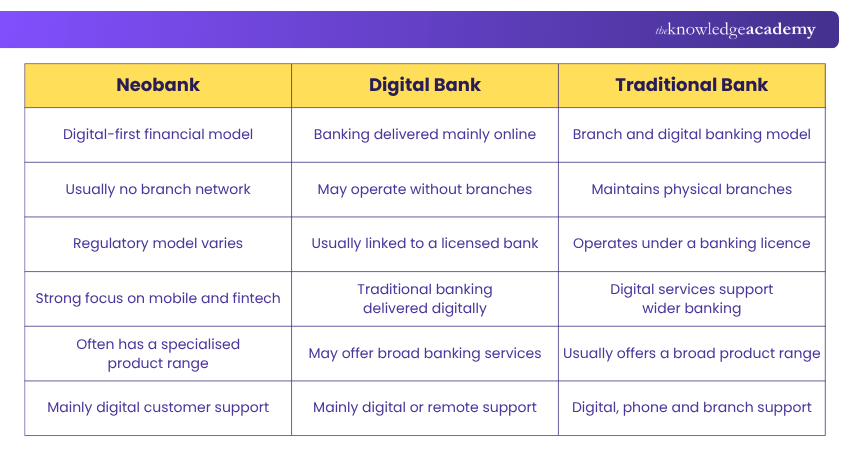
The terms Neobank and Digital Bank are sometimes used interchangeably, which can make comparisons difficult. There is no single international definition that separates them in every market.
Broadly, a Digital Bank is a bank that provides its services primarily or entirely through digital channels. A Neobank is generally associated with a newer, technology-led model, although some Neobanks are themselves fully licensed Digital Banks.
The differences can be understood more clearly through several characteristics:
Advantages and Disadvantages of Neobanks
Neobanks have attracted customers because their digital-first structure can remove some of the friction associated with conventional banking.
Advantages of Neobanks
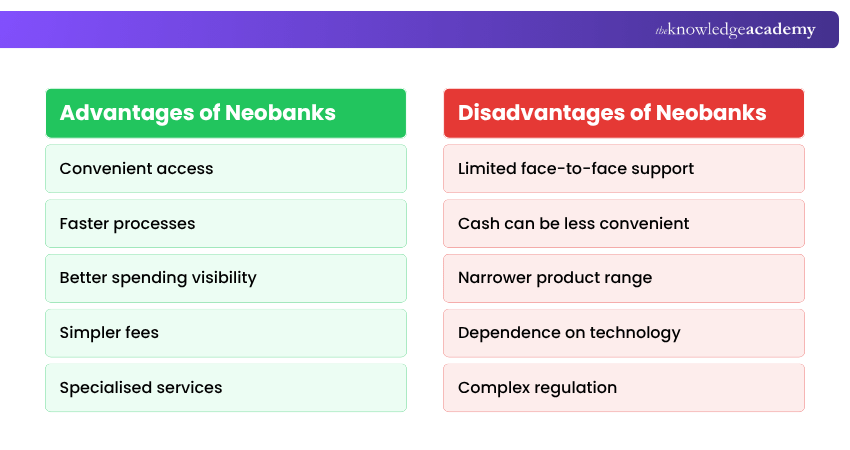
Neobanks can make everyday banking more convenient through a digital-first experience. Key advantages include:
• Convenient Access: Manage accounts, payments and cards through an app.
• Faster Processes: Open accounts and update banking settings more quickly.
• Spending Visibility: Use real-time alerts, categorisation and budgeting tools.
• Simpler Fees: Some providers offer clearer or lower-cost pricing structures.
• Specialised Services: Certain Neobanks cater to freelancers, businesses or travellers.
Disadvantages of Neobanks
Their digital model can also create some limitations. These include:
• Limited Face-to-face Support: In-person banking assistance may not be available.
• Cash Limitations: Deposits and withdrawals can be less convenient.
• Narrower Product Range: Some providers offer fewer financial products.
• Technology Dependence: Outages or device issues can affect account access.
• Complex Regulation: Licensing and customer protection arrangements may vary by provider.
Master the concept of Fintech and learn its latest advancements by signing up for our FinTech Course today!
Are Neobanks Safe?
A Neobank’s safety depends on how it is regulated, where customer funds are held and what protection applies.
For licensed UK banks, eligible deposits may be protected by the FSCS up to £120,000 per eligible person, per authorised firm. E-money institutions operate differently: customer funds must be safeguarded, but this is not the same as FSCS deposit protection.
In the US, eligible deposits held by FDIC-insured banks are generally protected up to $250,000 per depositor, per insured bank, per ownership category. Where a Neobank uses a partner bank, customers should check which institution actually holds their money.
Before choosing a provider, check whether it is a licensed bank, whether a partner bank is involved, which regulator supervises it and what deposit protection or safeguarding arrangements apply.
Cybersecurity also matters. Features such as authentication, transaction alerts and card freezing can improve security, but users should still protect passwords, devices and account access.
How Do Neobanks Make Money?
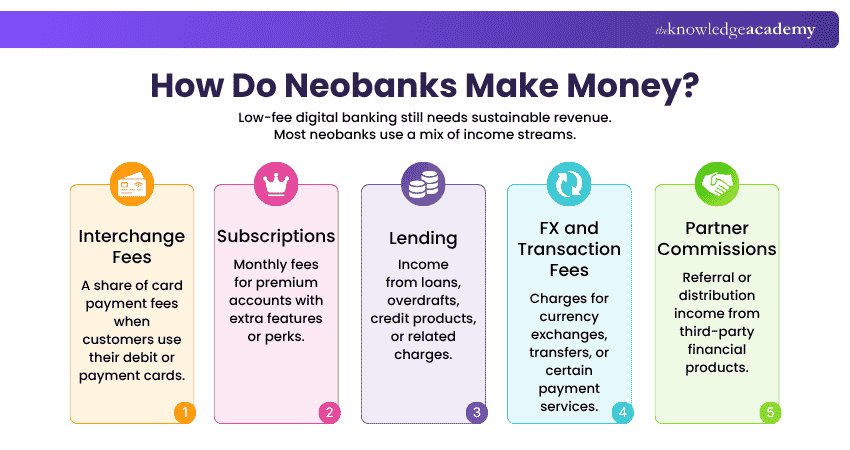
Neobanks use several revenue streams to support low-cost digital banking. Common sources include interchange fees from card payments, subscription plans for premium features, and lending income from credit products where permitted. They may also earn through foreign exchange fees, transaction charges and commissions from third-party financial products. Most Neobanks combine several of these sources rather than relying on one.
Is a Neobank the Same as a Fintech Company?
Fintech includes technology used across payments, lending, investing, insurance and other financial services.
Neobanking is one part of fintech, focused specifically on delivering banking or banking-related services digitally. For example, a payment-processing company can be a fintech without offering bank accounts.
In short: Neobanks operate within fintech, but not every fintech company is a Neobank.
Conclusion
Understanding what a Neobank is requires looking beyond the fact that it operates through an app. Neobanks use a digital-first model to provide banking or banking-related services, often combining mobile access with faster account management, spending tools and technology-led customer experiences.
Stand out in your fintech interview with these expert Fintech Interview Questions. Download now and get ready!

The Knowledge Academy develops accessible learning content across Project Management, IT, Cybersecurity, Data Science, Business Analysis, HR, Accounting and Finance, Leadership and Health and Safety. Its resources combine subject research with clear explanations to help professionals build practical knowledge across a wide range of disciplines.
View Detail

 If you wish to make any changes to your course, please


