




We may not have the course you’re looking for. If you enquire or give us a call on +43 720 115337 and speak to our training experts, we may still be able to help with your training requirements.
Advantage and Disadvanatages of Robotics
ByVishnu SankarLast updated on: 18 September 2026
This blog explores the advantages and disadvantages of robotics, from cost-effectiveness, quality and safety benefits to concerns around job losses, investment costs, environmental impact and the human element robots can't replicate.
Robotics is taking the world by storm, spanning across multiple industries. Over the next few years, robotic automation is expected to gain popularity as organisations seek to benefit from the multitude of benefits it offers. Undoubtedly, it has posed a threat owing to its hazardous potential.
As robotics becomes increasingly integrated into different industries, understanding the advantages and disadvantages of robotics is important for evaluating its practical impact. While robotic systems can support organisations in several ways, their adoption also brings challenges that need careful consideration.
What is Robotics?
Robotics is the interdisciplinary branch of engineering and science that involves mechanical engineering, electrical engineering, computer science, and others. It deals with the design, construction, operation, and use of robots, as well as computer systems for their control, sensory feedback, and information processing.
In this digital age, robotics represents a transformative shift. It is utilised extensively in manufacturing, research laboratories, traffic management, search initiatives, and defence activities. These have streamlined tasks previously performed by humans while raising important considerations about the laws of robotics, which guide the ethical and safe development of these technologies.

Advantages of Robotics
There are various advantages of Robotics, and some of them include:
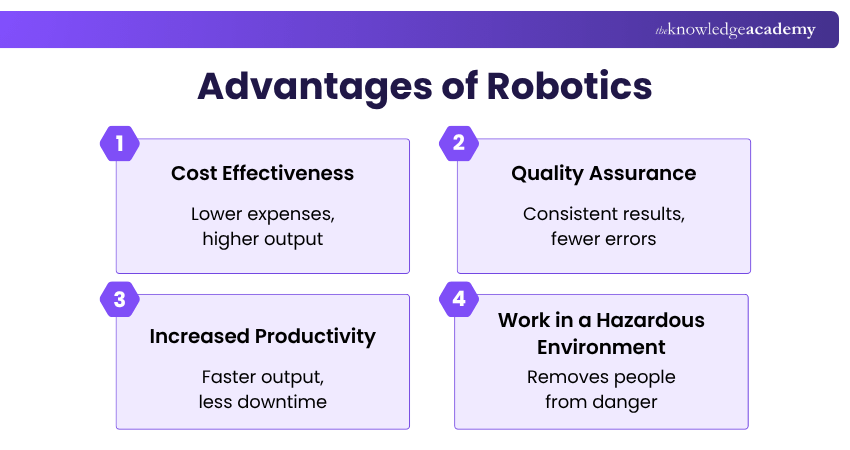
1) Cost-effectiveness: There will be no time set aside for robotic automation during lunch breaks, holidays, sick days, or shifts. It can be designed to operate in a repeated cycle, and if it is maintained properly, it will do so until told otherwise.
For every manufacturer, the increase in production at a cheaper cost results in clear advantages. However, how quickly the initial investment is recovered depends on factors such as implementation costs, utilisation, maintenance and the value generated by the automated process.
2) Quality Assurance: Few workers enjoy performing monotonous activities, and concentration levels will inevitably wane over time. This momentary loss of focus is referred to as vigilance reduction, and it frequently results in costly mistakes for the company as well as occasionally serious employee injuries.
Robotic automation ensures that products consistently meet the set standards by regularly producing and confirming their quality, thereby eliminating potential risks. The increased production of higher-quality products results in numerous business opportunities.
3) Increased Productivity: It makes perfect sense to automate monotonous chores with robotics. Robots are made to do repetitive tasks. Adding automation to your manufacturing process has a variety of positive effects on productivity, some of which are optimal machine efficiency, fewer manual delays, and increased manufacturing output.
Giving employees the chance to broaden their horizons and operate in different capacities will improve the workplace, which will be advantageous to the company. Allowing employees to focus on other activities while robots perform suitable repetitive tasks can support productivity and enable organisations to make better use of human skills.
4) Work in a Hazardous Environment: Staff workers in certain industries may be required to work in hazardous or unstable settings, in addition to potential occupational injuries. Robotic automation, for instance, provides the best option in situations where there are a lot of dangers present because it will continue to operate safely.
Due to the nature of the work, production facilities that demand extremely high or low temperatures frequently have a significant risk. Robotic automation can eliminate the need for people to take excessive risks in such a working environment.
Safety Note
Robots can reduce direct human exposure to certain hazardous tasks, but this does not eliminate workplace risk. Robotic systems still require appropriate safeguards, risk assessments and safe working procedures, particularly during activities such as maintenance, programming, testing and adjustment.
Disadvantages of Robotics
Robotics can deliver real benefits, but adopting it also comes with trade-offs that organisations need to weigh carefully. The following are the disadvantages of robotics:
1) Job Losses: The effect on jobs for employees is one of the main concerns surrounding the advent of Robotic Automation. The worry is that if a robot can work faster and more consistently, people might not even be required. These concerns are understandable, but the effect of robotics on employment is more complex than the direct replacement of workers.
2) Initial Investment Costs: This is one of the main barriers that determine whether a corporation invests in Robotic Automation at present or not. A thorough business case must be developed to evaluate the opportunities and potential shortcomings of such hefty investment.
The potential rewards can be significant where robotics is suitable for the application. However, organisations should assess the expected benefits against the initial investment and ongoing costs without jeopardising business stability or cash flow.
3) Lack of Human Touch: Robots can't replicate empathy, creativity or personal connection. Tasks that rely on a human element, such as artwork, animation, video production and other creative work, are difficult to automate meaningfully. Customers or users interacting with a robot instead of a person may also feel the exchange lacks warmth or genuine understanding.
Trainer's Pro Tip
Before assuming a job will disappear, break it into its individual tasks. Robots often take over the repetitive 20% of a role, not the whole thing, which usually leaves people with more time for the judgement-based work robots still can't do.
4) Maintenance and Breakdown Costs: Robotic systems require ongoing investment to maintain, and breakdowns can be costly to repair. These recurring expenses can reduce the overall return on the initial investment over time. Specialist parts and trained technicians are often needed, which can make repairs slower and more expensive than fixing conventional equipment.
5) Environmental Impact: Robotic systems eventually reach the end of their working life, contributing to electronic waste. As adoption grows, managing the disposal and recycling of robotic components becomes an increasing environmental concern. Many robotic parts contain metals, plastics and electronic components that are difficult to recycle safely.
6) Social and Ethical Tensions: Robotics can create disagreement between those who see it as progress and those concerned about its impact on jobs, privacy or society. These differing views can create friction within organisations and communities as adoption increases.
Employees may feel uneasy working alongside robots if they're unsure how the technology affects their own role or job security. Addressing these concerns openly is often necessary to maintain trust during the transition to more automated ways of working.
Put repetitive testing on autopilot with the Robot Framework Training – Join today!
Keep This in Mind
1. Robotics adds the most value when the task genuinely suits automation, not just because it can be automated.2. Initial investment should be weighed against ongoing maintenance and how quickly it's likely to pay back.3. Introducing robotics can change existing roles and the skills employees need going forward.4. Downtime, breakdowns and dependency on specialist repairs are real operational risks to plan for.5. The benefits of robotics should be reassessed once all costs are properly factored in.

Vishnu Sankar is a Senior Content Writer with 5+ years of experience across content development, software development, web development and system administration. His technical background and professional training support his expertise in IT and Tech, while his extensive research and writing experience covers Project Management and Health and Safety.
View Detail

 If you wish to make any changes to your course, please


