


 Top Rated Course


We may not have the course you’re looking for. If you enquire or give us a call on +44 20 4538 6376 and speak to our training experts, we may still be able to help with your training requirements.
PHP VS Python: Key Differences, Features & Use Cases
The Knowledge Academy 04 March 2026PHP is a server-side scripting language for web development, while Python is a versatile language used for web development, data science, and automation. Python is easier to learn for beginners due to its clear syntax and wide support, while PHP remains popular for building dynamic, interactive websites used globally.

Training Outcomes Within Your Budget!
We ensure quality, budget-alignment, and timely delivery by our expert instructors.
Table of Contents
Python and PHP rank among the top programming languages mostly used in contemporary software development. A number of beginners do a comparison of PHP vs Python just to know which one is better for their purpose. In this blog, we will analyse the various aspects, functionalities, and ideal scenarios for both languages so that you can make your choice without any doubts.
Table of Contents
1) What is PHP?
2) What is Python?
3) PHP vs Python: Key Differences
4) PHP vs Python: How to Choose the Right Language?
5) Can Python be Used for Building Websites Like PHP?
6) Conclusion
What is PHP?
Before delving into a detailed comparison of Python vs PHP, we will first define both – beginning with the latter. PHP, short for Hypertext Preprocessor, is a server-side scripting language primarily used for Web Development. It is widely adopted and powers numerous websites and web applications. PHP is known for its simplicity, versatility, and extensive support for database integration. It is compatible with various web servers and operating systems, making it highly accessible. PHP Interview Questions often cover these fundamental aspects of the language.
What is Python?
Python is a versatile, high-level programming language known for its readability and ease of use. It offers a variety of applications, from Web Development to data analysis and artificial intelligence. Python's clean syntax and comprehensive standard library contribute to its popularity among developers. It prioritises simplicity and encourages code readability, which aids in maintaining and scaling projects.
Enhance your programming skills with our Python Course – Sign up now!
PHP vs Python: Key Differences
We will consider the main difference between PHP and Python as we discuss the essential features below.
1) Syntax and Readability
Python comes with a very clear and clean syntax mainly due to the use of indentation. This makes the code easy to read and consistent. PHP on the other hand is of a C-like structure which is familiar to most programmers but might be more verbose especially with multi-dimensional arrays. On the whole, Python prevails for its readability and simplicity.
2) Performance and Scalability
The performance of a programming language is largely determined by its application. PHP is a web development language, and as such, it can perform server-side tasks very quickly. On the contrary, Python is less efficient in execution than PHP, but it is still the primary option in the data-intensive field thanks to its powerful libraries and scalable frameworks.
3) Frameworks
The ecosystems around both PHP and Python frameworks are extremely powerful. The main options in PHP are Laravel, Symfony, and CodeIgniter, while in Python one can choose between Django, Flask, and Pyramid. The main factors for choosing Python frameworks over others are their flexibility and speed of development.
4) Web Development
PHP has stellar, top-notch, and ace frameworks like Laravel, Symfony, and CodeIgniter which together turn the building of dynamic sites, CMSs, and e-stores into a walk in the park. Moreover, they form a solid union with powerful databases. Python, on the contrary, offers web development through Django and Flask but its versatility ranges far beyond the web; therefore, it can be considered for data manipulation, AI, automation, and scientific calculations.
5) Community and Support
Both languages have the advantage of powerful backlink communities and plentiful learning resources. PHP provides extensive tutorials, forums, and high-frequency updates that cater to the needs of Web Development. The Python community is also big and very open-minded: it not only provides libraries for web, data, AI, and automation but also makes it easy for developers to get help.
6) Job Market and Demand
PHP continues to be in great demand mainly because of its position in Web Development and its use in platforms like WordPress, CMS systems, and e-commerce sites. Contrarily, Python's demand has surged rapidly in the fields of Web Development, data science, AI, and automation, largely attributable to its versatile libraries and the universal acceptance of the language in different sectors.
7) Debugging
PHP employs XDebug to aid its debugging, while Python uses the PDB debugger, one of its built-in features; thus, both are quite helpful for tracing errors and debugging code.
8) Security
Python is usually considered more secure due to its security features and following modern practices. PHP has been better in recent times, but it still has had more security issues historically.
9) Documentation
The two languages provide comprehensive and well-kept documentation along with community resources; however, the documentation of Python is typically more organised and user-friendly.
10) Use Cases
PHP is primarily utilised for web development, where its strength lies in server-side scripts and database-oriented websites. On the other hand, Python is a much more adaptable language, allowing it to be used not only for web projects but also for data analysis, machine learning, AI, and automation.
PHP vs Python: How to Choose the Right Language?
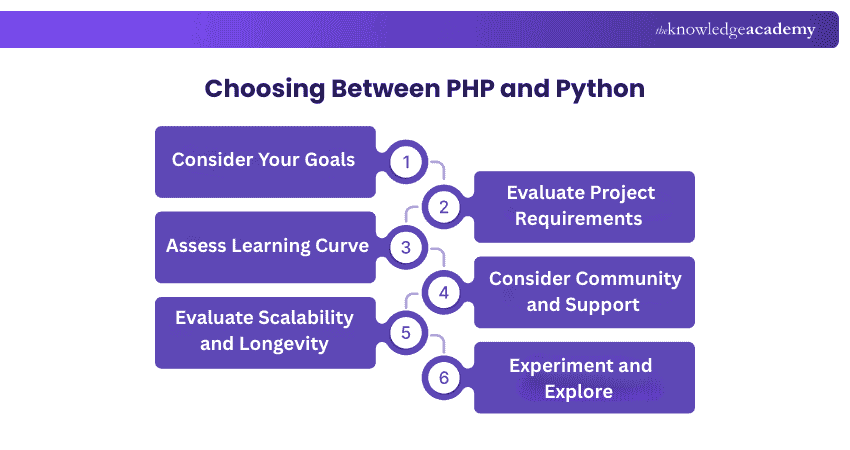
When embarking on a programming journey, choosing the right language is a crucial decision. With a myriad of programming languages available, selecting the one that aligns with your goals, project requirements, and personal preferences is essential. To make the right choice, consider some key aspects like the following:
1) Consider Your Goals
Before diving into any programming language, it is vital to identify your goals and aspirations as a developer. Are you interested in Web Development, data analysis, mobile app development, or machine learning? Each programming language has its strengths and specialities. For example, if your goal is to become a web developer, languages like JavaScript, PHP, or Python may be suitable choices. Comprehending your goals will help narrow down the options and guide you towards the language that aligns with your desired career path.
2) Evaluate Project Requirements
When selecting a programming language, carefully evaluate the requirements of your project. Consider the scope, complexity, and specific functionalities you need to implement. For example, if you are developing a web application that requires robust server-side scripting and database integration, PHP might be a good fit. On the other hand, if you are working on a project that involves data analysis, machine learning, or scientific computing, Python's extensive library ecosystem and data processing capabilities make it a suitable choice.
Empower yourself with programming skills with our Programming Training, Sign up now!
3) Assess Learning Curve
Consider your familiarity with programming concepts and your learning preferences. Some languages have steeper learning curves, while others are more beginner-friendly. If you are new to programming, it is advisable to choose a language with a gentle learning curve. Python, for example, is known for its simplicity and readability, making it an optimal choice for beginners. PHP also has a relatively straightforward syntax, particularly for those already familiar with C-style languages.
4) Consider Community and Support
The strength of a programming language's community and the availability of support resources are vital for developers. A vibrant community provides opportunities for learning, collaboration, and problem-solving. Consider the size, activity level, and accessibility of the community associated with your chosen language.
5) Evaluate Scalability and Longevity
While it may be tempting to choose a language solely based on current trends, it is important to evaluate its scalability and long-term viability. Consider the language's adoption rate, industry usage, and whether it has a history of successful projects. A language that is widely adopted and has an established ecosystem is more likely to have better long-term support, libraries, and frameworks. It is also important to assess the language's evolution and its compatibility with emerging technologies.
6) Experiment and Explore
Finally, don't be afraid to experiment and explore different programming languages. Building a strong foundation in one language often facilitates learning others in the future. By being open to new experiences, you can broaden your skill set and adapt to diverse project requirements.
Can Python be Used for Building Websites like PHP?
You are correct in saying that Python can be used in a way similar to PHP for web development. It provides very good backend functionality and is almost always compared with PHP if developers have to pick a language for their web projects.
Python, with the help of Django or Flask framework, can provide support for dynamic web portals, APIs, and complete sports applications. Such tools enable developers to have similar power and flexibility as in PHP-based development.
Conclusion
Deciding on PHP vs Python depends on your objectives, the requirements of the project, and the plans for long-term development. The two languages have their respective extensive communities, the most advanced frameworks, and the widest career opportunities, among others. If you have the right expertise, then you can create fast, large, and ready-to-use applications with either language.
Excel Django and build powerful web applications with our Python Django Training – Join now!
Frequently Asked Questions
Do PHP and Python Work Well With Cloud Platforms Like AWS or Azure?

Yes, both PHP and Python integrate seamlessly with AWS and Azure to build scalable, secure, cloud-based applications.
Is WordPress Available in Python?
Python does not have access to WordPress since it is developed with PHP together with JavaScript, HTML, and MySQL. Nonetheless, Python can still communicate with WordPress through its RESTful API for automation and integration purposes.
What are the Other Resources and Offers Provided by The Knowledge Academy?
The Knowledge Academy takes global learning to new heights, offering over 3,000+ online courses across 490+ locations in 190+ countries. This expansive reach ensures accessibility and convenience for learners worldwide.
Alongside our diverse Online Course Catalogue, encompassing 17 major categories, we go the extra mile by providing a plethora of free educational Online Resources like Blogs, eBooks, Interview Questions and Videos. Tailoring learning experiences further, professionals can unlock greater value through a wide range of special discounts, seasonal deals, and Exclusive Offers.
What is The Knowledge Pass, and How Does it Work?
The Knowledge Academy’s Knowledge Pass, a prepaid voucher, adds another layer of flexibility, allowing course bookings over a 12-month period. Join us on a journey where education knows no bounds.
What are the Related Courses and Blogs Provided by The Knowledge Academy?
The Knowledge Academy offers various Programming Courses, including the Python Course, Vue.js Framework Training, and ReactJS Course. These courses cater to different skill levels, providing comprehensive insights into Data Discrepancy.
Our Programming & DevOps Blogs cover a range of topics related to PHP vs Python, offering valuable resources, best practices, and industry insights. Whether you are a beginner or looking to advance your Programming & DevOps skills, The Knowledge Academy's diverse courses and informative blogs have got you covered

The Knowledge Academy


Global Training Provider
The Knowledge Academy is a world-leading provider of professional training courses, offering globally recognised qualifications across a wide range of subjects. With expert trainers, up-to-date course material, and flexible learning options, we aim to empower professionals and organisations to achieve their goals through continuous learning.


 If you wish to make any changes to your course, please


