


 Top Rated Course

We may not have the course you’re looking for. If you enquire or give us a call on 01344 203999 and speak to our training experts, we may still be able to help with your training requirements.
Object-Oriented Programming Basics: Learn OOP Step-by-Step
The Knowledge Academy 29 December 2025Object-Oriented Programming (OOP) is a coding approach that uses objects and classes to represent real-world concepts and simplify software development. It employs principles like inheritance, polymorphism, encapsulation, and abstraction to streamline complex software development processes. Read ahead to know more!

Training Outcomes Within Your Budget!
We ensure quality, budget-alignment, and timely delivery by our expert instructors.
Table of Contents

Let’s say that you are building a virtual pet game. Each pet has unique traits; size, colour, mood. How do you manage all this data without turning your code into a tangled mess? That’s where Object Oriented Programming comes in, making it easy to organise, reuse, and maintain code through objects and classes.
But what exactly is Object Oriented Programming, and why do developers swear by it? Think of it as a toolkit that transforms scattered data into well-defined structures using principles like inheritance, encapsulation, and polymorphism. In this blog, we’ll unravel OOP step-by-step, with relatable examples and actionable insights to help you master the basics.
Table of Contents
1) Understanding “What is Object Oriented Programming”?
2) What is the Structure of Object-oriented Programming?
3) Key Concepts of Object Oriented Programming (OOPs)
4) Advantages and Disadvantages of OOPs
5) Applications of OOPs
6) Popular Object Oriented Programming Languages
7) Real World Examples of OOPs
8) How Does Inheritance Work in OOP?
9) Conclusion
Understanding “What is Object Oriented Programming?”
Object Oriented Programming is designing and writing software programs that focus on the Objects representing the concepts and entities in the problem domain. An Object is a self-contained unit that has a state and behaviour. The state of an Object is defined by its attributes, which are the variables that store the values of the Object’s properties. The actions of an Object are determined by its methods, serving as the functions that execute specific functionalities for the Object.
For example, consider a software system that manages a library. In this system, one of the Objects could be a book, which has attributes such as title, author, genre, and ISBN, and methods such as borrow, return, and reserve. Another Object could be a user, which has attributes such as name, email, and password, and methods such as login, logout, and search.
These Objects can interact with each other through messages, which are the requests and responses that are exchanged between the Objects. Understanding these interactions is fundamental to OOP Concepts in JavaScript, making it easier to structure and maintain complex applications.

What is the Structure of Object-oriented Programming?
Object-Oriented Programming (OOP) is like building things with blocks. Instead of just writing code, you create objects that represent real-world things. These objects are created from classes and come with their own data and abilities. Let’s break it down:
Classes
Think of a class like a blueprint or recipe. It tells you how an object should be made;what data it should store and what actions it should be able to do. But a class alone isn't enough; it’s just a plan. You need objects to bring that plan to life!
Objects
An object is an actual instance of a class. If the class is a blueprint, then an object is like the house built from that blueprint. Each object can have its own unique data, even though they all share the same class. For example, you can have multiple "Car" objects, each with different colours, speeds, and fuel levels, but they all come from the same "Car" class.
Methods
Methods are like the actions or behaviours that objects can do. If the class is a recipe, methods are the steps that tell the object how to use its data. For example, a "Car" object might have methods like "drive" or "stop" to control the car’s movement.
Attributes
Attributes are the details or characteristics that belong to each object. Think of them as the properties that make an object unique. For example, a "Car" object might have attributes like "colour", "make", or "model". These attributes hold specific values for each car, so one car might be red and another might be blue
Land Your Dream Job! Practice with OOPS Interview Questions to stand out in interviews and demonstrate your expertise.
Key Concepts of Object Oriented Programming (OOPs)
Object Oriented Programming is based on some core elements that define the structure and behaviour of the Objects and the relationships between them. These elements are Object, class, coupling, cohesion, composition, association, and aggregation. Take a look at the comprehensive list below:
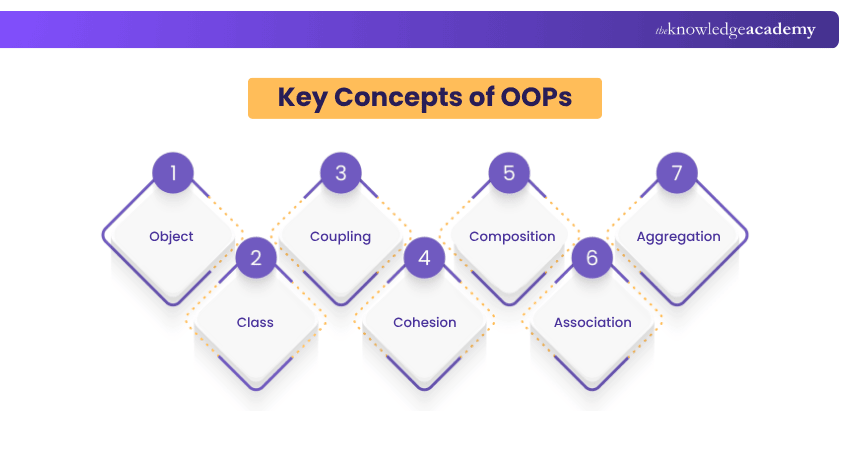
Object
An Object is a self-contained unit with a state and behaviour. It's an instance of a class, a blueprint defining the Object's attributes and methods. For example, a book Object may have attributes like title, author, and methods like borrow and return.
Class
A class is defined as a blueprint that defines the attributes and methods of a type of Object. It includes constructors to create and initialise instances. In the context of a library system, a book class might define attributes such as title and author, along with methods like borrow and return.
Coupling
Coupling measures the interdependence between classes or Objects. Tight coupling implies high dependency, while loose coupling suggests independence. A library system with loose coupling between the book and user classes ensures flexibility.
Cohesion
Cohesion measures the relatedness and consistency within a class or Object. High cohesion implies attributes and methods are closely related, contributing to better understanding and maintainability. In a book class, attributes like titles and methods like borrowing exhibit high cohesion.
Composition
The composition represents a whole-part or part-of relationship. A book Object could comprise page Objects, indicating a strong ownership and dependency relationship. The book controls the lifetime and behaviour of its pages.
Association
Association signifies a connection or link between classes or Objects. A book Object might be associated with a user Object in a library system. This implies a weak and optional connection, where both entities can exist independently.
Aggregation
Aggregation is a special association implying a whole-part relationship with weak and shared ownership. For instance, a library Object might have an aggregation relationship with book Objects. The library doesn't control the book's lifetime; books can exist independently.
Syntax
Syntax in OOP refers to the set of rules defining how to write code in a specific programming language. It determines how classes, objects, methods, and attributes are structured, ensuring the code is valid and can be compiled or interpreted.
Encapsulation
Encapsulation involves bundling data and methods within a class and restricting access to the internal details. It protects the object's state by making attributes private and using public methods to access or modify them, ensuring controlled interaction with the object.
Polymorphism
Polymorphism allows methods to behave differently based on the object’s class. It enables a common interface for different object types, with method overloading for compile-time polymorphism and method overriding for run-time polymorphism, making code more flexible and reusable.
Enhance your coding skills and unleash the potential of web development with our Ruby Programming Course. Join today!
Advantages and Disadvantages of OOPs
What is OOP? It's a programming approach that has both strengths and limitations. Understanding both the advantages and disadvantages is key to evaluating its suitability for a given project.
Advantages of OOPs
Object Oriented Programming has advantages over other programming paradigms, such as Procedural and Functional programming. Some of the Advantages of Object Oriented Programming are:
a) OOPs makes software development more modular, maintainable, and reusable by organising data and behaviour into reusable units called Objects and by applying some fundamental principles and core elements.
b) OOPs makes software development more intuitive and natural by modelling software systems as a collection of interactable entities with specific attributes and behaviours and reflecting the concepts and entities in the problem domain.
c) OOPs makes software development more flexible and adaptable by creating higher-level concepts and categories that can be reused and extended and by enabling the same message to be interpreted and executed differently by different Objects.
d) OOPs makes software development more robust and reliable by protecting the integrity and consistency of the Object’s state and by enforcing the access and modification rules of the Object’s attributes and methods.
Disadvantages of OOPs
Object Oriented Programming also has disadvantages and limitations that must be considered and addressed. Some of the disadvantages of OOPs are:
a) OOPs can increase the complexity and overhead of software development by introducing more layers of abstraction and encapsulation and requiring more design and planning decisions.
b) OOPs can reduce the performance and efficiency of software systems by consuming more memory and processing resources and by adding more indirection and overhead to the execution of the messages and methods.
c) OOPs can introduce some challenges and difficulties in software testing and debugging by hiding the internal implementation and state of the Objects and making the Objects' behaviour more dynamic and unpredictable.
d) OOPs can create problems and conflicts in software integration and interoperability by imposing some constraints and assumptions on the structure and behaviour of the Objects and by requiring some compatibility and standardisation between the different classes and Objects.
Unlock the power of OOPs languages with our comprehensive Object-Oriented Programming (OOPs) Course. Sign up now!
Applications of OOPs
Object Oriented Programming is widely used and applied in various domains and fields of software development, such as web development, mobile development, game development, database development, and artificial intelligence. Some of the applications of OOPs are:
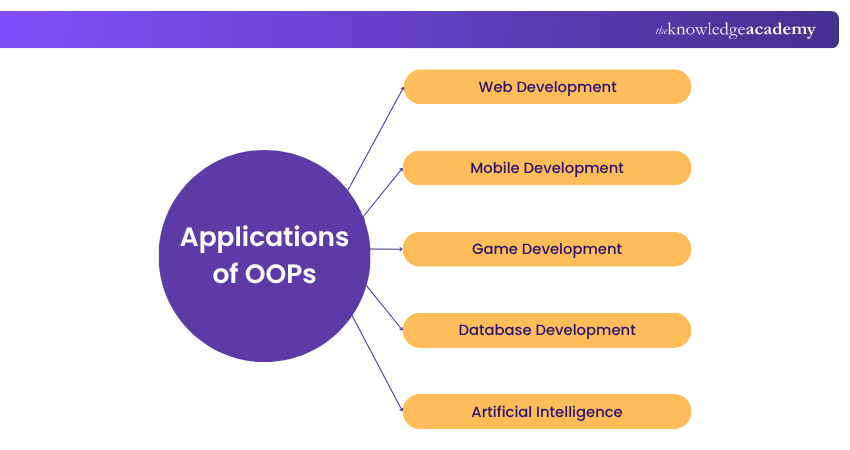
a) Web Development
OOPs is used to create dynamic and interactive web applications that use Objects, such as HTML, CSS, JavaScript, PHP, Ruby, and Python, to represent and manipulate the data and the user interface of the web pages.
b) Mobile Development
OOPs is used to create native and cross-platform mobile applications that use Objects to represent and control the data and the user interface of mobile devices, such as Java, Kotlin, Swift, Objective-C, and Flutter.
c) Game Development
OOPs is used to create immersive and realistic game applications that use Objects to model and simulate the characters, scenes, and physics of the game world, such as C++, C#, Unity, Unreal Engine, and Godot.
d) Database Development
OOPs is used to create and manage relational and non-relational database systems that use Objects, such as SQL, MongoDB and Firebase, to store and query the data and the metadata of the database.
e) Artificial Intelligence
OOPs is used to create and implement intelligent and learning systems that use Objects, such as Python, TensorFlow, PyTorch, and Keras, to represent and manipulate the data and the logic of the system.
Popular Object Oriented Programming Languages
Object-oriented programming is supported by many modern languages that make software development more efficient, scalable, and modular. Here are some of the most widely used OOP languages today:

Java
Java is a widely adopted, platform-independent language known for its stability and scalability. It’s extensively used in enterprise software, Android apps, and web platforms due to its strong object-oriented structure and “write once, run anywhere” capability.
C#
C# is a Microsoft-developed language that blends OOP principles with .NET framework capabilities. It’s used for building Windows applications, web services, and games, offering features like type safety, garbage collection, and strong integration with Microsoft tools.
Python
Python is beginner-friendly yet powerful, because of its clear syntax and strong OOP support. It’s ideal for web development, data science, and AI, offering vast libraries and rapid development capabilities across a wide range of industries.
Ruby
Ruby is a dynamic language known for its elegant syntax and simplicity. Built around OOP principles, it’s most famous for the Ruby on Rails framework, which enables quick and maintainable web application development.
PHP
PHP started as a web scripting language and evolved into a full-featured language with OOP support. It integrates well with HTML and databases, and popular frameworks like Laravel make it a go-to for dynamic website development.
Real World Examples of OOPs
OOP is used in everyday apps. A ride-sharing app might use a Vehicle class with Car and Bike objects. In banking software, each Customer object manages personal data, all built from a single class. OOP helps organise complex systems with reusable, scalable code.
How Does Inheritance Work in OOP?
Inheritance lets one class reuse code from another. A Child class inherits traits from a Parent class, like Dog from Animal. This makes it easier to build specific features without rewriting common ones, helping developers keep code clean, efficient, and easier to manage.
Conclusion
By mastering the fundamentals of Object Oriented Programming Basics, you’re now equipped to write organised, modular, and reusable code. Embrace these principles, practise consistently, and transform your coding approach to build more robust and scalable projects. The next step? Dive in and keep creating. Transform data with R expertise.
Join our R Programming Course to elevate your analytical skills and career potential.
Frequently Asked Questions
Why is OOPs Important in Programming?

OOPs enhances code flexibility, scalability, and maintainability. It simplifies complex systems, fosters code organisation, and supports collaborative development, making it crucial for building robust and efficient software.
What are the Key Principles of OOPs?
OOPs principles include encapsulation, inheritance, and polymorphism. Encapsulation protects data integrity, inheritance facilitates code reuse, and polymorphism allows Objects to take multiple forms, fostering code flexibility and extensibility.
What are the Other Resources and Offers Provided by The Knowledge Academy?
The Knowledge Academy takes global learning to new heights, offering over 3,000 online courses across 490+ locations in 190+ countries. This expansive reach ensures accessibility and convenience for learners worldwide.
Alongside our diverse Online Course Catalogue, encompassing 19 major categories, we go the extra mile by providing a plethora of free educational Online Resources like Blogs, eBooks, Interview Questions and Videos. Tailoring learning experiences further, professionals can unlock greater value through a wide range of special discounts, seasonal deals, and Exclusive Offers.
What is The Knowledge Pass, and How Does it Work?
The Knowledge Academy’s Knowledge Pass, a prepaid voucher, adds another layer of flexibility, allowing course bookings over a 12-month period. Join us on a journey where education knows no bounds.
What are the Related Courses and Blogs Provided by The Knowledge Academy?
The Knowledge Academy offers various Object Oriented Programming (OOPs) Course, including Python Course, PHP Course, Swift Training etc. These courses cater to different skill levels, providing comprehensive insights into Introduction to OOPs.
Our Programming & Devops Blogs cover a range of topics related to Object Oriented Programming (OOPs), offering valuable resources, best practices, and industry insights. Whether you are a beginner or looking to advance your Programming and DevOps skills, The Knowledge Academy's diverse courses and informative blogs have you covered.

The Knowledge Academy


Global Training Provider
The Knowledge Academy is a world-leading provider of professional training courses, offering globally recognised qualifications across a wide range of subjects. With expert trainers, up-to-date course material, and flexible learning options, we aim to empower professionals and organisations to achieve their goals through continuous learning.

Upcoming Programming & DevOps Resources Batches & Dates
Date
 Object Oriented Programming (OOPs) Course
Object Oriented Programming (OOPs) Course
Fri 24th Jul 2026
Object Oriented Programming (OOPs) Course
Fri 23rd Oct 2026

 If you wish to make any changes to your course, please


