
ILM Level 4

accredited by

Our ILM Approved Centre course is accredited by ILM

Online Self-paced (21 hours)

ILM Level 4 Award in Leadership and Management Assessment

ILM Level 4 Award in Leadership and Management Course Outline

Total Credit Value – 5

Guided Learning Hours – 9

Unit 8605-403: Managing Risk in the Workplace

Credit Value – 3

Guided Learning Hours – 6

Module 1: Understand the Importance of Managing Risks in the Workplace

  • Legal Risk Management
  • Purpose of the Evaluation
  • Structure of the Report
  • Hazards and Control Measures
  • Principles of Risk Management
  • Risk Management Process
  • Risk Management Standards and Frameworks
  • Risk and Regulatory Policy
  • Risk Management Policy

Module 2: Be Able to Identify and Manage Risks in Own Area of Responsibility

  • Steps to Risk Assessment
  • Hazard Prevention and Control
  • Build and Implement a Risk Management Plan
  • Monitor and Review
  • Risk Prioritisation
  • Objective Probability
  • Risk Management Documentation

Unit 8605-406: Developing Your Leadership Styles

Credit Value – 4

Guided Learning Hours – 10

Module 3: Understand the Outcomes of Effective Leadership

  • Leadership and Importance of Employee Engagement
  • Leadership's Role in Engagement
  • Styles and Models of Followership
  • Effective Performance Management

Module 4: Be Able to Assess Own Leadership Styles 

  • Leadership Styles and Methods
  • Diagnostic Tools for Leaders and Managers
  • Importance of Leadership Development

Module 5: Understand the Implications of Own Leadership Styles for Self and for Leadership within Own Organisation

  • Self-Assessment for Leadership
  • Pillars of Self Organisation
  • How to Become a Self-Managed Employee?
  • Manage Work Schedule Successfully
  • How Do Self-Organising Teams Work?
  • Leadership Profile

Module 6: Be Able to Assess Own Leadership Behaviour, in Terms of the Factors Which Determine Effective Leadership

  • Importance of Good Leadership Behaviour
  • Ways to Build Effective Leadership Behaviours
  • Factors that Affect Business Leadership
  • Situational Analysis
  • Leadership Styles - Choosing the Right Approach for the Situation

Module 7: Understand How to Develop Own Leadership Style and Effectiveness

  • Create an Action Plan for Leadership Development
  • Benefits of Creating an Action Plan
  • Monitoring and Evaluating an Action Plan
  • Steps to Increase Leadership Effectiveness

Show moredown

Who Should Attend This Level 4 Award in Leadership and Management Course?

This Level 4 Award in Leadership and Management Course is tailored for professionals seeking to refine their leadership capabilities and management strategies. It is particularly advantageous for:

  • Mid-Level Managers
  • Team Leaders
  • Project Managers
  • Aspiring Senior Managers
  • HR Professionals
  • Business Owners
  • Department Heads

Prerequisites of the Level 4 Award in Leadership and Management Course

There are no formal prerequisites for this Level 4 Award in Leadership and Management Course. However, a basic understanding of Leadership and Management principles is beneficial.

ILM Level 4 Award in Leadership and Management Course Overview

Leadership and Management are pivotal for achieving organisational success and navigating complex business challenges. The Level 4 Award in Leadership and Management Course is designed to provide professionals with advanced skills in leadership, resource management, and strategic decision-making. This course covers essential elements of strategic leadership and change management, equipping delegates with the expertise needed to lead teams effectively and manage organisational changes.

For professionals such as Mid-Level Managers, Team Leaders, and Project Managers, mastering these Leadership and Management skills is crucial for driving organisational growth and success. The Level 4 Award in Leadership and Management Training delivers the knowledge needed to implement strategic initiatives and manage resources efficiently, making it an invaluable course for those aiming to advance their careers.

This 1 day training by The Knowledge Academy offers practical insights and hands-on experience in Leadership and Management. Through interactive sessions, real-world scenarios, and strategic exercises, delegates will develop actionable strategies to enhance their leadership capabilities. The course is designed to be engaging and impactful, ensuring that all key aspects of Leadership and Management are thoroughly covered.

Course Objectives

  • To understand the role and responsibilities of an effective leader
  • To develop strategic thinking and resource management skills
  • To enhance conflict resolution and team management abilities
  • To learn how to manage organisational change effectively
  • To cultivate problem-solving and strategic decision-making skills

Upon completion, delegates will have acquired the advanced skills necessary to excel in leadership roles, drive organisational success, and foster a productive working environment.

Show moredown

What's Included in this ILM Level 4 Award in Leadership and Management Course? 

  • ILM Level 4 Award in Leadership and Management Assessment
  • World-Class Training Sessions from Experienced Instructors
  • ILM Level 4 Award in Leadership and Management Certificate 
  • Comprehensive Digital Delegate Pack

Show moredown

ILM Level 4 Award in Leadership and Management Assessment Information

  • You will complete assessments for each unit you study, which will consist of written tasks and project-based evaluations.  
  • All submissions are completed online and evaluated by your ILM tutor.

Show moredown

accredited by

Our ILM Approved Centre course is accredited by ILM

Online Self-paced (48 hours)

ILM Level 4 Certificate in Leadership and Management Assessment

ILM Level 4 Certificate in Leadership and Management Course Outline

Total Credit Value – 13

Guided Learning Hours – 43

Unit 8605-403: Managing Risk in the Workplace

Credit Value – 3

Guided Learning Hours – 6

Module 1: Understand the Importance of Managing Risks in the Workplace

  • Legal Risk Management
  • Purpose of the Evaluation
  • Structure of the Report
  • Hazards and Control Measures
  • Principles of Risk Management
  • Risk Management Process
  • Risk Management Standards and Frameworks
  • Risk and Regulatory Policy
  • Risk Management Policy

Module 2: Be Able to Identify and Manage Risks in Own Area of Responsibility

  • Steps to Risk Assessment
  • Hazard Prevention and Control
  • Build and Implement a Risk Management Plan
  • Monitor and Review
  • Risk Prioritisation
  • Objective Probability
  • Risk Management Documentation

Unit 8605-406: Developing Your Leadership Styles

Credit Value – 4

Guided Learning Hours – 10

Module 3: Understand the Outcomes of Effective Leadership

  • Leadership and Importance of Employee Engagement
  • Leadership's Role in Engagement
  • Styles and Models of Followership
  • Effective Performance Management

Module 4: Be Able to Assess Own Leadership Styles

  • Leadership Styles and Methods
  • Diagnostic Tools for Leaders and Managers
  • Importance of Leadership Development

Module 5: Understand the Implications of Own Leadership Styles for Self and for Leadership within Own Organisation

  • Self-Assessment for Leadership
  • Pillars of Self Organisation
  • How to Become a Self-Managed Employee?
  • Manage Work Schedule Successfully
  • How Do Self-Organising Teams Work?
  • Leadership Profile

Module 6: Be Able to Assess Own Leadership Behaviour, in Terms of the Factors Which Determine Effective Leadership

  • Importance of Good Leadership Behaviour
  • Ways to Build Effective Leadership Behaviours
  • Factors that Affect Business Leadership
  • Situational Analysis
  • Leadership Styles - Choosing the Right Approach for the Situation

Module 7: Understand How to Develop Own Leadership Style and Effectiveness

  • Create an Action Plan for Leadership Development
  • Benefits of Creating an Action Plan
  • Monitoring and Evaluating an Action Plan
  • Steps to Increase Leadership Effectiveness

Unit 8605-300: Solving Problems and Making Decisions

Total Credit Value – 2

Guided Learning Hours – 9

Module 8: Know How to Describe a Problem, Its Nature, Scope, and Impact

  • Problem, Its Nature Scope, and Impact
  • Ways to Recognise, Define, Investigate, and Analyse Problems
  • Objective Setting in Relation to Problem
  • Brainstorming, Problem Solving, and Creative Thinking Techniques

Module 9: Know How to Gather and Interpret Information to Solve a Problem

  • Gather and Interpret Information to Identify Possible Solutions to a Problem
  • Prepare a Summary of the Options Providing Facts and Evidence
  • Difference Between Data and Information

Module 10: Know How to Evaluate Options to Make a Decision

  • Importance of Adequate and Relevant Information for Effective Decision-Making
  • Identification of What Information is Relevant to Specific Decisions
  • Decision Making Techniques

Module 11: How to Plan, Monitor, and Review the Implementation and Communication of Decisions?

  • Plan the Implementation and Communication of the Decision
  • Monitoring and Review Techniques to Evaluate Outcomes

Unit 8605-303: Planning and Allocating Work

Total Credit Value – 2

Guided Learning Hours – 9

Module 12: Know How to Plan Work in the Workplace

  • Identify Organisational Targets Relevant to the Team
  • Set Smart Objectives for the Team to Achieve the Targets
  • Use a Technique to Plan to Achieve the Objectives
  • Explain How to Monitor and Control a Planned Activity

Module 13: Know How to Allocate Work to Team Members

  • Identify Resources Required to Complete a Planned Activity
  • How to Allocate Work to Team Members?
  • How to Assess and Support Team Performance in Achieving Objectives?

Module 14: Understand How to Improve the Performance of a Team in Delivering to Plan

  • Possible Cause of Variance from a Planned Activity
  • How to Involve Team Members in Identifying Ways to Improve Performance to Meet Objectives?
  • Techniques for Identifying Causes of Underperformance

Unit 8605-311: Developing Yourself and Others

Total Credit Value – 2

Guided Learning Hours – 9

Module 15: How to Identify Development Needs?

  • Identify own Learning Style(s) and the Learning Style(s) of Another Member of the Team
  • Simple Technique for Identifying Own Development Needs and Another Member of the Team 
  • Identify Potential Barriers to Learning 
  • How Barriers to Learning can be Overcome?

Module 16: How to Develop Self and Others to Achieve Organisational Objectives?

  • Analyse Learning/Development Options to Meet Need(s) of Self and Another Member of the Team
  • Identify Support Mechanisms for the Development of Self and Another Member of the Team
  • Prepare a Development Plan to Achieve a Learning Objective for Self or Another Team Member
  • Method that Could be Used to Monitor the Development of Self and Another Member of the Team

Show moredown

Who Should Attend this ILM Level 4 Certificate in Leadership and Management Course?

This Level 4 Certificate in Leadership and Management Course is ideal for professionals aiming to refine their Leadership and Management Skills. It is particularly beneficial for:

  • Mid-level Managers
  • Team Leaders
  • Project Managers
  • Aspiring Senior Managers
  • HR Professionals
  • Business Owners
  • Department Heads

Prerequisites of the ILM Level 4 Certificate in Leadership and Management Course

There are no formal prerequisites for this Level 4 Certificate in Leadership and Management Course. However, a foundational understanding of Leadership and Management principles is beneficial.

ILM Level 4 Certificate in Leadership and Management Course Overview

The ILM Level 4 Certificate in Leadership and Management is designed to enhance the leadership and management skills of professionals, equipping them with the knowledge and tools needed to lead teams and drive organisational success. This qualification is highly relevant in today’s competitive business environment, where effective leadership is crucial for achieving strategic goals and fostering a positive work culture.

Understanding leadership and management principles is essential for Mid-level Managers, Team Leaders, and Aspiring Leaders who want to improve their ability to manage people and processes efficiently. Mastering these skills enables professionals to make informed decisions, motivate their teams, and contribute to the overall success of their organisation.

This 1-day training by the Knowledge Academy provides delegates with a comprehensive introduction to leadership and management concepts. The course covers key topics such as decision-making, team dynamics, performance management, and strategic planning.

Course Objectives

  • To identify the problem and make appropriate decisions
  • To know about the responsibilities of a manager to achieve organisational goals
  • To understand the relationship between formal and informal organisations structures
  • To learn effective managerial communication and interpersonal skills
  • To get in-depth knowledge about effective leadership styles
  • To understand how to monitor and evaluate the action plan

After completing this training, delegates will be able to make effective decisions to solve problems in the workplace. They will also be able to engage more followers in the organisation with the help of an effective leadership style.

Show moredown

What's Included in this Level 4 Certificate in Leadership and Management Course?

  • ILM Level 4 Certificate in Leadership and Management Assessment
  • World-Class Training Sessions from Experienced Instructors
  • ILM Level 4 Certificate in Leadership and Management Certificate 
  • Digital Delegate Pack

Show moredown

ILM Level 4 Certificate in Leadership and Management Assessment Information 

  • You will complete assessments for each unit you study, consisting of written tasks and project-based evaluations. 
  • All submissions will be completed online and evaluated by your ILM tutor.

Show moredown

accredited by

Our ILM Approved Centre course is accredited by ILM

Online Self-paced (452 hours)

ILM Level 4 Diploma in Leadership and Management Assessment

ILM Level 4 Diploma in Leadership and Management Course Outline

Total Credit Value – 37

Guided Learning Hours – 34

Unit 8605-403: Managing Risk in the Workplace

Credit Value – 3

Guided Learning Hours – 6

Module 1: Understand the Importance of Managing Risks in the Workplace

  • Legal Risk Management
  • Purpose of the Evaluation
  • Structure of the Report
  • Hazards and Control Measures
  • Principles of Risk Management
  • Risk Management Process
  • Risk Management Standards and Frameworks
  • Risk and Regulatory Policy
  • Risk Management Policy

Module 2: Be Able to Identify and Manage Risks in Own Area of Responsibility

  • Steps to Risk Assessment
  • Hazard Prevention and Control
  • Build and Implement a Risk Management Plan
  • Monitor and Review
  • Risk Prioritisation
  • Objective Probability
  • Risk Management Documentation

Unit 8605-406: Developing Your Leadership Styles

Credit Value – 4

Guided Learning Hours – 10

Module 3: Understand the Outcomes of Effective Leadership

  • Leadership and Importance of Employee Engagement
  • Leadership's Role in Engagement
  • Styles and Models of Followership
  • Effective Performance Management

Module 4: Be Able to Assess Own Leadership Styles

  • Leadership Styles and Methods
  • Diagnostic Tools for Leaders and Managers
  • Importance of Leadership Development

Module 5: Understand the Implications of Own Leadership Styles for Self and for Leadership within Own Organisation

  • Self-Assessment for Leadership
  • Pillars of Self Organisation
  • How to Become a Self-Managed Employee?
  • Manage Work Schedule Successfully
  • How Do Self-Organising Teams Work?
  • Leadership Profile

Module 6: Be Able to Assess Own Leadership Behaviour, in Terms of the Factors Which Determine Effective Leadership

  • Importance of Good Leadership Behaviour
  • Ways to Build Effective Leadership Behaviours
  • Factors that Affect Business Leadership
  • Situational Analysis
  • Leadership Styles - Choosing the Right Approach for the Situation

Module 7: Understand How to Develop Own Leadership Style and Effectiveness

  • Create an Action Plan for Leadership Development
  • Benefits of Creating an Action Plan
  • Monitoring and Evaluating an Action Plan
  • Steps to Increase Leadership Effectiveness

Unit 8605-408: Management Communication

Credit Value – 4

Guided Learning Hours – 18

Module 8: Understand the Importance of Effective Communication in Management

  • Importance of Effective Communication in Management
  • Communication Process
  • Relevance of the Communication Cycle for Effective Communication
  • Importance of Selecting an Appropriate Tone and Language
  • Importance of Level of Formality
  • Effectiveness of Verbal and Written Communication Methods
  • Evaluate Communication Skills as a Manager

Module 9: Be Able to Develop Effective Communication Skills as a Reflective Manager

  • Developing Effective Communication Skills as a Reflective Manager
  • Tools for Evaluating Communication Skills
  • Importance of Feedback on Communication Skills
  • Identifying Strengths and Areas for Improvement
  • SWOT Analysis
  • Personal Development Planning

Unit 8605-300: Solving Problems and Making Decisions

Total Credit Value – 2

Guided Learning Hours – 9

Module 10: Know How to Describe a Problem, Its Nature, Scope, and Impact

  • Problem, Its Nature Scope, and Impact
  • Ways to Recognise, Define, Investigate, and Analyse Problems
  • Objective Setting in Relation to the Problem
  • Brainstorming, Problem Solving, and Creative Thinking Techniques

Module 11: Know How to Gather and Interpret Information to Solve a Problem

  • Gather and Interpret Information to Identify Possible Solutions to a Problem
  • Prepare a Summary of the Options Providing Facts and Evidence
  • Difference Between Data and Information

Module 12: Know How to Evaluate Options to Make a Decision

  • Importance of Adequate and Relevant Information for Effective Decision-Making
  • Identification of What Information is Relevant to Specific Decisions
  • Decision-Making Techniques

Module 13: How to Plan, Monitor, and Review the Implementation and Communication of Decisions?

  • Plan the Implementation and Communication of the Decision
  • Monitoring and Review Techniques to Evaluate Outcomes

Unit 8605-303: Planning and Allocating Work

Total Credit Value – 2

Guided Learning Hours – 9

Module 14: Know How to Plan Work in the Workplace

  • Identify Organisational Targets Relevant to the Team
  • Set Smart Objectives for the Team to Achieve the Targets
  • Use a Technique to Plan to Achieve the Objectives
  • Explain How to Monitor and Control a Planned Activity

Module 15: Know How to Allocate Work to Team Members

  • Identify Resources Required to Complete a Planned Activity
  • How to Allocate Work to Team Members?
  • How to Assess and Support Team Performance in Achieving Objectives?

Module 16: Understand How to Improve the Performance of a Team in Delivering to Plan

  • Possible Cause of Variance from a Planned Activity
  • How to Involve Team Members in Identifying Ways to Improve Performance to Meet Objectives?
  • Techniques for Identifying Causes of Underperformance

Unit 8605-311: Developing Yourself and Others

Credit Value – 2

Guided Learning Hours – 9

Module 17: How to Identify Development Needs?

  • Identify own Learning Style(s) and the Learning Style(s) of Another Member of the Team
  • Simple Technique for Identifying Own Development Needs and Another Member of the Team
  • Identify Potential Barriers to Learning
  • How Barriers to Learning can be Overcome?

Module 18: How to Develop Self and Others to Achieve Organisational Objectives?

  • Analyse Learning/Development Options to Meet Need(s) of Self and Another Member of the Team
  • Identify Support Mechanisms for the Development of Self and Another Member of the Team
  • Prepare a Development Plan to Achieve a Learning Objective for Self or Another Team Member
  • Method that Could be Used to Monitor the Development of Self and Another Member of the Team

Unit 8605-409: Managing Personal Development

Credit Value – 15

Guided Learning Hours – 6

Module 19: How to Identify and Prioritise Work-Related Development Requirements

  • Prioritising Employee Development
  • Self-Assessment Tool
  • Learning Styles
  • Model of Learning Styles
  • Surface and Deep Learning
  • SMART Objectives
  • Measure Progress and Achieve Goals

Module 20: Implement and Evaluate Planned Development Activities and Apply Learning in the Workplace

  • Individual Development Plan
  • How can Learning and Development can Improve the Workplace?
  • Employee Development Opportunities
  • Learning Preferences and Strengths
  • Self-Management Skills
  • Nature and Purpose of Evaluation

Module 21: Understand the Impact of Development on Workplace Performance

  • Impact of Learning and Development on Employee Productivity
  • Short-Term Goals
  • Steps to Set Short-Term Goals
  • How to Achieve Medium-Term Goals?
  • Set and Achieve Long-Term Goals
  • Performance Appraisal Methods

Unit 8605-514: Managing Recruitment

Credit Value – 15

Guided Learning Hours – 6

Module 22: Understand Human Resource Planning in an Organisation

  • Role and Relevance of Human Resource Planning in Own Organisation
  • Impact of Legal Requirements on Human Resource Planning in the Organisation
  • Impact of Organisational Policies and Procedures on Human Resource Planning in the Organisation

Module 23: Plan and Implement Recruitment in Line with Legal and Organisational Requirements

  • Recruitment Process in Own Organisation: From the Identification of a Vacancy
  • Justify a Need for Recruitment in Own Area of Responsibility
  • Implement the Recruitment Process in Own Area of Responsibility, Ensuring All Procedures

Show moredown

Who Should Attend this ILM Level 4 Diploma in Leadership and Management Course?

This Diploma is tailored for experienced professionals looking to elevate their Leadership and Management capabilities. It is ideal for:

  • Senior Managers
  • Department Heads
  • Project Managers
  • Business Leaders
  • HR Directors
  • Aspiring Executives
  • Retail Managers

Prerequisites of the ILM Level 4 Diploma in Leadership and Management Course

There are no formal prerequisites for attending this ILM Level 4 Diploma in Leadership and Management Training. 

ILM Level 4 Diploma in Leadership and Management Course Overview

Leadership is a social relationship between two or more people who rely on one another to achieve mutual goals, and management is the method of planning, organising, directing, and controlling employees' activities to achieve organisational goals with other resources. Leadership motivates others to believe in the vision set for the company and work to achieve it, whereas management administers the work and ensures the completion of daily activities.

This training explains decision-making techniques to evaluate options made to take a decision, innovate with an organisation, and allocate work to team members. Individuals with outstanding leadership and management skills will work on higher designations and climb the ladder of success within a short span of time. This course is beneficial for Senior Managers, Project Managers, and HR Directors.

In this 4-days training by The Knowledge Academy, delegates will acquire comprehensive knowledge of leadership and management. This training provides delegates with leadership qualities and ways to review their own leadership qualities and potential. They will also gain an understanding of factors that influence motivation levels in the workplace and the theory of motivation to improve performance levels.

Course Objectives

  • To hone their leadership style and devise an effective action plan
  • To learn about the effects of leadership styles on the organisation
  • To explore employee engagement and leadership roles in it
  • To attain knowledge of steps to build trust and respect in the workplace
  • To identify the problem and steps to problem analysis to describe their nature
  • To become a self-managed employee and effectively manage work schedules

At the end of this training, delegates will be able to assess leadership behaviour in terms of the factors which determine effective leadership. They will also be able to manage their personal development and evaluate planned development activities.

Show moredown

What's Included in this ILM Level 4 Diploma in Leadership and Management Course?

  • ILM Level 4 Diploma in Leadership and Management Assessment
  • World-Class Training Sessions from Experienced Instructors
  • ILM Level 4 Diploma in Leadership and Management Certificate
  • Comprehensive Digital Delegate Pack

Show moredown

ILM Level 4 Diploma in Leadership and Management Assessment Information 

  • You willcomplete assessments for each unit you study, which will consist of written tasks and project-based evaluations.  
  • All submissions are completed online and evaluated by your ILM tutor.

Show moredown

accredited by

Our ILM Approved Centre course is accredited by ILM

Online Self-paced (97 hours)

ILM Level 4 Diploma in Principles of Leadership and Management Assessment

Level 4 Diploma in Principles of Leadership and Management Course Outline

Total Credit Value – 37

Guided Learning Hours – 78

Unit 8625-400: Understanding the Management Role to Improve Management Performance

Credit Value – 4

Guided Learning Hours – 15

Module 1: Understand the Specific Responsibilities of Middle Managers in Enabling an Organisation to Achieve its Goals

  • Role of Management
  • Levels of Management
  • Functions of Management
  • Role of Manager in an Organisation
  • Nature of Goals and Objectives
  • Goals and Objectives of an Organisation
  • Benefits of Setting Work Goals and Objectives
  • Stakeholders' Objectives in an Organisation
  • Formal and Informal Organisational Relationships

Module 2: Understand How Communication and Interpersonal Skills Affect Managerial Performance in the Workplace

  • Importance of Interpersonal Skills in the Workplace
  • Interpersonal Skills That Every Manager Needs
  • How do Interpersonal Skills Affect Your Leadership Style?
  • Evaluate How Interpersonal Skills Affect Managerial Performance?
  • Importance of Feedback in the Workplace
  • How to Deliver Effective Feedback in the Workplace?
  • Personal Work Style
  • Effective Management Styles

Module 3: Be Able to Assess Personal Development Opportunities to Improve Own Managerial Performance

  • What is a Personal Development Plan (PDP)?
  • Benefits of Work Development Plans
  • What is Knowledge Sharing?
  • Benefits of Knowledge Sharing
  • Ways to Improve Your Personal Development Skills
  • Personal Development Strategies That Really Work
  • Formal and Informal Personal Development Methods
  • Internal Vs External Training Methods

Unit 8625-409: Managing Personal Development

Credit Value – 15

Guided Learning Hours – 6

Module 4: Understand How to Identify and Prioritise Work-Related Development Requirements

  • Prioritising Employee Development
  • Self-Assessment Tool
  • Learning Styles
  • Model of Learning Styles
  • Surface and Deep Learning
  • SMART Objectives
  • Measure Progress and Achieve Goals

Module 5: Be Able to Implement and Evaluate Planned Development Activities and Apply Learning in the Workplace

  • Individual Development Plan
  • How Learning and Development can Improve the Workplace?
  • Employee Development Opportunities
  • Learning Preferences and Strengths
  • Self-Management Skills
  • Nature and Purpose of Evaluation

Module 6: Understand the Impact of Development on Workplace Performance

  • Impact of Learning and Development on Employee Productivity
  • Short-Term Goals
  • Steps to Set Short-Term Goals
  • How to Achieve Medium-Term Goals?
  • Set and Achieve Long-Term Goals
  • Performance Appraisal Methods

Unit 8625-417: Managing and Implementing Change in the Workplace

Credit Value – 6

Guided Learning Hours – 24

Module 7: Understand the Reasons for Change in an Organisation

  • Organisations Need to Change
  • Organisational Change Management
  • Techniques of Environmental Analysis
  • Organisational Analysis
  • Types of Organisational Change

Module 8: Be Able to Manage and Implement Change in the Workplace

  • Benefits of Change Management
  • Assess Risk and Uncertainty
  • Essential Steps for an Effective Change Management Process
  • Principles of Change Management
  • Change Management Tools
  • Tips to Evaluate Your Current Change Management Process

Unit 8625-334: Understanding and Developing Relationships in the Workplace

Credit Value – 2

Guided Learning Hours – 8

Module 9: Understand the Needs and Expectations of Others

  • What is a Stakeholder?
  • Different Types of Stakeholders
  • How to Properly Communicate with Stakeholders?
  • Stakeholder Analysis
  • What are Customer Needs?
  • Identifying Customer Needs
  • Tips to Meet Customer Needs
  • Ways You Can Meet Customer Expectations
  • Importance of Knowing Employees
  • Importance of Relationships in the Workplace

Module 10: Know How to Meet the Needs and Expectations of Others

  • Need and Expectations of Others
  • Meeting Business Needs with Employee Expectations
  • Workplace Environment and Working Conditions
  • Feedback and Reporting
  • Principles of Effective Communication
  • Setting Expectations for Employees

Module 11: Know How to Manage Relationships Where it is not Possible to Meet the Needs and Expectations of Others

  • Build Trust in a Relationship
  • Building a Culture of Trust
  • Ways to Build and Maintain Strong Client Relationships
  • Principles of Effective Communication
  • Basic Knowledge of Negotiation Skills

Unit 8625-403: Managing Risk in the Workplace

Credit Value – 3

Guided Learning Hours – 6

Module 12: Understand the Importance of Managing Risks in the Workplace

  • Legal Risk Management
  • Purpose of the Evaluation
  • Structure of the Report
  • Hazards and Control Measures
  • Principles of Risk Management
  • Risk Management Process
  • Risk Management Standards and Frameworks
  • Risk and Regulatory Policy
  • Risk Management Policy

Module 13: Be Able to Identify and Manage Risks in Own Area of Responsibility

  • Steps to Risk Assessment
  • Hazard Prevention and Control
  • Build and Implement a Risk Management Plan
  • Monitor and Review
  • Risk Prioritisation
  • Objective Probability
  • Risk Management Documentation

Unit 8625-408: Management Communication

Credit Value – 4

Guided Learning Hours – 18

Module 14: Understand the Importance of Effective Communication in Management

  • Importance of Effective Communication in Management
  • Communication Process
  • Relevance of the Communication Cycle for Effective Communication
  • Importance of Selecting an Appropriate Tone and Language
  • Importance of Level of Formality
  • Effectiveness of Verbal and Written Communication Methods
  • Evaluate Communication Skills as a Manager

Module 15: Be Able to Develop Effective Communication Skills as a Reflective Manager

  • Developing Effective Communication Skills as a Reflective Manager
  • Tools for Evaluating Communication Skills
  • Importance of Feedback on Communication Skills
  • Identifying Strengths and Areas for Improvement
  • SWOT Analysis
  • Personal Development Planning

Unit 8625-310: Understanding How to Motivate to Improve Performance

Credit Value – 2

Guided Learning Hours – 9

Module 16: Understand the Factors that Influence Motivation Levels in the Workplace

  • What is Motivation?
  • Factors of Motivation
  • How Individual Differences Affect Levels of Motivation in the Workplace?
  • Potential Impact on Organisational Performance

Module 17: Understand How a Theory of Motivation can be Used to Improve Performance Levels

  • Motivation Theories
  • Ways to Improve Performance by Motivations Theory
  • Ways to Use Employee Engagement to Improve Motivation Levels

Unit 8625-314: Understanding Discipline in the Workplace

Credit Value – 1

Guided Learning Hours – 5

Module 18: Understand the Legal Aspects and Organisational Policy Relating to Discipline in the Workplace

  • Legal Aspects
  • Progressive Discipline Policy – Single Disciplinary Process
  • Importance of Policies and Procedures
  • How to Develop Policies and Procedures in the Workplace?
  • Types of Policies and Procedures

Module 19: Understand How to Monitor Discipline in the Workplace

  • Standard Disciplinary Procedure
  • Purposes and Objectives of Disciplinary Action
  • How to Maintain Workplace Discipline?
  • Steps to Improve and Develop Interpersonal Skills

Show moredown

Who should attend this ILM Level 4 Diploma in Principles of Leadership and Management Course?

The Level 4 Diploma in Principles of Leadership and Management Training is perfect for professionals seeking to enhance their leadership abilities, improve team management skills, and develop strategic decision-making capabilities. This course is particularly beneficial for the following professionals:

  • Team Leaders
  • Supervisors
  • Middle Managers
  • Aspiring Leaders
  • HR Professionals
  • Project Managers
  • Business Owners

Prerequisites of the ILM Level 4 Diploma in Principles of Leadership and Management Course

There are no formal Prerequisites for this Level 4 Diploma in Principles of Leadership and Management Training Course.

ILM Level 4 Diploma in Principles of Leadership and Management Course Overview

Leadership and management are critical components of any successful organisation, driving teams towards achieving business goals and fostering a positive workplace culture. The Level 4 Qualifications in Principles of Leadership and Management course equips professionals with the foundational knowledge and practical skills needed to lead effectively in today’s dynamic work environment.

Understanding the principles of leadership and management is essential for professionals who aspire to lead teams and drive organisational success. This course is particularly beneficial for Team Leaders, Supervisors, Middle Managers, and those aiming to transition into leadership positions.

This 4-days training by the Knowledge Academy offers delegates a comprehensive overview of leadership and management principles. The course covers key topics such as strategic decision-making, effective communication, team dynamics, and performance management.

Course Objectives

  • To understand the core principles of effective leadership and management
  • To develop strategic decision-making skills for leadership roles
  • To learn how to communicate effectively with teams and stakeholders
  • To enhance team management and motivation techniques
  • To master performance management strategies for improving team productivity
  • To build the confidence to handle leadership challenges and drive organisational success

Upon completion of this course, delegates will be well-equipped to lead teams with confidence, make strategic decisions, and manage performance effectively. These skills will not only enhance their career prospects but also contribute significantly to the success of their organisations.

Show moredown

What’s included in this ILM Level 4 Diploma in Principles of Leadership and Management Course?

  • Level 4 Diploma in Principles of Leadership and Management Assessment
  • World-Class Training Sessions from Experienced Instructors
  • Level 4 Diploma in Principles of Leadership and Management Certificate
  • Digital Delegate Pack

Show moredown

ILM Level 4 Diploma in Principles of Leadership and Management Assessment Information  

  • You will complete 2000 word written assignments, one for each unit you study.
  • You will submit these online and they will be marked by your ILM tutor.

Show moredown

accredited by

Our ILM Approved Centre course is accredited by ILM

Online Self-paced (12 hours)

ILM Level 4 Award in Leadership Training Course Outline

Total Credit Value – 6

Total Guided Learning Hours – 12

Unit 8604-308: Understanding Leadership

Credit Value – 2

Guided Learning Hours – 6

Module 1: Understand Leadership Styles

  • Outline Factors Influencing Leadership Style Choices in Workplaces
  • Discuss the Impact of Leadership Styles on Individual and Group Behaviour

Module 2: Evaluate Leadership Qualities and Potential

  • Personal Leadership in the Context of Specific Models and Organisational Culture
  • Suggest Ways to Enhance Personal Leadership According to a Specific Model

Unit 8604-401: Planning and Leading a Complex Team Activity

Credit Value – 4

Guided Learning Hours – 6

Module 3: Be Able to Plan a Complex Team Activity 

  • Define the Activity's Purpose and Goals
  • List Needed Tasks and Resources, Noting Any Constraints
  • Draft an Implementation Plan
  • Identify and Assess Risks and Safety Concerns

Module 4: Communicate Activity Details to Team

  • Share Activity Details, Encourage Queries, and Address Uncertainties
  • Assign Team Roles and Duties

Module 5: Review Leadership in Complex Activities

  • Gather Feedback on Leadership During a Complex Activity
  • Assess Personal Leadership Strengths and Weaknesses
  • Create a Plan to Enhance Planning and Leadership Skills Based on Feedback

Show moredown

Who Should Attend this ILM Level 4 Award in Leadership Course?

This course is designed for individuals in middle management or team leadership roles, aiming to refine their leadership skills and strategic planning capabilities.

  • Operations Managers
  • Team Leaders
  • Project Coordinators
  • Department Head Executives
  • Shift Supervisors
  • Business Unit Managers
  • Quality Assurance Leaders

Prerequisites of ILM Level 4 Award in Leadership Course

There are no formal prerequisites for attending this ILM Level 4 Award in Leadership Training.

ILM Level 4 Award in Leadership Course Overview

The ILM Level 4 Award in Leadership is tailored to enhance the leadership acumen of professionals stepping into or currently holding mid-level management roles. The course dissects the varied leadership styles and their implications on team dynamics, providing a robust framework for identifying and cultivating personal leadership qualities within organisational contexts.

This ILM Level 4 Award in Leadership Training is ideal for aspiring middle managers, team leaders, and supervisors aiming to enhance their leadership skills. It is designed for professionals seeking to develop strategic decision-making and effective management practices.

This 1-day ILM Level 4 Award in Leadership Training course by The Knowledge Academy is structured around two primary units—Understanding Leadership and Planning and Leading a Complex Team Activity. Through interactive modules, delegates will explore the factors influencing leadership styles, evaluate their leadership potential, and gain practical skills in orchestrating complex team tasks. The program balances theoretical knowledge with actionable strategies, ensuring leaders can adapt and thrive in diverse workplace scenarios.

Course Objectives

  • Identify and leverage different leadership styles to enhance team performance.
  • Evaluate and develop personal leadership qualities in a professional setting.
  • Plan and execute complex team activities efficiently.
  • Assess and mitigate risks in team projects effectively.
  • Foster clear and impactful communication within teams.
  • Continuously improve leadership skills through feedback and reflection.

By the end of this course, delegates will be equipped to recognise and apply effective leadership styles that resonate with their team's culture and goals. They will have mastered the skills to plan, communicate, and lead complex activities, ensuring both safety and efficiency.

Show moredown

What’s included in this ILM Level 4 Award in Leadership Course?

  • World-Class Training Sessions from Experienced Instructors
  • ILM Level 4 Award in Leadership Certificate
  • Digital Delegate Pack

Show moredown

Not sure which course to choose?

Speak to a training expert for advice if you are unsure of what course is right for you. Give us a call on + 1-866 272 8822 or Enquire.

Career Opportunities After ILM Level 4 Courses

ILM Level 4 is designed to develop foundational leadership and management skills for individuals who are entering or preparing for middle-management responsibilities. Learners can progress into roles such as:

  • New and Aspiring Middle Managers: Begin overseeing teams or small units, take responsibility for everyday management tasks, and gain the confidence to handle more complex responsibilities. Develop core management skills, including planning, resource allocation and basic decision-making.
  • First-line Managers: Step up to formally manage frontline staff, supervise day-to-day operations and support team productivity and cohesion. Build capabilities in communication, people management and operational oversight while gaining a recognised qualification.
  • Aspiring Department Heads: Prepare to lead entire departments by acquiring knowledge in leadership, resource planning, change management and organisational context. Equip learners to take on broader responsibilities such as departmental strategy, staff development and cross-team coordination.
     

Professional Benefits of ILM Level 4 Training

The ILM Level 4 Courses offer substantial career and capability advantages, enabling professionals to strengthen their leadership skills. Built around practical workplace skills, professionals gain confidence in managing teams, projects, and departmental tasks. Below are the benefits learners will gain from this training:

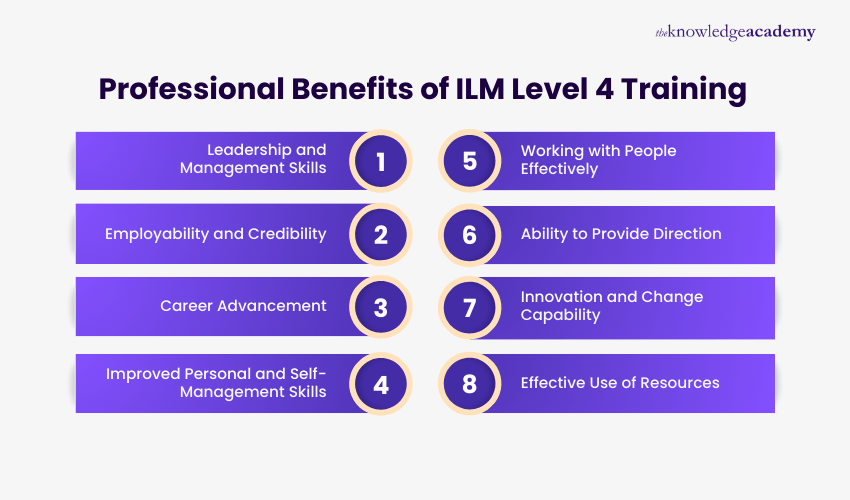
Professional Benefits of ILM Level 4 Training

  • Leadership and Management Skills: Enhance essential management capabilities, including team leadership, motivation, conflict management, and contributing to organisational improvement.
  • Employability and Credibility: Strengthen career prospects with a nationally recognised qualification that is valued across sectors and supports progression into supervisory and middle-management roles.
  • Career Advancement: Build the competence required to step into middle-management positions and lay the foundation for future senior leadership progression.
  • Improved Personal and Self-Management Skills: Develop personal awareness, resilience, and the ability to assess and improve your own leadership performance.
  • Working with People Effectively: Gain the skills to motivate and support colleagues, build team capability, and manage people confidently in day-to-day operations.
  • Ability to Provide Direction: Strengthen the skills needed to plan, delegate, and lead activities or projects effectively within your department.
  • Innovation and Change Capability: Understand how to manage change, encourage innovation, and support improvement within teams.
  • Effective Use of Resources: Learn how to use resources efficiently, plan workloads, and support productivity and operational results.
Show more blue-arrow

ILM Level 4 FAQs

ILM (Institute of Leadership & Management) provides accredited qualifications and training in leadership, management, and coaching, aimed at improving workplace performance and developing effective leaders.

Completing an ILM Level 4 Qualification enhances your leadership skills, boosts career progression opportunities, and provides a recognised credential that validates your management capabilities.

The prerequisites of these courses vary. Kindly refer to the respective course pages for more specific details.

This ILM Level 4 Training is ideal for mid-level managers, team leaders, and professionals looking to develop their leadership and management skills.

ILM Level 4 focuses on more advanced leadership and management skills, building on the foundational knowledge provided in Level 3, and is suited for mid-level management roles.

The ILM Level 4 Certification Courses cover topics such as leadership styles, team management, decision-making, performance management, and strategic planning.

While it's more suited to those with some experience, aspiring managers can still benefit, especially if they are ready to take on more responsibilities and challenges.

ILM Level 4 qualifications can lead to career advancement in roles such as team leader, department manager, operations manager, or project manager. It can also prepare you for further study at higher levels.

You will gain advanced leadership, team management, strategic planning, and decision-making skills, along with a deeper understanding of effective management practices.

Yes, ILM Level 4 is particularly beneficial in industries like healthcare, finance, retail, manufacturing, and public services, where strong management and leadership skills are essential.

The duration of these courses varies. Kindly refer to the respective course pages for more specific details.

The Knowledge Academy is a prestigious training provider known for its extensive course offerings, expert instructors, adaptable learning formats, and industry recognition. It's a dependable option for those seeking these ILM Level 4 Certification Courses.

Please see our ILM Level 4 available in Argentina

The Knowledge Academy is one of the Leading global training provider for ILM Level 4.

The training fees for ILM Level 4 in Argentina starts from $2495

Show more down

Why we're the go to training provider for you

icon

Best price in the industry

You won't find better value in the marketplace. If you do find a lower price, we will beat it.

icon

Trusted & Approved

Recognised by leading certification bodies, we deliver training you can trust.

icon

Many delivery methods

Flexible delivery methods are available depending on your learning style.

icon

High quality resources

Resources are included for a comprehensive learning experience.

barclays Logo
deloitte Logo
Thames Water Logo

"Really good course and well organised. Trainer was great with a sense of humour - his experience allowed a free flowing course, structured to help you gain as much information & relevant experience whilst helping prepare you for the exam"

Joshua Davies, Thames Water

santander logo
bmw Logo
Google Logo

Looking for more information on ILM Level 4

cross

Upgrade Your Skills. Save More Today.

superSale Unlock up to 40% off today!

WHO WILL BE FUNDING THE COURSE?

close

close

Thank you for your enquiry!

One of our training experts will be in touch shortly to go over your training requirements.

close

close

Press esc to close

close close

Back to course information

Thank you for your enquiry!

One of our training experts will be in touch shortly to go overy your training requirements.

close close

Thank you for your enquiry!

One of our training experts will be in touch shortly to go over your training requirements.