


 Top Rated Course

We may not have the course you’re looking for. If you enquire or give us a call on + 1-866 272 8822 and speak to our training experts, we may still be able to help with your training requirements.
What is a SWOT Analysis: How to Perform and Examples
The Knowledge Academy 05 June 2026SWOT Analysis helps organisations identify Strengths, Weaknesses, Opportunities and Threats to support strategic planning and informed decision-making. It gives you a clear picture of what you’re doing well, and where you might be falling short. It helps organisations prepare for both internal challenges and external risks.

Training Outcomes Within Your Budget!
We ensure quality, budget-alignment, and timely delivery by our expert instructors.
Table of Contents
Related Courses
- BCS Practitioner Certificate in Modelling Business Processes Training
- BCS Foundation Certificate in Organisational Behaviour
- BCS Business Analysis Diploma Oral Preparation Workshop
- BCS Practitioner Certificate in Digital Product Management Training Course
- BCS Advanced International Diploma in Business Analysis
Ever wondered why some businesses soar while others stumble? The secret often lies in understanding their Strengths, Weaknesses, Opportunities, and Threats; better known as SWOT Analysis. This powerful tool is a strategic compass guiding decisions and uncovering hidden potential.
In this blog, we’ll break down What is a SWOT Analysis, the steps to perform it effectively, and share a real-world example to spark your next big idea. So read on and get ready to decode business success like never before!
Table of Contents
1) What is a SWOT Analysis?
2) Elements of a SWOT Analysis
3) Why is SWOT Analysis Important?
4) How to Perform a SWOT Analysis?
5) When to Use a SWOT Analysis in Your Business?
6) SWOT Analysis Advantages
7) SWOT Analysis Disadvantages
8) Potential Questions While Performing SWOT Analysis
9) SWOT Analysis Example
10) Common Mistakes When Preparing a SWOT Analysis
11) SWOT Analysis Tips
12) Conclusion
What is a SWOT Analysis?
A SWOT Analysis is a strategic planning technique used to examine the key factors influencing a project or organisation: Strengths, Weaknesses, Opportunities and Threats. It begins by defining the objective, then identifying internal and external factors that either support or hinder achieving that goal.
While commonly applied in strategic planning, SWOT is also valuable for analysing situations and supporting informed decision-making across various contexts. The main strength of SWOT lies in its ability to encourage structured self-evaluation and strategic thinking.

Elements of a SWOT Analysis
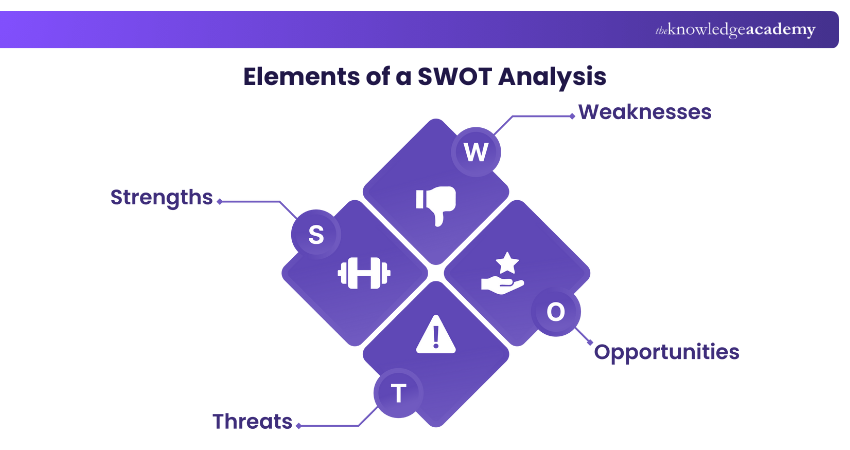
Now that you understand What is SWOT Analysis, it’s time to explore its components. Here are the main elements:
1) Strengths
These are the internal advantages that give your business a competitive edge. It could be anything from strong leadership to a loyal customer base. Highlighting these positives helps you build on what’s already working. They serve as the foundation for sustainable success. Focusing on strengths also boosts team morale and confidence.
2) Weaknesses
This covers areas where your organisation may be struggling or underperforming. Recognising these gaps is the first big step towards improvement. Addressing them opens the door to change and resilience. It’s also a chance to refine processes and reduce inefficiencies. The goal is to turn limitations into learning points.
3) Opportunities
These refer to external chances for growth, expansion, or innovation. Spotting them early can help you stay ahead of the curve. Whether it’s market trends or new partnerships, seizing the right moment matters. Opportunities encourage fresh thinking and bold action. They often come disguised as challenges.
4) Threats
These are potential challenges in the market or industry that could affect progress. Being aware of them helps in building better defences. They might include rising competition, economic shifts, or regulatory changes. Preparing for these risks can reduce future disruptions. A proactive approach helps maintain stability.
Why is SWOT Analysis Important?
SWOT Analysis helps organisations question risky assumptions and identify potential blind spots in their performance. When applied thoughtfully, it offers fresh insight into a business’s current position and supports the development of well-aligned strategies.
For instance, while certain strengths may seem obvious, reviewing them alongside weaknesses and threats can reveal how fragile those advantages really are. Similarly, a structured analysis may uncover overlooked opportunities that offset known weaknesses.
Your blueprint for smarter business decisions starts here with our Business Analysis Courses - Register now!
How to Perform a SWOT Analysis?
This is how you do a SWOT Analysis:
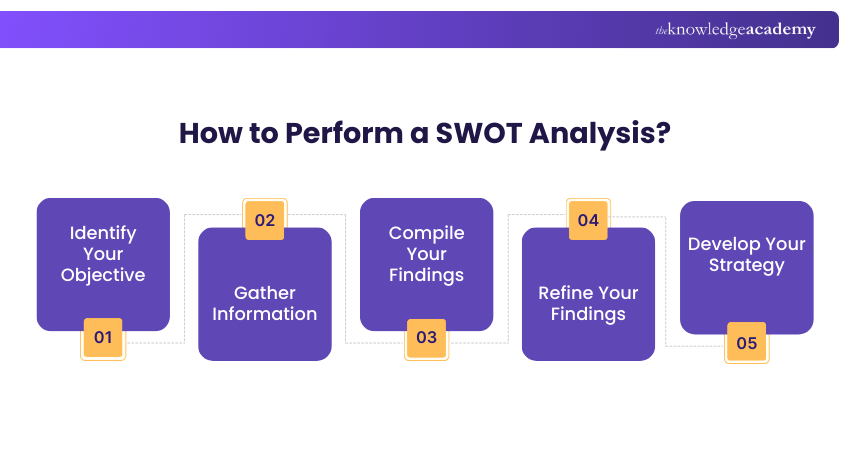
Step 1: Identify Your Objective
Start by clearly defining what you want to achieve. This sets the direction for your entire SWOT Analysis. A focused goal keeps your assessment sharp and relevant. It also helps align team efforts. Without a clear aim, insights may lack purpose.
Step 2: Gather Information
Collect relevant data from both internal operations and external market trends. A well-rounded view ensures deeper insight. Talk to team members, analyse reports, and study competitors. The more diverse your sources, the better. Don’t overlook feedback or frontline experiences.
Step 3: Compile Your Findings
Organise the strengths, weaknesses, opportunities, and threats into clear categories. Look for patterns or connections. Keep your observations honest and practical. Sorting ideas visually can reveal hidden links. Try using a grid to bring structure to your thoughts.
Step 4: Refine Your Findings
Evaluate each point critically and remove anything irrelevant or vague. Focus on what truly impacts your goals. Aim for clarity over quantity. Refined insights create a stronger foundation for decision-making. Be ready to challenge assumptions.
Step 5: Develop Your Strategy
Use the refined analysis to shape practical action steps. Align your decisions with insights to move forward with confidence. Choose approaches that leverage your strengths and minimise weaknesses. Keep your strategy agile and adaptable. Let your SWOT help both short-term actions and long-term vision.
Design processes that fuel long-term success with our BCS Practitioner Certificate in Modelling Business Processes - Sign up now!
When to Use a SWOT Analysis in Your Business?
SWOT Analysis can be applied in various business situations to support strategic decisions and enhance outcomes. Common scenarios include:
a) Launching a new project or initiative
b) Entering or exploring new markets
c) Addressing business challenges or issues
d) Improving internal processes or operations
e) Planning growth strategies effectively
f) Assessing competitors and industry position
SWOT Analysis Advantages
A SWOT Analysis is not going to answer every major question a company has. Nonetheless, a SWOT Analysis does have certain advantages that make it easier for strategic decision-makers to move on to the subsequent steps of the process:
a) SWOT Analysis uses a clear and straightforward four-quadrant framework.
b) It helps organisations clearly identify their strengths and weaknesses.
c) It promotes structured and strategic thinking.
d) It allows senior leaders to build on strengths while developing opportunities.
e) It supports anticipating potential threats and taking proactive action to reduce their impact.
f) It helps identify and maximise emerging business opportunities.
g) It provides flexibility and can be applied across various situations and contexts.
Check out our BCS Foundation Certificate in Organisational Behaviour Training today and decode the human side of business- Join now!
SWOT Analysis Disadvantages
Here are some drawbacks of SWOT Analysis:
a) It can oversimplify complex decisions when limited or insufficient data is used.
b) Collecting excessive information may result in analysis paralysis.
c) Findings may rely on assumptions that later prove inaccurate.
d) Accessing reliable internal data can be time-consuming and politically challenging, especially in large organisations.
e) Its loose structure may cause important factors to be overlooked.
f) Rapid market and environmental changes make future developments harder to predict.
g) The analysis must be reviewed and updated regularly to remain effective.
Potential Questions While Performing SWOT Analysis
Consider these questions while performing a SWOT Analysis:
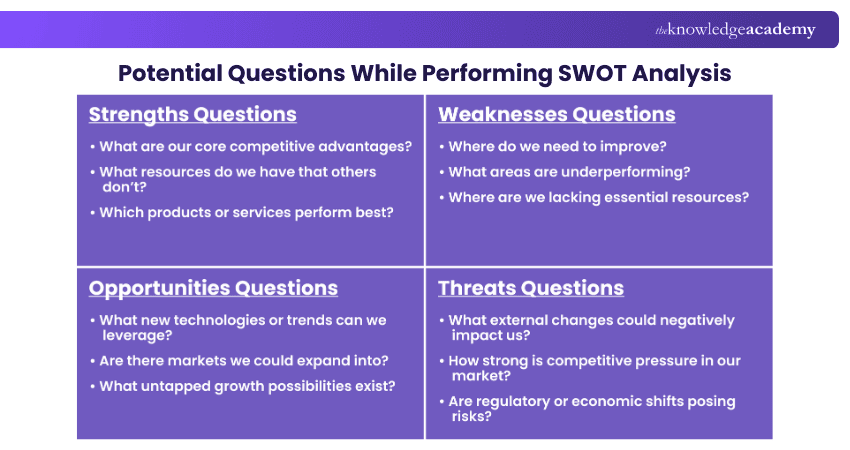
Here are some potential questions to identify internal factors include:
a) Strength: Which areas are we performing strongly in?
b) Strength: What assets or capabilities give us the greatest advantage?
c) Weakness: What factors are limiting our performance?
d) Weakness: Which products or services are delivering the weakest results?
Here are some potential questions to identify external factors include:
a) Opportunity: What market trends could we take advantage of?
b) Opportunity: Which customer segments are currently underserved or untapped?
c) Threat: How intense is competition, and how is market share distributed?
d) Threat: Are there upcoming regulations that could negatively affect our products or operations?
SWOT Analysis Example
Here’s a simple example on how to do a SWOT Analysis for a small local bakery:
Strengths:
a) Unique homemade recipes that attract loyal customers
b) Strong presence in the neighbourhood with repeat business
c) High-quality ingredients and friendly service
Weaknesses:
a) Limited seating capacity and no online ordering system
b) Dependence on foot traffic
c) Higher costs compared to supermarket bakeries
Opportunities:
a) Expanding into online delivery or catering services
b) Partnering with local events or cafes for wider exposure
c) Introducing seasonal or themed product lines
Threats:
a) New competitors opening nearby
b) Fluctuations in ingredient prices
c) Changing consumer preferences toward healthier options
This example shows how to conduct a SWOT Analysis effectively, helping you see what’s working, where improvements are needed, and how to address future risks or growth opportunities.
Strengthen strategic decision-making with the BCS Practitioner Certificate in Enterprise and Solution Architecture Training. Register now!
Common Mistakes When Preparing a SWOT Analysis
When developing a SWOT Analysis, certain common pitfalls can reduce its value and impact. Here are some ways in which a SWOT Analysis may fall short or become ineffective:
a) Lacking objectivity and honesty by overstating strengths and minimising weaknesses. This can lead to unrealistic conclusions.
b) Allowing bias to distort findings, which can hide improvement areas and expose the organisation to unexpected threats.
c) Conducting the analysis in isolation without input from key stakeholders such as customers, employees, suppliers or industry experts.
d) Missing valuable perspectives by relying on a limited group of contributors.
e) Failing to prioritise or weight identified factors based on their impact and importance.
f) Allowing critical issues to be overshadowed by less significant points.
g) Treating the SWOT Analysis as a one-time activity rather than a recurring process.
h) Not translating insights into clear strategic actions or reviewing progress in future analyses.
SWOT Analysis Tips
The given tips for SWOT Analysis are as follows:
a) Be Specific, Not Generic: Dig into exact strengths or risks to uncover meaningful insights.
b) Gather Diverse Input: Involve people from different teams to spot things you might overlook.
c) Stay Honest and Grounded: Base your points on real situations, not assumptions or hopes.
d) Balance Every Section: Give equal attention to both positives and challenges for a fair view.
e) Keep it Current: Review and update your analysis as situations and markets evolve.
f) Turn Insight into Action: Use the findings to shape clear goals, refine plans, and move forward.
Conclusion
Therefore, SWOT Analysis is more than a planning tool. This is because it helps you pause, reflect, and see your organisation with fresh eyes. By identifying where you stand and what lies ahead, you can make smarter choices. When done thoughtfully, it brings in action, not just discussion, and brings clarity to your strategy in an ever-changing environment.
Advance your career with the BCS International Diploma in Business Analysis. Sign up now and ensure the passport to global Business Analysis excellence!
Frequently Asked Questions
How Does SWOT Analysis Affect a Business?

SWOT Analysis helps businesses develop strategies by identifying strengths to leverage, weaknesses to improve, opportunities to explore, and threats to mitigate. This technique guides decision-making and strategic planning.
What is a SWOT Table?
A SWOT Table is a strategic tool that outlines Strengths, Weaknesses, Opportunities, and Threats in four quadrants. It helps organisations analyse internal capabilities and external factors, supporting better decision-making, risk management, and strategic planning for long-term growth and success.
What are the Other Resources and Offers Provided by The Knowledge Academy?
The Knowledge Academy takes global learning to new heights, offering over 3,000+ online courses across 490+ locations in 190+ countries. This expansive reach ensures accessibility and convenience for learners worldwide.
Alongside our diverse Online Course Catalogue, encompassing 17 major categories, we go the extra mile by providing a plethora of free educational Online Resources like Blogs, eBooks, Interview Questions and Videos. Tailoring learning experiences further, professionals can unlock greater value through a wide range of special discounts, seasonal deals, and Exclusive Offers.
What is The Knowledge Pass, and How Does it Work?
The Knowledge Academy’s Knowledge Pass, a prepaid voucher, adds another layer of flexibility, allowing course bookings over a 12-month period. Join us on a journey where education knows no bounds.
What are the Related Courses and Blogs Provided by The Knowledge Academy?
The Knowledge Academy offers various Business Analysis Courses, including the BCS Certificate in Business Analysis Practice Course, BCS Foundation Certificate in Agile Course and BCS Foundation Certificate in Artificial Intelligence Training. These courses cater to different skill levels, providing comprehensive insights into Business Operations.
Our Business Analysis Blogs cover a range of topics related to SWOT Analysis, offering valuable resources, best practices, and industry insights. Whether you are a beginner or looking to advance your Business Analysis skills, The Knowledge Academy's diverse courses and informative blogs have got you covered.

The Knowledge Academy


Global Training Provider
The Knowledge Academy is a world-leading provider of professional training courses, offering globally recognised qualifications across a wide range of subjects. With expert trainers, up-to-date course material, and flexible learning options, we aim to empower professionals and organisations to achieve their goals through continuous learning.

Upcoming Business Analysis Resources Batches & Dates
Date
 BCS Certificate in Business Analysis Practice
BCS Certificate in Business Analysis Practice
Mon 26th Oct 2026

 If you wish to make any changes to your course, please


