


 Top Rated Course


We may not have the course you’re looking for. If you enquire or give us a call on +44 1344 203 999 and speak to our training experts, we may still be able to help with your training requirements.
What is Statistical Modeling? A Complete Guide
William Brown 22 April 2026Statistical Modelling uses mathematical frameworks to analyse data, identify patterns, and make predictions, helping in decision-making across various fields. It turns complex data into clear, meaningful insights. These models are essential for spotting trends, testing theories, and forecasting future outcomes. Read on to know more!

Training Outcomes Within Your Budget!
We ensure quality, budget-alignment, and timely delivery by our expert instructors.
Table of Contents

Have you ever wondered how Netflix suggests your next favourite show? The answer often lies in Statistical Modelling. It is a technique that helps companies analyse patterns in your behaviour and predict what you’re most likely to enjoy next. But its use goes far beyond entertainment.
You can interpret data, spot trends, and make smarter decisions in any field once you get an idea of What is Statistical Modelling. So, let’s delve into this blog to explore the basics of Statistical Modelling, how it works, and why it’s one of the most powerful tools in the data-driven world!
Table of Contents
1) What is Statistical Modelling?
2) Importance of Statistical Modelling
3) Different Types of Statistical Models
4) Reasons to Learn Statistical Modelling
5) Statistical Modelling Techniques
6) How to Build Statistical Models?
7) Difference Between Machine Learning and Statistical Modelling
8) Conclusion
What is Statistical Modelling?
Statistical Modelling is the process of using mathematical formulas and data to represent real-world situations. These models help us understand patterns, trends, and relationships between different things, which are called variables.
For example, a retail business might use a statistical model to predict how many customers it will get next month based on previous sales and advertising efforts. A hospital could use it to understand how age and lifestyle affect the risk of heart disease. In simple words, it is a smart way to convert messy data into a useful one that helps you make better decisions.

Importance of Statistical Modelling
Statistical Modelling is important because it helps to transform complex data into useful insights. So, here are some of its importance that you should know:
a) Understanding Complex Datasets: Statistical Modelling helps to simplify complicated data and makes it easier to understand. It does this by finding patterns and connections in the data, making it easier to understand what the data is referring to.
b) Accurate Predictions and Forecasting: It allows you to predict future trends based on past data. This helps businesses and organisations plan better and make smart choices.
c) Evidence-based Decision-making: Instead of guessing, Statistical Modelling helps you make decisions using real facts and numbers. It gives you a strong base and evidence for making the right choices.
d) Risk Assessment and Management: It helps to identify possible risks and can measure how serious they might be. This is useful in fields like finance, healthcare, and insurance to prevent problems before they happen.
e) Analysing Large Volumes of Data: Statistical Modelling makes it easier to work with large amounts of data. It helps turn huge sets of information into clear insights that are useful for planning and growth.
Explore the different types of control charts for variables with our Statistical Process Control Training – Register now!
Different Types of Statistical Models
There are different ways to build statistical models, depending on the data and goals. Let’s check its three prominent types:

1) Parametric Model
Parametric models assume that data follows a certain pattern or distribution, like a bell-shaped curve. These models are easy to work with and are often used when the data behaves predictably. Examples include linear regression and logistic regression.
Its Key Traits Include:
1) Assumes a known distribution
2) Easy to interpret
3) Works well with clean, structured data
2) Non-parametric Model
Non-parametric models do not assume a fixed shape for the data. They are flexible and can model more complex patterns. These are great when you don’t know what the data looks like in advance.
The Traits of a Non-parametric Model are:
1) No assumptions about data distribution
2) More flexible in handling non-linear relationships
3) Can adapt to different data shapes and sizes
3) Semi-parametric Model
These models combine features of both parametric and non-parametric methods. They use fixed structures for some variables and flexible ones for others. This gives a good balance between simplicity and flexibility.
Its Key Traits Involve:
1) Combines the strengths of both methods
2) Handles both structured and unstructured data well
3) Provides more accurate results with fewer assumptions
Uncomplicate complicated tasks through the Mathematical Optimisation for Business Problems.
Reasons to Learn Statistical Modelling
Whether you're in Data Science, marketing, healthcare, or finance, learning Statistical Modelling can be useful. Here are some key reasons:

1) Selecting the Right Models
Knowing Statistical Modelling helps you choose the best model for your data. Whether your goal is classification, forecasting, or understanding trends, you will be able to select the methods that can give reliable results.
2) Better Data Preparation for Analysis
Statistical Modelling teaches you how to clean and organise data effectively. This is important because you might take wrong decisions with poor-quality data. Therefore, you’ll learn how to handle missing values and formatting issues.
3) Strengthening Communication Skills
In general, Statistical Modelling is not just about numbers. You’ll learn to explain complex and difficult ideas in simple terms. This will be helpful when you are sharing results with people who are not experts, such as business teams or clients.
4) Career Opportunities
Statistical Modelling is in high demand across various industries. Companies look for people who can work with data and build models to support decisions. You can work in roles like Data Analyst, Business Intelligence Expert, Statistician, or even a Researcher.
Explore the business analysis process model and Stakeholder Management with our Business Analyst Green Belt Training – Join soon!
Statistical Modelling Techniques
There are several techniques used in a Statistical Modelling. The two main categories are supervised learning and unsupervised learning.
Supervised Learning
In supervised learning, the model learns from labelled data, where we already know the correct answers. It finds relationships between input (like advertising budget) and output (like sales).
Examples:
1) Linear regression
2) Logistic regression
3) Support Vector Machines (SVM)
Used for:
1) Predictions
2) Classifications
3) Risk scoring
Unsupervised Learning
In unsupervised learning, the model works with data that has no labels. It tries to find hidden patterns or groupings within the data.
Examples:
1) Clustering
2) Association Rule Learning
3) Principal Component Analysis (PCA)
Used for:
1) Market segmentation
2) Anomaly detection
3) Customer profiling
How to Build Statistical Models?
Building a Statistical Model involves several stages. Let's explore those stages:
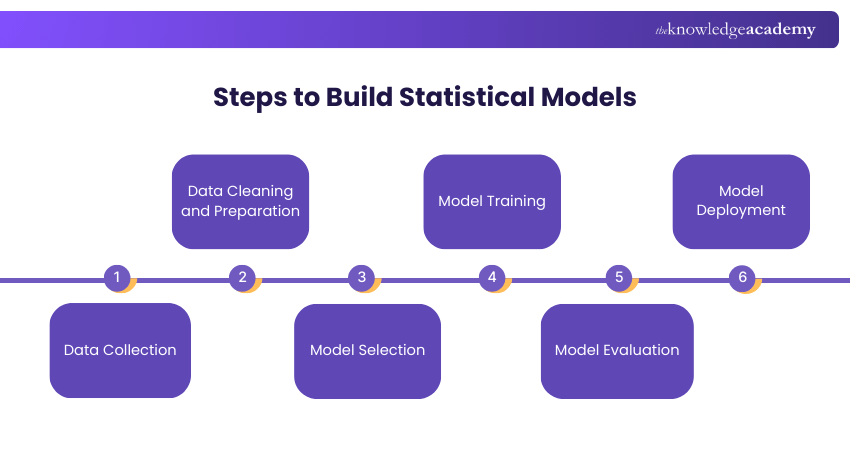
a) Data Collection: Start by collecting accurate and relevant data related to your problem. A good model depends on having good-quality data.
b) Data Cleaning and Preparation: Get the data ready by fixing missing values, removing unusual entries, and making sure it's in the right format for analysis.
c) Model Selection: Pick a model that suits your data and goal. This could be something like linear regression or decision trees.
d) Model Training: Here, you can use your data to teach the model how to find patterns. You may need to adjust settings to make it more accurate.
e) Model Evaluation: Test how well your model works using methods like cross-validation or checking accuracy and error rates.
f) Model Deployment: Once your model performs well, use it in real-world situations to make predictions or help with decisions.
Get started with analysis techniques that drive business success with our Business Analyst Fundamentals Training - Join now!
Difference Between Machine Learning and Statistical Modelling
Many people get confused with Machine Learning and Statistical Modelling. While they are related, they have different goals and methods.

Conclusion
Statistical Modelling is a powerful tool that helps in making data-driven decisions. From predicting sales and spotting trends to helping doctors make better decisions, it’s used in nearly every industry. As data continues to grow, so does the need for people who can make sense of it. Learning What is Statistical Modelling opens doors to exciting opportunities, smarter decisions, and deeper insights.
Learn the business analytics techniques with our Introduction to Business Analytics Training - Sign up today!
Frequently Asked Questions
What is the Purpose of Statistical Modelling?

The major purpose of Statistical Modelling is to understand relationships between variables, make calculations, and help with decision-making. It simplifies complex data into a clear structure that supports problem-solving.
What are Statistical Models in Research?
In research, Statistical Models help test theories, find patterns, and support conclusions using data. They provide a structured way to understand whether the observed effects are real. They also help researchers make sense of complex information, identify trends, and support evidence-based findings through structured analysis.
What are the Other Resources and Offers Provided by The Knowledge Academy?
The Knowledge Academy takes global learning to new heights, offering over 3,000+ online courses across 490+ locations in 190+ countries. This expansive reach ensures accessibility and convenience for learners worldwide.
Alongside our diverse Online Course Catalogue, encompassing 17 major categories, we go the extra mile by providing a plethora of free educational Online Resources like Blogs, eBooks, Interview Questions and Videos. Tailoring learning experiences further, professionals can unlock greater value through a wide range of special discounts, seasonal deals, and Exclusive Offers.
What is The Knowledge Pass, and How Does it Work?
The Knowledge Academy’s Knowledge Pass, a prepaid voucher, adds another layer of flexibility, allowing course bookings over a 12-month period. Join us on a journey where education knows no bounds.
What are the Related Courses and Blogs Provided by The Knowledge Academy?
The Knowledge Academy offers various Business Analyst Courses including the Statistical Process Control Training, Statistics Course and the Mathematical Optimisation for Business Problems. These courses cater to different skill levels, providing comprehensive insights into Statistical Process Control (SPC).
Our Business Analysis Blogs cover a range of topics related to Statistical Modelling, offering valuable resources, best practices, and industry insights. Whether you are a beginner or looking to advance your Business Analysis skills, The Knowledge Academy's diverse courses and informative blogs have got you covered.

William Brown


Senior Business Analyst and Strategic Advisor
William Brown is a senior business analyst with over 15 years of experience driving process improvement and strategic transformation in complex business environments. He specialises in analysing operations, gathering requirements and delivering insights that support effective decision making. William’s practical approach helps bridge the gap between business goals and technical solutions.
View Detail

 If you wish to make any changes to your course, please


