


 Top Rated Course

We may not have the course you’re looking for. If you enquire or give us a call on +44 1344 203 999 and speak to our training experts, we may still be able to help with your training requirements.
What is Lean Manufacturing? Definition, Types, and Principles
William Brown 16 July 2026Lean Manufacturing is a smart business production approach that focuses on minimising waste and delivering maximum value to customers. This method streamlines processes, reduces both cost and time, improves quality, and prepares the business for long-term growth, customer satisfaction, and operational efficiency.

Training Outcomes Within Your Budget!
We ensure quality, budget-alignment, and timely delivery by our expert instructors.
Table of Contents

Nowadays, simply building a product is not enough; it must be created efficiently, quickly, and with minimal waste. This is where Lean Manufacturing comes in, an approach that streamlines processes and focuses only on what truly adds value for the customer. The goal of Lean Manufacturing is simple: eliminate waste and maximise value. Originally used in factories, it’s now widely adopted across industries like healthcare, IT, and services for greater efficiency and quality.
In this blog, we’ll explore What is Lean Manufacturing, how it works, and its core principles. You’ll also learn how to implement it effectively to achieve better efficiency, lower costs, and higher customer satisfaction.
Table of Contents
1) What is Lean Manufacturing?
2) How Does Lean Manufacturing Work?
3) Core Principles of Lean Manufacturing
4) Benefits of Lean Manufacturing
5) Drawbacks of Lean Manufacturing
6) Lean Manufacturing Techniques
7) How to Implement Lean Manufacturing in 3 Simple Steps?
8) Real-world Examples of Lean Manufacturing
9) Lean vs Six Sigma: A Comparison
10) Conclusion
What is Lean Manufacturing?
Lean Manufacturing is a systematic approach that focuses on minimising waste while delivering maximum value to the customer. The main objective of this method is to remove unnecessary steps in the production process that waste time, space, and resources. By streamlining workflows, Lean Manufacturing enhances efficiency and maintains consistent quality.
Some key practices include defining customer value, mapping the value stream, and identifying areas for continuous improvement. Non-value-adding activities such as overproduction, excess inventory, waiting time, and unnecessary movements are eliminated. Lean principles can also be applied using tools like Kanban, 5S, and Kaizen to drive long-term efficiency and sustainable growth.

How Does Lean Manufacturing Work?
Lean Manufacturing works by continuously identifying and eliminating waste to maximise customer value. It starts by understanding what the customer values most, then analysing each step of the production process to remove inefficiencies like overproduction or delays.
Using tools such as 5S, Kaizen, and Kanban, Lean simplifies workflows, balances resources, and enhances productivity. Instead of major changes, it focuses on small, ongoing improvements that lead to higher quality, reduced costs, and long-term operational efficiency.
Core Principles of Lean Manufacturing
The success of Lean Manufacturing is based on its five core principles. Only by following these principles can any organisation make its processes lean. Their main focus is to provide value to the customer and eliminate every activity that does not create value.

Identify Value
First of all, it is important to understand what the actual value is for the customer. You should focus on what the customer wants and which will be of real benefit to them.
Map the Value Stream
Map each process in detail so that you can see the flow of the product or service. Identify steps that are not adding value and eliminate them.
Create Flow
When the value-added steps are clear, organise them in a way that the process runs smoothly. There should be no interruption or delay in the process so that the work happens in a continuous flow.
Establish a Pull System
In the traditional method, work is pushed. Lean follows a pull system where production is done according to customer demand. This prevents overproduction and excess inventory.
Pursue Perfection
The main goal of Lean is to continuously improve towards perfection. Review every step regularly and find ways to save both time and effort and increase value.
Gain essential Lean knowledge and get certified with our Certified Lean Foundation Course – join today!
Benefits of Lean Manufacturing
Lean Manufacturing is not just a way to save money. It is a smart system that improves business at every level. Below are some simple benefits that make lean important:
Environmentally Friendly
The Lean approach minimises waste, which in turn reduces pollution and the excessive use of materials. This makes operations more sustainable and helps protect the environment.
Saves Time and Money
By eliminating unnecessary steps, processes become faster and more efficient. This saves time, increases productivity, and reduces operational costs while allowing more work to be completed with fewer resources.
Improved Customer Satisfaction
Delivering high-quality products on time builds customer trust and loyalty. When customers are satisfied, they are more likely to return and recommend the business to others.
Drawbacks of Lean Manufacturing
Lean Manufacturing has many benefits, but it also has some challenges. Below are some common problems that can be faced in the lean system.
Difficult to Standardise
Every company has a unique way of working, making it difficult to apply Lean principles uniformly. Each organisation must adapt the system to suit its specific processes and goals.
Hinders Future Development
Since Lean focuses on producing based on current demand, companies may struggle to respond quickly to sudden increases in future demand. This can limit flexibility and slow down long-term growth.
Employee Safety and Wellbeing
In a highly efficiency-driven environment, employees may feel pressured to work faster, which can impact safety and wellbeing. Maintaining balance is essential to prevent stress, fatigue, and potential errors.
Lean Manufacturing Techniques
In Lean Manufacturing, some special techniques are used which make the processes fast, safe and smooth. Some important techniques are explained below, which are part of every Lean system.
Gemba
Gemba means real work area. Managers or team leaders go to the factory floor and see what the actual problems are. Understanding at the ground level is Gemba.
Andon
Andon is a visual signal system like a light or screen which alerts as soon as there is a problem in the machine or process. This helps in resolving the issues quickly.
5 Whys
To understand the real reason for any problem, "why" is asked 5 times. Every time you reach the root cause with the answer.
Poka-Yoke
Poka-Yoke means mistake-proofing. Tools or systems that prevent mistakes before they happen. Like a plug that fits only in the right way.
Hoshin Kanri
This is a planning technique in which the company's goals and the team's daily tasks are matched. This makes everyone's direction clear.
SMED
The full form of SMED is Single Minute Exchange of Dies. It means minimising the setup time so that the machine is quickly ready for the next task.
5S
The 5S method Sort, Set in Order, Shine, Standardise, and Sustain - creates a clean, organised, and efficient workplace. It helps maintain discipline and consistency across operations.
Take the first step towards a successful future with our industry-focused 5S Training – get started today!
Kanban Boards
Kanban is a visual board showing the steps of work, such as To Do, In Progress, and Done. This helps the team know what is going on and what is next.
Total Productive Maintenance (TPM)
TPM empowers machine operators to share responsibility for maintenance, reducing breakdowns and improving reliability. This approach ensures equipment runs smoothly and consistently.
How to Implement Lean Manufacturing in 3 Simple Steps?
To start Lean Manufacturing, you have to follow some basic steps. With these simple steps, you can make your system lean and easily control waste.
Visualise the Entire Value Stream Process
First of all, you have to have a clear view of your entire process. In this, you see how the flow is going from raw material to final delivery. When you visualise every step, you can easily identify the Wastes of Lean and understand where the waste is happening and how it can be eliminated.
Establish a Demand-based Work System
In the Lean system, work is done according to demand. This means that work on the product or service does not start until there is actual demand from the customer. This prevents overproduction, and inventory remains under control. Resources are also used optimally.
Seek Continuous Improvement
The most important part of Lean is to keep improving. Taking regular feedback, reviewing processes and trying new ideas is a part of Lean culture. This improves quality, saves time and reduces errors.
Real-world Examples of Lean Manufacturing
Many leading global companies have successfully applied Lean Manufacturing to streamline their operations. Below are some real examples where Lean practices helped reduce costs, improve quality, and increase overall efficiency.
1) Toyota
Toyota pioneered Lean Manufacturing through the Toyota Production System (TPS). Their focus was to eliminate waste, simplify workflows, and enhance product quality. Using Jidoka (automation with human intelligence) and Just-in-Time production, Toyota improved inventory control and prevented overproduction — setting the global standard for Lean efficiency.
2) FedEx Express
After the 2008 recession, FedEx introduced Lean principles into its aircraft maintenance operations. By adding milestones to the C-check process, they significantly reduced downtime and maintenance costs. As a result, the same team that once handled 14 checks could complete over 30 C-checks with improved consistency and quality.
3) Nike
Nike adopted Lean Manufacturing to reduce waste and improve sustainability. Through the Manufacturing Index, they established performance benchmarks and encouraged improvement across suppliers. Their Just-in-Time production model ensures goods are produced only when there is genuine customer demand, enhancing efficiency and reducing excess inventory.
4) Harley-Davidson
Harley-Davidson implemented tools like Total Productive Maintenance, 5S, and Kaizen to streamline operations. They also used Value Stream Mapping to identify inefficiencies. These initiatives boosted production speed, improved quality, and delivered greater value to customers.
5) John Deere
John Deere embraced Lean thinking to enhance supply chain and logistics efficiency. They invested in automation to streamline production, reduce errors, and maintain consistent quality. This integration of Lean tools transformed their manufacturing performance and responsiveness.
Streamline operations and drive continuous improvement with Lean Processes and Tools Training – start learning now!
Lean vs Six Sigma: A Comparison
Lean Manufacturing and Six Sigma are both used to improve business processes. The goal of both is to improve quality and reduce waste. But there is a slight difference between the two. Their simple comparison is given below.
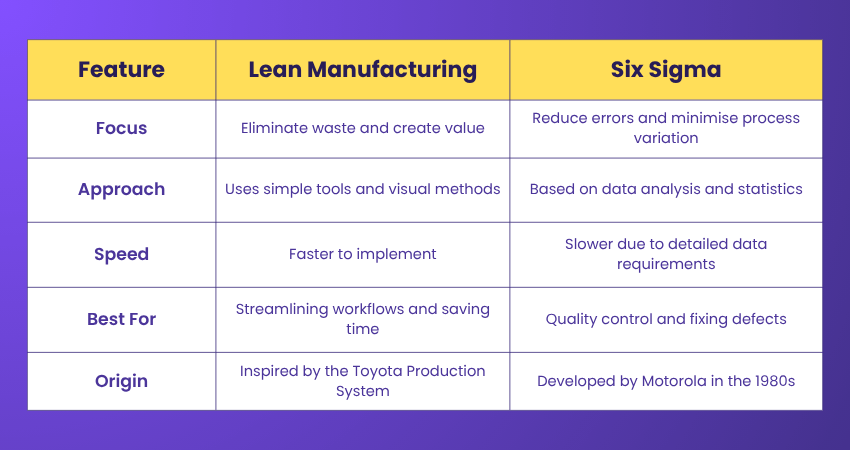
In short, the goal of Lean is to make work easy and fast. Six Sigma focuses on accuracy and quality. Many companies use a mix of both, which we call Lean Six Sigma.
Conclusion
Lean Manufacturing is a smart approach that adds value by reducing waste. Its principles and techniques make every business more efficient and customer-focused. Whether you are a small company or a global brand, a lean system can bring clarity, speed and quality to your processes. Through regular improvement and team involvement, lean becomes a long-term success strategy. Start thinking lean today and grow your business the smart way.
Unlock new job opportunities and level up your skills with our practical Lean Awareness Training – join now!
Frequently Asked Questions
What is Lean Manufacturing in GCSE?

In the GCSE syllabus, Lean Manufacturing is a method used to improve efficiency by reducing waste. Students learn how businesses streamline processes to save both time and cost while maintaining quality.
What is Kaizen in Lean Manufacturing?
Kaizen means continuous improvement. Lean Manufacturing focuses on making small, ongoing changes that enhance quality, boost productivity, and promote long-term efficiency.

William Brown


Senior Business Analyst and Strategic Advisor
William Brown is a senior business analyst with over 15 years of experience driving process improvement and strategic transformation in complex business environments. He specialises in analysing operations, gathering requirements and delivering insights that support effective decision making. William’s practical approach helps bridge the gap between business goals and technical solutions.
View Detail

 If you wish to make any changes to your course, please


