


 Top Rated Course


We may not have the course you’re looking for. If you enquire or give us a call on +44 1344 203 999 and speak to our training experts, we may still be able to help with your training requirements.
What is 3D Printing? Process, Types, and Applications
Richard Harris 07 May 20263D printing, or additive manufacturing, creates objects from digital models by slicing designs into layers and building them with materials like plastic or metal. This technology allows for rapid prototyping, customisation and reduced waste in production. It is widely used in industries like healthcare, aerospace and automotive.

Training Outcomes Within Your Budget!
We ensure quality, budget-alignment, and timely delivery by our expert instructors.
Table of Contents
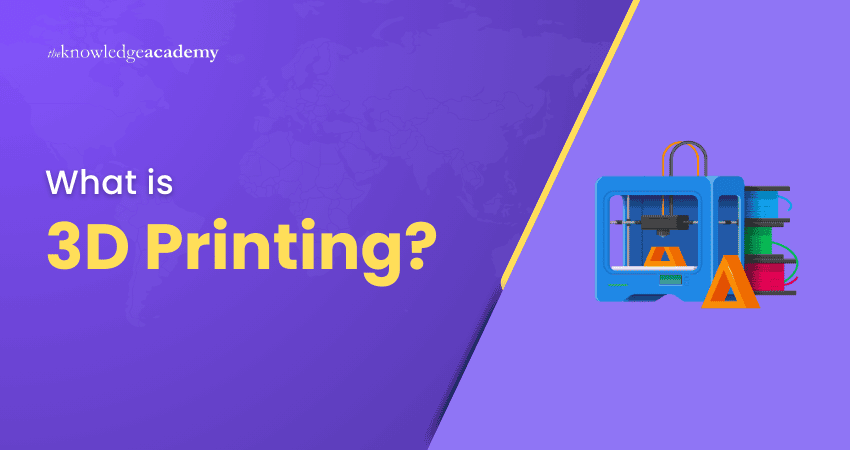
The way we produce is changing through technology, and 3D printing is the centre of this change. It has limitless avenues in various fields, whether in rapid prototyping or in one-off manufacturing. What is 3D Printing, though, and how does it work? In this blog, we will deconstruct it and discuss its effect, its uses, and possible prospects.
Table of Contents
1) What is 3D Printing?
2) How Does 3D Printing Work?
3) Application of 3D Printing in Different Industries
4) Different types of 3D Printing
5) Advantages and Disadvantages of 3D Printing
6) What is the difference between 3D Printing and traditional manufacturing?
7) Conclusion
What is 3D Printing?
Additive manufacturing, also known as 3D printing, refers to a fabrication process where physical products are fabricated by over-deposition of a layer-by-layer construction of a specific product on the basis of a computer-generated design. Compared to the conventional methods of manufacture (i.e. cutting or moulding material), the 3D printing technique only builds material where it is required. Hence, it is the most appropriate technique used when dealing with objects of complex shape and in cases where the process of prototyping is fast.
It can be used on plastics, metals and composites and is mainly used in aerospace, healthcare, and automobile sectors. The technology is fast and would be economical for handling small volumes, while also being very customisable.
How Does 3D Printing Work?
Additive manufacturing or 3D Printing refers to the manufacture of physical products based on the digital representation of that product by placing material in layers. This consists of three primary steps:
1) Design
A 3D model is used as the starting point of the process, and it is produced either with the help of CAD software or a CAD scan. This model is exported in the form of an STL or OBJ file that is compatible with slicing software. It involves parameters such as orientation, support structures and height of the layers.
2) Slicing: From file to 3D Printer
The slicing software transforms the 3D model into flat, horizontal-oriented cuts and creates commands to the printer. These commands are transmitted to the printer through USB, Wi-Fi or cloud. The object is then produced in layers by the printer utilising technologies such as the SLA (resin curing), SLS (powder sintering) or FDM (filament extrusion).
3) Post-Process
The object can be post-processed after printing. This can involve rinsing with isopropyl alcohol to remove uncured resin and curing in UV light to harden the material. It will also break down the support structures or blasting with compressed air, media or blasting. This is done by making sure that the final product is of quality and functionality.
Enhance your learning in 2D Animation with our 2D Animation Course - Join now!
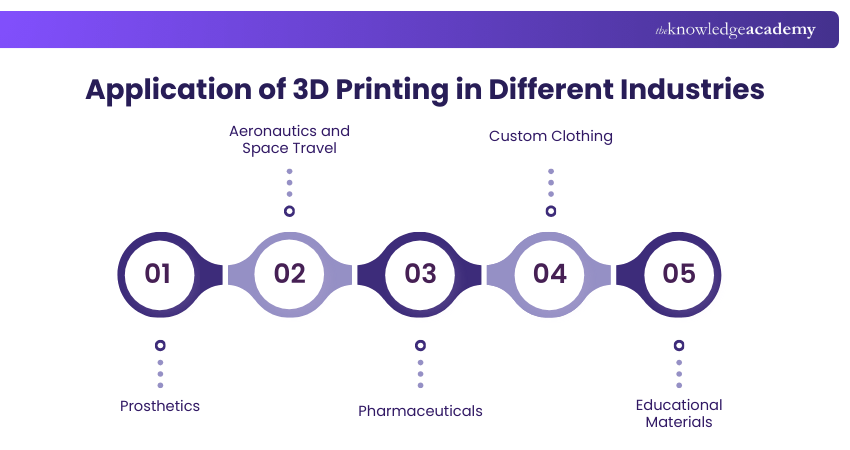
Application of 3D Printing in Different Industries
The use of 3D Printing is changing the industries as it makes it possible to produce faster, customise, and innovate in the areas of health sector, education, and the others.
1) Prosthetics
The conventional processes of creating prosthetics may require days and cost thousands of dollars, but the 3D-printed ones can be created in a day at a fraction of the price. With 3D Printing, one can use customised designs that enhance the comfort and functionality of users.
2) Aeronautics and Space Travel
In the aerospace industry, lightweight and complicated parts, like turbine blades, fuel nozzles, and rocket parts, can be produced using 3D Printing. It minimises both the time of production and cost and maximises performance and fuel efficiency.
3) Pharmaceuticals
Personalised drugs with accurate dosages and release patterns can be made with the aid of 3D Printing. It allows the production of drugs that meet the needs of individual patients. The production of the first FDA-approved 3D-printed drug, Spritam, demonstrates the possibilities of making individual drugs.
4) Custom Clothing
They are using 3D Printing to make bespoke clothes and accessories. Intricate patterns and designs can also be made by the designers using novel techniques. This technology is sustainable because it helps to minimise waste and make products on order.
5) Educational Materials
In learning, 3D printing is applied to make designs real. It allows students to create and print models that provide them with a better understanding of such subjects as geometry, biology, and engineering. It helps in creativity, problem-solving and practical learning and makes abstract concepts more visible.
Do you want to become an expert in Animation and Design? Register now for our Animation and Design Training!
Different types of 3D Printing
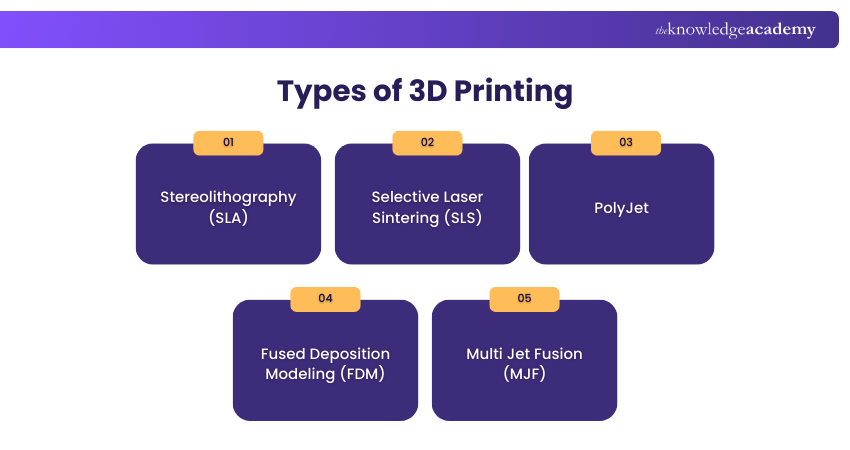
There are many different technologies incorporated in 3D Printing, and each of them is applicable in various materials, applications, and industries. The most commonly used ones and their mechanisms are given below.
1) Stereolithography (SLA)
a) SLA uses a laser to cure liquid resin into hardened plastic, layer by layer.
b) It produces highly detailed parts with smooth finishes, ideal for medical models and microfluidics.
2) Selective Laser Sintering (SLS)
a) SLS fuses nylon powder using a laser, creating durable parts without the need for support structures.
b) It’s suitable for functional prototypes and low-volume production with complex geometries.
3) PolyJet
a) PolyJet jets layers of photopolymer and cures them with UV light, allowing for multi-material and full-colour printing.
b) It’s used for prototyping soft-touch or over-moulded parts with fine details.
4) Fused Deposition Modeling (FDM)
a) FDM extrudes melted thermoplastic filament to build parts layer by layer.
b) It’s cost-effective and widely used for basic prototypes, jigs, and fixtures.
5) Multi Jet Fusion (MJF)
a) MJF uses a fusing agent and heat to bond nylon powder, offering faster production and consistent mechanical properties.
b) It’s ideal for functional parts with improved surface finish and lower production costs.
Do you want to acquire knowledge of Architectural Design? Sign up now for our Architectural Design and Animation in Blender Training!
Advantages and Disadvantages of 3D Printing
There are various benefits of 3D printing, however, there are also some constraints, which are associated with the technology and its usage. Discovering the two sides assists in informed decision making in designing, manufacturing as well as business application.
Advantages of 3D Printing
The following are some advantages of using 3D Printing techniques:
a) Rapid prototyping: 3D Printing allows for the quick creation of prototypes. Thus, it enables faster design and testing cycles compared to traditional manufacturing methods.
b) Complex geometries: It can produce numerous complex shapes and internal structures, which would be difficult to achieve with conventional manufacturing.
c) Customisation: Offers unparalleled flexibility in customising products to specific needs or preferences, ideal for personalised medical devices, custom-fit apparel, and bespoke consumer products.
d) Reduced material waste: Additive Manufacturing processes use only the material needed to create the object. As a result, they significantly reduce waste compared to subtractive methods.
e) Cost-effective for small productions: 3D Printing is more economically feasible for small batch production than traditional manufacturing, which often requires expensive moulds and tooling.
f) Accessibility: Advances in technology have made 3D Printers more accessible and affordable. This advancement has opened up many possibilities for hobbyists, small businesses, and educational institutions.
g) Lightweight and robust designs: Especially with Metal Printing, it’s possible to create lighter and stronger parts than those made through traditional methods, benefiting industries like aerospace and automotive.
h) Time savings: The ability to go from design to finished product quickly without setting up various machines or 3D Printed Tools saves significant time.
i) Reduced inventory costs: On-demand production means companies can reduce or eliminate the need to store extensive inventories of products or parts.
j) Environmental benefits: Potential for less transportation of goods and more localised production, leading to lower carbon emissions.
Enhance your skills in Dimensional Modelling with our Dimensional Modelling Foundations Training - Sign up now!
Disadvantages of 3D Printing
Even though 3D Printing has many benefits, there are still some disadvantages. Let us look at some of the disadvantages of 3D Printing:
a) Limited materials: While the range is expanding, 3D Printing materials still need to be improved compared to traditional manufacturing, especially for high-strength or specialised applications.
b) Lower strength: Parts produced by 3D Printing can be less sturdy than those made through conventional methods. It can often be due to the layer-by-layer construction, which can create weak points.
c) Surface finish and precision: The surface finish of 3D printed objects, such as those used in 3D printed houses, can be rougher than those produced by traditional methods. Moreover, the accuracy might only sometimes meet the required standards for some applications.
d) Speed for mass production: While fast for prototypes, 3D Printing can be slower and less efficient than traditional manufacturing processes.
e) Cost of large-scale printing: For large-scale objects, the cost of 3D Printing can be high in terms of material costs and the time required for printing.
f) Size limitations: Most 3D printers have a limited build volume, restricting the size of objects that can be printed in one piece.
g) Energy consumption: Certain 3D Printing processes, particularly those involving metals, can require significant energy.
h) Post-processing requirements: Many 3D printed parts require additional processing after printing, such as cleaning, curing, or surface finishing, which adds time and cost to the process.
i) Intellectual property concerns: The ease of copying and distributing digital designs raises concerns about intellectual property rights and the potential for counterfeiting.
j) Environmental impact: While 3D Printing reduces material waste, the energy consumption and potential toxicity of materials, particularly in resin and plastic-based processes, can be environmental concerns.
Acquire extensive knowledge of Motions Graphics with our Motion Graphics Course - join today!
What is the Difference Between 3D Printing and Traditional Manufacturing?
3D printing and traditional manufacturing differ in their processes, cost structures, material usage, and production suitability. Let’s compare the two below:
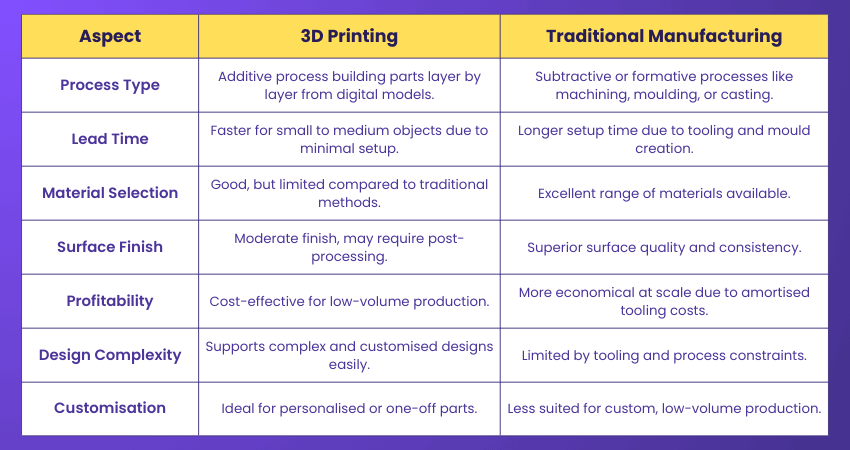
1) Process Type
a) 3D Printing: An additive process that builds parts layer by layer from digital models.
b) Traditional Manufacturing: Subtractive or formative processes like machining, molding, or casting.
2) Lead Time
a) 3D Printing: Faster for small to medium objects due to minimal setup.
b) Traditional Manufacturing: Longer setup time due to tooling and mould creation.
3) Material Selection
a) 3D Printing: Good, but limited compared to traditional methods.
b) Traditional Manufacturing: Excellent range of materials available.
4) Surface Finish
a) 3D Printing: Moderate finish, may require post-processing.
b) Traditional Manufacturing: Superior surface quality and consistency.
5) Profitability
a) 3D Printing: Cost-effective for low-volume production.
b) Traditional Manufacturing: More economical at scale due to amortised tooling costs.
6) Design Complexity
a) 3D Printing: Supports complex and customised designs easily.
b) Traditional Manufacturing: Limited by tooling and process constraints.
7) Customisation
a) 3D Printing: Ideal for personalised or one-off parts.
b) Traditional Manufacturing: Less suited for custom, low-volume production.
Conclusion
We hope this blog has made you realise What is 3D Printing and the increasing impact it has on contemporary manufacturing. It promises great opportunities for innovation and customisation, but requires thoughtful usage and further development, as well. In 3D Printing it's important to embrace it thoughtfully, as the possibilities are endless.
Enhance your video game skills with the Blender features only with our Blender 3D Modelling for Unity Course - join now!
Frequently Asked Questions
How Much Does 3D Printing an Object Cost?

The cost of 3D printing is relative to a number of variables such as the size and complexity of the object to be printed, type of material, and type of printers. Prices are very variable whether it be prototypes, tools or decorative objects.
How Easy is 3D Printing Actually?
Nowadays, 3D printing is more accessible to beginners due to the availability of desktop printers and Internet sources. Although there is a learning curve in terms of design and configuration, anyone can learn the basics.
What are the Other Resources and Offers Provided by The Knowledge Academy?
The Knowledge Academy takes global learning to new heights, offering over 3,000 online courses across 490+ locations in 190+ countries. This expansive reach ensures accessibility and convenience for learners worldwide.
Alongside our diverse Online Course Catalogue, encompassing 19 major categories, we go the extra mile by providing a plethora of free educational Online Resources like Blogs, eBooks, Interview Questions and Videos. Tailoring learning experiences further, professionals can unlock greater value through a wide range of special discounts, seasonal deals, and Exclusive Offers.
What is The Knowledge Pass, and How Does it Work?
The Knowledge Academy’s Knowledge Pass, a prepaid voucher, adds another layer of flexibility, allowing course bookings over a 12-month period. Join us on a journey where education knows no bounds.
What are the Related Courses and Blogs Provided by The Knowledge Academy?
The Knowledge Academy offers various Animation and Design Training, including the Animation Course, Video Editing Training, and Sketchbook Essential Training. These courses cater to different skill levels, providing comprehensive insights into 3D Modelling.
Our Office Applications Blogs cover a range of topics related to 3D Printing, offering valuable resources, best practices, and industry insights. Whether you are a beginner or looking to advance your Office Application skills, The Knowledge Academy's diverse courses and informative blogs have got you covered.

Richard Harris


Senior Full Stack Developer and Technology Educator
Richard Harris is a highly experienced full-stack developer with deep expertise in both frontend and backend technologies. Over his 12-year career, he has built scalable web applications for startups, enterprises and government organisations. Richard’s writing combines technical depth with clear explanations, ideal for developers looking to grow in modern frameworks and tools.


 If you wish to make any changes to your course, please


