


 Top Rated Course

We may not have the course you’re looking for. If you enquire or give us a call on +44 1344 203 999 and speak to our training experts, we may still be able to help with your training requirements.
What Is an Advanced Persistent Threat (APT)?
John Davies 25 February 2026Advanced Persistent Threat (APT) are stealthy, long-term cyberattack aimed at stealing sensitive data or disrupting critical systems. Unlike disruptive threats like ransomware, APTs quietly infiltrate networks and expand access without detection. Their primary goal is to stay hidden while gathering valuable intelligence.

Training Outcomes Within Your Budget!
We ensure quality, budget-alignment, and timely delivery by our expert instructors.
Table of Contents
The scenario in the current digital age is that not every cyberattack enters with a warning, red alerts, or through a blocked screen. Others manage to get in without being noticed, stay out of sight, and work for months to occasionally years, without being found.
These silent intruders, named as Advanced Persistent Threat (APT), have become the most dangerous enemies in the field of cyber security. In this blog, we will disclose their methods, the reasons for their undetectability, and their large-scale organisational threat potential.
Table of Contents
1) Advanced Persistent Threat Definition
2) Key Characteristics of an APT Attack
3) Stages of an Advanced Persistent Threat
4) APT Security Measures
5) Common APT Attack Techniques
6) Real-world Examples
7) Conclusion
Advanced Persistent Threat Definition
Do you know What is Advanced Persistent Threat? It refers to a prolonged, very sophisticated type of cyberattack where the intruders take the time to sneakily access the network, steal the confidential data and do so without arousing any alarms. The attacks perfectly compromise the security measures and achieve hiding for a long time.
APT activities require extraordinary expertise and personalisation, which are frequently the domain of heavily financed, very structured hacker groups. Maximum impact is achieved by spending a lot of time on research about the target and on the exploitation of the weaknesses presented by the systems.

Key Characteristics of an APT Attack
Advanced persistent threats (APT) do not act like regular cyber-attacks and hence leave behind some signs in the network that may be subtle but very informative. An attack that's classified as APT has the following main features:
1) Spear-phishing attempts that are targeted at either higher-ups or certain users who have great value to the organisation
2) Account activity that is not normal, for instance, logins with high privileges at times are not usually logged in
3) The existence of backdoor malware that was planted so as to keep long-term, hidden access
4) Bundles of data that are large or irregular are an indication that information is being staged for extraction
5) Data movement that is not normal, which may include sudden increases in outbound traffic or strange operations in the database
Stages of an Advanced Persistent Threat
The majority of Advanced Persistent Threats (APTs) share a common pattern, sneaking in, spreading their wings, and finally taking away the most important data. Knowing these 3 phases is a must for the prompt detection and solid cyber defence:
1) Stage 1 – Infiltration
Attackers usually get in through social engineering, which is very sophisticated, like sending spear-phishing emails to the executives or other important persons in the company, specifically made for them. These emails usually look very authentic, mentioning real projects or co-workers, which makes them hard to spot.
2) Stage 2 – Expansion
After getting into the network, the attackers use the malware to get familiar with the layout, collect the passwords, and get into the critical systems. They often set up secret backdoors and create several access points to provide themselves with long-term, stealthy access, even if one way is found out.
3) Stage 3 – Extraction
During this last stage, the data that has been stolen is patiently gathered in a secure internal location before being taken out without being noticed. The attackers may keep the network distracted by initiating DoS attacks while stealing the data, thereby allowing them to walk away unobserved but still leaving the network open for future access.
Boost your cyber security skills and protect your digital world with our Cyber Security Training–Join today!
APT Security Measures
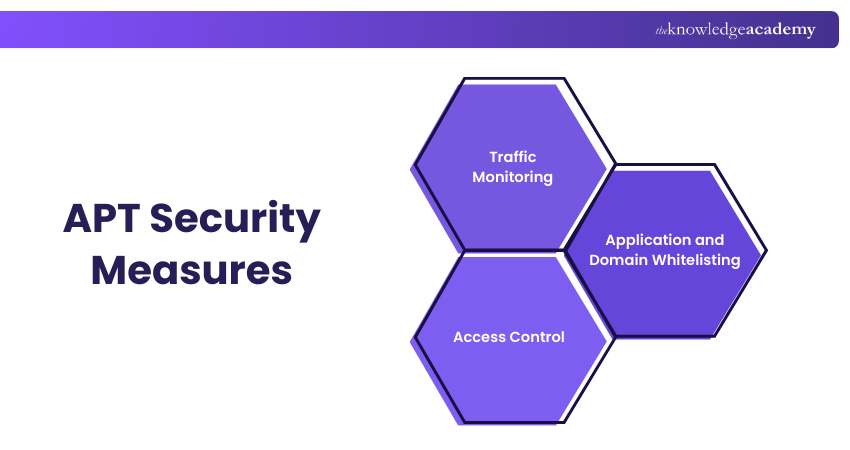
To detect APT attackers and safeguard systems from their impacts, an organisation needs to adopt a multipronged strategy. APT attack are a threat that many companies have to deal with, but there is a way to secure their networks against such attacks, and that is through:
1) Traffic Monitoring
The monitoring of all network traffic, including both inbound and outbound, should be done constantly as one of the first steps to APT detection and prevention. The use of next-generation firewalls (NGFWs) allows the monitoring of the network, filtering out and reporting suspicious activities, and preventing the installation of a backdoor by users or them going deep into the network.
2) Application and Domain Whitelisting
Whitelisting is a practice where only "good" applications and users are allowed access to the network, and this enhances security. The environment created this way is safer because there is less risk of unauthorised traffic entering, and also because attackers will not be able to find their way in through the very few ways established for them.
3) Access Control
Strict user identity verification/authorisation controls help to limit considerably the number of users who can enter the network. The application of security techniques such as multi-factor authentication (MFA) guarantees that only legitimate users have entry into the network, thereby reducing the chances of an attack being successfully carried out and also making it easier to detect and manage any breach
Common APT Attack Techniques
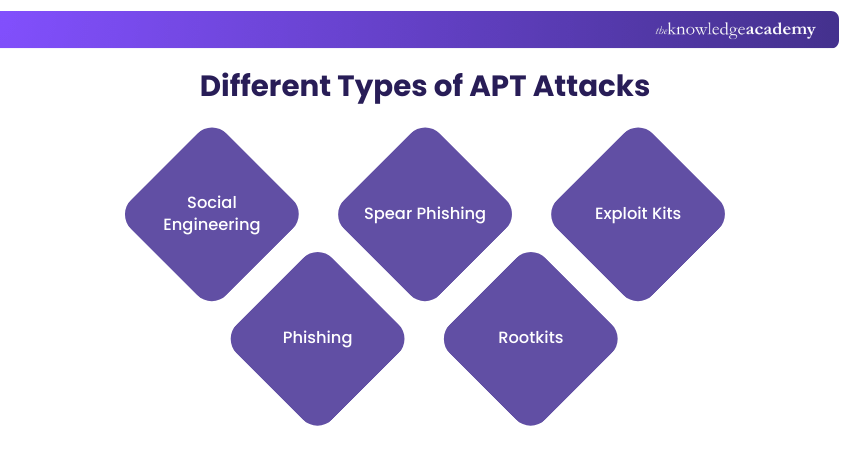
It's challenging to imagine a more concerning scenario than falling victim to a sophisticated Advanced Persistent Threat (APT). APT malware is a tool used for executing extended-duration APT attacks that operates differently from typical malware. Instead of causing immediate damage to a computer or network, APT malware specialises in secretly extracting data over an extended period. Here are some of the most common Advanced Persistent Threats seen in different Types of Attacks in Cyber Security:
1) Social Engineering
Unauthorised access takes place when the attackers use social engineering as their main weapon while pretending to be reliable persons or sources. Through the manipulation or deception of certain targets, attackers access the systems or even physically places.
2) Phishing
APT phishing attacks employ the strategy of using counterfeit, but attractive web pages made to rob sensitive information that includes passwords, credit card numbers, and banking information.
3) Spear Phishing
Spear phishing involves targeting specific individuals, companies, or organisations through email or electronic communications. While the primary goal may be data theft, cybercriminals sometimes use malware to compromise the targeted user's computer.
4) Rootkits
Malware like rootkits allows hackers to seize control of a targeted device. Some rootkits can infect both hardware and software components of a computer, compromising the operating system and software.
5) Exploit kits
Exploit kits capitalise on outdated software by exploiting already discovered vulnerabilities to inject malware into the affected systems. They frequently employ shellcode to get more harmful files, thereby gaining a stronger foothold in the system and causing an infection flow through devices and organisations.
Real-world examples
Here are some expanded real-world examples of Advanced Persistent Threats (APTs):
1) Stuxnet: A Cyberweapon Against Iran's Nuclear Program
Stuxnet was an extremely advanced and complex malicious software that aimed to disrupt Iran's nuclear program by inflicting damage to the SCADA control systems. It came to light in 2010 and had already caused significant operational damage before its eradication.
2) Equifax Data Breach
In the year 2017, Equifax, one of the biggest credit bureaus in the US, had a cyber security issue where hackers took advantage of a flaw in their web application and gained access to sensitive personal and financial information of 147 million consumers.
3) Operation Aurora
Operation Aurora comprised a sequence of APT attacks during the year 2009 that endeavoured to penetrate the networks of major technology and financial companies and were linked to hackers sponsored by the Chinese government. Employee computers were compromised through spear-phishing emails, resulting in corporate networks being infiltrated.
4) APT28 (Fancy Bear): Alleged Russian State-sponsored APT
APT28, or Fancy Bear, is a hacker group particularly skilled in espionage that is associated with the Russian government. Among the various attacks attributed to them, the most striking one was probably their interference in the US presidential election of 2016.
5) APT29 (Cozy Bear): Another Russian State-linked APT
APT29, also known as Cozy Bear, is a cyber group associated with the Russian state. Its biggest fame was the 2016 DNC cyberattack, which led to a major political scandal. By means of spear-phishing, they revealed the tenacity and accuracy of APTs in attacking for political objectives.
6) OceanBuffalo (APT30): Espionage in Southeast Asia
APT30 or OceanBuffalo is a cyber spy group associated with China. It has been targeting the governments and organisations in Southeast Asia for a long time. APT30 is a clear case of APTs being utilised for intelligence and political surveillance in the Asia-Pacific region.
Conclusion
Advanced Persistent Threats (APTs) are among the most sophisticated and covert cyberattacks targeting organisations today. Understanding their tactics, stages, and notable real-world examples is crucial for protecting sensitive data. By implementing robust security measures and continuous monitoring, businesses can detect and prevent these persistent threats. Staying informed and proactive is essential to safeguard your organisation against the hidden dangers posed by APTs.
Secure your organisations digital landscape with our Cyber Security Risk Management Course- Join now!
Frequently Asked Questions
How Long do APT Attacks Last?

APT attacks are sustained cyberattacks that can range from a few months to several years in duration. Their purpose is to stay unnoticed while performing either data theft or espionage.
Is APT a Malware?
No, an APT (Advanced Persistent Threat) cannot be regarded as one malware. Rather, it is a well-planned, long-lasting cyberattack that usually involves the usage of several methods, including malware, to get into and keep access to a network.
What are the Other Resources and Offers Provided by The Knowledge Academy?
The Knowledge Academy takes global learning to new heights, offering over 3,000+ online courses across 490+ locations in 190+ countries. This expansive reach ensures accessibility and convenience for learners worldwide.
Alongside our diverse Online Course Catalogue, encompassing 17 major categories, we go the extra mile by providing a plethora of free educational Online Resources like Blogs, eBooks, Interview Questions and Videos. Tailoring learning experiences further, professionals can unlock greater value through a wide range of special discounts, seasonal deals, and Exclusive Offers.
What is The Knowledge Pass, and How Does it Work?
The Knowledge Academy’s Knowledge Pass, a prepaid voucher, adds another layer of flexibility, allowing course bookings over a 12-month period. Join us on a journey where education knows no bounds.
What are the Related Courses and Blogs Provided by The Knowledge Academy?
The Knowledge Academy offers various Cyber Security Training, including the Certified Cyber Security Professional Training, Cyber Security Risk Management Training, and Malware Analysis Training. These courses cater to different skill levels, providing comprehensive insights into Identity Theft.
Our IT Security & Data Protection Blogs cover a range of topics related to Cyber Security, offering valuable resources, best practices, and industry insights. Whether you are a beginner or looking to advance your Data Protection skills, The Knowledge Academy's diverse courses and informative blogs have got you covered.

John Davies


Cyber Security Governance & Assurance Specialist
John Davies is a cybersecurity expert specialising in governance, risk management, and compliance. With over 15 years in the field, he has led enterprise-wide security programmes across finance, healthcare and public sector organisations. His content provides practical guidance on building secure environments, managing risk and aligning with regulatory frameworks.

Upcoming IT Security & Data Protection Resources Batches & Dates
Date
 CISSP Training
CISSP Training
Mon 13th Jul 2026
CISSP Training
Mon 10th Aug 2026
CISSP Training
Mon 7th Sep 2026
CISSP Training
Mon 12th Oct 2026
CISSP Training
Mon 9th Nov 2026
CISSP Training
Mon 14th Dec 2026

 If you wish to make any changes to your course, please


