


 Top Rated Course

We may not have the course you’re looking for. If you enquire or give us a call on +971 8000311193 and speak to our training experts, we may still be able to help with your training requirements.
What is Data Entry? A Guide to Types, Skills & Job Roles
Charlotte Wilson 24 February 2026Data Entry is the process of inputting data from various sources into computer systems or databases for digital storage, organisation, and analysis. It involves tasks such as typing documents, entering numbers, or updating records. This ensures data accuracy and accessibility for business operations, analysis, and reporting.

Training Outcomes Within Your Budget!
We ensure quality, budget-alignment, and timely delivery by our expert instructors.
Table of Contents
Data entry isn’t just about typing - it’s about accuracy, efficiency, and ensuring that the right information lands in the right place at the right time. From updating records and surveys to managing inventory, data entry keeps information flowing smoothly across systems and departments. In this blog, we’ll explore What is Data Entry, why it matters, and the skills that turn this behind-the-scenes task into a vital business function.
Table of Contents
1) What is Data Entry?
2) Pros and Cons of Working in Data Entry
3) Types of Data Entry Jobs
4) Key Responsibilities of Data Entry Experts
5) Skills Required for Data Entry
6) List of Top Data Entry Tools
7) How to Get a Job Doing Data Entry?
8) Is a Data Entry Job Easy?
9) Can I Work From Home as a Data Entry?
10) Conclusion
What is Data Entry?
Data Entry is the process of entering information into a computer or database. It involves typing or copying data from various sources, such as forms or documents, into digital formats. This task ensures accurate and organised records, aiding businesses in managing information efficiently.
Data Entry can include entering text, numbers, or other relevant details, and it is a fundamental part of administrative work across different industries. The main goal is to create a reliable and accessible database that supports easy retrieval and analysis of information.

Pros and Cons of Working in Data Entry
Data Entry is a popular choice for those looking to start a career with minimal barriers. It offers remote work options, basic entry requirements, and opportunities across various industries. However, it also comes with some drawbacks that are worth considering.
Pros of Working in Data Entry
1) Job Availability: Data Entry roles are in demand across various industries, including healthcare, finance, and retail, making it relatively easy to find opportunities.
2) Flexibility: Many Data Entry positions offer flexible working hours, and some can be done remotely, providing a good work-life balance.
3) Minimal Qualifications Required: These roles typically require basic computer skills, attention to detail, and a good understanding of Data Entry software, making them accessible to individuals with a range of backgrounds.
4) Skill Development: Working in Data Entry allows you to improve your typing speed, attention to detail, and data management skills, all of which are valuable across many fields.
5) Low Entry Barrier: Unlike other jobs, Data Entry does not usually require advanced degrees or years of experience, which is ideal for those starting their careers or seeking a career shift.
Cons of Working in Data Entry
1) Monotonous Tasks: Data Entry work can be repetitive, especially when entering large volumes of data, which might lead to boredom or lack of job satisfaction over time.
2) Limited Career Growth: While it’s a good entry-level job, Data Entry roles may not offer significant opportunities for advancement without further skills development or transitioning into other roles.
3) Risk of Repetitive Strain Injuries: Extended hours spent on a computer can lead to physical discomfort, including eyestrain, carpal tunnel syndrome, or back pain.
4) Lack of Social Interaction: Many Data Entry jobs are solitary, especially when remote, and this lack of social interaction may not be appealing for those who thrive in team-oriented environments.
5) Low Pay: Many Data Entry positions offer lower salaries compared to other professional roles, especially for entry-level positions or those with limited skills.
6) Potential for Boring Work: If the job involves repetitive tasks, it may not offer the variety or challenge that some people seek in their work.
Enhance your Data Entry skills with our comprehensive Data Entry Course- Join now!
Types of Data Entry Jobs
There are several types of Data Entry roles across industries, each with its own tasks and expectations. Since responsibilities differ based on the type of work involved, every Data Entry Job Description is unique. To explore these roles effectively, developing strong Data Entry Skills is essential. Here are some of the most common categories:
a) Numeric Data Entry: This involves entering numerical information such as financial data, statistics, or inventory numbers into databases or spreadsheets.
b) Alphanumeric Data Entry: Entails inputting both letters and numbers, commonly used in processing forms, applications, or surveys.
c) Text Data Entry: Focuses on entering textual information, including transcribing documents, reports, or manuscripts into digital formats.
d) Online Form Entry: Requires inputting data from online forms into databases, often seen in customer registration or survey responses.
e) Image and document Data Entry: This involves extracting information from scanned documents, images, or PDFs and entering it into a digital database.
f) Database Data Entry: Encompasses tasks related to managing and updating databases, ensuring data accuracy and integrity.
g) Data Cleaning and Validation: Requires reviewing and correcting errors or inconsistencies in existing datasets to maintain data quality.
h) Medical Data Entry: Involves handling medical records, transcribing patient information, and ensuring accurate entry of healthcare-related data.
i) E-commerce Data Entry: Focuses on managing product information, updating prices, and ensuring accurate details on e-commerce platforms.
j) Financial Data Entry: Includes entering financial transactions, invoices, and payroll information into accounting systems.
k) Remote Data Entry: Involves performing Data Entry tasks from a remote location, leveraging online tools and communication platforms.
l) Administrative Data Entry: Encompasses a broad range of administrative tasks, such as updating contact information, managing schedules, and handling correspondence.
m) Data Processing: Involves converting raw data into a more usable format, often using software tools to analyse and summarise information.
n) Legal Data Entry: Focuses on handling legal documents and case information and maintaining accurate records within the legal field.
o) Inventory Data Entry: Involves managing and updating inventory databases, tracking stock levels, and ensuring accurate records of available products.
Elevate your career with our PA and Secretarial Courses – Explore courses now!
Key responsibilities of Data Entry experts
Data Entry experts play a crucial role in ensuring the accuracy and efficiency of data management within an organisation. Their key responsibilities include:
1) Data Collection and Input: Accurately entering data from various sources (e.g., paper documents, online forms, and audio recordings) into digital systems or databases.
2) Data Verification: Checking and cross-referencing entered data for accuracy and consistency and making necessary corrections when errors are identified.
3) Data Maintenance: Regularly updating, organising, and managing data to ensure it remains current and easily accessible.
4) Data Storage: Ensuring that data is properly stored in secure systems or databases, following company policies for data confidentiality and security.
5) Handling Sensitive Information: Manage confidential information with discretion and comply with privacy regulations to protect data integrity.
6) File Management: Maintaining proper filing systems for both electronic and paper records, ensuring easy retrieval when needed.
7) Reporting: Generating reports from data for analysis and assisting teams or management by providing accurate and relevant data insights.
8) Collaboration: Working with other departments, such as IT or management teams, to ensure smooth data flow and integration within the organisation.
Skills required for Data Entry
Several skills are crucial for excelling in the Data Entry field, and spending significant time on your computer can aid in skill development. Follow these steps to stand out:
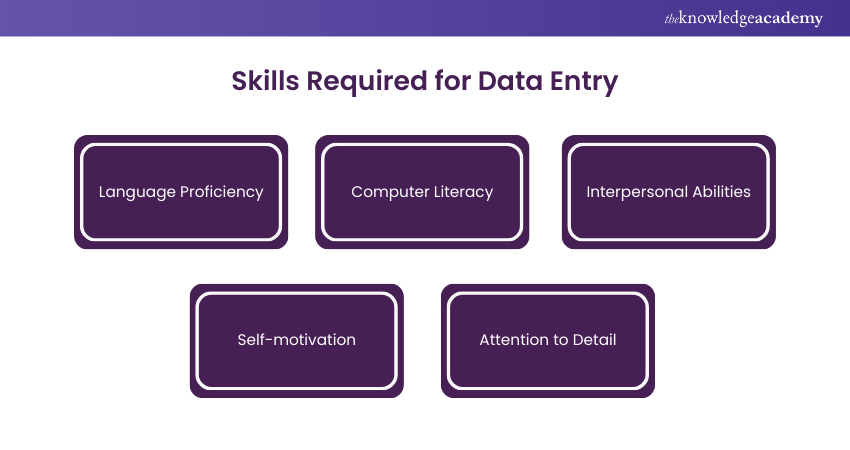
Language proficiency
Enhance your English language skills by improving your reading and writing abilities. Proofreading your work multiple times ensures the delivery of high-quality results.
Computer literacy
Develop proficiency in computer programs for electronic data input and editing. Utilise online tutorials to grasp popular word processing and spreadsheet software. Familiarity with scanners and printers enhances effectiveness.
Interpersonal abilities
Since Data Entry workers interact with colleagues and employers, they improve customer service skills using freely available online resources. Role-playing can be beneficial for practising responses in various situations.
Self-motivation
Strong self-motivation is advantageous, given the potential for remote work or unsupervised tasks. This trait empowers you to complete repetitive or mundane tasks proactively.
Attention to detail
Excel as a Data Entry worker by honing excellent attention to detail. This skill enables focused and high-quality work, ensuring task accuracy and efficiency.
Master the art of minute-taking for effective meetings – Join our Minute Taking Training now!
List of Top Data Entry tools
Here, we will provide you with a compilation of top Data Entry tools you must know.
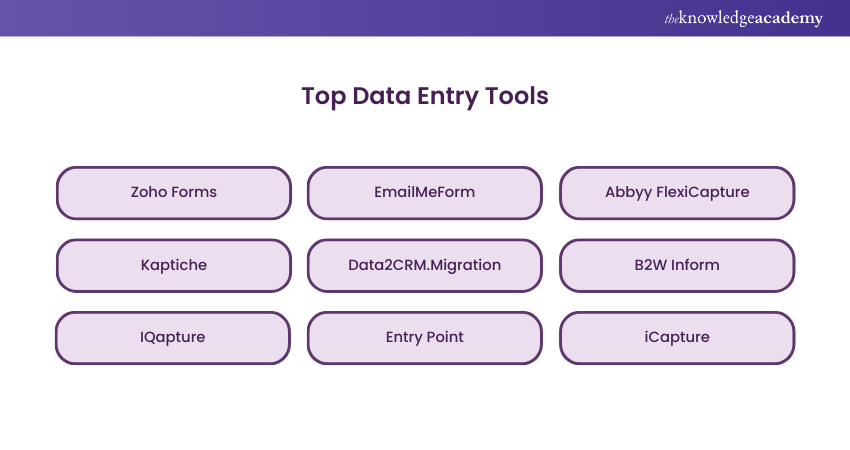
a) Zoho Forms: Zoho Forms simplifies the data management process by enabling the creation of web forms. It allows for the setup of email notifications based on specific requirements and integrates with built-in applications.
b) EmailMeForm: It offers a straightforward HTML form and survey creation application.
c) Abbyy FlexiCapture: It facilitates collecting, processing, verifying, and implementing accurate data in critical processes.
d) Kaptiche: It aids in cost reduction and increased efficiency by streamlining day-to-day operations, minimising inaccuracies in manual entries.
e) PieSync: It is a no-code platform that enables users to sync their businesses and customers seamlessly.
f) Data2CRM.Migration: It contributes to effortless data migration.
g) B2W Inform: assists in collecting and recording quality data, focusing on improving coverage in areas such as safety, human resources, and more.
h) IQapture: It is an electronic data capture tool that provides live online training and education through documents and webinars.
i) Entry Point: comprises user-friendly tools for creating and installing various custom Data Entry applications, offering built-in options for authentication, export, and editing.
j) iCapture: A lead capture solution ideal for events, trade shows, and conferences. It allows the scanning and sorting of contact data with instant CRM integration.
Become the backbone of Business Compliance. Join our Company Secretary Training now!
How to Get a Job Doing Data Entry?
To secure a Data Entry job, follow these steps:
1) Complete Your Secondary Schooling
Securing a strong foundation for a career in Data Entry can be achieved through the completion of secondary education or participation in college courses. Another option is engaging in technical training sessions or workshops. Beneficial courses to prepare for a Data Entry career encompass subjects like computer sciences and communications.
2) Finish Your Internship
Completing an internship is a valuable way to determine if a career in Data Entry is suitable for you. Acquiring experience through voluntary work or applying for a Data Entry internship provides an opportunity to establish connections within the professional realm. This network can prove beneficial as you seek employment in the field.
3) Increase the Accuracy and Speed of Your Typing
Enhance your typing skills by consistently engaging with popular software programs. Practice extensively until you achieve a satisfactory typing speed. Utilise various online typing speed games and tests to both refine and assess your typing speed and accuracy.
Is a Data Entry Job Easy?
Data Entry may seem simple, but it requires strong focus, accuracy, and speed. While no advanced qualifications are needed, unclear data or repetitive tasks can make it challenging. It’s suitable for beginners but demands discipline and attention to avoid errors.
Can I Work From Home as a Data Entry?
Yes, you can work from home in a Data Entry role. Many companies hire remote workers for tasks like typing, updating records, and managing databases. All you need is a reliable internet connection, a computer, and the ability to work independently with attention to detail.
Conclusion
Understanding What is Data Entry can turn a routine task into a valuable skill that boosts efficiency and accuracy across industries. With smart tools and the right approach, Data Entry offers valuable flexibility. It also provides a strong foundation for building a successful, detail-oriented career. It also opens opportunities to work across diverse sectors, from healthcare to finance.
Elevate your productivity with precision typing by joining our Touch Typing Training. Sign up today!
Frequently Asked Questions
What is the Professional Name for Data Entry?

The professional title for this role is usually "Data Entry Clerk." Other common names include "Data Operator" or "Data Input Clerk." These roles involve entering information into systems from paper or digital sources, often using a keyboard to maintain accurate records.
What Questions are Asked in a Data Entry Interview?
In a Data Entry interview, you may be asked about your typing speed, software knowledge, and attention to detail. Common questions include “What Data Entry tools have you used?”, “How do you ensure accuracy?” and “Can you handle repetitive tasks while maintaining focus?”.
What are the Other Resources and Offers Provided by The Knowledge Academy?
The Knowledge Academy takes global learning to new heights, offering over 3,000+ online courses across 490+ locations in 190+ countries. This expansive reach ensures accessibility and convenience for learners worldwide.
Alongside our diverse Online Course Catalogue, encompassing 17 major categories, we go the extra mile by providing a plethora of free educational Online Resources like Blogs, eBooks, Interview Questions and Videos. Tailoring learning experiences further, professionals can unlock greater value through a wide range of special discounts, seasonal deals, and Exclusive Offers.
What is Knowledge Pass, and how Does it Work?
The Knowledge Academy’s Knowledge Pass, a prepaid voucher, adds another layer of flexibility, allowing course bookings over a 12-month period. Join us on a journey where education knows no bounds.
What are the Other Resources and Offers Provided by The Knowledge Academy?
The Knowledge Academy offers various PA and Secretarial Course, including the Data Entry Masterclass and Company Secretary Training Course, and the Office Management Course. These courses cater to different skill levels, providing comprehensive insights into Data Entry Job Description.
Our Business Skills Blogs cover a range of topics related to PA and Secretarial, offering valuable resources, best practices, and industry insights. Whether you are a beginner or looking to advance your Business skills, The Knowledge Academy's diverse courses and informative blogs have got you covered.

Charlotte Wilson


Soft Skills and Business Training Manager
Charlotte Wilson is an expert in soft skills development, with over 14 years of experience helping individuals and teams improve communication, productivity and emotional intelligence in the workplace. Her training content is focused on enhancing interpersonal effectiveness and fostering positive, collaborative environments across all levels of an organisation.
View Detail
Upcoming Business Skills Resources Batches & Dates
Date
 Company Secretary Training Course
Company Secretary Training Course
Fri 24th Jul 2026
Company Secretary Training Course
Fri 16th Oct 2026

 If you wish to make any changes to your course, please


