


 Top Rated Course


We may not have the course you’re looking for. If you enquire or give us a call on +971 8000311193 and speak to our training experts, we may still be able to help with your training requirements.
Types of Quantum Computers: A Brief Overview
The Knowledge Academy 19 February 2026Dive into the realm of Quantum Computing with this blog on different Types of Quantum Computers and explore the intricacies of each of them. From superconducting to photonic, and quantum dots Quantum Computers, gain insight into the cutting-edge technologies shaping the future of computation. Read further to learn more.

Training Outcomes Within Your Budget!
We ensure quality, budget-alignment, and timely delivery by our expert instructors.
Table of Contents
Quantum Computers are devices that use the principles of Quantum Mechanics to perform computations that are impossible or impractical for classical computers. They are seen as the future of computing, offering unprecedented speed and power for various applications. However, not all Quantum Computers are the same. Different Types of Quantum Computers have different architectures, capabilities, and challenges.
This blog will provide a brief overview of the Types of Quantum Computers you should know and how they differ from each other. So, let’s dive in to learn more!
Table of Contents
1) What are Quantum Computers?
2) Top 5 Types of Quantum Computers
a) Superconducting Quantum Computers
b) Photonic Quantum Computers
c) Neutral Atoms Quantum Computers
d) Trapped Ions Quantum Computers
e) Quantum Dots Quantum Computers
3) Conclusion
What are Quantuqm Computers?
Quantum Computers are advanced computing devices that harness the principles of Quantum Mechanics to perform computations. Quantum Computers use Quantum Bits or Qubits to represent information as opposed to classical computers that use bits like 0s and 1s. Quantum Bits can exist simultaneously in multiple states due to superposition. This allows Quantum Computers to process vast amounts of data and perform calculations exponentially faster than classical computers.
Quantum Computers leverage entanglement, a quantum phenomenon where qubits become correlated, and quantum interference to enhance computational power further. Quantum Computers hold the potential to revolutionise various industries by solving complex problems that are currently not possible by classical computers.
Top five Types of Quantum Computers
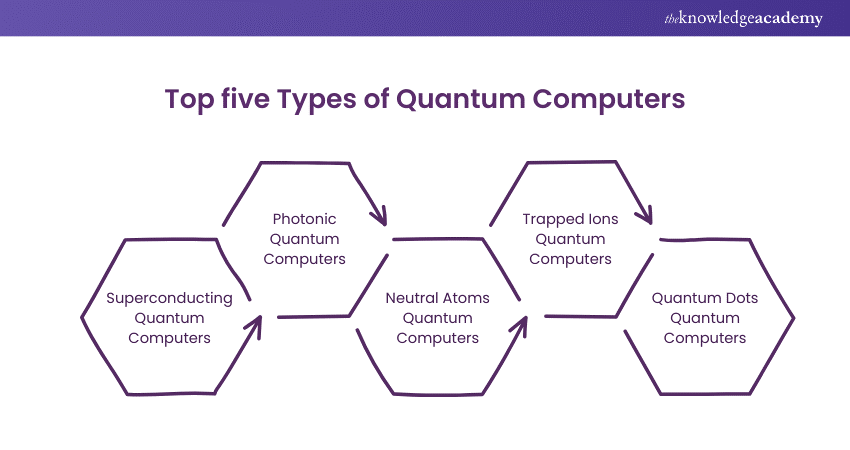
Quantum Computing is a groundbreaking field of research, with multiple Classification of Computers emerging as key players in advancing computing capabilities. Various types of quantum computers are being explored for their potential to revolutionize computing capabilities, often discussed in Quantum Computing Interview Questions to assess expertise in the area. Here, we delve deeper into the top 5 Types of Quantum Computers shaping the landscape of quantum technology:
1) Superconducting Quantum Computers
Superconducting Quantum Computers rely on superconducting circuits cooled to ultra-low temperatures to manipulate Qubits. These Qubits, typically made from superconducting materials such as aluminium or niobium, exhibit long coherence times, essential for stable quantum operations.
The Quantum Computing Guide highlights that Industry leaders like IBM and Google have made notable advancements in superconducting Quantum Computing, with their respective systems demonstrating remarkable progress in scaling up qubit counts and achieving quantum supremacy. Working of quantum computer in this context involves using microwave pulses to control qubits and perform quantum operations, paving the way for practical Quantum Computing applications in cryptography, optimisation, and material science.
2) Photonic Quantum Computers
Photonic Quantum Computers harness photons, the fundamental particles of light, as qubits. These qubits are generated and manipulated using optical components such as beam splitters, mirrors, detectors, and laser sources to create and manipulate quantum states of light. One key advantage of photonic Quantum Computers is their ability to maintain quantum coherence over long distances.
This makes them well-suited for quantum communication applications such as secure quantum key distribution and quantum teleportation. Ongoing research efforts focus on developing scalable photonic quantum processors using integrated photonic circuits and free-space optical setups to overcome challenges related to photon loss and noise, further advancing how Quantum Computer Works in practical, real-world scenarios.
3) Neutral Atoms Quantum Computers
Neutral Atoms Quantum Computers employ individual atoms as qubits, confined and manipulated using optical lattices and laser beams. These atoms, typically from alkali or alkaline-earth elements, are trapped in an array of focused laser beams, forming a periodic potential that confines the atoms in space.
With long coherence times and precise control over qubit interactions, neutral atoms offer promising avenues for implementing error-corrected quantum gates and quantum algorithms. Companies like IonQ and ColdQuanta are at the forefront of research in neutral atoms Quantum Computing, driving advancements in qubit stability and scalability.
4) Trapped Ions Quantum Computers
Trapped Ions Quantum Computers utilise ions, or charged atoms, as qubits trapped and manipulated using electromagnetic fields and laser beams. These ions, typically from elements like calcium or ytterbium, are confined in a linear or planar ion trap and manipulated using laser beams to perform quantum operations.
Trapped ions exhibit long coherence times and high-fidelity qubit operations, making them suitable for implementing error-corrected quantum gates and quantum algorithms. Companies such as IonQ and Honeywell have demonstrated significant progress in developing trapped ions quantum processors, paving the way for scalable Quantum Computing platforms with applications in quantum chemistry, cryptography, and optimisation.
5) Quantum Dots Quantum Computers
Quantum dots Quantum Computers leverage semiconductor nanostructures called quantum dots as qubits. These quantum dots, typically fabricated using semiconductor materials such as gallium arsenide or silicon, confine electrons in a small region, forming discrete energy levels that can be manipulated to encode quantum information.
Quantum dots offer scalability and compatibility with existing semiconductor manufacturing processes, making them promising candidates for practical Quantum Computing architectures. Companies like Intel and Microsoft are actively researching quantum dot-based quantum processors, aiming to develop scalable and reliable Quantum Computing platforms for practical applications ranging from quantum simulations to machine learning and optimisation algorithms.
Want to secure a role in quantum computing? Review expert Quantum Computing Interview Questions to help you demonstrate your knowledge and readiness in this cutting-edge field!
Conclusion
Quantum Computing is a fascinating and rapidly evolving field with numerous potential applications and challenges. Understanding the Advantages and Disadvantages of Quantum Computing along with the Types of Quantum Computers allows you to better appreciate their power and limitations. Thank you for reading!
Frequently Asked Questions
Are all Types of Quantum Computers equally advanced?

No, each type of quantum computer has distinct strengths and limitations. Factors such as coherence times, qubit stability, and scalability vary among different types, leading to variations in their level of advancement and suitability for specific applications.
Can I build my own quantum computer?
Building a quantum computer requires advanced expertise in Quantum Mechanics, materials science, and engineering. While enthusiasts can experiment with Quantum Computing concepts, practical implementations demand significant resources and expertise, making it challenging to build a quantum computer independently.
What are the other resources and offers provided by The Knowledge Academy?
The Knowledge Academy takes global learning to new heights, offering over 3,000+ online courses across 490+ locations in 190+ countries. This expansive reach ensures accessibility and convenience for learners worldwide.
Alongside our diverse Online Course Catalogue, encompassing 19 major categories, we go the extra mile by providing a plethora of free educational Online Resources like Blogs, eBooks, Interview Questions and Videos. Tailoring learning experiences further, professionals can unlock greater value through a wide range of special discounts, seasonal deals, and Exclusive Offers.
What is Knowledge Pass, and how does it work?
The Knowledge Academy’s Knowledge Pass, a prepaid voucher, adds another layer of flexibility, allowing course bookings over a 12-month period. Join us on a journey where education knows no bounds.
What are the related courses and blogs provided by The Knowledge Academy?
The Knowledge Academy offers various Advanced Technologies courses, including Quantum Computing Training and 5G Wireless Training. These courses cater to different skill levels, providing comprehensive insights into Latest Technology Trends.
Our Advanced Technologies blogs cover a range of topics related to Quantum Computing, offering valuable resources, best practices, and industry insights. Whether you are a beginner or looking to advance your Quantum Computing skills, The Knowledge Academy's diverse courses and informative blogs have you covered.

The Knowledge Academy


Global Training Provider
The Knowledge Academy is a world-leading provider of professional training courses, offering globally recognised qualifications across a wide range of subjects. With expert trainers, up-to-date course material, and flexible learning options, we aim to empower professionals and organisations to achieve their goals through continuous learning.


 If you wish to make any changes to your course, please


