


 Top Rated Course


We may not have the course you’re looking for. If you enquire or give us a call on +971 8000311193 and speak to our training experts, we may still be able to help with your training requirements.
What is Polygon (MATIC): A Complete Guide
Richard Harris 08 December 2025Polygon (MATIC) is a Layer 2 Ethereum scaling solution that reduces fees and boosts speed, using MATIC for transactions, staking, and governance. By effectively understanding What is Polygon (MATIC) helps developers and users to overcome Ethereum’s limitations by delivering high-speed transactions and low fees.

Training Outcomes Within Your Budget!
We ensure quality, budget-alignment, and timely delivery by our expert instructors.
Table of Contents
Have you ever tried Ethereum only to get stuck with slow paced transactions or high fees? As more people begin using decentralised apps, blockchains, such as Ethereum, will become crowded. That is where the question, “What is Polygon?” becomes essential for users and developers.
Polygon was developed to address the challenges mentioned above. It is done through making blockchains faster, cheaper, and seamless. In this blog, you will learn about What is Polygon (MATIC), how it works, how to use it, features and more. Whether you are a crypto trader or exploring Non-fungible Tokens, Polygon provides a powerful and affordable way to do it.
Table of Contents
1) What is Polygon (MATIC)?
2) How Does Polygon Works?
3) How Can You Use Polygon?
4) Polygon vs MATIC: Key Differences
5) Key Features of Polygon Blockchain
6) How to Create a Polygon Wallet?
7) Advantages and Disadvantages of Polygon
8) Future of Polygon (MATIC)
9) Conclusion
What is Polygon (MATIC)?
Polygon (MATIC) is a Layer 2 scaling solution developed for making the Ethereum blockchain efficient and affordable. It aims to solve slow transaction speed or high gas fees on Ethereum by improving speed, reducing costs, and offering a seamless experience for its users and developers.
Polygon stands out because it provides multiple solutions for a wide range of causes, such as DeFi platforms, NFT marketplaces, payments, and blockchain gaming. At its core lies Polygon’s infrastructure token, MATIC. It is utilised to pay transaction fees across Polygon’s networks and plays a key role in keeping the system secure.

How Does Polygon Works?
Polygon is a faster, more efficient chain built alongside Ethereum for reducing congestion and faster transaction processing. It utilises a set of technologies that create a high-performance parallel blockchain. At the system’s core is proof-of-stake (PoS) consensus mechanisms, responsible for creating new MATIC tokens and securing the Polygon network.
Here is how Polygon works:
1) Validators:
Validators are the backbone of the network. They verify transactions, add new blocks, and keep the system secure. In return for their service, they earn rewards in the form of transaction fees and newly generated MATIC. It requires serious commitment to be a validator, since a validator’s mistake can lead to losing staked tokens.
2) Delegators:
Delegators are responsible for supporting the network without the need to run their own mode. They stake the MATIC through a trusted validator. This is a simpler way to earn staking rewards but still requires careful selection. Also, validators must act responsibly, or delegators may lose some or all their staked MATIC.
Want to become familiar with Cryptocurrency trading and Blockchain technology- Join Cryptocurrency Trading Training now.
How Can You Use Polygon?
Using Polygon is straightforward for both beginners and advanced users. Anyone can buy, sell, receive or hold MATIC through popular crypto wallets, including those originally designed for Bitcoin. These wallets usually provide simple options and step-by-step guidance for managing your transactions with ease.
For more experienced users, Polygon offers a rich ecosystem of decentralised applications. These dApps support a wide range of DeFi and Web3 activities, including:
1) Trading tokens
2) Borrowing and lending
3) Prediction markets
4) Crypto derivatives
5) Synthetic assets
6) NFT minting, buying and selling
7) Web3 gaming experiences
Polygon vs MATIC: Key Differences
Polygon and MATIC, though often used interchangeably, have distinct differences. Here are some key points to understand their relationship and functionalities:
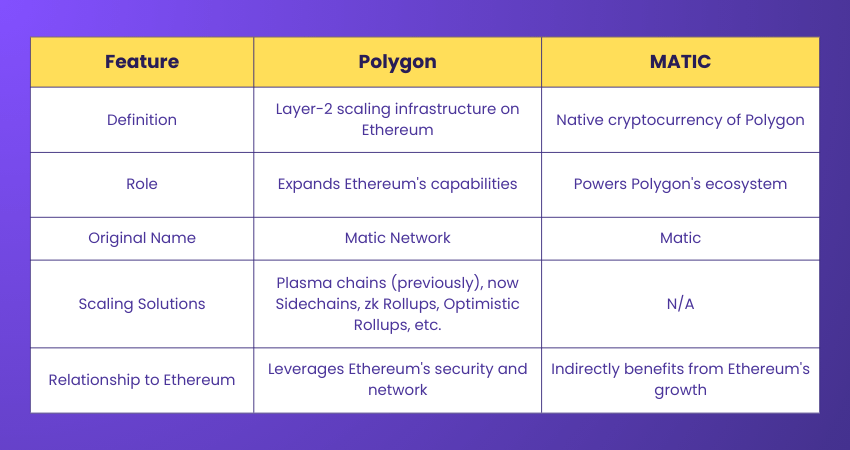
1) Definition
Polygon: Polygon is a Layer-2 scaling infrastructure that exists on the Ethereum Blockchain, initially launched as Matic Network in 2019.
MATIC: The native token of the Polygon ecosystem, used to power the Blockchain.
2) Role
Polygon: It enhances Ethereum's scalability by providing a framework for building interconnected Blockchains, initially using Plasma chains and later adopting sidechains.
MATIC: It serves as the utility token within the Polygon network to facilitate transactions and governance.
3) Original Name
Polygon: It was originally launched as Matic Network in 2019.
MATIC: It is always known by the name MATIC, even after the network rebranding.
4) Scaling Solutions
Polygon: Polygon utilises various scaling solutions. Initially, it was Plasma chains, and later it was side chained by Zero-knowledge (zk) Rollups, and Optimistic Rollups, to enhance scalability.
MATIC: MATIC supports these scaling solutions by serving as the token used in transactions and network staking.
5) Relationship to Ethereum
Polygon: It acts as a Layer-2 scaling infrastructure on the Ethereum Blockchain. This helps to address Ethereum's limitations, such as high transaction fees and slow processing speeds.
MATIC: It is powered by the Polygon ecosystem to facilitate transactions and governance. This contributes to the overall efficiency and scalability of the Ethereum network.
Learn how Bitcoins work and how are Bitcoins made secured by joining Bitcoin and Cryptocurrency Course.
Key Features of Polygon Blockchain
Polygon is among the leading Layer-2 competitors for several reasons. Here are four main features that make Polygon distinct from others:
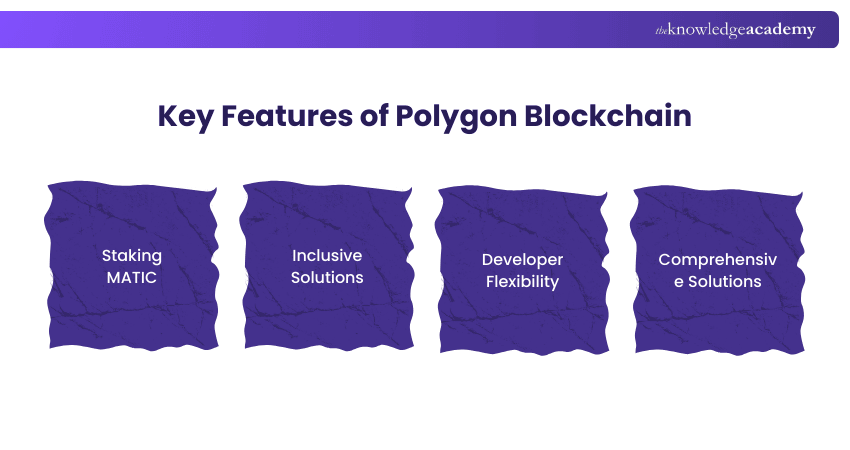
1) Staking MATIC: One of the distinctive features of Polygon is it allows MATIC, its native Cryptocurrency, to be staked on its Blockchain. This is distinct in Polygon and sets it apart from other networks.
2) Inclusive Solutions: Polygon was designed to provide solutions for everyone, including users and enterprises, not just developers. Its ultimate aim is to scale Ethereum to one billion users without compromising security, with a goal of creating an Internet of Things (IoT) for the Ethereum Blockchain.
3) Developer Flexibility: Another special feature of Polygon is the flexibility it offers developers. They can choose between zk rollups or optimistic rollups and also have the option of using Polygon Avail for secure data availability.
4) Comprehensive Solutions: Polygon provides a range of solutions on a single network for developers. This allows them to make better choices regarding the scaling solution for their applications, enhancing the overall efficiency and effectiveness of their projects.
Learn to use managed Blockchain networks quickly using AWS CLI and AWS Management Console. Sign up for our Amazon Managed Blockchain Training today!
Gain insights into the Cryptography and Bitcoin core concepts- register for our Blockchain Course today!
How to Create a Polygon Wallet?
Creating a Polygon wallet requires beginner-friendly steps to be followed. Here, we have provided the steps to create your Polygon wallet
1) Open your wallet application and tap the Funds tab at the bottom of the screen
2) Select “ADD/IMPORT” and choose “Add new personal wallet”
3) From the list of supported networks, choose MATIC
4) Enter a name of your choice for your new wallet
5) Tap “Create Matic Wallet”
Advantages and Disadvantages of Polygon
Polygon is a popular Blockchain platform known for its speed and cost-efficiency, but like any technology, it has its own set of strengths and limitations. Below are the key advantages and disadvantages of using Polygon:
Advantages:
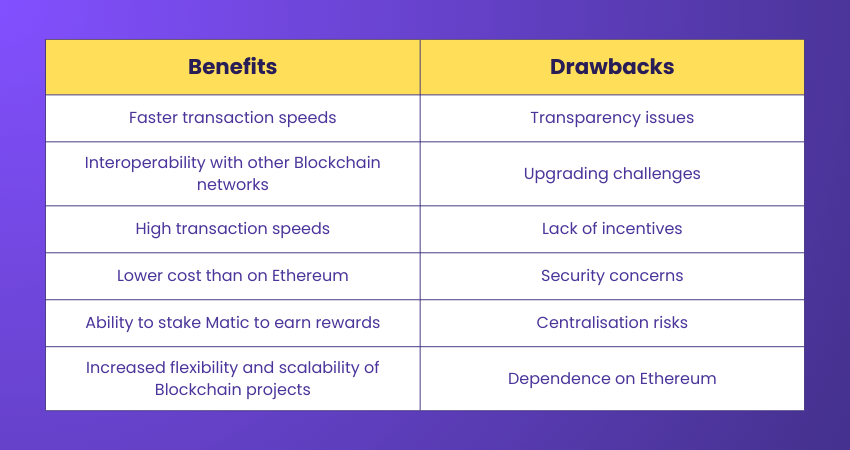
1) It offers faster transaction speeds
2) Its interoperability with other Blockchain networks is a huge advantage
3) High transaction speeds
4) Lower cost than on Ethereum
5) Ability to stake Matic to earn rewards from network security
6) Increased flexibility, scalability, and sovereignty of a Blockchain project
Disadvantages:
1) It offers only partial transparency
2) Upgrading the Polygon network can be a challenge
3) Lack of direct incentives for users
4) Smaller validator set increases the risk of potential attacks
5) Limited validators raise concerns about centralisation within the Polygon Blockchain
6) Dependence on Ethereum
This table summarises the benefits and drawbacks of the Polygon Blockchain
Future of Polygon (MATIC)
The future of Polygon (MATIC) looks promising given its current growth trajectory. Here are some key points which highlights its potential:
1) Secure Future: With its rapid growth, Polygon's future appears secure. The platform continues to enhance its capabilities and user base, reinforcing its position in the Blockchain ecosystem.
2) Polygon Studios: Launched in 2021, Polygon Studios is a branch of Polygon focused on gaming and non-fungible tokens (NFTs). This addition has significantly contributed to Polygon's growth and its appeal to developers and users in the gaming and NFT sectors.
3) Decentralised Gaming and NFTs: The success of Polygon Studios is a powerful factor in positioning Polygon as a prominent technology provider for decentralised gaming and NFTs. This success is expected to drive further adoption and innovation within the Polygon ecosystem.
Conclusion
Understanding What is Polygon (MATIC) is essential for enhancing Ethereum with fast transactions, low fees, and flexible tool, such a PoS sidechain or zkEVM. These features support the growth and demand for efficient decentralised applications. As blockchain evolves, Polygon plays a significant role in building an accessible and scalable digital future.
Frequently Asked Questions
Is Polygon (MATIC) a Good Investment?

Polygon (MATIC) offers scalability, low costs, and interoperability, making it appealing for blockchain enthusiasts. However, its success depends on market trends, adoption, and competition. Always assess your risk tolerance and research thoroughly before investing.
Is Polygon Part of Ethereum?
Yes, Polygon is built to work alongside Ethereum. It's a Layer 2 scaling solution to enhance Ethereum's functionality by providing faster and cheaper transactions while leveraging Ethereum's security and ecosystem. However, it operates independently with its own Blockchain network.
What are the Other Resources and Offers Provided by The Knowledge Academy?
The Knowledge Academy takes global learning to new heights, offering over 3,000 online courses across 490+ locations in 190+ countries. This expansive reach ensures accessibility and convenience for learners worldwide.
Alongside our diverse Online Course Catalogue, encompassing 19 major categories, we go the extra mile by providing a plethora of free educational Online Resources like Blogs, eBooks, Interview Questions and Videos. Tailoring learning experiences further, professionals can unlock greater value through a wide range of special discounts, seasonal deals, and Exclusive Offers.
What is The Knowledge Pass, and How Does it Work?
The Knowledge Academy’s Knowledge Pass, a prepaid voucher, adds another layer of flexibility, allowing course bookings over a 12-month period. Join us on a journey where education knows no bounds.
What are the Related Courses and Blogs Provided by The Knowledge Academy?
The Knowledge Academy offers various Blockchain Courses, including the Bitcoin and Cryptocurrency Course and the Ethereum Developer Course. These courses cater to different skill levels, providing comprehensive insights into the Pros and Cons of Cryptocurrency.
Our Advanced Technology Blogs cover a range of topics related to Blockchain Technology, offering valuable resources, best practices, and industry insights. Whether you are a beginner or looking to advance your Blockchain knowledge skills, The Knowledge Academy's diverse courses and informative blogs have got you covered.

Richard Harris


Senior Full Stack Developer and Technology Educator
Richard Harris is a highly experienced full-stack developer with deep expertise in both frontend and backend technologies. Over his 12-year career, he has built scalable web applications for startups, enterprises and government organisations. Richard’s writing combines technical depth with clear explanations, ideal for developers looking to grow in modern frameworks and tools.


 If you wish to make any changes to your course, please


