


 Top Rated Course

We may not have the course you’re looking for. If you enquire or give us a call on +44 1344 203 999 and speak to our training experts, we may still be able to help with your training requirements.
What is Innovation: A Complete Guide for Organisations
Benjamin Walker 06 March 2026Innovation is the process of creating and implementing new or improved ideas to deliver value, solve problems, boost growth, efficiency, and social impact. It turns creative thinking into practical solutions that enhance products, services, and processes. As organisations adapt to change, they remain competitive and relevant.

Training Outcomes Within Your Budget!
We ensure quality, budget-alignment, and timely delivery by our expert instructors.
Table of Contents

Why do some ideas change the world while others quietly fade away? The answer starts with understanding What is Innovation and how it influences everything around us. From the way you order food online to how businesses deliver faster services, Innovation is woven into daily life. It is not just about big inventions, but about improving what already exists in smarter and more meaningful ways.
In a fast-moving world, knowing What is Innovation gives you an edge. It helps businesses grow, professionals stand out, and students think differently. Those who embrace new ideas adapt quickly, solve problems creatively, and create real value. If you want to stay relevant and ahead, Innovation is not optional; it is essential.
Table of Contents
1) What is Innovation?
2) What is the Importance of Innovation?
3) Stages of Innovation
4) Different Types of Innovation
5) Innovation Process: 7 Key Steps
6) What is an Innovation Portfolio?
7) Ways to Measure Innovation
8) How Can Organisations Foster Innovation?
9) What are the Barriers to Innovation?
10) Conclusion
What is Innovation?
Innovation involves creating fresh ideas, techniques, items, services, or answers that result in meaningful and valuable outcomes. It translates Innovative ideas into tangible outcomes that improve productivity and performance or meet unrecognised requirements.
Although Innovation is typically linked to technological advancement, it also encompasses new methods of addressing problems, procedures, organisational strategies, and business structures. At its core, Innovation questions the current state, promotes creative thinking and accepts calculated risks to advance and achieve transformative results.
Innovation arises from curiosity, originality, and a thirst for progress. Innovative people welcome change, encourage brainstorming, and support trial and error. It can happen in different areas such as business, science, technology, social sectors, or public services and result in economic expansion, social progress, enhanced quality of life, and lasting development.
Key Components of Innovation:
a) Culture of Creativity: Promotes trying new things and appreciates a variety of viewpoints.
b) Leadership Support: Offers resources and direction for new initiatives.
c) Collaborative Teams: Teams that collaborate with different functions promote diverse perspectives.
d) Resource Allocation: Allocates funds towards researching, developing, and utilising technology to promote Innovation.
e) Customer-centric Approach: Encourages Innovation through understanding the needs of customers.
f) Flexibility and Agility: Allows for rapid responses to evolving market needs.
g) Risk Management: Encouraging calculated risks and embracing failures promotes effective Risk Management.
h) Feedback Mechanisms: Feedback mechanisms involve employees and customers providing regular input to refine ideas.
i) Strategic Vision: Aligning Innovation initiatives with company objectives.

What is the Importance of Innovation?
Innovation is crucial for businesses and organisations, as it can provide them with various benefits, such as:
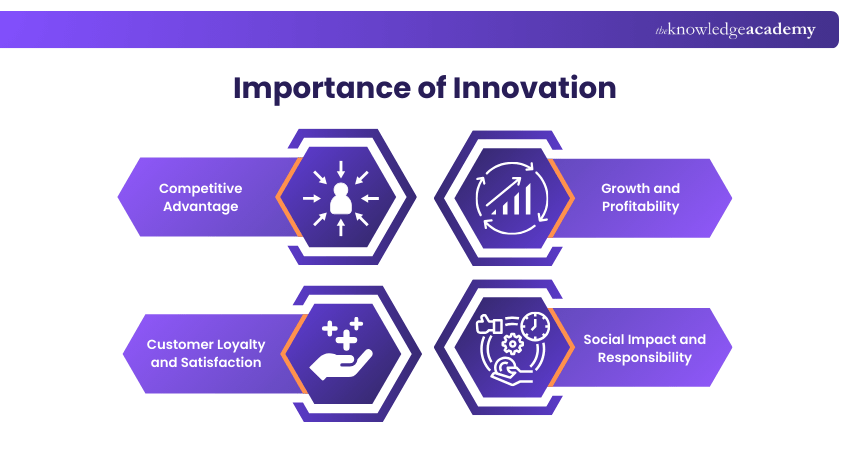
a) Competitive Advantage: Innovation allows companies to differentiate themselves by providing unique products or services. It assists businesses in remaining ahead by adjusting to changing customer demands, market trends, and industry disruptions.
b) Growth and Profitability: Innovation drives increased revenue and market growth by introducing new products and services in the markets. It additionally enhances productivity and reduces expenses by streamlining processes and managing resources effectively.
c) Customer Loyalty and Satisfaction: Innovation enables businesses to exceed customer expectations by providing improved solutions and experiences. Involving customers in the Innovation process helps establish trust and long-lasting loyalty.
d) Social Impact and Responsibility: Innovation enables businesses to address social and environmental issues, producing beneficial advancements. It also enhances alignment with stakeholder values, advocating for ethical and eco-friendly business practices.
Stages of Innovation
These stages work together to guide Innovation from idea to impact. Let us now explore each stage in detail to understand how the process unfolds and how organisations can manage it effectively:
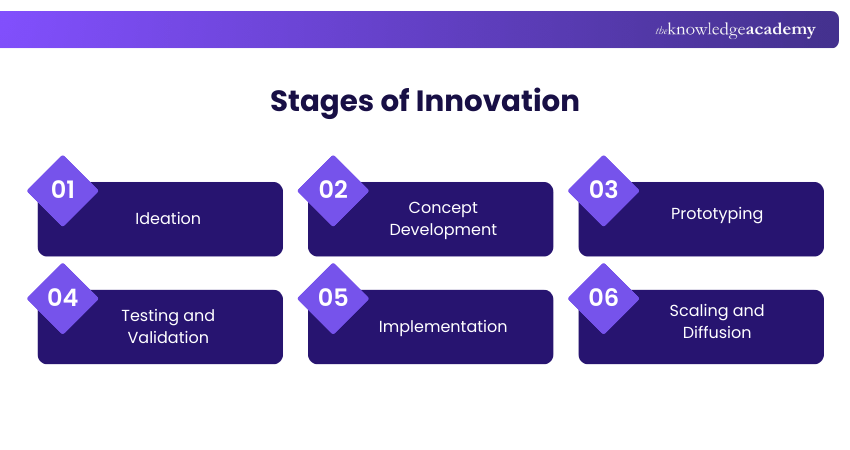
1) Ideation
This is the starting point where creative ideas are generated. Through brainstorming, research, and collaboration, organisations identify problems and imagine possible solutions. The focus is on exploring opportunities and encouraging fresh thinking.
2) Concept Development
At this stage, raw ideas are refined into clear and practical concepts. Teams assess feasibility, align the idea with customer needs, and outline how it will function in real situations. Only the most viable concepts move forward.
3) Prototyping
Here, early versions or models of the idea are created. Prototypes allow teams to experiment, test functionality, and identify weaknesses. This stage encourages learning from mistakes before large-scale investment.
4) Testing and Validation
The Innovation is tested with users and evaluated for technical and market readiness. Feedback is collected to improve performance, usability, and value. Adjustments are made to ensure the solution meets expectations.
5) Implementation
Once validated, the product or service is officially launched into the target market. This involves carefully planning pricing, marketing, distribution, and operational processes to deliver the Innovation effectively and consistently to customers.
6) Scaling and Diffusion
After launch, the focus shifts to expansion and improvement. Organisations increase reach, optimise efficiency, and adapt based on market demand. Continuous refinement ensures the Innovation remains competitive and sustainable over time.
Learn to use creative and analytical thinking for solving critical problems successfully with our Creative and Analytical Thinking Training – Register today!
Different Types of Innovation
Here are some of the common types of Innovation:
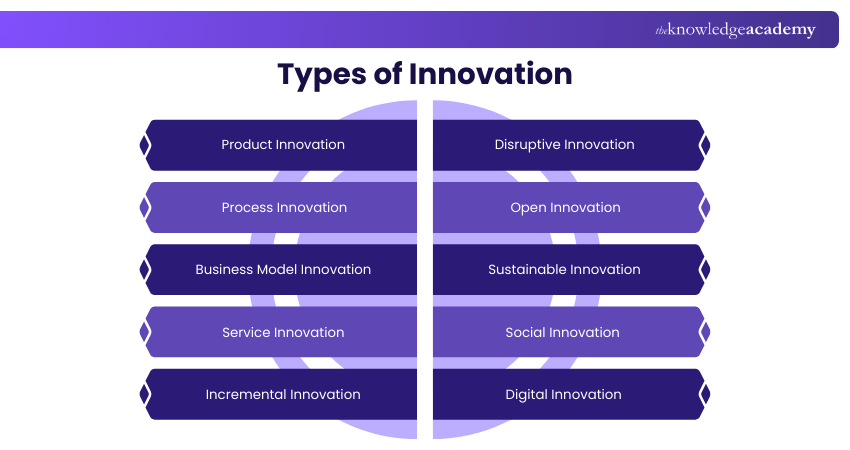
1) Product Innovation
Product Innovation encompasses developing new products or enhancing current ones to satisfy evolving market requirements and customer expectations. It involves improvements in features, aesthetics, speed, and user interaction.
2) Process Innovation
Process Innovation is centred on improving internal processes, systems, and technologies to make operations more efficient, reduce costs, and streamline workflows. Its objective is to enhance the organisation's agility and competitiveness.
3) Business Model Innovation
Business model Innovation changes how businesses generate, provide, and benefit from value. It examines fresh ways to generate income, manage costs, form partnerships, and enhance customer involvement to bring about market change and distinctiveness.
4) Service Innovation
It changes how customers interact with products by implementing new delivery methods, customisation features, and increased accessibility. The aim is to surpass customer expectations and enhance brand loyalty.
5) Incremental Innovation
Incremental Innovation refers to continuous enhancements and adjustments to current products, services, or processes. It promotes continuous improvements in effectiveness, excellence, and customer contentment, ensuring continued market significance.
6) Disruptive Innovation
Disruptive Innovation challenges current market standards and presents fresh solutions that offer new value propositions. It typically starts in specialised markets and gradually replaces incumbents by meeting the needs of customers that are not being fulfilled.
7) Open Innovation
Open Innovation involves working with third-party entities, including customers, suppliers, and research institutions, to create innovative solutions jointly. This strategy utilises outside knowledge and assets to speed up Innovation processes and enhance industry dominance.
8) Sustainable Innovation
Sustainable Innovation is centred on creating environmentally friendly products, services, and business models that reduce environmental harm and uphold social responsibility. It addresses worldwide issues such as climate change and resource preservation.
9) Social Innovation
Sustainable Innovation is centred on creating environmentally friendly products, services, and business models that minimise environmental harm and uphold social responsibility. It addresses worldwide issues such as climate change and resource preservation.
10) Digital Innovation
Digital Innovation uses the power of digital technologies such as AI, IoT, and blockchain to transform products, services, and operational processes. It improves efficiency, supports data-driven decision making, and accelerates digital transformation.
Improve negotiation and communication skills to navigate deals and partnerships with our Business Development Training – Register today!
Innovation Process: 7 Key Steps
Here are seven common steps in the Innovation process:
1) Spot Opportunities
Start by finding areas where Innovation is needed. This could be through market research, customer feedback, trend analysis, or looking at internal processes. The aim is to discover unmet needs, new trends, or problems that Innovation can solve.
2) Come Up with Ideas
Once opportunities are found, it’s time to brainstorm solutions. This can happen through team discussions, idea challenges, customer suggestions, or collaboration across departments. The goal is to gather as many creative ideas as possible.
3) Pick the Best Ideas
Next, review the ideas and choose the ones with the most potential. Consider factors like how practical the idea is, the resources needed, market demand, and how well it fits the organisation’s goals. Select the ideas that are likely to succeed.
4) Build and Test Prototypes
Turn the chosen ideas into basic models or samples, like mock-ups or simple versions of the product. This step allows you to test the idea, gather feedback, and make improvements.
5) Refine Through Testing
Try out the prototypes with real users or in real-world settings. Use their feedback to improve the idea. This back-and-forth process helps fix any problems and fine-tune the Innovation before it’s finalised.
6) Launch and Expand
When the Innovation is ready, put it into action. Create a detailed plan, assign resources, and roll it out step by step. Once it’s working well, scale it up to reach more people or areas.
7) Track and Improve
After the Innovation is launched, keep an eye on how it’s performing. Measure its success using key metrics and make improvements where needed. Learn from this experience to make your next Innovation even better.
What is an Innovation Portfolio?
An Innovation portfolio is a thoughtfully selected grouping of possible projects, each with specific objectives and necessary resources. Effectively managing this portfolio is important for discovering new opportunities and deciding on the best combination of initiatives, such as determining the right number and mix.
a) Confirming Total Value: Evaluating the complete value needed for the portfolio
b) Evaluating Existing Projects: Examining present Innovation endeavours considering their additional worth, risk factor, and conformity with strategic goals
c) Saying “No”: Easily discontinuing projects that waste resources and avoiding small initiatives that may not bring enough benefits
d) Reallocating Resources: Shifting abilities and expertise towards new or current projects that could use extra assistance
e) Identifying Gaps: Recognising deficiencies in the portfolio and developing new strategies to fill those gaps
Ways to Measure Innovation
There are various ways to measure Innovation, depending on the measurement's purpose, context, and perspective. Some of the common ways to measure Innovation are:
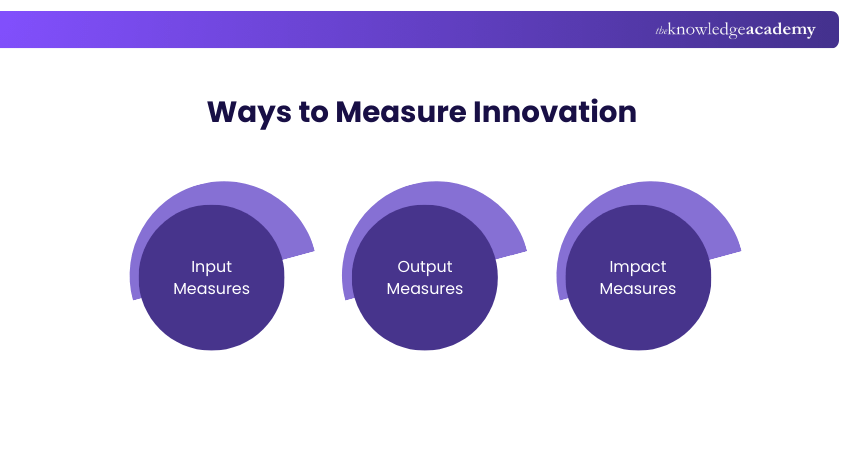
a) Input Measures: It monitors the resources committed to Innovation endeavours, including expenditures on R&D, time allocated to brainstorming, and the volume of newly launched projects. These measures assist in assessing a company's dedication and endorsement of Innovation.
b) Output Measures: It assesses the tangible outcomes of Innovation, such as the quantity of new products introduced, patents submitted, or process enhancements. These indicators show how productive and efficient Innovation activities are.
c) Impact Measures: It evaluates the effects and consequences of Innovation on business performance and market success. Key metrics include increased profits from newly launched products, customer happiness level, the portion of the market captured, and total impact on the sustained competitive edge.
Empower your team to be at their best by creating a positive business environment. Join our Leadership and Management Course now!
How Can Organisations Foster Innovation?
Organisations can foster Innovation by creating a culture where employees feel safe to share ideas and take calculated risks. When failure is treated as learning rather than punishment, creativity and experimentation increase.
Key strategies include empowering employees with autonomy instead of micromanagement, building diverse and cross-functional teams, and encouraging collaboration. Organisations should also allocate dedicated time, tools, and resources for experimentation, promote rapid testing and learning, and ensure leaders actively support and model innovative thinking.
What are the Barriers to Innovation?
Barriers to Innovation are challenges that prevent organisations from developing and applying new ideas effectively. These obstacles may stem from culture, structure, leadership gaps, limited resources, or external pressures, ultimately slowing growth and adaptability.
Cultural barriers include fear of failure and resistance to change. Organisational barriers involve siloed teams and rigid processes. Leadership issues such as unclear vision or short-term focus can weaken Innovation. Limited time, funding, or skills, along with regulations or market resistance, can also slow progress.
Conclusion
Understanding What is Innovation helps individuals and organisations turn ideas into meaningful progress. By encouraging continuous Innovations and overcoming common barriers, organisations can drive sustainable growth and long-term competitiveness. When supported by strong leadership and a creative culture, Innovation and Innovations together empower teams to adapt, improve, and succeed in a changing world.
Learn best practices of social innovation with our Social Innovation Course – Join today!
Frequently Asked Questions
What is Innovation for a Business?

Innovation in a business involves creating new products, processes, or models that increase value, stimulate growth, and meet changing market needs efficiently.
What is the Importance of Innovation?
Innovation is important for organisations to remain competitive, enhance efficiency, and meet customer needs in the changing market conditions.
What are the Other Resources and Offers Provided by The Knowledge Academy?
The Knowledge Academy takes global learning to new heights, offering over 3,000 online courses across 490+ locations in 190+ countries. This expansive reach ensures accessibility and convenience for learners worldwide.
Alongside our diverse Online Course Catalogue, encompassing 19 major categories, we go the extra mile by providing a plethora of free educational Online Resources like Blogs, eBooks, Interview Questions and Videos. Tailoring learning experiences further, professionals can unlock greater value through a wide range of special discounts, seasonal deals, and Exclusive Offers.
What is The Knowledge Pass, and How Does it Work?
The Knowledge Academy’s Knowledge Pass, a prepaid voucher, adds another layer of flexibility, allowing course bookings over a 12-month period. Join us on a journey where education knows no bounds.
What are the Related Courses and Blogs Provided by The Knowledge Academy?
The Knowledge Academy offers various Leadership Courses, including Managing Innovation Training, Staff Motivation Training, and Leadership Skills Training. These courses cater to different skill levels, providing comprehensive insights into Business Strategy.
Our Business Skills Blogs cover a range of topics related to Innovation, offering valuable resources, best practices, and industry insights. Whether you are a beginner or looking to advance your Business skills, The Knowledge Academy's diverse courses and informative blogs have got you covered.

Benjamin Walker


Leadership Development Coach and Management Consultant
Benjamin Walker is a leadership coach and business consultant with over 18 years of experience in guiding organisations through strategic growth and transformation. He specialises in developing leadership capabilities at all levels, from emerging managers to executive teams. Benjamin’s work focuses on practical leadership, team dynamics, and performance management.
View Detail
Upcoming Business Skills Resources Batches & Dates
Date
 Managing Innovation
Managing Innovation
Fri 3rd Jul 2026
Managing Innovation
Fri 4th Sep 2026
Managing Innovation
Fri 18th Dec 2026

 If you wish to make any changes to your course, please


