


 Top Rated Course

We may not have the course you’re looking for. If you enquire or give us a call on +44 1344 203 999 and speak to our training experts, we may still be able to help with your training requirements.
Introduction of Quality Theme in PRINCE2
Grace Mitchell 27 May 2026This blog on PRINCE2 Quality Theme will explain how to maintain the quality of PRINCE2 in a project and how to review the quality of PRINCE2 in a project. It defines clear quality criteria and standards to ensure outputs meet set requirements, enabling effective quality planning, control, and assurance throughout the project's lifecycle.

Training Outcomes Within Your Budget!
We ensure quality, budget-alignment, and timely delivery by our expert instructors.
Table of Contents

The PRINCE2 Quality Theme helps teams achieve and sustain quality at every project stage. Here, quality refers to the standard that the products, team members, and processes involved in a project must achieve to produce the best results. Implementing the quality theme ensures that the project's outcome meets business expectations.
The significance of PRINCE2 is high even today, as Project Management methodologies and software have considerably risen in popularity. According to Mordor Intelligence, the market for Project Management software is estimated to reach up to £7.9 billion by 2026. Learn about the PRINCE2 Quality Theme, how it fulfils requirements, and how you may use the themes of PRINCE2 to manage projects efficiently.
Table of Contents
1) How do you Ensure Quality in PRINCE2?
a) Quality Management Approach
b) Quality Planning
c) Quality Control
2) Quality Review Technique of PRINCE2
3) Conclusion
How do you Ensure Quality in PRINCE2?
The responsibility of maintaining quality at every stage of a project falls on the Project Manager. They must take note of the customers' expectations regarding product quality and factor that into the product to earn customer satisfaction. Often, customers cannot clearly convey their expectations, leaving the Project Manager to deliver good quality results via effective Quality management.
The factors that change to sustain quality may differ based on the type of organization or project. While some projects prioritise good quality resources, some might focus on the process of creating the product. Quality management can be ensured through steps like quality planning or a quality management approach.
Quality Management Approach
A quality management approach defines the set of tasks and techniques to help manage product quality. It includes the project's objectives and scope alongside individual responsibilities for certain activities.
It describes the procedure to maintain effective Quality Management through steps like quality planning, quality control, etc. The approach also includes information about the tools and techniques that can be used to enforce quality in various stages of the project.
Two other features mentioned in the Quality management approach are records and reports that carry the proof of quality management activities being implemented. The timings of the activities are also included. There are particular roles and responsibilities of members that are defined in the approach. They are stated beside the quality criteria set forth by either the customer or corporate.

Quality Planning
Quality planning involves meeting the customers' expectations regarding quality and defining the acceptance criteria of projects. It documents the plans and processes that can help improve product quality, its criteria, and more.
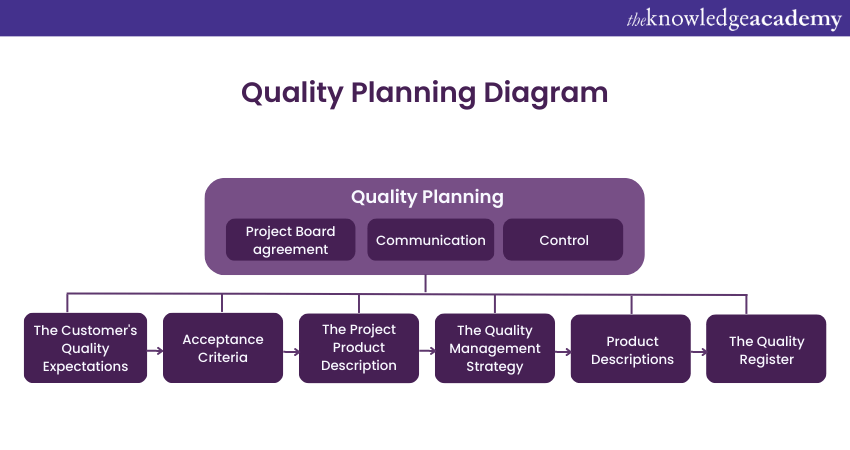
Customer quality expectations are noted at the initial stages of the project. The factors considered at that point are the primary quality requisites and specifications on processes they prefer to apply, among others. Project Managers can review the team's adherence to these factors after every project stage.
The acceptance criteria of a product refer to a set of standards that must be achieved before presenting it to the customer. Appearance, durability, and ease of use are some factors in the acceptance criteria.
The Quality planning stage demands documentation of all the established quality criteria and goals that must be met for customer satisfaction, resulting in the project product description document.
Develop the practical knowledge needed to lead Agile projects with PRINCE2 Agile® Practitioner (Version 2) Training - Sign up now!
Quality Control
Quality control refers to a couple of steps that the designated people must follow to ensure that the products of a project meet the quality requirements. It is also used to measure the metrics of product quality. The following are some of the steps to be followed for quality control:
a) Quality Check: The first step is conducting a product quality check. This entails a detailed review of the product to check if it's meeting the required Quality criteria. Everything from appearance to the product's weight is under rigorous scrutiny.
b) Quality Record: After the Quality inspection, it is imperative to note down your observations. This record serves as proof that the Quality check was completed, providing a detailed account of your findings. Additionally, a Quality Inspector Salary is often influenced by the thoroughness and accuracy of the documentation process.
c) Approval:The next step is to get the steps mentioned above approved. An official sign-off on the product and proof that it has been assessed fairly. The evidence regarding the approval can be stored in a document called an approval record.
Transform strategy into successful project delivery with the PRINCE2® Practitioner Training – Sign up now!
Quality Review Technique of PRINCE2
The quality of projects can be reviewed through various methods. The PRINCE2 Quality review technique is a method mentioned in the PRINCE2 manual which can be used for Quality checks. It comprises four roles and three steps. The four roles are:
a) Chair: Organises and coordinates the review meeting
b) Presenter: The presenter is in charge of presenting products and representing producers
c) Reviewer: Checks Quality by comparing it to the originally determined standards and handles improvements
d) Administrator: The administrator helps support the chair
The three steps of the Quality review technique are:
a) Review preparation:The first step of the quality review technique involves the preparation for a product review. The Chair gives the green signal for initiating the review, after which a copy of the product is given to the reviewers with the product description.
The reviewers thoroughly assess the product, who prepare their feedback and hand it back to the Chair. The Chair uses the questions and suggested improvements as the basis for the next meeting with the Presenter.
b) Review Meeting: The review meeting starts with the presenter introducing the product and addressing the concerns of the Reviewers, which were stated in the previous meeting.
The Reviewers work together to find solutions, and their deductions are noted in a document by the Administrator. The Reviewers propose a collective decision concerning product Quality.
c) Review Follow-up: The last stage in the Quality review technique is a follow-up review meeting. The Presenter executes any remaining work, after which the reviewers are given the product again.
If the Reviewers approve the last stretch of work, the product is signed off by the Chair, followed by the Administrator's product approval request. The Quality review results are then shared with stakeholders by the Administrator.
Conclusion
The PRINCE2 Quality Theme is undoubtedly one of the essential Themes of the project management methodology. We hope this blog helped you understand the Quality Theme in PRINCE2, alongside the methods to achieve quality products
Looking for a high-value certification to upgrade your skillset? Sign up for our PRINCE2® Foundation & Practitioner Training now!
Frequently Asked Questions
What are Key Aspects of the PRINCE2 Quality Theme?

The PRINCE2 Quality Theme ensures deliverables are fit for purpose and meet stakeholder expectations. Key aspects include defining quality requirements through Product Descriptions, planning quality methods, and applying quality control with testing, records, and user approval.
What is the Purpose of the Quality Theme?
The purpose of the PRINCE2 Quality Theme is to ensure project products are fit for purpose and meet stakeholder expectations. It defines how quality is planned, controlled, and assured throughout the lifecycle, ensuring all deliverables meet agreed acceptance criteria.
What are the Other Resources and Offers Provided by The Knowledge Academy?
The Knowledge Academy takes global learning to new heights, offering over 3,000+ online courses across 490+ locations in 190+ countries. This expansive reach ensures accessibility and convenience for learners worldwide.
Alongside our diverse Online Course Catalogue, encompassing 17 major categories, we go the extra mile by providing a plethora of free educational Online Resources like Blogs, eBooks, Interview Questions and Videos. Tailoring learning experiences further, professionals can unlock greater value through a wide range of special discounts, seasonal deals, and Exclusive Offers.
What is the Knowledge Pass, and How Does it Work?
The Knowledge Academy’s Knowledge Pass, a prepaid voucher, adds another layer of flexibility, allowing course bookings over a 12-month period. Join us on a journey where education knows no bounds.
What are the Related Courses and Blogs Provided by The Knowledge Academy?
The Knowledge Academy offers various PRINCE2® Training, including the PRINCE2® Foundation Training, PRINCE2® Practitioner Training, and PRINCE2 Agile® Practitioner (Version 2) Training. These courses cater to different skill levels, providing comprehensive insights into Advantages and Disadvantages of PRINCE2 Methodology.
Our Project Management Blogs cover a range of topics related to PRINCE2 Quality Theme, offering valuable resources, best practices, and industry insights. Whether you are a beginner or looking to advance your Project Management skills, The Knowledge Academy's diverse courses and informative blogs have got you covered.

Grace Mitchell


Senior Project Management Consultant and Author
Grace Mitchell is a highly experienced project management professional with over 15 years of expertise in leading large-scale projects across industries, including construction, IT, and finance. With qualifications in PRINCE2®, PMP®, AgilePM®, and MSP®, Grace specialises in delivering complex programmes with precision and clarity. Her writing is grounded in real-world application and focuses on helping learners build confidence in project delivery and stakeholder management.
View Detail
Upcoming Project Management Resources Batches & Dates
Date
 PRINCE2® Foundation & Practitioner Training Course
PRINCE2® Foundation & Practitioner Training Course
Sat 20th Jun 2026, Sun 21st Jun 2026
PRINCE2® Foundation & Practitioner Training Course
Mon 22nd Jun 2026
PRINCE2® Foundation & Practitioner Training Course
Mon 29th Jun 2026
PRINCE2® Foundation & Practitioner Training Course
Mon 6th Jul 2026
PRINCE2® Foundation & Practitioner Training Course
Sat 11th Jul 2026, Sun 12th Jul 2026
PRINCE2® Foundation & Practitioner Training Course
Mon 13th Jul 2026
PRINCE2® Foundation & Practitioner Training Course
Mon 20th Jul 2026
PRINCE2® Foundation & Practitioner Training Course
Mon 27th Jul 2026
PRINCE2® Foundation & Practitioner Training Course
Mon 3rd Aug 2026
PRINCE2® Foundation & Practitioner Training Course
Mon 10th Aug 2026
PRINCE2® Foundation & Practitioner Training Course
Mon 17th Aug 2026
PRINCE2® Foundation & Practitioner Training Course
Sat 22nd Aug 2026, Sun 23rd Aug 2026
PRINCE2® Foundation & Practitioner Training Course
Mon 24th Aug 2026
PRINCE2® Foundation & Practitioner Training Course
Tue 1st Sep 2026
PRINCE2® Foundation & Practitioner Training Course
Mon 7th Sep 2026
PRINCE2® Foundation & Practitioner Training Course
Sat 12th Sep 2026, Sun 13th Sep 2026
PRINCE2® Foundation & Practitioner Training Course
Mon 14th Sep 2026
PRINCE2® Foundation & Practitioner Training Course
Mon 21st Sep 2026
PRINCE2® Foundation & Practitioner Training Course
Mon 28th Sep 2026
PRINCE2® Foundation & Practitioner Training Course
Mon 5th Oct 2026
PRINCE2® Foundation & Practitioner Training Course
Mon 12th Oct 2026
PRINCE2® Foundation & Practitioner Training Course
Sat 17th Oct 2026, Sun 18th Oct 2026
PRINCE2® Foundation & Practitioner Training Course
Mon 19th Oct 2026
PRINCE2® Foundation & Practitioner Training Course
Mon 26th Oct 2026
PRINCE2® Foundation & Practitioner Training Course
Mon 2nd Nov 2026
PRINCE2® Foundation & Practitioner Training Course
Mon 9th Nov 2026
PRINCE2® Foundation & Practitioner Training Course
Sat 14th Nov 2026, Sun 15th Nov 2026
PRINCE2® Foundation & Practitioner Training Course
Mon 16th Nov 2026
PRINCE2® Foundation & Practitioner Training Course
Mon 23rd Nov 2026
PRINCE2® Foundation & Practitioner Training Course
Mon 30th Nov 2026
PRINCE2® Foundation & Practitioner Training Course
Sat 5th Dec 2026, Sun 6th Dec 2026
PRINCE2® Foundation & Practitioner Training Course
Mon 7th Dec 2026
PRINCE2® Foundation & Practitioner Training Course
Mon 14th Dec 2026
PRINCE2® Foundation & Practitioner Training Course
Mon 21st Dec 2026

 If you wish to make any changes to your course, please


