


 Top Rated Course

We may not have the course you’re looking for. If you enquire or give us a call on +44 1344 203 999 and speak to our training experts, we may still be able to help with your training requirements.
After B.Pharmacy Which Course is Best? A Detailed Guide
Sophia Ellis 05 December 2025Are you confused After B. Pharmacy Which is Best? From specialised master's course to diverse job-oriented courses, the possibilities are vast. This blog will guide you through the key choices, helping you identify the best fit for your career aspirations and unlock new opportunities in the dynamic healthcare sector.

Training Outcomes Within Your Budget!
We ensure quality, budget-alignment, and timely delivery by our expert instructors.
Table of Contents

Congratulations on sailing through your Bachelor’s in Pharmacy! You’ve now unlocked a treasure chest of opportunities in the Pharmaceutical realm. As you ponder, “After B. Pharmacy, Which Course is Best?” our blog stands as your beacon of guidance.
We’re here to illuminate the path to the courses that shine brightest after your degree. So, let’s embark on this academic adventure together and discover the course that will make your career sparkle!
Table of Contents
1) Know about B. Pharmacy
2) Best Courses after B.Pharmacy
3) Skills gained after B. Pharmacy
4) Careers and jobs After B.Pharmacy
5) Conclusion
Know About B. Pharmacy
B. Pharmacy is a four-year undergraduate courses across UK that gives students a solid grasp of Pharmaceutical sciences. This includes learning about drug composition, formulation, synthesis, and analysis.
By pursuing a B. Pharmacy degree, you open up exciting career opportunities. You can Become a Pharmacist in a community or hospital setting, or work in the Pharmaceutical industry. Graduates of this course play a crucial role in ensuring safe medication use, driving innovation, and advancing healthcare.
So, if you're interested in the world of Pharmaceuticals and want to make a difference in people's lives, B. Pharmacy is the perfect path for you.

Why study after a Bachelor's Degree in Pharmacy?
Getting a B. Pharmacy degree is a great starting point, but if you want to take your knowledge and skills to the next level, further education can really boost your expertise and open up more career options. Advanced courses give you specialised training so you can focus on specific areas of Pharmacy and pursue a wide range of career paths. Plus, it's a smart move because it can also increase your earning potential.
Best Courses after B.Pharmacy
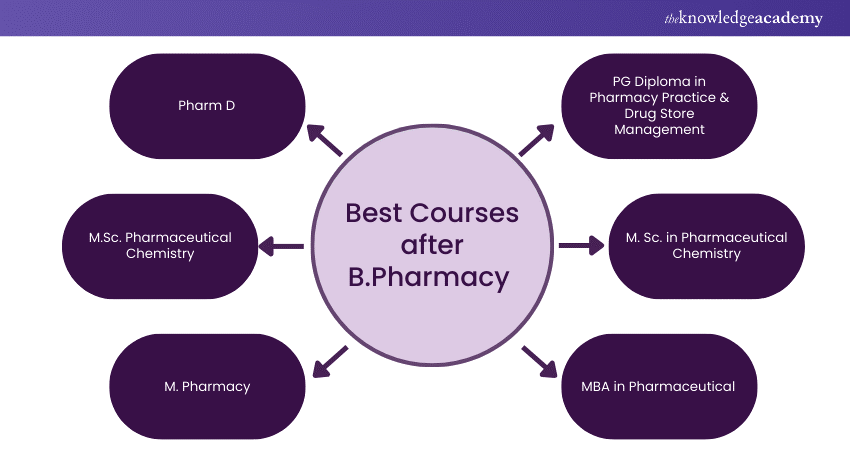
After completing B.Pharmacy, you have several options for further education. Here are some of the best courses to consider:
1) Pharm D.
Pharm D. (Doctor of Pharmacy) is a professional doctoral degree focusing on patient care and medication management. This course prepares graduates for clinical Pharmacy practice, enabling them to work directly with patients in healthcare settings.
2) M.Sc. Pharmaceutical Chemistry
M.Sc. Pharmaceutical Chemistry is a Post-graduate course that provides advanced training in medicinal chemistry, drug design, and synthesis. This course is ideal for students interested in Pharmaceutical research and drug development.
3) M. Pharmacy
M. Pharmacy is a master's degree course that offers specialisation in various fields such as Pharmacology, Pharmaceutics, Pharmaceutical analysis, and Pharmacognosy. This course provides in-depth knowledge and research opportunities in specific areas of Pharmacy.
4) PG Diploma in Pharmacy Practice & Drug Store Management
This diploma course focuses on Pharmacy practice, including clinical Pharmacy, patient counselling, and drug store management. The course equips graduates with the practical skills required for working in community Pharmacies, hospitals, and Pharmaceutical industries.
5) M. Sc. in Pharmaceutical Chemistry
M.Sc. Pharmaceutical Chemistry course emphasises advanced training in Pharmaceutical chemistry and drug discovery. The course prepares students for careers in Pharmaceutical research, analytical chemistry, and drug manufacturing.
6) MBA in Pharmaceutical Management
An MBA in Pharmaceutical Management combines business administration with Pharmaceutical sciences, providing graduates with the skills to manage Pharmaceutical companies, healthcare organisations, and drug marketing strategies.
Skills gained after B. Pharmacy
After completing a B. Pharmacy degree, the course provides a range of valuable skills applicable across various Pharmaceutical industry sectors. These skills include:
1) Knowledge of drug composition and formulation
2) Proficiency in Pharmaceutical analysis techniques
3) Ability to interpret prescriptions and provide patient counselling
4) Strong interpersonal and communication skills
5) Attention to accuracy and detail in dispensing medications
6) Regulatory knowledge and adherence to Pharmaceutical laws and standards
7) Problem-solving and critical thinking abilities
Improve your Time Management skills with our Time Management Training!
Careers and jobs After B.Pharmacy
With a B. Pharmacy degree, you can pursue different career opportunities in the Pharmaceutical industry, healthcare sector, research institutions, and regulatory agencies. Some popular career paths include:

1) Community Pharmacist
Community Pharmacists work in retail, dispensing medications, counselling patients on proper medication use and its side effects and offering healthcare advice. They collaborate with healthcare providers, monitor medication therapy, and ensure patient safety.
With their accessibility and expertise, Community Pharmacists serve as trusted healthcare resources within their communities. Community Pharmacists are integral healthcare team members, bridging the gap between healthcare services and patients to deliver personalised and accessible care.
2) Formulation development associate
Formulation Development Associates create and optimise drug formulations for various dosage forms. They design experiments, optimise manufacturing processes, ensure quality control, and collaborate with multidisciplinary teams. Their expertise ensures the safety, efficacy, and quality of Pharmaceutical products.
3) Pharmaceutical marketing
Pharmaceutical Marketers play a key role. They promote products to healthcare providers, Pharmacies, and consumers. First, they analyse markets and devise strategies. Then, they create promotional materials and help sales teams. Their goal is to boost product awareness, use, and market share. They always check campaign effectiveness. By tracking indicators and data, they make changes to improve strategies and results.
4) Drug Inspector
Drug Inspectors check if drug-related activities follow laws and standards, ensuring public health. They inspect Pharmaceutical sites for compliance. These sites include manufacturing plants, distribution centres, and Pharmacies. Their checks cover product quality, safety, and effectiveness. They also look at manufacturing, storage, and quality control.
If they find issues, they can issue warnings, fines, or regulatory actions. Their goal is to fix problems and protect public health. In short, Drug Inspectors are crucial. They ensure drugs are safe and effective. They also prevent fake or low-quality medicines.
5) Quality control Associate
Quality Control Associates are key in Pharmaceutical companies. They ensure product quality and safety. Their main job is to conduct tests and inspections. This ensures that products meet standards and company rules. They also solve quality issues. In doing so, they protect product quality and patient safety. They also keep companies compliant in the regulated industry.
6) Medical underwriting
Medical Underwriting assesses the risk of insuring people for health policies. Experts review their medical histories, lifestyles, and pre-existing conditions. This helps decide whether they are eligible and sets their premiums. They check medical records and lab reports to judge future medical costs. Using math and stats, they calculate and control risk. Their work guides insurers in choosing risks, setting prices, and creating standards.
7) Research and Development
In the drug industry, R&D teams find new drugs. They also develop and test them. Their goal is to meet medical needs and improve patient outcomes. They work in teams, researching and identifying drug targets. Then, they design potential treatments.
Before clinical trials, they test these treatments in labs for safety and efficacy. Overall, R&D is vital. It introduces new therapies, improves care, and advances healthcare. Their work also leads to life-saving treatments for many diseases.
8) Clinical Research Associate
Clinical Research Associates (CRAs) play a vital role in conducting clinical trials. They ensure compliance with rules and protocols. They do this while protecting the rights and welfare of study participants. CRAs track clinical trial sites.
These sites include hospitals, clinics, and research centres. CRAs ensure that these sites follow study protocols. They play a vital role in clinical trials and are instrumental in ensuring ethical practices, safety, and regulatory compliance. For those interested in pursuing such a career, exploring best courses after 12th science can provide the foundational knowledge needed to excel. Their expertise and attention to detail help execute clinical trials while advancing medical science.
Conclusion
Hoping our blog answered your question After B.Pharmacy Which Course is Best for you Pursuing further education after B.Pharmacy Course opens a plethora of opportunities for career advancement and specialisation in the Pharmaceutical field. By assessing your interests, goals, and skillset, you can make an informed decision about the best course of action to take after completing your B.Pharmacy Degree. Get started now!
Improve your strategic planning efficiency through our Strategic Planning and Thinking Course!
Frequently Asked Questions
Are there specific certifications that enhance career prospects post-B.Pharmacy?

Yes, certifications help. They include the Pharmacy Technician Certification (CPhT) and Board Certification in Pharmacotherapy (BCPS). They improve job prospects for B.Pharmacy grads.
Are there opportunities for entrepreneurship or starting a business after B.Pharmacy?
Certainly, B.Pharmacy graduates have opportunities for entrepreneurship Post-graduation. They can establish Pharmacies, compounding laboratories, or specialty Pharmacies. They can also venture into Pharmaceutical distribution, manufacturing, or consulting.
What are the other resources and offers provided by The Knowledge Academy?
The Knowledge Academy takes global learning to new heights, offering over 3,000 online courses across 490+ locations in 190+ countries. This expansive reach ensures accessibility and convenience for learners worldwide.
Alongside our diverse Online Course Catalogue, encompassing 19 major categories, we go the extra mile by providing a plethora of free educational Online Resources like Blogs, eBooks, Interview Questions and Videos. Tailoring learning experiences further, professionals can unlock greater value through a wide range of special discounts, seasonal deals, and Exclusive Offers.
What is the Knowledge Pass, and how does it work?
The Knowledge Academy’s Knowledge Pass, a prepaid voucher, adds another layer of flexibility, allowing course bookings over a 12-month period. Join us on a journey where education knows no bounds.
What are related Business Skills Courses and blogs provided by The Knowledge Academy?
The Knowledge Academy offers various Personal Development Training, including Time Management Training, Attention Management Training, Motivational and Goal Setting Training. These courses cater to different skill levels, providing comprehensive insights into Building Self-Discipline: How to Build Your Confidence.
Our Career Growth Blogs covers various topics related to Career Growth, offering valuable resources, best practices, and industry insights. Whether you are a beginner or looking to advance your Business Skills, The Knowledge Academy's diverse courses and informative blogs have you covered.
Upcoming Business Skills Resources Batches & Dates
Date
 Time Management Training
Time Management Training
Fri 10th Jul 2026
Time Management Training
Fri 11th Sep 2026
Time Management Training
Fri 6th Nov 2026

 If you wish to make any changes to your course, please


