


 Top Rated Course

We may not have the course you’re looking for. If you enquire or give us a call on +44 1344 203 999 and speak to our training experts, we may still be able to help with your training requirements.
What is a Responsibility Assignment Matrix (RAM) Explained
Grace Mitchell 25 February 2026A Responsibility Assignment Matrix (RAM) or RACI chart defines roles by outlining who is Responsible, Accountable, Consulted, and Informed for each task. It helps teams avoid confusion and improve communication. It assigns responsibilities and keeps projects organised. It boosts teamwork and supports better decision-making.

Training Outcomes Within Your Budget!
We ensure quality, budget-alignment, and timely delivery by our expert instructors.
Table of Contents
Have you ever found yourself in the middle of a project wondering who's actually doing what? Enter the Responsibility Assignment Matrix guide, a simple yet powerful tool that brings structure to chaos. It’s more than just a chart; it’s your go-to map for defining roles, aligning responsibilities, and making teamwork seamless.
Whether you’re leading a small team or managing a complex project, the Responsibility Assignment Matrix helps clarify who’s responsible, accountable, consulted, and informed. With RAM, you transform confusion into clarity and give your team a clear path to success.
Table of Contents
1) What is a Responsibility Assignment Matrix in Project Management?
2) Responsibility Assignment Matrix Goal in Project Management
3) How to Create a Responsibility Assignment Matrix?
4) Responsibility Assignment Matrix Example
5) Benefits of Responsibility Assignment Matrix
6) Developing Responsibility Assignment Matrix Best Practices
7) What is the Golden Rule of RACI?
8) What are the Pitfalls of a RACI Matrix?
9) Conclusion
What is a Responsibility Assignment Matrix in Project Management?
A Responsibility Assignment Matrix is a useful Project Management tool that clearly defines who is responsible for what in a project. It lays out the roles and duties of each team member or group, making sure everyone understands their tasks. This helps reduce confusion, avoid overlapping responsibilities, and keep people accountable throughout the project.
One popular form of RAM is the RACI matrix, which breaks down responsibilities into four categories:
1) Responsible: This is the person or team doing the actual work to complete a task or deliverable.
2) Accountable: This is the person ultimately answerable for the task. They make decisions and ensure the work is completed properly.
3) Consulted: These are the people whose input is sought before action is taken. They offer advice or expertise but aren’t doing the work themselves.
4) Informed: These are individuals who need to be kept in the loop about progress, but they don’t take part in the actual task.
Using a RAM or RACI matrix helps project teams stay organised and ensures everyone knows their role from start to finish.

Responsibility Assignment Matrix Goal in Project Management
The main goal of a Responsibility Assignment Matrix is to make sure everyone on the project team knows their job. It shows who is responsible for each task and helps the project run smoothly. Here are the key goals of using a RAM:
1) Clear Roles and Jobs: It clearly shows what each person is responsible for, so there’s no confusion or overlap.
2) Better Communication: It helps team members know who to talk to about specific tasks or questions.
3) Solving Conflicts: If there’s a disagreement, the RAM helps clear things up by showing who is responsible.
4) Easier to Manage the Project: It helps the Project Manager track tasks, check progress, and see who oversees what.
5) Improves Team Accountability: Everyone knows what they need to do, which helps them work better and take ownership of their tasks.
6) Helps Manage Risks: It can show if any tasks are missing or if roles overlap, helping spot problems early.
7) Better Use of Resources: By knowing who is doing what, the Project Manager can assign work more fairly and use time and skills wisely.
Ready to lead digital service projects to success? Register for our CDSPM (Certified Digital Services Project Manager) Course today!
How to Create a Responsibility Assignment Matrix?
A Responsibility Assignment Matrix (RAM) helps define who does what in a project. Follow these easy steps to create one:

Identify the Project Scope
Understand the project’s purpose, goals, and key milestones. A clear scope sets the foundation for building an effective RAM matrix.
Define Roles and Responsibilities
List key roles like Project Manager, Team Leader, and Stakeholders. These roles form the backbone of your RAM, so make each responsibility specific and outcome focused.
Choose a Framework - RACI, RASCI, or DACI
To create a Responsibility Assignment Matrix, choosing a framework like RACI, RASCI, or DACI. RACI is the most common, defining who’s Responsible, Accountable, Consulted, and Informed. RASCI adds a Supportive role, while DACI focuses on decision-making by identifying Drivers, Approvers, Contributors, and those to Inform.
Assign Roles Using the Framework
Once you've chosen a framework like RACI, the next step is to assign roles to each task or deliverable. Clearly define who is Responsible, Accountable, Consulted, and Informed for every activity, this ensures everyone knows their role and reduces overlap, confusion, or missed responsibilities.
Document the RAM
Create a table with tasks and roles, then fill in R, A, C, I, S, or D. Keep the RAM easy to read and understand for all team members.
Review and Validate
Share the RAM matrix with your team to confirm accuracy. Address overlaps or unclear roles to ensure full team alignment.
Implement and Communicate
Once validated, share the RAM widely so everyone knows their role. Store it somewhere accessible for quick reference during the project.
Regularly Update the RAM
Keep the RAM current by reviewing and updating it as project roles or tasks evolve. Regular checks help it stay relevant and useful.
Learn risk identification plans with our Project Risk Management Course – Join today!
Responsibility Assignment Matrix Example
A Responsibility Assignment Matrix makes it easy for everyone in a project to understand their role. For example, in a website design project, the designer is Responsible for creating the layout, while the Project Manager is Accountable for making sure it’s completed on time. The marketing team is Consulted for input, and the client is Informed of progress. These are the Responsibility Assignment Matrix Example

When the development stage begins, the Developer becomes Responsible for building the site, with the Project Manager still Accountable. The designer is Consulted to ensure the design is followed, and the client continues to be Informed. The same approach is used for testing and launch each task has clear roles, helping the project stay on track without confusion.
Benefits of Responsibility Assignment Matrix
Using a Responsibility Assignment Matrix (RAM) brings many helpful benefits to Project Management and team organisation. Here are the main advantages:
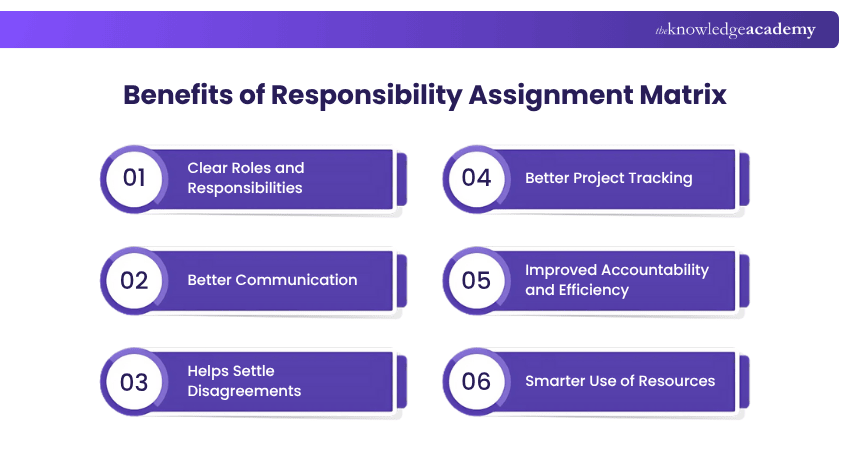
1) Clear Roles and Responsibilities: RAM shows exactly who is in charge of each task, reducing confusion and helping everyone understand what they need to do.
2) Better Communication: It acts as a handy reference, so team members know who to speak to about different tasks or issues.
3) Helps Settle Disagreements: If there’s a misunderstanding about a task, the RAM helps clear things up by showing who is responsible.
4) Better Project Tracking: Project Managers can use the RAM to follow task progress and check that everything is running smoothly.
5) Improved Accountability and Efficiency: When roles are clearly set, people are more likely to take ownership and complete tasks properly and on time.
6) Smarter Use of Resources: Knowing who is doing what helps Managers assign tasks fairly and make the best use of the team’s time and skills.
Developing Responsibility Assignment Matrix Best Practices
Creating a Responsibility Assignment Matrix (RAM) is an important part of Project Management. To make it work well, follow these best practices:
1) Involve Key People: Talk to team members, stakeholders, and experts when defining roles. Their input helps match responsibilities with the project’s goals.
2) Keep It Simple: Choose an easy-to-understand model like RACI, RASCI, or DACI so the team can follow it without confusion.
3) Use Clear Language: Write tasks and roles in simple, clear terms. Avoid vague or confusing wording.
4) Assign One Accountable Person: Every task should have just one person who is fully responsible for making sure it gets done. This avoids confusion and mixed responsibility.
5) Choose the Right People to Consult and Inform: Only include people who really need to be consulted or updated. This keeps the process focused and efficient.
6) Get Team Feedback: Share the RAM with the whole team and get their feedback. Make sure everyone agrees on their roles and understands what’s expected.
7) Note Assumptions or Clarifications: If something assumes or needs further explanation, write it down. This helps prevent confusion later.
Join our Project Management Certification today and take the leap towards becoming a Project Management expert!
What is the Golden Rule of RACI?
The golden rule of RACI is to ensure that every task or decision in a project has clear ownership and accountability. It defines four roles: Responsible, Accountable, Consulted, and Informed. The person who is Responsible does the work, and the person who is Accountable ensures it gets done. Those who are Consulted provide advice or input, while those Informed are kept updated on progress.
What are the Pitfalls of a RACI Matrix?
A RACI Matrix can sometimes create problems if it’s not used correctly. One issue is too much detail, where tasks are overcomplicated with too many roles, making it hard to follow. Another problem is role confusion, where people don’t fully understand who does what. It can also lead to blame games if something goes wrong. Lastly, if it’s not kept up to date, the matrix becomes useless as projects change over time.
Conclusion
A Responsibility Assignment Matrix helps teams stay organised, reduce confusion, and improve accountability across all project stages. By clearly defining roles and responsibilities, it supports better teamwork and smoother workflows. Understanding What is a Responsibility Assignment Matrix is key to successful Project Management and ensuring every task has the right person behind it.
Take the next step in your Project Management career with our CGPM (Certified Global Project Manager) Course – Join now!
Frequently Asked Questions
When is it Appropriate to Create a Responsibility Matrix?

Creating a Responsibility Matrix is appropriate for the project's initiation stage. It outlines roles, duties, and communication channels to promote responsibility throughout the project's lifecycle.
What is the Responsibility Assignment Matrix RACI Format?
The Responsibility Assignment Matrix or RACI model divides tasks as Responsible, Accountable, Consulted, or Informed. It promotes transparency and accountability among the project group.
What are the Other Resources and Offers Provided by The Knowledge Academy?
The Knowledge Academy takes global learning to new heights, offering over 3,000+ online courses across 490+ locations in 190+ countries. This expansive reach ensures accessibility and convenience for learners worldwide.
Alongside our diverse Online Course Catalogue, encompassing 17 major categories, we go the extra mile by providing a plethora of free educational Online Resources like Blogs, eBooks, Interview Questions and Videos. Tailoring learning experiences further, professionals can unlock greater value through a wide range of special discounts, seasonal deals, and Exclusive Offers.
What is The Knowledge Pass, and How Does it Work?
The Knowledge Academy’s Knowledge Pass, a prepaid voucher, adds another layer of flexibility, allowing course bookings over a 12-month period. Join us on a journey where education knows no bounds.
What are the Related Courses and Blogs Provided by The Knowledge Academy?
The Knowledge Academy offers various Project Management Courses, including Introduction to Project Management Certification, CDSPM (Certified Digital Services Project Manager) Course and Project Risk Management Course. These courses cater to different skill levels, providing comprehensive insights into Different Types of Project Managers.
Our Project Management Blogs cover a range of topics related to Project Management, offering valuable resources, best practices, and industry insights. Whether you are a beginner or looking to advance your Project Management skills, The Knowledge Academy's diverse courses and informative blogs have you covered.

Grace Mitchell


Senior Project Management Consultant and Author
Grace Mitchell is a highly experienced project management professional with over 15 years of expertise in leading large-scale projects across industries, including construction, IT, and finance. With qualifications in PRINCE2®, PMP®, AgilePM®, and MSP®, Grace specialises in delivering complex programmes with precision and clarity. Her writing is grounded in real-world application and focuses on helping learners build confidence in project delivery and stakeholder management.
View Detail
Upcoming Project Management Resources Batches & Dates
Date
 Introduction to Project Management Course
Introduction to Project Management Course
Fri 17th Jul 2026
Introduction to Project Management Course
Fri 14th Aug 2026
Introduction to Project Management Course
Fri 11th Sep 2026
Introduction to Project Management Course
Fri 16th Oct 2026
Introduction to Project Management Course
Fri 13th Nov 2026
Introduction to Project Management Course
Fri 18th Dec 2026

 If you wish to make any changes to your course, please


