
Data Science Courses

Online Instructor-led (1 days)

Online Self-paced (8 hours)

Keras Training for Data Scientists Course Outline

Module 1: Introduction to Keras

  • What is Keras?
  • Guiding Principles
  • Installation and Setup
  • Configuration

Module 2: Exploring Models

  • Keras Models
  • Sequential Model
  • Model (Functional API)

Module 3: Overview of Keras Layers

  • Core Layers
  • Convolutional Layers
  • Pooling Layers
  • Locally-Connected Layers
  • Recurrent Layers
  • Pre-Processing Layers
  • Merging Layers
  • Activations Layers
  • Normalisation Layers

Module 4: Pre-Processing

  • Dataset Pre-Processing
  • Dataset Pre-Processing Utilities
    • Image Data Pre-Processing
    • Time Series Data Pre-Processing
    • Text Data Pre-Processing

Module 5: Optimisers

  • SGD
  • RMSprop
  • Adam and AdamW
  • Adadelta
  • Adagrad
  • Adamax
  • Adafactor
  • Nadam
  • Ftrl

Show moredown

Who Should Attend this Keras Training for Data Scientists Course?

The Keras Training for Data Scientists is tailored for Data Scientists and professionals who want to gain proficiency in Deep Learning using the Keras framework. This Data Science Training is particularly beneficial for the following professionals:

  • Data Scientists
  • Machine Learning Engineers
  • Software Developers
  • Deep Learning Engineers
  • Medical Researchers
  • Bioinformaticians
  • Data Journalists

Prerequisites of the Keras Training for Data Scientists Course

There are no formal prerequisites for attending this Keras Training for Data Scientists Course. However, having some prior knowledge of Machine Learning concepts and Python programming can be beneficial.

Keras Training for Data Scientists Course Overview

Keras Training for Data Scientists introduces delegates to a powerful open-source framework for building neural networks. It explains how Keras supports rapid model development and integrates with Python-based deep learning environments, simplifying complex data science workflows.

This training supports professionals seeking to strengthen deep learning capability. It builds the ability to design, test, and refine neural network models efficiently, enabling delegates to meet the growing demand for intelligent, data-driven solutions across industries.

This 1-Day course offered by The Knowledge Academy enables delegates to apply Keras concepts with confidence. Through focused learning, delegates gain the skills to work with core and recurrent layers, preprocess data, and prepare text, images, and sequences for neural network applications.

Keras Training for Data Scientists Course Objectives

  • To grasp the fundamentals of Keras and its integration with Deep Learning frameworks
  • To explore various Keras layers for building neural networks
  • To learn the essentials of preprocessing data for sequence, text, and image applications
  • To gain proficiency in using regularisers and constraints to enhance model performance
  • To master the practical aspects of compiling models with loss and optimiser functions
  • To acquire the skills to architect neural networks efficiently for complex data science problems

Upon completing this course, delegates will possess a robust understanding of Keras, enabling them to efficiently experiment with and architect diverse neural network models. The acquired skills in preprocessing for sequences, text, and images will enhance their ability to tackle complex data science problems.

Show moredown

What’s Included in this Keras Training for Data Scientists Course?

  • World-Class Training Sessions from Experienced Instructors
  • Keras Training for Data Scientists Certificate
  • Digital Delegate Pack

Show moredown

Online Instructor-led (2 days)

Online Self-paced (16 hours)

Pandas for Data Analysis Training Course Outline

Module 1: Introduction and Installation

  • Define Pandas
  • Installing Pandas
  • Running Test Suite
  • Dependencies

Module 2: Getting Started with Pandas

  • Package Overview
  • Exploring Pandas
  • Essential Basic Functionality
  • Comparison with Other Tools

Module 3: User Guide

  • IO Tools
  • Indexing
  • Merge, Join, and Concatenate
  • Reshaping and Pivot Tables
  • Working with Text Data, Missing Data, and Categorical Data
  • Nullable Integer Data Type
  • Computational Tools
  • Group By: Split-Apply-Combine
  • Time Series and Time Deltas
  • Stylings
  • Options and Settings
  • Enhancing Performance
  • Sparse Data Structures

Module 4: Pandas Ecosystem

  • Statistics and Machine Learning
  • Visualisation
  • IDE
  • Extension Data Types

Module 5: Development Phase

  • Extending Pandas
  • Storing Pandas DataFrame Objects in Apache Parquet Format

Show moredown

Who Should Attend this Pandas for Data Analysis Training Course?

The Pandas for Data Analysis Course aims at equipping delegates with the knowledge and skills to manipulate, analyse, and visualise data using the Pandas library in Python. The following professionals can benefit greatly with this course:

  • Data Analysts
  • Data Scientists
  • Business Analysts
  • Researchers
  • Statisticians
  • Data Engineers
  • Machine Learning Engineers

Prerequisites of the Pandas for Data Analysis Training Course

There are no formal prerequisites to attend Pandas for Data Analysis Course. However, a basic knowledge of programming can be beneficial in this Data Analysis Training.

Pandas for Data Analysis Training Course Overview

Pandas for Data Analysis Training introduces delegates to a powerful Python library for data analysis and manipulation. It explains how structured tools enable efficient handling, cleaning, and transformation of datasets across analytical and business environments.

This training supports professionals working with data in Python. It builds the ability to manage diverse datasets, improve data quality, and extract meaningful insights, strengthening decision-making and analytical performance across industries.

This 2-Day course offered by The Knowledge Academy enables delegates to apply Pandas with confidence. Through focused learning, delegates gain the skills to work with varied data types and perform essential operations such as merging, reshaping, and transforming data effectively.

Pandas for Data Analysis Training Course Objectives

  • To master Pandas data structures and operations
  • To efficiently handle text, missing, and categorical data
  • To explore essential Pandas functions for merging, reshaping, and pivot tables
  • To acquire data visualisation skills and utilise integrated development environments
  • To understand data validation practices and work with extension data types
  • To gain proficiency in storing Pandas Data Frame objects in Apache Parquet format

Upon completing this Data Science Course, delegates will benefit from enhanced proficiency in data analysis using Pandas. They will be equipped with the skills to efficiently manipulate diverse datasets, perform essential Pandas operations, and utilise data visualisation techniques.

Show moredown

What’s Included in this Pandas for Data Analysis Training Course?

  • World-Class Training Sessions from Experienced Instructors
  • Pandas for Data Analysis Certificate
  • Digital Delegate Pack

Show moredown

Online Instructor-led (3 days)

Online Self-paced (24 hours)

Python Data Science Course Outline

Module 1: Introduction of Python

  • What is Python?
  • What can be Done by Using Python Programming Language?
  • Why Python?

Module 2: Working with IPython

  • Launching IPython Shell and Jupyter Notebook
  • Keyboard Shortcuts in the IPython Shell
  • Special Commands of Python
    • Pasting Code Blocks: %paste and %cpaste
    • Running External Code: %run
    • Timing Code Execution: %timeit
    • %magic and %Ismagic
  • IPython’s In and Out Objects
  • IPython and Shell Commands
  • Errors and Debugging
  • Profiling and Timing Code

Module 3: Introduction to NumPy

  • Understand Data Types in Python
  • NumPy Arrays
  • Universal Functions
  • Aggregations: Min, Max and more
  • Computation on Arrays: Broadcasting
  • Comparison, Boolean Logic, and Masks
  • Fancy Indexing
  • Sorting Arrays
  • NumPy’s Structured Array

Module 4: Working with Pandas

  • Installing and Using Pandas
  • Pandas Objects
  • Data Indexing and Selection
  • Operating on Data in Pandas
  • Handling Missing Data
  • Hierarchical Indexing
  • Concat and Append
  • Merge and Join
  • Aggregations and Grouping
  • Pivot Tables
  • Vectorised String Operations
  • Working with Time Series
  • eval() and query()

Module 5: Visualisation with Matplotlib

  • Overview of Matplotlibs
  • Object Oriented Interface
  • Two Interfaces
  • Simple Line Plots and Scatter Plots
  • Visualising Errors
  • Density and Contour Plots
  • Histograms, Binnings, and Density
  • Customising Plot Legends
  • Customising Colorbars
  • Multiple Subplots
  • Text Annotation
  • Three-Dimensional Plotting in Matplotlib
  • Visualisation with Seaborn

Show moredown

Who Should Attend this Python Data Science Course? 

This Python Data Science Course is ideal for professionals who want to apply Python to data analysis, modelling, and data driven decision making. It is particularly beneficial for:  

  • Software Developers
  • Data Analysts
  • Machine Learning Engineers
  • Product Managers
  • Business Analysts
  • Natural Language Processing Professionals
  • Data Scientists

Prerequisites of the Python Data Science Course

There are no formal prerequisites for attending this Python Data Science Training Course. However, a basic understanding of programming would be beneficial.

Python Data Science Course Overview 

Python Data Science Training focuses on using Python for data analysis, visualisation, and manipulation tasks. It covers core programming concepts and data-focused techniques required to work confidently with structured datasets. 

This Python Data Science Online Training helps delegates build practical data handling and analytical skills using Python libraries. Delegates improve readiness to analyse data, create visual insights, and support informed, data-driven decisions. 

This 3-Day course offered by The Knowledge Academy enables delegates to apply Python data science techniques in real scenarios. Delegates learn to work with arrays, perform data manipulation, and visualise results to solve practical data challenges. 

Python Data Science Course Objectives

  • To equip delegates with proficiency in Python
  • To establish a solid foundation in data manipulation using Python at the advanced level
  • To cultivate expertise in data visualisation techniques, including the creation of line plots, scatter plots, and the visualisation of three-dimensional functions
  • To instruct delegates in advanced data visualisation skills, such as crafting histograms, performing binning, estimating density, and customising plot legends and colorbars
  • To broaden programming versatility by imparting knowledge of multiple programming paradigms supported by Python

Upon completing this course, delegates will have the knowledge and skills required to personalise their Matplotlib visualisations as well.

Show moredown

What’s Included in this Python Data Science Course?

  • World-Class Training Sessions from Experienced Instructors
  • Python Data Science Certificate
  • Digital Delegate Pack

Show moredown

Online Instructor-led (2 days)

Online Self-paced (16 hours)

Probability and Statistics for Data Science​ Training Course Outline

Day 1: Probability and Random Variables

Module 1: Basic Probability Theory
  • Probability Spaces
  • Conditional Probability
  • Independence
Module 2: Random Variables
  • Random Variables Intro
  • Discrete Random Variables
  • Continuous Random Variables
  • Conditioning on Events
  • Functions of Random Variables
  • Generating Random Variables
Module 3: Multivariate Random Variables
  • Introduction
  • Discrete & Continuous Multivariate Variables
  • Joint Distributions
  • Independence
  • Functions of Several Variables
  • Generating Multivariate Variables & Rejection Sampling
Module 4: Expectation
  • Expectation Operator, Mean and Variance
  • Covariance, Conditional Expectation
Module 5: Random Processes
  • Intro, Mean, and Autocovariance Functions
  • IID
  • Gaussian Process
  • Poisson Process
  • Random Walk

Day 2: Statistics and Applications (8 hours total)

Module 6: Convergence of Random Processes
  • Types of Convergence
  • Law of Large Numbers
  • Central Limit Theorem
  • Monte Carlo Simulation
Module 7: Markov Chains
  • Markov Property and Basic Concepts
  • Recurrence
  • Periodicity
  • Convergence
  • Introduction to Markov-Chain Monte Carlo (MCMC)
Module 8: Descriptive Statistics
  • What are Descriptive Statistics?
  • Examples and Types of Descriptive Statistics
Module 9: Frequentist Statistics
  • Mean Square Error
  • Consistency
  • Confidence Intervals
  • Parametric vs Nonparametric Model Estimation
  • Maximum Likelihood Estimation (MLE)
Module 10: Bayesian Statistics
  • Bayesian Parametric Models
  • Conjugate Priors
  • Bayesian Estimators
Module 11: Hypothesis Testing
  • Hypothesis-Testing Framework
  • Parametric Testing
  • Nonparametric Testing: The Permutation Test
  • Multiple Testing Correction
Module 12: Linear Regression
  • Introduction to Linear Regression
  • Linear Models & Applications
  • Least-Squares Estimation

Show moredown

Who Should Attend this Probability and Statistics for Data Science Training?

This Probability and Statistics for Data Science Course is designed to provide foundational and practical knowledge in Probability and Statistics, which are crucial for Data Science, Machine Learning, and Data Analysis. The following are some professionals who will benefit from attending this course:

  • Data Scientists
  • Machine Learning Engineers
  • Data Analysts
  • Business Analysts
  • Product Managers
  • Quantitative Analysts
  • Statisticians

Prerequisites of the Probability and Statistics for Data Science Training

There are no formal prerequisites for this course.

Probability and Statistics for Data Science Training Course Overview

Probability and Statistics Training introduces delegates to the core concepts that underpin data-driven decision-making. It explains how uncertainty, variability, and data patterns are measured and interpreted, forming the foundation for meaningful analysis in Data Science.

This training supports professionals working with data in building analytical confidence. It develops the ability to quantify uncertainty, recognise trends, and draw accurate conclusions, enabling informed decisions across analytical and business-focused roles.

This 2-Day course offered by The Knowledge Academy enables delegates to apply probability and statistics with confidence. Through focused learning, delegates gain the skills to work with distributions, hypothesis testing, and regression, supporting practical, evidence-based decisions.

Probability and Statistics for Data Science Training Course Objectives

  • To represent and analyse uncertain phenomena using a framework
  • To quantify the outcome of the experiment as belonging to a specific event
  • To assign probabilities to each occurrence of interest and an experiment
  • To become accustomed to Markov chains and different statistical types
  • To generate samples from the appropriate conditional distribution
  • To evaluate the occurrence of a particular event that influences another event

Upon completion of this Data Science Training, delegates will possess a strong foundation in Probability and Statistics for Data Science. They will be equipped with the tools and techniques needed to analyse data effectively, make informed decisions, and contribute meaningfully to data-driven projects within their organisations.

Show moredown

What’s Included in this Probability and Statistics for Data Science Training?

  • World-Class Training Sessions from Experienced Instructors
  • Probability and Statistics for Data Science Certificate
  • Digital Delegate Pack

Show moredown

Online Instructor-led (2 days)

Online Self-paced (16 hours)

Text Mining Training​ Course Outline

Module 1: Introduction to Text Mining

  • What is Text Mining?
  • Text Mining Systems Architecture

Module 2: Core Text Mining Operations

  • What are Core Text Mining Operations?
  • Text Mining Query Languages

Module 3: Text Mining Pre-Processing Techniques

  • Task-Oriented Approaches

Module 4: Categorisation

  • Text Categorisation Applications
  • Document Representation
  • Knowledge Engineering to TC
  • Using Unlabelled Data
  • Evaluating Text Classifiers

Module 5: Introduction to Clustering

  • Partitioning of Networks
  • Clustering Tasks in Text Analysis
  • Clustering Algorithms
  • Clustering of Textual Data

Module 6: Information Extraction (IE)

  • Define Information Extraction
  • IE Systems Architecture
  • Anaphora Resolution
  • IE Inductive Algorithms
  • Structural Information Extraction (IE)

Module 7: Probabilistic Models for IE

  • Hidden Markov Models
  • Stochastic Context-Free Grammar
  • Maximal Entropy Modelling
  • Conditional Random Fields

Module 8: Pre-Processing Applications

  • HMM to Textual Analysis Applications
  • Using MEMM for IE
  • Applications of CRFs to Textual Analysis MEMM for IE
  • Using SCFG Rules
  • Bootstrapping

Module 9: Presentation-Layer Considerations

  • Browsing
  • Accessing Constraints and Simple Specification Filters at the Presentation Layer
  • Accessing the Underlying Query Language

Module 10: Visualisation Approaches

  • Architectural Considerations
  • Text Mining Visualisation Approaches
  • Visualisation Techniques in Link Analysis

Module 11: Introduction to Link Analysis

  • Automatic Layout of Networks
  • Paths and Cycles in Graphs
  • Centrality
  • Partitioning of Networks
  • Networks Pattern Matching

Show moredown

Who Should Attend this Text Mining Training Course?

This Text Mining Training Course is suitable for a wide range of professionals and individuals who want to gain expertise extracting information, sentiment, or patterns from unstructured text-based data. The following professionals can benefit from this training:

  • Data Scientists
  • Software Engineers
  • Data Analysts
  • Digital Marketers
  • Product Managers
  • Business Intelligence Analysts
  • NLP Engineers

Prerequisites of the Text Mining Training Course

There are no formal prerequisites for attending this Text Mining Course.

Text Mining Training Course Overview

Text Mining Training introduces delegates to the principles of analysing large volumes of text to uncover patterns, trends, and insights. It explains how structured techniques transform unorganised content from documents, reports, and digital platforms into meaningful information.

This training supports professionals working with data and content in building analytical capability. It develops the ability to extract value from textual sources, strengthening decision-making and providing a competitive advantage in data-driven environments.

This 2-Day course offered by The Knowledge Academy enables delegates to apply text mining concepts with confidence. Through focused learning and practical activities, delegates gain the skills to preprocess data, categorise text, evaluate classifiers, and refine analytical outcomes effectively.

Text Mining Training Course Objectives

  • To grasp the fundamentals of text mining and preprocessing techniques
  • To utilise key algorithms for efficient text categorisation
  • To evaluate and enhance text classifiers using unlabelled data
  • To gain expertise in clustering and Information Extraction (IE)
  • To explore techniques for constraint handling and specification filtering
  • To master the application of hidden Markov models and maximal entropy Markov models for Information Extraction

Upon completing the Data Science Online Training, delegates will possess a comprehensive skill set in text mining, enabling them to efficiently extract valuable insights from textual data, automate processes, and enhance decision-making in their respective professional domains.

Show moredown

What’s Included in this Text Mining Training?

  • World-Class Training Sessions from Experienced Instructors 
  • Text Mining Certificate 
  • Digital Delegate Pack

Show moredown

Online Instructor-led (2 days)

Online Self-paced (16 hours)

Predictive Analytics Course Outline

Module 1: Introduction to Predictive Analytics

  • What is Predictive Analytics?
  • How Does Predictive Analytics Works?
  • Business Intelligence
  • Business Intelligence Lifecycle
  • Predictive Analytics Vs Business Intelligence
  • Predictive Analytics Challenges

Module 2: Setting Up the Problem

  • Predictive Analytics Processing Steps
  • Target Variable
  • Success Measures for Predictive Models
  • Data for Predictive Modelling

Module 3: Understanding the Data

  • Single and Multiple Variables
  • Data Visualisation
  • Histograms

Module 4: Data Preparation

  • Data Cleaning
  • Feature Creation

Module 5: Itemsets and Association Rules

  • Association Rules
  • Parameter Settings
  • Data Organisation Techniques
  • Deploying Association Rules
  • Making Classification Rules from Association Rules

Module 6: Descriptive Modelling

  • Introduction to Descriptive Modelling
  • Principal Component Analysis
  • Clustering Algorithms

Module 7: Interpreting Descriptive Models

  • Introduction to Descriptive Analytics
  • How Does Descriptive Analytics Work?
  • Advantages of Descriptive Analytics

Module 8: Predictive Modelling

  • Introduction to Predictive Modelling
  • Decision Tree
  • Types of Decision Trees
  • Logistic Regression
  • Neural Networks
  • K-Nearest Neighbour
  • Naïve Bayes
  • Linear Regression

Module 9: Predictive Models Assessment

  • Introduction to Predictive Models Assessment
  • Metrics to Evaluate Predictive Models

Module 10: Model Ensembles

  • Ensemble Modelling
  • Types of Model Ensembles
  • Bias Variance Trade-Off
  • Bagging and Boosting
  • Interpreting Model Ensembles

Module 11: Text Mining

  • Introduction to Text Mining
  • Structured Vs Unstructured Data
  • Text Mining Applications
  • Steps of Data Preparation
  • Regular Expressions

Module 12: Predictive Model Deployment

  • Introduction to Predictive Model Deployment
  • Building Predictive Models

Show moredown

Who Should Attend this Predictive Analytics Course?

This Predictive Analytics Training Course aims to provide professionals with the core concepts, techniques, and tools used to predict future events based on historical data and delves into the various stages of the analytics life cycle. This training can help various professionals, including:

  • Data Scientists
  • Business Analysts
  • Marketing Analysts
  • Financial Analysts
  • Business Intelligence Professionals
  • Risk Managers
  • CRM Professionals

Prerequisites of the Predictive Analytics Course

There are no formal prerequisites required for attending this Predictive Analytics Training Course.

Predictive Analytics Course Overview

Predictive Analytics Training introduces delegates to techniques used to analyse historical and transactional data to forecast future outcomes. It covers core methods such as data modelling, statistical analysis, and pattern identification to support informed decision-making.

This certification enhances delegates’ analytical capabilities by building practical skills in identifying trends, risks, and opportunities. It improves readiness to support data-driven strategies, optimise operations, and strengthen organisational planning and resilience.

This 2-Day Predictive Analytics Course offered by The Knowledge Academy enables delegates to apply predictive analytics techniques confidently in real-world scenarios. Delegates learn data cleaning, feature creation, and predictive modelling methods to uncover actionable insights across industries.

Predictive Analytics Course Objectives

  • To master the predictive analytics process, including data cleaning and feature creation
  • To gain proficiency in uncovering valuable patterns and associations using itemsets and association rules
  • To explore various predictive modelling techniques, such as logistic regression and Naïve Bayes
  • To develop the skills to apply predictive models effectively in real-world scenarios
  • To enhance decision-making by leveraging data-driven predictions and insights
  • To empower organisations to become forward-looking and proactive using predictive analytics

Upon completing this Predictive Analytics Course, delegates will gain the skills to develop and apply predictive models effectively. They will be able to make data driven predictions, optimise decision making processes, and support new opportunities for organisational growth.

Show moredown

What’s Included in this Predictive Analytics Course?

  • World-Class Training Sessions from Experienced Instructors
  • Predictive Analytics Certificate
  • Digital Delegate Pack

Show moredown

Online Instructor-led (1 days)

Online Self-paced (8 hours)

Introduction to Knime Analytics Platform Training Course Outline

Module 1: Installing KNIME Analytics Platform

  • Extensions and Integrations Installation
  • Update Sites

Module 2: Introduction to KNIME Analytics Platform

  • Building Workflows

Module 3: KNIME Workbench

  • Overview of KNIME Workbench
  • Customising KNIME Workbench
  • Configure KNIME Analytics Platform
  • KNIME Tables

Module 4: KNIME Flow Control

  • Introduction
  • Flow Variables

Module 5: KNIME Extensions and Integrations

  • Introduction to KNIME Extensions and Integrations
  • Community Extensions

Module 6: CSS Styling for JavaScript Views and QuickForm Nodes

  • Setup
  • Description of CSS Classes

Module 7: Data Preprocessing in KNIME

  • Introduction to Data Preprocessing
  • Types of Data Cleaning Methods
  • Data Transformation Techniques
  • Feature Selection and Reduction Methods
  • Handling Missing and Duplicate Data

Show moredown

Who Should Attend this Introduction to KNIME Analytics Platform Training Course?

The Introduction to KNIME Analytics Platform Course is designed to provide an in-depth understanding of the KNIME platform, a leading open-source data analytics, reporting, and integration tool. This course can be beneficial for various professionals, including:

  • Data Scientists
  • Data Analysts
  • Data Engineers
  • Data Visualisation Experts
  • Machine Learning Engineers
  • Database Administrators
  • Marketing Analysts

Prerequisites of the Introduction to KNIME Analytics Platform Training Course

There are no formal prerequisites required for attending this Introduction to KNIME Analytics Platform Training Course.

Introduction to KNIME Analytics Platform Course Overview

KNIME Analytics Platform Training introduces delegates to an open-source environment for building data science workflows and applications. It explains how visual tools transform complex data into structured, reusable processes for effective analysis and insight generation.

This training supports professionals working with data across industries. It builds the ability to create visual workflows, analyse datasets without coding, and extract value from growing data volumes, strengthening capability in modern data-driven roles.

This 1-Day course offered by The Knowledge Academy enables delegates to apply KNIME with confidence. Through focused learning, delegates gain the skills to install and navigate the platform, manage tables, and build practical data workflows effectively.

KNIME Analytics Platform Course Objectives

  • To empower individuals with the skills to create data science applications using the KNIME Analytics Platform
  • To enable understanding of data intricacies and the design of code-free, drag-and-drop visual workflows
  • To cater to a broad spectrum of professionals, including data scientists, analysts, and business intelligence professionals
  • To provide practical knowledge on installing, updating, and navigating the KNIME Analytics Platform
  • To equip delegates with the ability to handle KNIME tables for data manipulation and analysis

Upon completing course, delegates will possess the proficiency to create data science applications effortlessly using the KNIME Analytics Platform. They will be equipped with the skills to navigate, manipulate, and analyse data efficiently, fostering the ability to automate data processes.

Show moredown

What’s Included in this Introduction to Knime Analytics Platform Training?

  • World-Class Training Sessions from Experienced Instructors
  • Introduction to Knime Analytics Platform Certificate
  • Digital Delegate Pack

Show moredown

Online Instructor-led (2 days)

Online Self-paced (16 hours)

Data Mining Training​ Course Outline

Day 1: Foundations and Data Preparation

Module 1: Introduction to Data Mining
  • What is Data Mining?
  • Importance and Applications of Data Mining
  • Types of Data (Structured, Semi-structured, Unstructured)
  • Data Objects and Attribute Types (Nominal, Ordinal, Numeric)
  • Measuring Data Similarity and Dissimilarity
  • Introduction to Data Visualisation Techniques
Module 2: Data Preprocessing Essentials
  • Overview of Data Preprocessing
  • Data Integration and Aggregation Techniques
  • Data Cleaning Strategies (Missing Values, Noisy Data)
  • Data Reduction Techniques (Sampling, PCA, Feature Selection)
  • Data Transformation (Normalisation, Scaling, Encoding Categorical Data)
  • Data Discretisation Methods (Binning, Histogram Analysis)
Module 3: Data Warehousing and Online Analytical Processing (OLAP)
  • Basic Concepts of Data Warehousing
  • Introduction to Data Cubes and OLAP Operations
  • Multidimensional Data Models (Star Schema, Snowflake Schema)
  • Data Warehouse Design and Architecture
  • Implementing and Managing Data Warehouses
  • Practical Uses and Applications of Data Warehousing and OLAP
Module 4: Mining Frequent Patterns and Associations
  • Concept of Frequent Pattern Mining
  • Frequent Itemset Mining Algorithms (Apriori Algorithm, FP-Growth)
  • Association Rule Generation and Interpretation
  • Evaluation of Patterns (Support, Confidence, Lift, Conviction)
  • Real-world Application Scenarios and Examples (Market Basket Analysis)

Day 2: Advanced Analytics & Real-world Applications

Module 5: Classification Techniques and Algorithms
  • Introduction and Purpose of Classification
  • Decision Tree Induction (CART, ID3, C4.5)
  • Bayesian Classification (Naïve Bayes Classifier)
  • Rule-Based Classification Methods
  • Evaluation Metrics: Confusion Matrix, Accuracy, Precision, Recall, F1-Score
  • Practical examples using real-world datasets
Module 6: Advanced Classification Methods
  • Introduction to Neural Networks and Backpropagation (brief overview)
  • Frequent Pattern-based Classification Concepts
  • Lazy Learners (k-Nearest Neighbours - kNN)
  • Overview: Genetic Algorithms, Rough Set Approach, Fuzzy Logic (brief, conceptual coverage)
  • Strengths and Weaknesses of Advanced Classification Techniques
Module 7: Cluster Analysis Methods
  • Understanding Cluster Analysis and Applications
  • Partitioning Methods (k-Means and k-Medoids Clustering)
  • Hierarchical Clustering (Agglomerative, Divisive)
  • Density-based Clustering Methods (DBSCAN)
  • Grid-based Clustering Methods (Conceptual overview)
  • Evaluating and Visualising Cluster Results
Module 8: Outlier Detection & Advanced Clustering Techniques
  • Understanding Outliers and Importance of Detection
  • Statistical Approaches to Outlier Detection
  • Proximity-based Outlier Detection (Distance-based, Density-based)
  • Clustering-based and Classification-based Outlier Detection
  • Overview of Advanced Clustering: Probabilistic Model-Based Clustering (Gaussian Mixtures)
  • High-dimensional Data Clustering and Challenges (brief overview)

Show moredown

Who Should Attend this Data Mining Training?

The Data Mining Course is tailored to impart knowledge on the process of extracting patterns, correlations, and information from large amounts of data stored in databases, data warehouses, or other information repositories. This course can be beneficial for various professionals aiming to derive insights from data, including:

  • Data Scientists
  • Business Analysts
  • Database Administrators
  • Marketing Analysts
  • Researchers
  • Statisticians
  • Machine Learning Engineers

Prerequisites of the Data Mining Training

There are no formal prerequisites required for attending this Data Mining Course. Although, a prior understanding of IT concepts can be helpful.

Data Mining Training Course Overview

Data Mining Training introduces delegates to identifying patterns and extracting valuable insights from large datasets using statistical and analytical techniques. It covers core concepts such as data preprocessing, visualisation, and data warehousing fundamentals.

This training strengthens delegates’ analytical capabilities by building practical skills in data transformation, pattern discovery, and interpretation. It enhances readiness to support data-driven decision making, fraud detection, and business and research analysis.

This 2-Day Data Mining Course offered by The Knowledge Academy enables delegates to apply data mining techniques confidently in real-world scenarios. Delegates gain a hands-on understanding of pattern mining, classification, clustering, and outlier detection to support informed analytical outcomes.

Data Mining Course Objectives

  • To comprehend Data Mining concepts and its practical applications
  • To acquire data preprocessing skills for effective analysis
  • To grasp data transformation and discretisation techniques
  • To understand data warehousing and Online Analytical Processing (OLAP)
  • To become proficient in frequent pattern mining and associations
  • To develop expertise in advanced pattern mining, classification, clustering, and outlier detection

Upon completing this Data Mining Training Course, delegates will gain advanced skills in extracting valuable insights from large datasets, enhancing their ability to make informed business decisions. Additionally, the course equips them with practical knowledge of cutting-edge data mining techniques.

Show moredown

What’s Included in this Data Mining Training?

  • World-Class Training Sessions from Experienced Instructors
  • Data Mining Certificate
  • Digital Delegate Pack

Show moredown

Online Instructor-led (1 days)

Online Self-paced (8 hours)

GIS Development Training Course Outline

Module 1: Introduction to Geographic Information Systems (GIS)

  • What is GIS?
  • GIS Terminologies
  • Overview of ArcGIS Pro
  • Data Representations in ArcGIS Pro
  • Desktop GIS Software Packages
  • GIS Analyst Skills
  • Installing ArcGIS Desktop

Module 2: Basics of ArcGIS

  • Explore Data Using ArcGIS Pro
  • View and Change Layer Properties
  • Feature Classes and Attribute Tables
  • Select by Attribute and Calculate Geometry
  • Select by Location
  • Define Projections
  • Analyse Data with Geoprocessing Tools
  • Geoprocessing Environment Setting
  • Assess Spatial Relationships with Spatial Join Tool

Module 3: Making Maps with Common Datasets

  • Core Map Elements
  • Symbology: Changing How Data Looks
  • Setting Symbology in ArcGIS
  • Labelling Map Features
  • Making Map Books

Module 4: Retrieving and Sharing Data

  • Using Metadata to Document Data Products
  • Sharing Data and Maps
  • Joins and Relates

Show moredown

Who Should Attend this GIS Development Training?

The GIS Development Course offers professionals the knowledge of the concepts, tools, and techniques necessary for developing Geographic Information Systems (GISs). This course can be beneficial for various professionals, including:

  • GIS Developers
  • GIS Analysts
  • Geospatial Engineers
  • Remote Sensing Specialists
  • Infrastructure Planners
  • Natural Resource Managers
  • Landscape Architects

Prerequisites of the GIS Development Training

There are no formal prerequisites required for attending this GIS Development Course.

GIS Development Training Course Overview

GIS Development Training introduces delegates to the principles of collecting, managing, analysing, and visualising spatial data. It explains how Geographic Information Systems transform location-based information into meaningful maps and insights for informed decision-making.

This training supports professionals working with location data across diverse fields. It builds the ability to analyse spatial information, optimise resources, and visualise complex data, enabling clearer planning and more accurate decisions.

This 1-Day course offered by The Knowledge Academy enables delegates to apply GIS concepts with confidence. Through focused learning, delegates gain the skills to understand spatial analysis, use ArcGIS, and work effectively with modern Geographic Information Systems.

GIS Development Training Course Objectives

  • To provide a comprehensive understanding of Geographic Information Systems (GIS) fundamentals
  • To explore the realm of spatial analysis and cartography within the GIS domain
  • To familiarise delegates with ArcGIS, the leading software tool for GIS
  • To demonstrate the evolution of GIS from traditional paper maps to electronic software packages
  • To equip delegates with the knowledge to analyse data using geoprocessing tools
  • To guide delegates in creating and using map packages, uploading them to ArcGIS online, and creating layer files and packages

Upon completion of this Data Science Training, delegates will possess a solid understanding of GIS fundamentals and proficiency in using ArcGIS, the industry-leading software. They will be able to analyse spatial data, create insightful maps, and leverage GIS capabilities for informed decision-making.

Show moredown

What’s Included in this GIS Development Training Course?

  • World-Class Training Sessions from Experienced Instructors
  • GIS Development Certificate
  • Digital Delegate Pack

Show moredown

Online Instructor-led (1 days)

Online Self-paced (8 hours)

Decision Tree Modeling Using R Training​ Course Outline

Module 1: Introduction to Decision Tree

  • Decision Tree Modelling Objective
  • Anatomy of a Decision Tree
  • Important Terminology Related to Decision Trees

Module 2: Overview of R Programming

  • R Programming Language
  • Data Types
  • Control Structures in R

Module 3: Data Treatment Before Modelling

  • Data Sanity Check-Contents
  • View
  • Frequency Distribution
  • Uni-Variate
  • Categorical Variable Treatment

Module 4: Classification of Tree Development and Algorithm Details

  • Installing R Package and R studio
  • Developing First Decision Tree in R Studio
  • Find Strength of the Model

Module 5: Decision Tree Analysis in Project Management

  • Use Decision Tree in Project Management
  • Tools for Decision Tree Analysis
  • Decision Tree Analysis Strategy

Module 6: Regression Tree and Auto Pruning

  • Introduction to Pruning
  • Understand K Fold Validation for Model 
  • Develop Regression Tree 
  • How is it Different from Linear Regression? 
  • Advantages and Disadvantages over Linear Regression

Module 7: CHAID Algorithm

  • What is CHAID/CART Algorithm?
  • Chi-Square Statistics 
  • Implement Chi-Square for Decision Tree Development 
  • CHAID Vs CART

Module 8: Other Algorithms

  • ID3
  • Random Forest Method
  • Using R for Random Forest Method

Show moredown

Who Should Attend this Decision Tree Modelling Using R Training?

The Decision Tree Modelling Using R Training Course offers a detailed exploration of Decision Tree models, one of the most widely used algorithms in Machine Learning and Data Science. This course can be beneficial for various professionals, including:

  • Data Scientists
  • Machine Learning Engineers
  • Data Analysts
  • Research Scientists
  • Quantitative Researchers
  • Risk Assessment Managers
  • Predictive Modelers

Prerequisites of the Decision Tree Modelling Using R Training Course

There are no formal prerequisites for attending this Decision Tree Modelling Using R Training Course. However, having some knowledge of the R programming language will be helpful.

Decision Tree Modelling Using R Training Course Overview

Decision Tree Modelling Using R Training introduces delegates to a powerful analytical method for data-driven decision-making. It explains how decision trees support pattern recognition, prediction, and optimisation across industries such as finance, automotive, and telecommunications.

This training supports professionals seeking to strengthen data science capability. It builds the ability to analyse complex datasets, identify meaningful patterns, and derive actionable insights, enabling confident, evidence-based decisions in data-driven environments.

This 1-Day course offered by The Knowledge Academy enables delegates to apply Decision Tree Modelling using R with confidence. Through focused learning, delegates gain the skills to design models, understand algorithms, validate outcomes, and apply best practices in real-world scenarios.

Decision Tree Modelling Using R Training Course Objectives

  • To understand the fundamentals of Decision Tree Modelling
  • To learn data treatment and frequency distribution techniques
  • To explore Decision Tree algorithm development and pruning
  • To gain expertise in advanced topics like Random Forest and CHAID Algorithm
  • To acquire practical skills in using R for Decision Tree Modelling
  • To become proficient in applying Decision Tree Modelling to real-world scenarios

By the end of this course, delegates will emerge with expertise in Decision Tree Modelling using R, empowering them to leverage this powerful tool for data analysis and informed decision-making.

Show moredown

What’s included in this Decision Tree Modelling Using R Training?

  • World-Class Training Sessions from Experienced Instructors
  • Decision Tree Modelling Using R Certificate
  • Digital Delegate Pack

Show moredown

Online Instructor-led (1 days)

Online Self-paced (8 hours)

PySpark Training​ Course Outline

Module 1: Introduction to PySpark

  • What is PySpark?
  • Environment
  • Spark Dataframes
  • Reading Data
  • Writing Data
  • MLlib

Module 2: Installation

  • Using PyPI
  • Using PySpark Native Features
  • Using Virtualenv
  • Using PEX
  • Dependencies

Module 3: DataFrame

  • DataFrame Creation
  • Viewing Data
  • Applying a Function
  • Grouping Data
  • Selecting and Accessing Data
  • Working with SQL
  • Get () Method

Module 4: Setting Up a Spark Virtual Environment

  • Understanding the Architecture of Data-Intensive Applications
  • Installing Anaconda
  • Setting a Spark Powered Environment
  • Building App with PySpark

Module 5: Building Batch and Streaming Apps with Spark

  • Architecting Data-Intensive Apps
  • Build a Reliable and Scalable Streaming App
  • Process Live Data with TCP Sockets
  • Analysing the CSV Data
  • Exploring the GitHub World
  • Previewing App

Module 6: Learning from Data Using Spark

  • Classifying Spark MLlib Algorithms
  • Spark MLlib Data Types
  • Clustering the Twitter Dataset
  • Build Machine Learning Pipelines

Show moredown

Who Should Attend this PySpark Course?

This PySpark Training Course covers the fundamentals of Spark, its architecture, and how to use the PySpark API for Data Processing, Analytics, and Machine Learning tasks. This course can be beneficial for various professionals, including:

  • Data Engineers
  • Big Data Analysts
  • Data Scientists
  • Machine Learning Engineers
  • Software Developers
  • Python Developers
  • Solution Architects
  • System Administrators
  • Database Administrators

Prerequisites of the PySpark Course

There are no formal prerequisites required for attending this PySpark Training Course.

PySpark Training Course Overview

PySpark Training introduces delegates to a powerful framework for large-scale data processing and analytics. It explains how PySpark, as a Python API for Apache Spark, enables efficient handling of big data and supports modern data science workflows.

This training supports professionals working with large datasets in building advanced analytical capability. It develops the ability to process data at scale, apply machine learning techniques, and derive insights, strengthening effectiveness in data-driven environments.

This 1-Day course offered by The Knowledge Academy enables delegates to apply PySpark concepts with confidence. Through focused learning and practical activities, delegates gain the skills to work with big data, perform analytics, and process large datasets efficiently.

PySpark Training Course Objectives

  • To provide a comprehensive understanding of PySpark fundamentals
  • To cover advanced topics such as Big Data analytics using PySpark
  • To offer hands-on experience in applying PySpark for data processing and analytics
  • To equip professionals with the skills to efficiently handle large-scale data processing tasks
  • To empower delegates to leverage PySpark for Machine Learning applications

Upon completion of this course, the delegates will possess the skills to effectively utilise PySpark for Big Data processing and analytics. They will have hands-on experience in applying PySpark for Machine Learning applications, enhancing their proficiency in handling large-scale data tasks.

Show moredown

What’s Included in this PySpark Training Course?

  • World-Class Training Sessions from Experienced Instructors
  • PySpark Certificate
  • Digital Delegate Pack

Show moredown

Online Instructor-led (4 days)

Online Self-paced (32 hours)

Advanced Data Science Certification​ Course Outline

Module 1: Python for Data Analysis - NumPy

  • Introduction to NumPy
  • NumPy Arrays
  • Aggregations
  • Computation on Arrays: Broadcasting
  • Comparison, Boolean Logic and Masks
  • Fancy Indexing
  • Sorting Arrays
  • NumPy’s Structured Arrays

Module 2: Python for Data Analysis – Pandas

  • Installing Pandas
  • Pandas Objects
  • Data Indexing and Selection
  • Operating on Data in Pandas
  • Handling Missing Data
  • Hierarchical Indexing
  • Concat and Append
  • Merge and Join
  • Aggregations and Grouping
  • Pivot Tables
  • Vectorised String Operations
  • Working with Time Series
  • Eval() and Query()

Module 3: Python for Data Visualisation – Matplotlib

  • Overview
  • Object-Oriented Interface
  • Two interfaces
  • Simple Line Plots and Scatter Plots
  • Visualising Errors
  • Contour Plots
  • Histograms, Binnings and Density
  • Customising Plot Legends
  • Customising Colour Bars
  • Multiple Subplots
  • Text Annotation
  • Three-Dimensional Plotting

Module 4: Python for Data Visualisation – Seaborn

  • Installing Seaborn and Load Dataset
  • Plot the Distribution
  • Regression Analysis
  • Basic Aesthetic Themes and Styles
  • Distinguish between Scatter Plots, Hexbin Plots and KDE Plots
  • Use Boxplots and Violin Plots
  • Compare the Use Cases of Swarn Plots, Bar Plots Strip Plots, and Categorical Plots
  • Recall Some of the Use Cases and Features of Seaborn

Module 5: Machine Learning

  • Introduction
  • Importance
  • Types
  • How Does Machine Learning Works?
  • Machine Learning Mathematics

Module 6: Natural Language Processing

  • Introduction to NLP
  • NLP and Writing Systems
  • Advantages
  • NLP Applications

Module 7: Deep Learning

  • Introduction
  • Importance
  • Working

Module 8: Big Data

  • Big Data Analytics
  • State of Practice in Analytics
  • Main Roles for New Big Data Ecosystem
  • Phases of Data Analytics Lifecycle

Module 9: Working with Data in R

  • Data Manipulation in R
  • Data Clean Up
  • Reading and Exporting Data
  • Importing Data
  • Charts and Graphs

Module 10: Regression in R

  • Regression Analysis
  • Linear Regression
  • Logistic Regression
  • Multiple Regression
  • Normal Distribution
  • Binomial Distribution

Module 11: Modelling Data

  • What are the Relationships?
  • Viewing Relationships
  • Creating Relationships
  • Cardinality
  • Cross Filter Direction
  • What is DAX?
  • Syntax
  • Functions
  • Row Context
  • Calculated Columns
  • Calculated Tables
  • Measures

Module 12: Shaping and Combining Data using Power BI

  • Query Editor
  • Shaping Data and Applied Steps
  • Advanced Editor
  • Formatting Data
  • Transforming Data
  • Combining Data

Module 13: Interactive Data Visualisations

  • Page Layout and Formatting
  • Multiple Visualisation
  • Creating Charts
  • Using Geographic Data
  • Histograms
  • Power BI Admin Portal
  • Service Settings
  • Desktop Settings
  • Dashboard and Report Settings

Show moredown

Who Should Attend this Advanced Data Science Certification Course?

This Advanced Data Science Certification Course is tailored for individuals seeking to enhance their expertise in the field of data science. This training is particularly beneficial for professionals such as:

  • Experienced Data Analysts
  • Data Scientists
  • Machine Learning Engineers
  • Statisticians
  • Business Analysts
  • AI Developers
  • Entrepreneurs
  • Researchers

Prerequisites of the Advanced Data Science Certification Course

There are no formal prerequisites for the Advanced Data Science Certification Course. However, having prior knowledge of multiple programming languages will be beneficial for the delegates.

Advanced Data Science Certification Course Overview

Advanced Data Science Training introduces delegates to key concepts that underpin modern data-driven practice. It explains how techniques such as numerical computing, regression, and machine learning mathematics enable deeper analysis and informed decision-making across complex datasets.

This Advanced Data Science Training supports professionals seeking to strengthen advanced analytical capability. It builds the ability to identify patterns, interpret data accurately, and drive innovation, enabling confident contribution in data-focused and strategic roles across industries.

This 4-Day course offered by The Knowledge Academy enables delegates to apply advanced data science concepts with confidence. Delegates gain the skills to work with time series, visualise data, manage analytics lifecycles, and operate at an expert level.

Advanced Data Science Certification Course Objectives

  • To provide a comprehensive understanding of basic and advanced data science concepts
  • To equip delegates with practical skills in tools such as Pandas and Power BI
  • To cover critical topics like NumPy arrays, regression analysis, and Machine Learning mathematics
  • To empower Business Analysts, Data Engineers, Software Developers, and executives with data science proficiency
  • To enable delegates to unravel complex patterns and make informed decisions through data-driven insights
  • To ensure delegates emerge as adept Data Scientists capable of tackling real-world data challenges

Upon completion of this Data Science Certification training, delegates will not only possess a solid foundation in data science but also practical skills in tools like Pandas and Power BI. This empowers them to analyse data effectively, make informed decisions, and contribute meaningfully to their organisations' success.

Show moredown

What’s Included in this Advanced Data Science Certification Course?

  • World-Class Training Sessions from Experienced Instructors
  • Advanced Data Science Certificate
  • Digital Delegate Pack

Show moredown

Online Instructor-led (2 days)

Online Self-paced (16 hours)

Data Science with R Training Course Outline

Module 1: Introduction to R

  • What is R? 
  • Variables 
  • Data Types 
  • Operators 
  • Conditional Statements 
  • Looping Statements 
  • Functions 

Module 2: Data Structures in R

  • What are Data Structures?
  • Vectors
  • Lists
  • Matrix

Module 3: Working with Data in R

  • Types of Files in R
  • Working with CSV

Module 4: Data Manipulation in R

  • What is Data Manipulation?
  • Installation of Dplyr Package
  • Data Manipulation Operations in R

Module 5: Data Visualisations in R

  • What is Data Visualisation?
  • Working with Graphs and Plots in R

Module 6: Statistics in R

  • Introduction to Statistics in R
  • Introduction to Descriptive Statistics
  • Distributions in R

Module 7: Machine Learning

  • Introduction to Machine Learning in R
  • Types of Machine Learning in R
  • Introduction to Supervised Learning in R
  • Introduction to Unsupervised Learning in R


Show moredown

Who Should Attend this Data Science with R Training?

The Data Science with R Training Course is designed for professionals, analysts, and individuals who are interested in acquiring skills and knowledge in data analysis, visualisation, and modelling using the R programming language. This course is beneficial for various professionals, including:

  • Data Analysts
  • Data Scientists
  • Statisticians
  • Business Analysts
  • Quantitative Finance Professionals
  • Epidemiologists and Public Health Experts
  • Data Engineers
  • Geographic Information System (GIS) Analysts

Prerequisites of the Data Science with R Training

There are no formal prerequisites for attending this Data Science with R Training.

Data Science with R Training Overview

Data Science with R Training introduces delegates to using the R programming language for analysing, modelling, and visualising data. It explains how R transforms raw datasets into meaningful insights, supporting informed decision-making across data-driven environments. 

This training supports professionals seeking to strengthen analytical capability with R. It builds the ability to preprocess data, perform statistical analysis, and develop predictive models, enabling delegates to extract value from complex datasets across industries. 

This 2-Day course offered by The Knowledge Academy enables delegates to apply Data Science with R confidently. Through focused learning, delegates gain the skills to work with data structures, manipulate datasets, and enhance analytical outcomes using R. 

Data Science with R Training Course Objectives

  • To provide a comprehensive understanding of the R programming language in the context of Data Science
  • To equip delegates with the skills to preprocess data, construct predictive models, and perform statistical analyses using R
  • To empower individuals to effortlessly conduct complex computations and statistical analyses using R tools
  • To deliver expertise in working with essential tools like data frames, matrices, vectors, and lists in the R language
  • To enhance proficiency in data manipulation for refining and adapting data for analytical capabilities
  • To ensure mastery of R programming through hands-on training and practical applications in Data Science

Upon completion of this Data Science with R Training, delegates will possess comprehensive knowledge and mastery of the R programming language. They will be equipped with the skills to preprocess data, construct predictive models, and perform statistical analyses, enhancing their Data Science capabilities.

Show moredown

What’s Included in this Data Science with R Training Course?

  • World-Class Training Sessions from Experienced Instructors
  • Data Science with R Certificate
  • Digital Delegate Pack

Show moredown

Online Instructor-led (1 days)

Online Self-paced (8 hours)

Data Science and Blockchain Training Course Outline

Module 1: Introduction to Data Science

  • What is Data Science?
  • How Does Data Science Work?
  • Data Science Life Cycle
  • Roles and Responsibilities of a Data Scientist
  • Importance of Data Science
  • Data Science Applications
  • Business Intelligence Vs Data Science

Module 2: Blockchain Overview

  • Blockchain Technology
  • Why is Blockchain Important?
  • How Does Blockchain Work?
  • Decentralisation in Blockchain
  • Blockchain Uses
  • Blockchain Applications

Module 3: Implications of Blockchain in Data Science

  • Relationship Between Blockchain and Data Science
  • How Blockchain can Help Big Data?
  • How Blockchain will Enhance Data Science?

Module 4: Blockchain in Big Data Transformation

  • Introduction
  • What is a Blockchain, and How Does it Work?
  • Bringing Blockchain and Big Data Together
  • Things That Blockchain Transforms Big Data

Module 5: Blockchain Storage

  • What is Blockchain Storage?
  • What Will Blockchain Mean for Data Storage?
  • Data Flow Through a Blockchain
  • Blockchain Data Storage Solutions
  • Why is Data Storage is Shifting to the Blockchain?
  • Issues with Centralised Data Centres

Show moredown

Who Should Attend this Data Science and Blockchain Training?

The Data Science and Blockchain Course is designed for those who want to get better at understanding the intricacies surrounding Data Science and Blockchain for complex problem-solving and application development. The Data Science and Blockchain Training Course can benefit professionals such as:

  • Data Scientists
  • Blockchain Developers
  • Business Analysts
  • Software Engineers
  • Project Managers
  • Supply Chain Professionals
  • Ethical Hackers  

Prerequisites of the Data Science and Blockchain Training

There are no formal prerequisites for this Data Science and Blockchain Training Course.

Data Science and Blockchain Training Course Overview 

Data Science and Blockchain Training introduces delegates to the principles of extracting insight from data and securing it through decentralised ledger technology. It explains how analytical methods and Blockchain combine to support trusted, data-driven decision-making.

This training supports professionals seeking to build capability across data science and Blockchain. It develops the ability to contribute innovatively in data-driven environments, strengthening career growth and readiness for leadership in emerging technology roles.

This 1-Day course offered by The Knowledge Academy enables delegates to apply Data Science and Blockchain concepts with confidence. Through focused learning, delegates gain the skills to understand data roles, apply modelling techniques, and explore practical Blockchain solutions.

Data Science and Blockchain Training Course Objectives

  • To learn how to alter information about the records retrospectively
  • To analyse data and track transactions to make better decisions
  • To understand the entire process of gathering actionable insights from raw data
  • To speed up the work process and reduces the time taken to obtain and analyse data
  • To identify dangerous or fraudulent transactions and prevent fraud entirely
  • To identify trends, models, and threats through data production and exchange

Upon completion of this 1-day course, delegates will gain a deep understanding of the synergies between data science and blockchain technology. They will be equipped with practical skills to navigate complex data segments, predict outcomes, and unlock blockchain's solutions.

Show moredown

What’s Included in this Data Science and Blockchain Training?

  • World-Class Training Sessions from Experienced Instructors
  • Data Science and Blockchain Certificate
  • Digital Delegate Pack

Show moredown

Not sure which course to choose?

Speak to a training expert for advice if you are unsure of what course is right for you. Give us a call on +44 1344 203 999 or Enquire.

Skills You Will Gain from Data Science Training

The Knowledge Academy’s Data Science Courses equip learners with analytical and technical expertise to interpret data and drive strategic business decisions. Learners gain the ability to extract insights, predict outcomes, and create data-driven solutions. Key skills gained through this training include:

  • Advanced Analytical Skills: Delegates learn to collect, process, and analyse complex data using modern tools and techniques.
  • Programming and Technical Proficiency: Gain hands-on experience in Python, R, SQL, and data visualisation tools to handle large datasets effectively.
  • Informed Decision-Making: Professionals can use predictive analytics and data models to support evidence-based business strategies.
  • Career Flexibility and Demand: Learners can stand out in an expanding field with opportunities across finance, healthcare, technology, and more.
  • Problem-Solving and Innovation: Develop the ability to translate data into actionable insights that improve efficiency and performance.
     

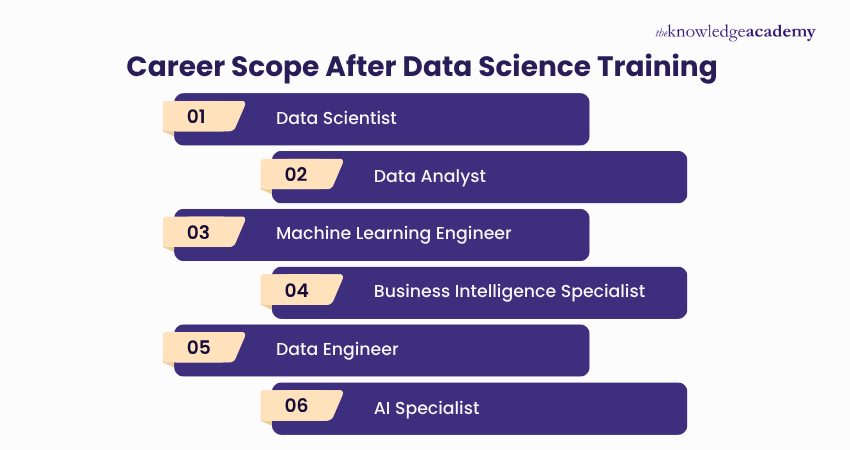
Career Scope After Data Science Training

Career Scope After Data Science Training

The Knowledge Academy’s Data Science Training opens a range of high-demand roles across global industries. Learners gain the skills to lead analytical projects and contribute to data-driven transformation. The following are some of the prominent career opportunities available after completing this training:

  • Data Scientist: Build predictive models, apply algorithms, and generate insights that shape business strategies.
  • Data Analyst: Interpret data trends, create dashboards, and provide actionable reports for decision-makers.
  • Machine Learning Engineer: Design and deploy intelligent models that enable automation and predictive capability.
  • Business Intelligence Specialist: Combine analytics and visualisation to help organisations identify trends and improve outcomes.
  • Data Engineer: Develop data pipelines and architecture that support analysis, storage, and scalable data access.
  • AI Specialist: Advance into roles that apply deep learning and artificial intelligence to complex problems.
Show more blue-arrow

Data Science Courses FAQs

Data Science is an interdisciplinary field that uses scientific methods, algorithms, and systems to extract insights from structured and unstructured data, helping organisations make data-driven decisions and predictions.

Data Science Courses focus on turning raw data into meaningful insight. They teach you how to collect, analyse, and interpret information using tools like Python, statistics, and visualisation, helping you make informed, data-driven decisions across real business scenarios.

A Data Scientist analyses complex data, builds predictive models, and develops Machine Learning algorithms to uncover insights. They interpret results, optimise data strategies, and communicate findings to support informed business decisions.

Obtaining a Data Science Certification through Data Science Courses strengthens your ability to analyse data, apply machine learning, and support data-driven decisions. It enhances career prospects, credibility, and earning potential across industries seeking skilled data professionals.

Yes, you can learn Data Science without a strong background in mathematics or statistics. Our Science Courses starts with foundational concepts and gradually introduces essential analytical techniques in a structured and accessible way.

No, Data Analytics and Data Science Courses are different. Data Analytics focuses on interpreting existing data for decision-making, while Data Science involves advanced techniques like machine learning to predict future trends and patterns.

You will be able to access the course material using MyTKA Training Portal for the Data Science Courses. It will be available to you even after the training period, so that you can constantly refer to and learn.

The prerequisites for the Data Science Courses are based on the course specifications and the target group of professionals they serve. Check the respective course page of the course that you are planning to take to know about its prerequisites.

Some of the best advanced Data Science Courses include Advanced Data Science Certification, Predictive Analytics, PySpark Training, and Data Science with R. Specialised options such as Keras Training, Text Mining, Data Mining, and Decision Tree Modelling also support deeper expertise in analytics and machine learning.

Yes, The Knowledge Academy offers support via phone & email before attending, during, and after the Data Science Courses. Our customer support team is available to assist and promptly resolve any issues you may encounter.

After completing a Data Science Online Courses, you can apply for roles like Data Scientist or Analyst, specialise in areas like machine learning or big data, or pursue advanced certifications to enhance your expertise.

Our Data Science Courses cover topics such as Python and R programming, data analysis with Pandas, statistics and probability, data mining, predictive analytics, and machine learning techniques. They also include text mining, big data processing, visualisation, and emerging areas like blockchain and analytics platforms.

Completing Data Science Courses can lead to an average salary increase of 15–30%, depending on your prior experience, role, and industry. The boost reflects high demand for data skills and the ability to contribute to data-driven decision-making and analytics initiatives.

Learning programming languages is essential in data science because they let you prepare, analyse, model and visualise data efficiently. Languages like Python and R are widely used to build statistical models and machine learning solutions that drive real business decisions.

Yes, our Data Science Training Courses cover additional tools and languages beyond Python and R. Depending on the course, this includes SQL, PySpark, and platforms such as KNIME, supporting broader data processing and analytics skills.

The Knowledge Academy stands out as a prestigious training provider known for its extensive course offerings, expert instructors, adaptable learning formats, and industry recognition. It's a dependable option for those seeking Data Science Courses.

The Knowledge Academy is one of the Leading global training provider for Data Science Courses.

The training fees for Data Science Courses in Zambia starts from $3795

Show more down

Why we're the go to training provider for you

icon

Best price in the industry

You won't find better value in the marketplace. If you do find a lower price, we will beat it.

icon

Trusted & Approved

Recognised by leading certification bodies, we deliver training you can trust.

icon

Many delivery methods

Flexible delivery methods are available depending on your learning style.

icon

High quality resources

Resources are included for a comprehensive learning experience.

barclays Logo
deloitte Logo
Thames Water Logo

"Really good course and well organised. Trainer was great with a sense of humour - his experience allowed a free flowing course, structured to help you gain as much information & relevant experience whilst helping prepare you for the exam"

Joshua Davies, Thames Water

santander logo
bmw Logo
Google Logo
cross

Exclusive Deals Big Savings This March!

Grab up to 40% OFF and level up your skills this spring! march-madness

WHO WILL BE FUNDING THE COURSE?

close

close

Thank you for your enquiry!

One of our training experts will be in touch shortly to go over your training requirements.

close

close

Press esc to close

close close

Back to course information

Thank you for your enquiry!

One of our training experts will be in touch shortly to go overy your training requirements.

close close

Thank you for your enquiry!

One of our training experts will be in touch shortly to go over your training requirements.