


 Top Rated Course

We may not have the course you’re looking for. If you enquire or give us a call on +44 1344 203 999 and speak to our training experts, we may still be able to help with your training requirements.
What is B2B Sales: Examples, Process and Strategies
Charlotte Wilson 27 March 2026B2B Sales involve one business selling products or services to another, typically within SaaS environments where buying cycles are longer and more strategic. These deals require deeper relationship building and tailored value propositions. Strong problem-solving and consultative selling are essential to build long-term partnerships.

Training Outcomes Within Your Budget!
We ensure quality, budget-alignment, and timely delivery by our expert instructors.
Table of Contents
Understanding What is B2B Sales is essential for recognising how organisations evaluate, purchase, and adopt new technologies. These transactions involve significant risk, longer timelines, and strategic decision-making. With this foundation in place, we can now explore how the B2B Sales process works in real-world scenarios.
Table of Contents
1) What is B2B Sales?
2) What is the B2B Sales Process?
3) What are the B2B Sales Strategies That Work?
4) What are the Six Challenges in B2B Sales and How to Overcome Them?
5) Difference Between B2B Sales and B2C Sales
6) What are the Main B2B Sales Examples?
7) What is the Future of B2B Sales?
8) Conclusion
What is B2B Sales?
B2B sales, or business-to-business sales, are when one company sells products or services to another company, not directly to consumers like in B2C sales. In B2B Sales, firms are selling their products or services to other firms that make use of the services or products in their operations or retail to their clients.
Such a Sales Process is associated with a lengthy sales cycle, large value dealings, and more involving decision-making procedures as opposed to Sales of B2C. During the preparations for the role in such a process, it is very much possible that by reviewing the common Sales Interview Questions, you get a good idea of what should be expected and what kind of challenges you face in such a type of sales.

What is the B2B Sales Process?
The B2B Sales process is a structured approach to turning potential leads into paying customers. It involves several steps; each aimed at building a relationship and providing solutions that meet the business's needs. Let’s break down the main stages of the B2B Sales process.
1) Lead Generation
The goal is to pinpoint leads that are truly compatible with your offering and demonstrate actual interest. This allows you to pay attention to the best prospects that are indeed worth the engagement you can give them.
2) Lead Qualifying
Sales teams can tell which leads are really worth the effort of pursuing just by asking specific questions. It eliminates the leads who are not interested, do not have the money or are not ready.
3) Prospect Engagement
Taking effective engagement means being aware of the prospect's wants and needs and giving them value throughout the conversation. Showing empathy and being consistent in communication will gain trust and create a stronger basis for a sale.
4) Product Demo
A product demonstration that is professionally executed demonstrates how the solution you offer tackles the customer's problem points very clearly. Showing the customer the clear worth and usefulness of the product may have a very strong impact on their million-dollar decision-making.
5) Deal Closing
The termination of the transaction consists of settling all terms, making a promise, and making sure that both parties are on the same page regarding their expectations. Very good negotiation skills are useful in clarifying any objections that may come up at the last minute and finalising the transaction.
6) Customer Support
After the sale, the sales process is kept on, and the support that is continuously offered is a key factor in the establishment of long-term client relationships. In a competitive B2B scenario, the excellent after-sales service increases customer satisfaction, generates new customers, and brings in referrals.
7) Implementation and Delivery
Your organisation is obliged to roll out the product or service and make sure it is up to the client’s standards. An unhindered onboarding procedure and continuous support are the main factors in converting a sale into a regular customer for a long period of time.
Enhance your sales strategy with data-driven decisions- Join our Sales Analytics Training now!
What are the B2B Sales Strategies That Work?
The focus of B2B sales success is on building trust, providing value, and establishing long-term partnerships instead of using aggressive methods. Below are three major strategies that are still effective in generating results today:
1) Account-based Sales
Account-Based Selling is all about the strategy of engaging and winning over individual high-value accounts through a personalised approach that is specifically designed to meet the needs of that particular customer.
Why it works:
a) Targets high-value prospects
b) Delivers highly relevant pitches
c) Builds stronger decision-maker relationships
2) Content Marketing
Content marketing is the process of disseminating valuable and informative content, such as blogs, case studies, and webinars, not only to educate your potential customers but also to elevate your brand's perception as an expert in the field.
3) Social Selling
Social selling employs platforms such as LinkedIn, Twitter, and industry forums to reach out to potential clients, initiate dialogues, and gain trust through regular networking.
What are the Six Challenges in B2B Sales and How to Overcome Them?
B2B Sales can be intricate and demanding due to longer sales cycles, multiple decision-makers, and competitive markets. Overcoming these challenges requires strategic planning, effective communication, and a customer-centric approach. In Outbound Sales, addressing these challenges is crucial for success. Here are six key challenges in B2B Sales and ways to tackle them effectively:
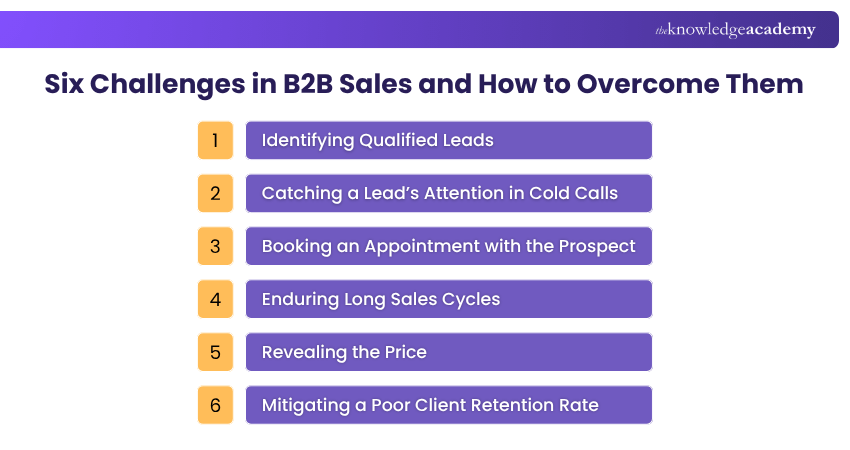
1) Identifying Qualified Leads
Challenge: Winning a deal is just the beginning; retaining clients is crucial, yet many businesses struggle with post-sale engagement.
Solution: Use lead scoring, CRM tools, and intent data to filter high potential leads. Thoroughly research prospects on LinkedIn and industry databases to ensure they align with your target market.
2) Catching a Lead’s Attention in Cold Calls
Challenge: Cold calling often faces resistance as decision-makers receive numerous sales pitches daily, making it hard to stand out.
Solution: Personalise your pitch by addressing a specific pain point. Start with a compelling value proposition, keep the conversation engaged, and use open-ended questions to encourage dialogue.
3) Booking an Appointment with the Prospect
Challenge: Securing a meeting can be difficult as prospects may be hesitant to commit time without seeing a clear benefit.
Solution: Highlight the value of the meeting upfront by demonstrating how your solution can address their challenges. Use personalised outreach, flexible scheduling options, and follow-up reminders to increase appointment rates.
4) Enduring Long Sales Cycles
Challenge: B2B Sales often involve multiple decision-makers and a lengthy approval process, causing delays in closing deals.
Solution: Keep leads engaged with regular follow-ups, case studies, and educational content. Build trust by addressing concerns early and demonstrating how your solution aligns with their business goals.
5) Revealing the Price
Challenge: Discussing prices too early may scare prospects; while delaying it too much can lead to wasted time if the budget doesn’t align.
Solution: Focus on the Return on Investment (ROI) rather than just the cost. Show how your product or service can lead to long-term savings, increased efficiency, or revenue growth.
6) Mitigating a Poor Client Retention Rate
Challenge: Winning a deal is just the beginning; retaining clients is crucial, yet many businesses struggle with post-sale engagement.
Solution: Provide excellent customer support, regular check-ins, and personalised engagement. Offer value through loyalty programs, exclusive insights, and proactive problem-solving to build long-term relationships.
Boost your B2B communication prowess with our B2B Communications Training – Join now!
Difference Between B2B Sales and B2C Sales
In the case of sales, what can vary radically is the method you adopt to carry out the sale when you are selling to corporate clients (B2B) and when you are selling to the customer (B2C). Although both forms of sales are meant to generate revenue, the process, procedures, and results may not be very similar. Now, let us get into the primary distinctions between B2B and B2C sales.
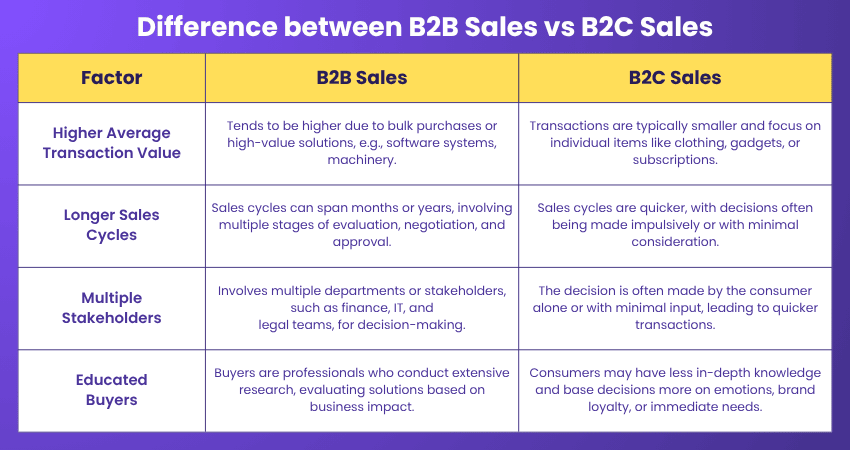
1) Higher Average Transaction Value
In B2B Sales, transactions are typically high in value as businesses invest in large-scale or complex solutions. This contrasts with smaller B2C purchases and demands a more strategic approach focused on pricing, contracts, and long-term ROI.
2) Longer Sales Cycles
B2B sales cycles are longer due to thorough evaluations, multi-stage approvals, and cross-departmental input. Unlike B2C, which involves quicker, impulse-driven decisions, B2B purchases require deeper analysis of value, integration, and long-term impact.
3) Multiple Stakeholders
B2B sales involve multiple stakeholders from various departments, making the buying process more complex and lengthy. In contrast, B2C sales are typically faster and simpler, with decisions made by individual consumers or small groups.
4) Educated Buyers
B2B buyers are highly informed professionals who make strategic, research-driven decisions based on long-term business goals. In contrast, B2C buyers often rely on emotions, brand loyalty, or immediate needs when making purchases.
Master techniques to improve sales performance with our Sales Management Training – Join today!
What are the Main B2B Sales Examples?
B2B Sales are very broad and diverse in terms of the industries they touch and the kinds of transactions they involve since they all deal with the selling of goods or services to other businesses. In contrast to B2C in independent consumers, B2B Sales involves bigger scale purchase and longer sales cycle. Now, let us have a look at the most widespread forms of B2B Sales examples.
Type 1: Supply Sales
Basically, this is about selling essential items or consumables (such as office supplies or workwear) in large quantities to other companies, which necessitates getting internal permissions first.
Type 2: Wholesale/Distribution Sales
Businesses selling core manufacturing or retail components (such as raw material) to other companies for further resale to themselves or consumption.
Type 3: Service/Software Sales
The business in this model does not give a physical product but rather delivers a service or software (for example, SaaS tools or professional consulting) to another company.
Learn to build long-term client relationships with our Sales Negotiation Training – Join now!
What is the Future of B2B Sales?
AI, automation, and highly personalised digital engagement will be the driving forces behind the future of B2B sales. Hybrid selling, self-service buying, and stronger long-term customer relationships will characterise the ways in which businesses sell and support their clients.
Conclusion
It is very important for the companies to know What is B2B Sales, in order to get used to and thrive in the competitive market of today. The modern buyers demand to receive value, insight and personalised treatment during the whole process. Companies, by being flexible and putting the relationship first, will have the advantage of winning the best deals and eventually achieving great and long-lasting growth.
Boost your sales success with our Dynamic Sales Account Management Training. Register today and take your skills to the next level!
Frequently Asked Questions
What is B2B Sales' First Step?

The first step in B2B Sales is lead generation. This involves identifying potential businesses that could benefit from your product or service. Methods such as cold calling, email marketing, networking, and leveraging digital platforms like LinkedIn help build a list of prospects to engage with.
What is the Role of Data in B2B Sales?
Data plays a crucial role in B2B Sales by providing valuable insights into customer behaviour, preferences, and market trends. It helps sales teams target the right prospects, personalise outreach, predict sales outcomes, and optimise strategies, ultimately increasing efficiency and conversion rates in the sales process.
What are the Other Resources and Offers Provided by The Knowledge Academy?
The Knowledge Academy takes global learning to new heights, offering over 3,000+ online courses across 490+ locations in 190+ countries. This expansive reach ensures accessibility and convenience for learners worldwide.
Alongside our diverse Online Course Catalogue, encompassing 17 major categories, we go the extra mile by providing a plethora of free educational Online Resources like Blogs, eBooks, Interview Questions and Videos. Tailoring learning experiences further, professionals can unlock greater value through a wide range of special discounts, seasonal deals, and Exclusive Offers.
What is The Knowledge Pass, and How Does it Work?
The Knowledge Academy’s Knowledge Pass, a prepaid voucher, adds another layer of flexibility, allowing course bookings over a 12-month period. Join us on a journey where education knows no bounds.
What are the Related Courses and Blogs Provided by The Knowledge Academy?
The Knowledge Academy offers various Sales Courses, including Sales Negotiation Training, Sales Analytics Training, and Key Account Management Training. These courses cater to different skill levels, providing comprehensive insights into Sales Analytics.
Our Business Skills Blogs cover a range of topics related to B2B Sales, offering valuable resources, best practices, and industry insights. Whether you are a beginner or looking to advance your Business skills, The Knowledge Academy's diverse courses and informative blogs have got you covered.

Charlotte Wilson


Soft Skills and Business Training Manager
Charlotte Wilson is an expert in soft skills development, with over 14 years of experience helping individuals and teams improve communication, productivity and emotional intelligence in the workplace. Her training content is focused on enhancing interpersonal effectiveness and fostering positive, collaborative environments across all levels of an organisation.
View Detail
Upcoming Digital Marketing Resources Batches & Dates
Date
 Online Sales Training
Online Sales Training
Fri 17th Jul 2026
Online Sales Training
Fri 25th Sep 2026

 If you wish to make any changes to your course, please


