


 Top Rated Course

We may not have the course you’re looking for. If you enquire or give us a call on +44 1344 203 999 and speak to our training experts, we may still be able to help with your training requirements.
How to Become a Pilot After 12th? A Step-by-Step Guide
The Knowledge Academy 21 April 2026After 12th, you can be a pilot by clearing medical and entrance exams, joining a flying school, completing flight training, and earning the required licences. Learn about eligibility, training stages, top aviation universities, career options, and practical tips to begin your journey towards a professional career in the skies.

Training Outcomes Within Your Budget!
We ensure quality, budget-alignment, and timely delivery by our expert instructors.
Table of Contents

Dream of flying above the clouds, steering through endless skies, and exploring the world from the best seat there is? We’ve got you covered. For many students, the question isn’t “if”, but How to Become a Pilot After 12th. The dream is bold, the path is thrilling, and with the right steps, it’s entirely achievable.
From picking the perfect flying school and passing your medical exams to clocking flight hours and earning your Commercial Pilot Licence, the journey is both structured and rewarding. In this blog, you’ll learn exactly How to Become a Pilot After 12th, with clear steps, smart tips, and all the insight you need to launch a successful aviation career.
Table of Contents
1) Who is a Pilot?
2) What Does a Pilot do?
3) How to Become a Pilot?
4) Pilot Licence Types
5) Pilot Physical Criteria
6) Pilot Eligibility Criteria
7) Best Universities to Become a Pilot in India
8) Tips for Becoming a Pilot
9) Conclusion
Who is a Pilot?
A pilot is a trained professional responsible for operating aircraft safely. Pilots are not just responsible for flying the plane; they must also plan flights, check aircraft performance, monitor weather conditions, and communicate with air traffic controllers. They can work in commercial airlines, military services, private charter firms, or for cargo carriers.
What Does a Pilot do?
A pilot’s role extends far beyond flying. Before take-off, they must inspect aircraft systems, calculate fuel requirements, review weather reports and file flight plans. During the flight, they monitor instruments, manage navigation and ensure safety protocols are followed. After landing, they conduct post-flight inspections and write detailed reports. The job demands excellent communication, technical skills and the ability to remain calm under pressure.
How to Become a Pilot?
Becoming a pilot involves a structured process. This includes formal training, gaining flying experience, and earning the required licences. Let's break down the key steps you need to follow.

1) Student Training
Once you’ve finished your 12th standard with stream that offers Physics and Mathematics, your first step is getting into a recognised flying school. The school needs to be approved by the Directorate General of Civil Aviation (DGCA) or your country's aviation authority. Training begins with ground school, where you’ll study subjects like aviation theory, aerodynamics, navigation, and weather patterns.
After completing ground school, you’ll move on to practical flight training under the guidance of experienced instructors. In India, to apply for a Commercial Pilot Licence (CPL), you need at least 200 flying hours. This includes 100 hours of solo flying, 20 hours of cross-country as Pilot in Command (PIC), and 80 hours of dual instruction. You also need 70 hours as PIC and 5 hours of night flying, including a solo flight of at least one hour.
2) Co-pilot Experience
After acquiring your initial licence, most pilots start as co-pilots or first officers. In this role, you assist the captain, manage flight operations, and gain crucial in-air experience. This step is essential in building your hours, Upskilling, and progressing towards a senior role.
3) Licensing and Certification
To fly commercially, you need to secure a Commercial Pilot Licence (CPL). After gaining enough flying hours and experience, you can upgrade to an Airline Transport Pilot Licence (ATPL), which is required to become a captain. Both licences include practical flight tests and written examinations.
Turn customer interactions into lasting impressions with our Exceptional Customer Service Training – Join now!
Pilot Licence Types
There are different types of pilot licences, each allowing you to operate specific kinds of aircraft and take on various roles in aviation. These are the main pilot licences:
1) Commercial Pilot Licence (CPL)
1) This licence lets you work as a professional pilot
2) You can fly for airlines, private charters, or cargo companies
3) You must be at least 18 years old
4) You need at least 200 hours of flight experience
5) You must pass written exams on navigation, weather, air rules, and how planes work
2) Airline Transport Pilot Licence (ATPL)
1) This is the highest pilot licence you can get
2) It is needed to become the captain of a commercial flight
3) You need to have 1500 flight hours
4) You must pass advanced theory exams
5) Most pilots get this after working as a co-pilot for some time
Pilot Physical Criteria
Pilots must meet strict health standards to ensure they are physically fit to handle the pressures of flying. You must undergo a Class 1 medical examination by a DGCA-approved or CAA-approved medical examiner.
The key physical criteria include:
1) Good vision (correctable to 6/6)
2) Normal hearing
3) No colour blindness
4) Healthy cardiovascular and respiratory systems
5) No mental health disorders
Maintaining your medical fitness is crucial throughout your flying career. These exams must be repeated at regular intervals to keep your licence valid.
Upgrade Your Supervisory Style with our Supervisor Training – Register Today!
Pilot Eligibility Criteria
To become a pilot after 12th in India, you must fulfil certain academic and non-academic criteria:
1) Educational Background: You must have completed your 12th standard with Physics and Mathematics. Some flying schools may accept candidates from commerce or arts if they clear certain science subjects through open schooling.
2) Minimum Age: You must be at least 17 years old to begin flight training, and 18 to apply for a CPL.
3) Language Proficiency: You must be proficient in English, both spoken and written.
4) Medical Fitness: You must clear the Class 1 medical examination.
Best Universities to Become a Pilot in India
If you’re considering international education, India has several renowned institutions that offer pilot training combined with academic degrees in aviation or aerospace engineering. Here are some of the best options:
1) Indira Gandhi Institute of Aeronautics (IGIA)
This institution offers courses in aviation management and pilot training and is one of the top choices for students looking to become pilots in India.
2) Captain Sahil Khurana Aviation Academy
Known for its comprehensive pilot training program and academic excellence, this academy is a popular choice for aspiring pilots in India.
3) Bombay Flying Club
One of the oldest flying clubs in India, Bombay Flying Club offers quality pilot training programs under the guidance of experienced instructors.
Build Winning Strategies That Deliver Results with our Strategic Planning And Thinking Course – Register now!
Tips for Becoming a Pilot
To help you succeed on your journey to becoming a pilot, here are some practical tips that can guide your preparation, planning and decision-making.
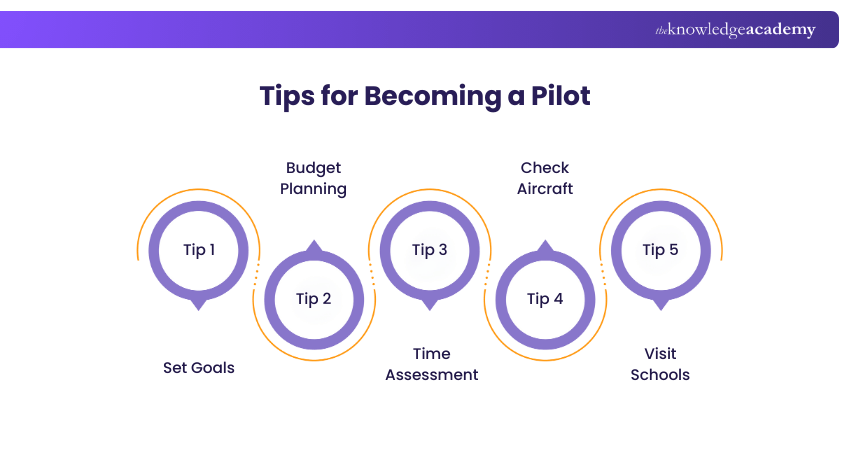
Tip 1. Set Goals
Before starting your journey, know whether you want to become a commercial pilot, military pilot or private pilot. This decision will shape your training path, licensing requirements and future job opportunities.
Tip 2. Budget Planning
Pilot training can be expensive. In India, CPL training can cost between ₹30 to ₹50 lakhs. Plan your finances, explore scholarships, and consider student loans if necessary.
Tip 3. Time Assessment
Becoming a pilot requires time and dedication. Flight training, exams, and certifications can take 1.5 to 3 years. You must also be prepared for long hours and irregular schedules in your future job.
Tip 4. Check Aircraft
Before choosing a flying school or university, visit their training facilities. Look for well-maintained aircraft, certified instructors, and simulators. A good training environment directly impacts your learning and safety.
Tip 5. Visit Schools
If possible, attend orientation days or open house events at flight academies. Speak to instructors and students to understand the curriculum and learning experience.
Conclusion
Pursuing a career in aviation in India is challenging yet incredibly rewarding. If you have just completed your 12th standard and are wondering How to Become a Pilot After 12th, the path is clear but requires careful planning, commitment, and financial preparation. From choosing the right training school to gaining licences and meeting eligibility criteria, these steps will bring you closer to flying an aircraft as a professional pilot.
Strengthen Your Network, Strengthen Your Business. Join our Building Business Relationships Course – Today!
Frequently Asked Questions
What is the Pilot Room Called?

The room called cockpit, also known as the flight deck, is the area at the front of the aircraft where pilots control and monitor the plane.
What is the Highest Rank in Pilot?
The highest rank is Captain, also referred to as the Pilot-in-Command. Captains are responsible for the overall operation and safety of the aircraft during flight.
What are the Other Resources and Offers Provided by The Knowledge Academy?
The Knowledge Academy takes global learning to new heights, offering over 3,000+ online courses across 490+ locations in 190+ countries. This expansive reach ensures accessibility and convenience for learners worldwide.
Alongside our diverse Online Course Catalogue, encompassing 17 major categories, we go the extra mile by providing a plethora of free educational Online Resources like Blogs, eBooks, Interview Questions and Videos. Tailoring learning experiences further, professionals can unlock greater value through a wide range of special discounts, seasonal deals, and Exclusive Offers.
What is The Knowledge Pass, and How Does it Work?
The Knowledge Academy’s Knowledge Pass, a prepaid voucher, adds another layer of flexibility, allowing course bookings over a 12-month period. Join us on a journey where education knows no bounds.
What are the Related Courses and Blogs Provided by The Knowledge Academy?
The Knowledge Academy offers various Personal Development Courses, including the Exceptional Customer Service Training, Supervisor Training, and the Building Business Relationships. These courses cater to different skill levels, providing comprehensive insights into Chief Product Officer.
Our Business Skills Blogs cover a range of topics related to Personal Development, offering valuable resources, best practices, and industry insights. Whether you are a beginner or looking to advance your Business skills, The Knowledge Academy's diverse courses and informative blogs have got you covered.

The Knowledge Academy


Global Training Provider
The Knowledge Academy is a world-leading provider of professional training courses, offering globally recognised qualifications across a wide range of subjects. With expert trainers, up-to-date course material, and flexible learning options, we aim to empower professionals and organisations to achieve their goals through continuous learning.

Upcoming Business Skills Resources Batches & Dates
Date
 Career Development Course
Career Development Course
Fri 3rd Jul 2026
Career Development Course
Fri 4th Dec 2026

 If you wish to make any changes to your course, please


