


 Top Rated Course

We may not have the course you’re looking for. If you enquire or give us a call on +44 1344 203 999 and speak to our training experts, we may still be able to help with your training requirements.
Cycle Time vs Lead Time: Key Differences Explained
The Knowledge Academy 15 July 2026Cycle Time measures how long active work takes, while Lead Time covers the full journey from request to delivery, including waiting time and delays. While Cycle Time focuses on actual working time, Lead Time also accounts for approvals and pauses, helping teams spot bottlenecks and improve overall delivery speed.

Training Outcomes Within Your Budget!
We ensure quality, budget-alignment, and timely delivery by our expert instructors.
Table of Contents

Efficiency and customer satisfaction are essential to staying ahead in a competitive market. Have you ever wondered how companies manage to deliver products so quickly and keep everything running smoothly? It all comes down to understanding the difference between Cycle Time vs Lead Time. These two essential metrics help businesses streamline their processes, from starting a task to delivering the final product.
In this blog, we will discuss what Cycle Time vs Lead Time are, how to calculate them, and why they matter so much for your business success. So read on and explore the secrets to boosting your productivity and delighting your customers!
Table of Contents
1) Defining Cycle Time and Lead Time
2) What is Cycle Time?
3) What is Lead Time?
4) Differences Between Cycle Time and Lead Time
5) What are the Similarities Between Lead Time and Cycle Time?
6) How to Calculate Cycle Time vs Lead Time?
7) Benefits of Calculating Cycle Time and Lead Time
8) What is the Formula for Calculating Cycle Time?
9) What is the Formula for Calculating Lead Time?
10) Conclusion
Defining Cycle Time and Lead Time
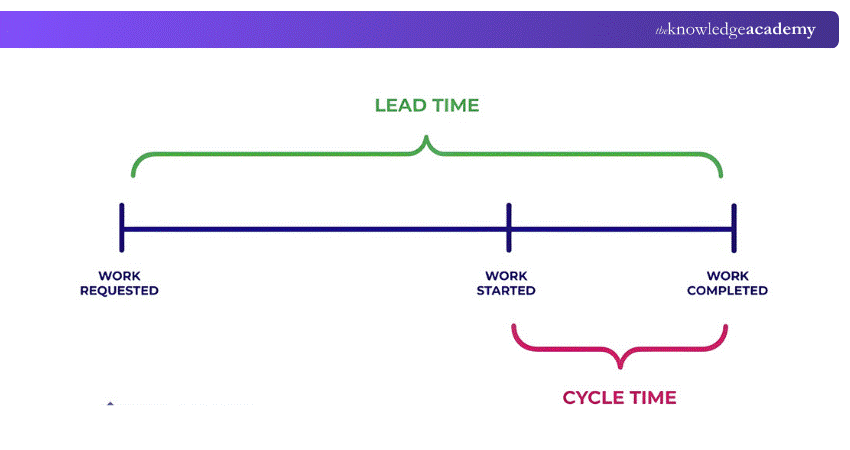
Cycle Time and Lead Time are key metrics in Lean philosophy that show how work moves through a process. Tracking them helps organisations understand how long tasks take from start to completion and how work flows over time.
Analysing these metrics highlights delays, bottlenecks, and inefficiencies. This allows teams to improve processes, reduce waste, and deliver products or services more consistently and on time, improving customer satisfaction.

What is Cycle Time?
Cycle Time is an important metric used in Project Management and manufacturing to measure the amount of time it takes to complete one cycle of a process. It starts when the work begins on an item and ends when the item is available for delivery. It helps organisations identify inefficiencies and optimise processes to improve productivity and reduce costs. In Kanban, Cycle Time is used to measure the efficiency of the workflow and identify bottlenecks.
What is Lead Time?
Lead Time is the total time it takes from the moment a customer places an order until the final product or service is delivered. It covers the entire process, including order processing, production, and shipping. It includes both the Cycle Time (actual work time) and any waiting time or delays caused by external factors. In Kanban, Lead Time is critical for assessing the overall speed of the process and ensuring timely delivery to customers.
Differences Between Cycle Time and Lead Time
Here are some of the differences between Cycle Time and Lead Time:
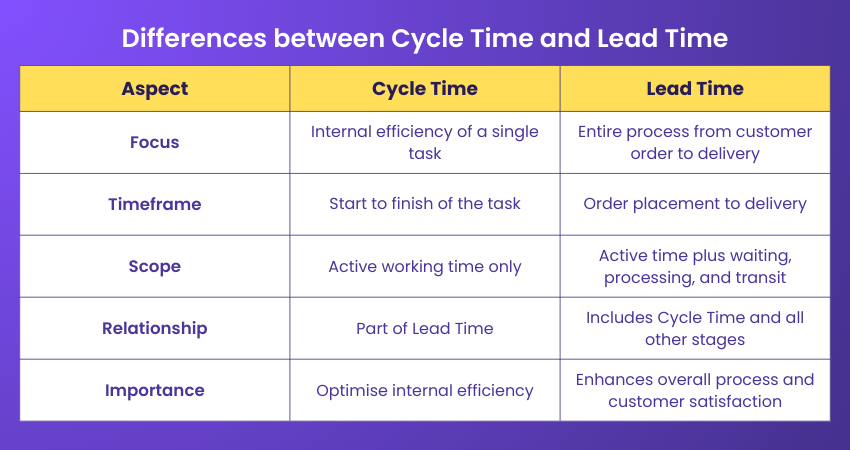
1) Focus
Cycle Time measures the internal efficiency of completing a single unit of work. It tracks how long it takes to complete a task from start to finish within the production process.
On the other hand, Lead Time measures the entire process from the customer's perspective. It measures the total time taken from when a customer places an order until the final product or service is delivered.
2) Scope
Cycle Time includes only the time spent actively working on the task. It does not account for any waiting periods or delays.
On the other hand, Lead Time covers the Cycle Time as well as any additional time spent waiting, processing, or in transit. It accounts for all stages of the process, from initial order placement to final delivery.
3) Component Relationship
Cycle Time is a component of Lead Time. It represents just the active working period within the overall process.
In contrast, Lead Time provides a complete picture of the total time taken for the entire process.
4) Importance
Cycle Time is essential for assessing the internal efficiency of specific tasks and processes within the production cycle. It helps you identify those areas where processes can be optimised for faster completion.
On the other hand, Lead Time is vital for improving overall process efficiency and enhancing customer satisfaction. By reducing Lead Time, companies can ensure quicker delivery times, thereby increasing customer satisfaction and gaining a competitive edge.
Your Agile evolution begins here. Sign up for our Certified Kanban Foundation Training and nurture future-ready teams!
What are the Similarities Between Lead Time and Cycle Time?
Lead Time and Cycle Time share several similarities because both focus on how work flows through a process. They are time-based metrics used to measure efficiency and understand how smoothly tasks move from start to finish.
Both metrics help teams identify delays, bottlenecks, and inefficiencies in workflows. They are widely used in Lean, Agile, and Kanban to improve predictability, optimise processes, and support faster, more consistent delivery of products or services.
How to Calculate Cycle Time vs Lead Time?
Calculating Lead Time and Cycle Time for any project is simple with the right Project Management software. The most common method to calculate these times is using the Cumulative Flow Diagram (CFD). Consider these points:
a) A CFD is a graph that shows the progress of a project over time.
b) The diagram is divided into segments, each corresponding to a column on a Kanban Board.
c) The basic segments include planned tasks, tasks in progress and completed tasks.
d) Additional sections can be added to further streamline the tracking process.
e) To calculate the Lead Time, interpret the data from when a request is added to the backlog, moves through the process and is completed.
f) The time from the request entering the system to its completion represents the Lead Time.
g) To calculate Cycle Time, skip the initial backlog phase and start measuring once the work begins.
h) Cycle Time is the time spent per unit of work after it has started.
Benefits of Calculating Cycle Time and Lead Time
Let's explore some of the advantages of calculating Cycle Time and Lead Time:
Benefits of Calculating Cycle Time:
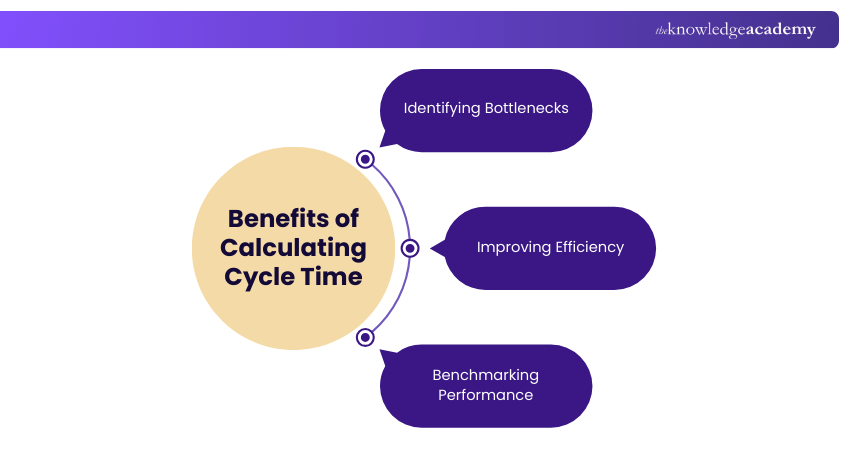
a) Identifying Bottlenecks: By measuring Cycle Time, organisations can pinpoint stages in the process that take longer than expected and address inefficiencies.
b) Improving Efficiency: Reducing Cycle Time can lead to faster production rates and lower costs.
c) Benchmarking Performance: Cycle Time provides a clear metric to benchmark against industry standards or previous performance.
Benefits of calculating Lead Time:
a) Enhancing Customer Satisfaction: Shorter Lead Times lead to faster delivery, improving customer satisfaction and loyalty.
b) Better Inventory Management: Understanding Lead Time helps in managing inventory levels more effectively, reducing overstock or stockouts.
c) Competitive Advantage: Companies that can deliver products faster than their competitors can gain a significant market advantage.
Transform your workflow with Certified Kanban Practitioner Training – Join today!
What is the Formula for Calculating Cycle Time?
The Cycle Time formula is:
Cycle Time = Total Time Spent Working ÷ Number of Units Completed
This formula shows the average time taken to complete one unit of work once the process has started. It helps teams understand how quickly work is being completed and is commonly used in Lean, Agile, and Kanban to measure efficiency and improve workflow performance.
What is the Formula for Calculating Lead Time?
The Lead Time formula is:
Lead Time = Delivery Date − Request Date
This formula measures the total time taken from when a request is made until it is delivered. It includes both waiting time and actual working time, helping teams understand how long customers wait to receive a product or service.
Conclusion
Understanding Cycle Time vs Lead Time is important for making processes better and keeping your customers happy. Cycle Time shows how long it takes to finish one task, while Lead Time covers the entire process from order to delivery. By measuring these times, businesses can find and fix slow spots, work more efficiently, and improve overall performance.
Learn Kanban process and principles with our Certified Kanban Foundation and Practitioner Training – Join today!
Frequently Asked Questions
Why is Reducing Lead Time Important in Project Delivery?

Reducing Lead Time is important because it helps deliver projects faster, making customers happy sooner. It also gives companies an edge by allowing them to respond quickly to market demands and cut down on costs.
How Does Tracking Cycle Time Benefit my Team?
Reducing Lead Time is important because it helps deliver projects faster, making customers happy sooner. It also gives companies an edge by allowing them to respond quickly to market demands and cut down on costs.

The Knowledge Academy


Global Training Provider
The Knowledge Academy is a world-leading provider of professional training courses, offering globally recognised qualifications across a wide range of subjects. With expert trainers, up-to-date course material, and flexible learning options, we aim to empower professionals and organisations to achieve their goals through continuous learning.


 If you wish to make any changes to your course, please


