


 Top Rated Course

We may not have the course you’re looking for. If you enquire or give us a call on +44 1344 203999 and speak to our training experts, we may still be able to help with your training requirements.
What is LangChain? The Framework for Custom LLM Apps
Lily Turner 22 April 2026LangChain is a framework that helps build apps using large language models by linking them to tools, data sources, and workflows for better output. It makes app building easier by using ready-made parts, supports memory, prompt templates, and connects to real data for smarter and more accurate responses. It also helps test, run, and monitor apps smoothly.

Training Outcomes Within Your Budget!
We ensure quality, budget-alignment, and timely delivery by our expert instructors.
Table of Contents
Ever chatted with ChatGPT and thought, “Wow, I wish I could build something like this for my work”? Well, now you can, with LangChain. It’s like giving your app a brain and memory of its own, powered by tools, real data, and simple logic. And the best part? You don’t have to be an Artificial Intelligence (AI) wizard to do it.
This blog will walk you through What is LangChain, how it works, the smart features it offers, the building blocks behind it, what you can build with it, and why people are choosing it over other tools like LlamaIndex.
Table of Contents
1) What is LangChain?
2) Features of LangChain
3) How Does LangChain Work?
4) What are the Essential Components of LangChain?
5) Applications of LangChain
6) Benefits of LangChain
7) LlamaIndex vs LangChain
8) Conclusion
What is LangChain?
LangChain is a free tool that helps people build smart apps using big AI models, like ChatGPT. These models can write text, answer questions, and talk like humans because they learned from lots of data. LangChain is made with Python and JavaScript, and it works with many types of AI models.
LangChain was created by Harrison Chase and Ankush Gola in October 2022. Many people like it because it is easy to use and has many helpful parts. It gives simple tools to connect AI with your own data, apps, or websites. This makes it faster and easier to build smart tools.
Features of LangChain
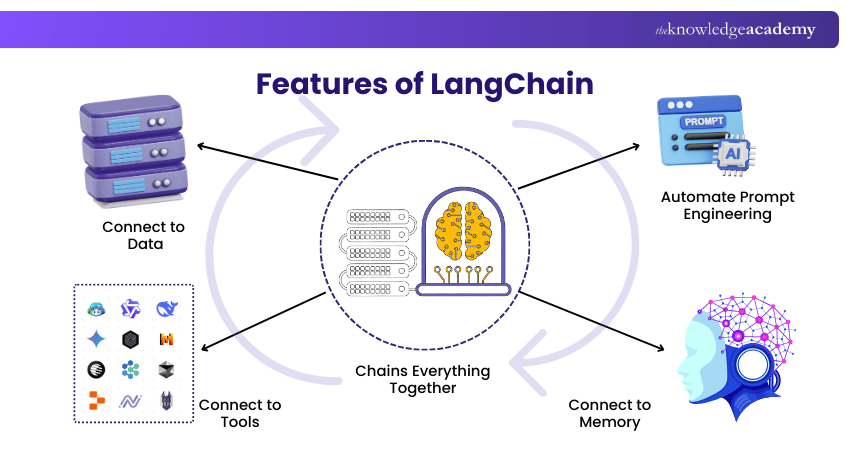
LangChain provides easy-to-use interfaces for connecting with data sources like Google Drive, databases amd more. These features help you build complex AI apps. Let’s look at the main ones.
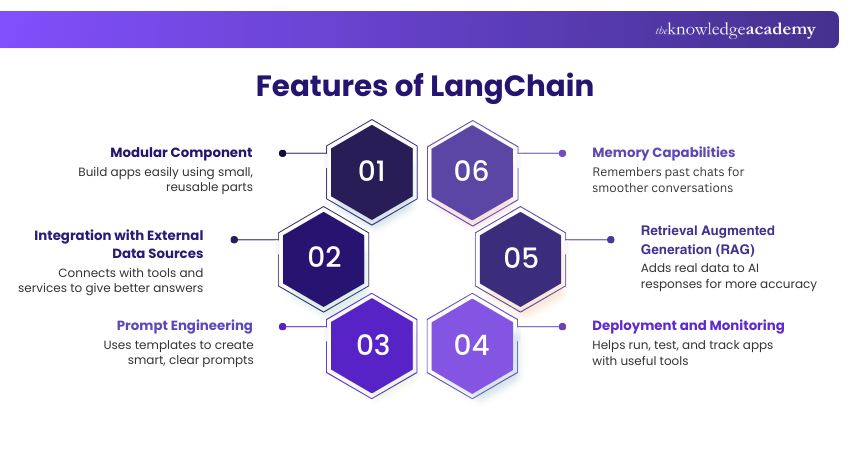
1) Modular Components
LangChain is made of small building blocks, like LEGO. Each block does something specific, such as talking to users or finding data. You can put these blocks together to build smart apps. If you want to change one part, you don’t need to rebuild everything. This makes it easy to test new ideas and fix things quickly.
2) Integration with External Data Sources
LangChain connects to tools like Google Drive, YouTube, Notion, Trello, and databases. This lets the AI access real data from these sources. For example, a health app can use patient files and medical articles to give smarter, more helpful answers using your own data.
3) Prompt Engineering
Prompt Engineering means giving clear instructions to the AI. LangChain helps you write good prompts, so the AI knows exactly what to do. You can test and improve the prompts anytime. LangChain also lets you use prompt templates. These are ready-made question formats where you just fill in the blanks. It saves time and keeps the answers better.
4) Retrieval Augmented Generation (RAG)
RAG helps AI give better answers by finding the latest and most useful information before replying. Retrieval Modules search files, websites, or databases. LangChain makes it easy to add RAG to your app, so the AI gives more accurate and trusted responses.
5) Memory Capabilities
LangChain helps AI remember past messages, called memory. This is useful for chatbots, for example, remembering a user’s name or problem later in the conversation. It makes chatting with AI feel more human and smoother.
6) Deployment and Monitoring
LangChain makes it easy to run your app and keep track of how it works. It offers tools like LangSmith to test and fix any issues. It also has LangServe, which turns your app into a service that other systems can use. These tools help your app run well, grow with more users, and stay reliable.
Learn best practices in Search Management and Cyber Security compliance. Join our Deepseek Training now!
How Does LangChain Work?
LangChain is made to help people build AI apps easily. It hides the hard parts of coding by using simple tools. This is called abstraction, it means you use a small name for something big and complex.
Here’s how it works:
1) LangChain Gives Simple Tools: These tools do big jobs, but you don’t need to know how everything works inside.
2) It’s Like Things we use Every Day: For example, we use “π” instead of writing a long number. Or we use a thermostat to change the temperature without knowing how the machine works.
3) LangChain has Many Small Parts: These parts are made for common AI tasks like answering questions or using memory.
4) You can Join the Parts Together: You can link the parts to build a full app, like steps in a recipe.
5) You don’t Need to be an Expert: Even beginners can use LangChain to make smart apps without writing lots of code.
6) Experts can use it too: While experts may want more control, LangChain still helps them build and test faster.
What are the Essential Components of LangChain?
LangChain is made of small parts that help you build smart apps using AI. Each part has a job. You can use just the parts you need to build your app. Let’s look at these parts:
1) Language Models (LLMs)
LangChain works with AI models like GPT, Claude, and watsonx.ai. It makes using these models easy in your app. You don’t need to do much setup, just connect and use.
2) Prompt Templates
Prompt templates are fill-in-the-blank question formats. They help you ask the AI clearly and get better answers. You can reuse them repeatedly.
3) Chains and Agents
Chains are linked steps that complete a task, like finding info, asking the AI, and showing the answer. Agents are smart helpers that decide what to do next on their own.
4) Document Loaders and Indexes
LangChain can read files like PDFs or data from Google Drive and websites. It then creates an index, so the AI can quickly find and use the right info.
5) Memory
Memory lets the AI remember what was said earlier in a chat. This helps in longer talks or follow-ups. The AI can keep the context and respond better.
6) Tools and Add-ons
LangChain comes with tools like Google Search and Wikipedia. The AI can use them to find facts or take action. You can also add your own tools if needed.
7) Deployment and Monitoring
LangChain helps run your app smoothly. LangSmith lets you test and fix issues, while LangServe turns your app into a web service for easy online use.
Master techniques for troubleshooting and refining prompts. Join our ChatGPT Prompt Engineering Certification today!
Applications of LangChain
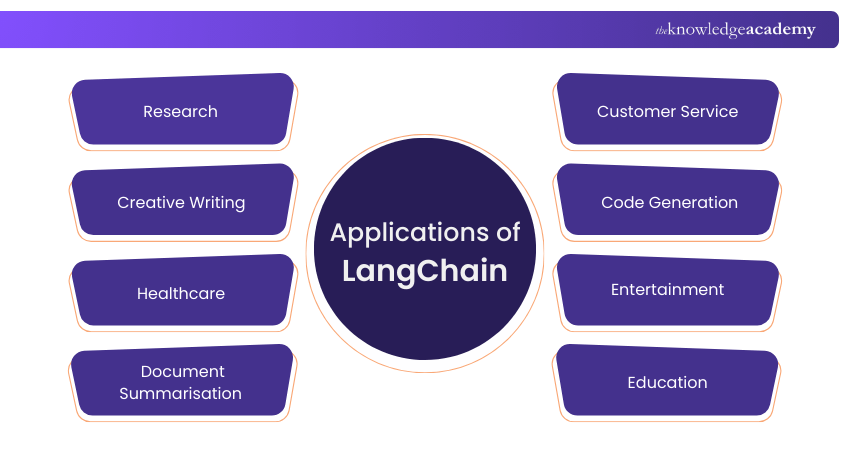
LangChain helps people build many different types of smart apps. Here are some easy examples of what you can make with it:
1) Research
LangChain can help find, read, and summarise research papers. It makes learning new information faster and easier. It also helps save time for researchers by quickly giving them the main points.
2) Creative Writing
It can assist in writing poems, stories, songs, emails, or fun content. This is great for writers and marketers looking for fresh ideas. LangChain can also suggest better words or fix grammar to improve the writing.
3) Healthcare
LangChain can support doctors and patients by providing health advice, answering questions, or booking appointments using medical data. It reduces waiting times and gives quick answers to common health concerns.
4) Document Summarisation
LangChain can read long documents and generate short, simple summaries. This helps users understand large texts quickly. It's especially useful for reviewing reports, emails, or articles efficiently.
5) Customer Service
You can build support tools that talk to customers, answer questions, and solve problems, just like a real customer care person. These tools can work day and night, helping customers anytime they need support.
6) Code Generation
You can use LangChain to write small pieces of computer code. It can also help fix code errors, which is great for developers. This makes programming faster and helps beginners learn by example.
7) Entertainment
You can use LangChain to make games, quizzes, or fun chat apps that entertain people. It can also create jokes or stories that change each time, keeping things fresh.
8) Education
LangChain can make apps that explain things simply, create quizzes, or help students with learning. It can also give feedback to students and help teachers prepare learning material. These apps can be used in schools, online classes, or for self-study at home.
9) Chatbots
You can create chatbots that engage in conversation, answer questions, solve problems, or share information in a friendly way. They’re useful for websites, mobile apps, education platforms, and business tools.
10) Translation
LangChain can build apps that change text from one language to another. This is helpful for people who speak different languages. It helps people around the world understand and talk to each other better.
Learn how to use AI tools to enhance your performance marketing efforts. Join our AI Tools in Performance Marketing Training now!
Benefits of LangChain
LangChain offers many helpful benefits:
1) Simplified Development
LangChain is easy to use. You don’t need to be an expert in AI to build apps with it. It hides the hard parts, so anyone can try and make smart apps, even beginners.
2) Increased Flexibility
You can connect LangChain to many tools and data. For example, you can make a chatbot that gets answers from your own files or does tasks for you. You can build apps in many different ways.
3) Improved Performance
Apps made with LangChain run fast and can handle many users at once. This means your app will work smoothly, even when lots of people use it.
4) Open Source
LangChain is free to use. You can also change the code if you want. This gives you more control and lets you build apps the way you like.
5) Community Support
Many people use LangChain and share tips. You can find help, guides, and examples online. This makes it easier to learn and fix problems.
LlamaIndex vs LangChain
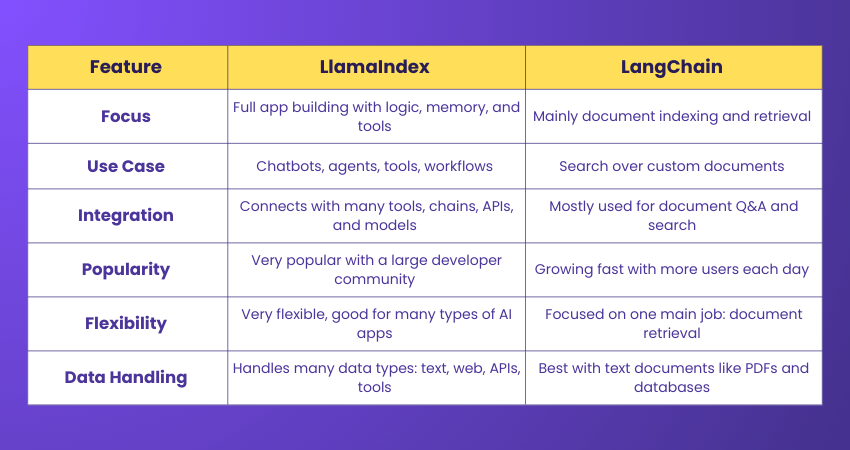
LlamaIndex (previously known as GPT Index) and LangChain are both used to connect data with LLMs, but they are different.
Conclusion
If you’ve ever wondered What is LangChain, now you know it’s more than just a framework; it’s a smarter way to build real AI solutions. From answering questions to reading files or linking to live data, LangChain makes it all work together. With its simple parts and powerful tools, it’s helping people turn AI ideas into useful, working apps every day.
Acquire skills in interpreting the outputs of AI models. Join our Artificial Intelligence Tools Training now!
Frequently Asked Questions
Is LangChain a Python Library?

Yes, LangChain is a library you can use with Python and also with JavaScript/TypeScript. Most people use the Python version.
Does ChatGPT use LangChain?
No, ChatGPT itself does not use LangChain. But many developers build ChatGPT-style apps using LangChain, because it makes it easy to use OpenAI models with your own data.
What are the Other Resources and Offers Provided by The Knowledge Academy?
The Knowledge Academy takes global learning to new heights, offering over 3,000+ online courses across 490+ locations in 190+ countries. This expansive reach ensures accessibility and convenience for learners worldwide.
Alongside our diverse Online Course Catalogue, encompassing 17 major categories, we go the extra mile by providing a plethora of free educational Online Resources like Blogs, eBooks, Interview Questions and Videos. Tailoring learning experiences further, professionals can unlock greater value through a wide range of special discounts, seasonal deals, and Exclusive Offers.
What is The Knowledge Pass, and How Does it Work?
The Knowledge Academy’s Knowledge Pass, a prepaid voucher, adds another layer of flexibility, allowing course bookings over a 12-month period. Join us on a journey where education knows no bounds.
What is The Knowledge Pass, and How Does it Work?
The Knowledge Academy offers various Artificial Intelligence Tools Training, including the ChatGPT Course, ChatGPT Prompt Engineering Certification, and the Google BARD Training. These courses cater to different skill levels, providing comprehensive insights into Chain of Thought Prompting.
Our Data, Analytics & AI Blogs cover a range of topics related to LangChain, offering valuable resources, best practices, and industry insights. Whether you are a beginner or looking to advance your AI skills, The Knowledge Academy's diverse courses and informative blogs have got you covered.

Lily Turner


Senior AI/ML Engineer and Data Science Author
Lily Turner is a data science professional with over 10 years of experience in artificial intelligence, machine learning, and big data analytics. Her work bridges academic research and industry innovation, with a focus on solving real-world problems using data-driven approaches. Lily’s content empowers aspiring data scientists to build practical, scalable models using the latest tools and techniques.
View Detail
Upcoming Data, Analytics & AI Resources Batches & Dates
Date
 ChatGPT Course

 If you wish to make any changes to your course, please


